Stakeholder Analysis:
A Practical Guide to Understanding People, Influence and Engagement
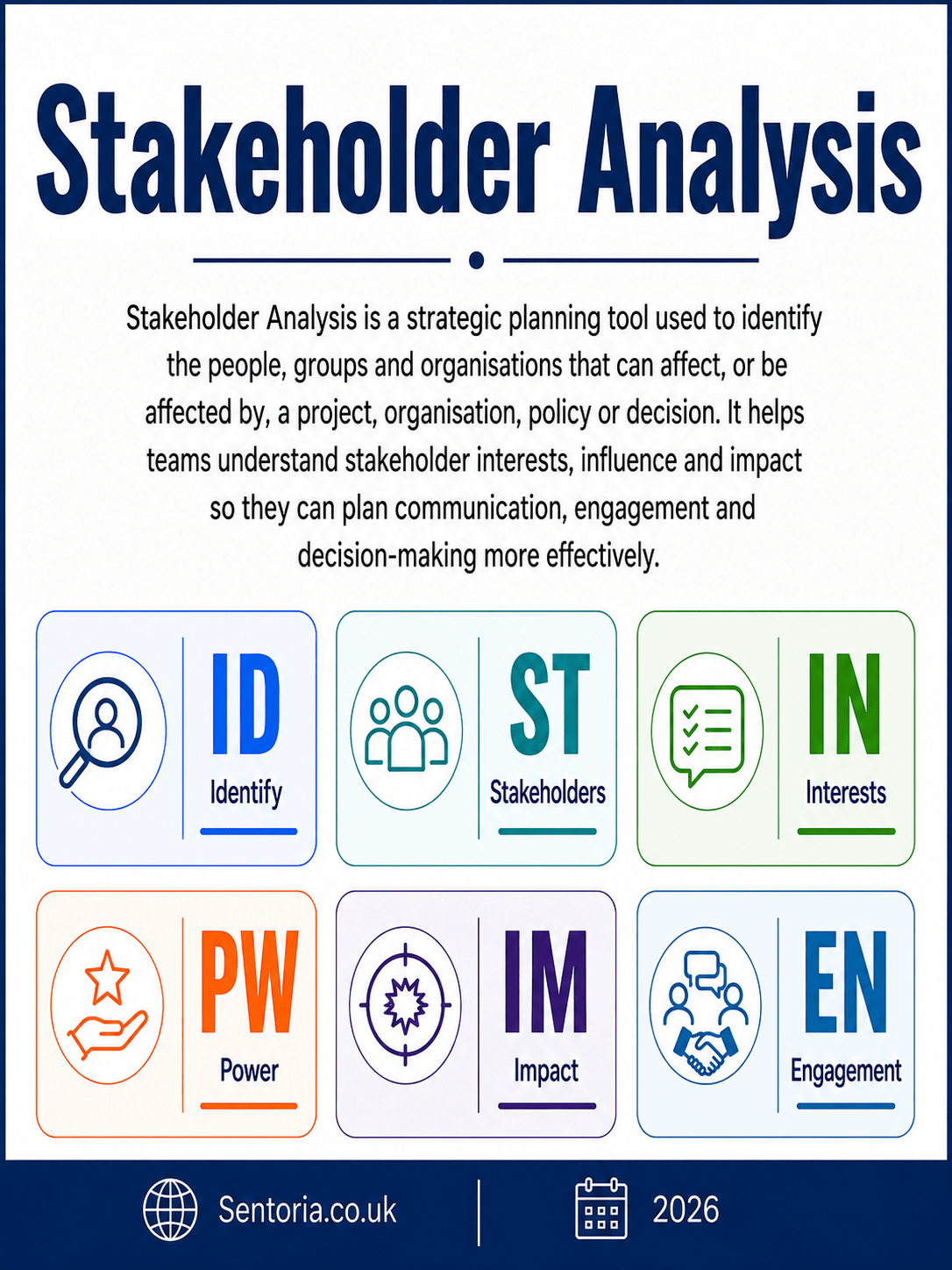
Stakeholder analysis is a strategic planning tool used to identify the people, groups and organisations that can affect, or be affected by, a project, organisation, policy, service or decision.
At its simplest, stakeholder analysis asks:
Who matters, what do they care about, how much influence do they have, and how should we engage with them?
That makes it useful for business planning, project management, public consultation, charity governance, property development, organisational change, marketing, communications, policy development and risk management.
A project or strategy rarely succeeds just because the technical plan is good. It also depends on people. Customers, staff, funders, regulators, suppliers, trustees, residents, partners, shareholders, service users and community groups can all shape whether a plan is accepted, supported, challenged, delayed or blocked.
The UK Government Project Delivery guidance describes stakeholder analysis as a way of identifying groups and individuals who have a stake in the work, including their interest, expectations and influence, so that these can be considered throughout the project life cycle.
Used properly, stakeholder analysis helps organisations move from assumption to understanding.
What is stakeholder analysis?
Stakeholder analysis is the structured process of identifying, understanding, prioritising and planning engagement with stakeholders.
A stakeholder may be an individual, group or organisation that has an interest in a project, service, decision or strategy. Some stakeholders may be directly affected. Others may have influence, expertise, funding power, regulatory authority, political interest, operational involvement or public voice.
Stakeholder analysis usually considers:
- Who the stakeholders are
- What their interests are
- How they may be affected
- How much influence they have
- Whether they are likely to support, oppose or remain neutral
- What they need to know
- What the organisation needs to learn from them
- How they should be engaged
- Who owns the relationship
- How engagement should be reviewed
The Association for Project Management defines stakeholder engagement as the systematic identification, analysis, planning and implementation of actions designed to influence stakeholders.
That is an important point. Stakeholder analysis is not just a list of names. It should lead to an engagement plan.
What is a stakeholder?
A stakeholder is someone who has a stake in what is being done.
Stakeholders may include:
- Customers
- Clients
- Employees
- Directors
- Trustees
- Volunteers
- Shareholders
- Funders
- Lenders
- Suppliers
- Contractors
- Regulators
- Local authorities
- Residents
- Community groups
- Service users
- Beneficiaries
- Media
- Professional advisers
- Delivery partners
- Campaign groups
- Trade bodies
- Politicians
- Internal departments
- Future users or affected groups
In project management, stakeholders are often described as people or groups with an interest in, or influence over, a project or strategy. PMI describes stakeholder analysis as a set of techniques used to identify and understand the needs and expectations of major interests inside and outside the project environment.
The key point is that stakeholders are not all the same. Some have high influence. Some have high interest. Some are supportive. Some are sceptical. Some are affected but have little formal power. Some have power but little day-to-day interest unless something goes wrong.
A good stakeholder analysis recognises those differences.
History and development of stakeholder analysis
Stakeholder thinking has developed through business ethics, strategy, project management, public policy, sustainability and corporate governance.
One of the most important milestones was R. Edward Freeman’s work on stakeholder theory. His book Strategic Management: A Stakeholder Approach was first published in 1984 and is widely regarded as a landmark in the development of stakeholder theory. Cambridge University Press describes it as a foundational work that continues to influence business ethics and strategic management.
Freeman’s stakeholder approach challenged the idea that organisations should focus only on shareholders or owners. Instead, it encouraged managers to consider a wider group of people and organisations whose interests affect, or are affected by, the organisation’s activities.
In project management, stakeholder analysis became important because projects often fail for reasons that are not purely technical. Poor communication, ignored concerns, weak sponsorship, public opposition, internal resistance and unclear responsibilities can all damage delivery. PMI highlights that understanding stakeholder attributes, relationships and interfaces is important because project risk and viability often depend on obtaining and retaining support.
A major practical development was the use of stakeholder mapping tools. One of the best known is the power and interest grid, often associated with Mendelow’s Matrix. The Open University describes the power and interest grid as a tool used to understand stakeholder criteria and notes that it is sometimes referred to as Mendelow’s matrix.
Another important development was the stakeholder salience model developed by Mitchell, Agle and Wood in 1997. Their model considers stakeholder importance through three attributes: power, legitimacy and urgency.
Stakeholder analysis has also become important in sustainability and responsible business practice. AccountAbility’s AA1000 principles include inclusivity, materiality, responsiveness and impact, reflecting the idea that people should have a say in decisions that affect them and that organisations should understand and respond to material stakeholder concerns.
Over time, stakeholder analysis has moved from being a project management tool to a broader strategic discipline. It is now used in business planning, ESG, public consultation, community engagement, policy design, charity governance, change management and corporate communication.
Stakeholder analysis, stakeholder mapping and stakeholder engagement
These terms are related, but they are not identical.
Stakeholder analysis
Stakeholder analysis is the process of identifying and understanding stakeholders.
It asks:
- Who are they?
- What do they care about?
- What influence do they have?
- How are they affected?
- What is their likely position?
- What should we do about it?
Stakeholder mapping
Stakeholder mapping is the visual part of the process.
It places stakeholders into a framework, such as:
- Power and interest
- Influence and impact
- Support and opposition
- Power, legitimacy and urgency
- Current engagement and desired engagement
Mapping helps simplify complex stakeholder environments.
Stakeholder engagement
Stakeholder engagement is the practical action that follows.
It includes communication, consultation, involvement, negotiation, partnership-building, issue resolution and relationship management.
The International Finance Corporation describes stakeholder engagement as a broad set of activities and interactions, with its good practice handbook focusing particularly on external stakeholder groups such as affected communities, local authorities, civil society organisations and other interested or affected parties.
In simple terms:
Stakeholder analysis helps you understand people.
Stakeholder mapping helps you prioritise them.
Stakeholder engagement helps you work with them.
Why stakeholder analysis matters
Stakeholder analysis matters because organisations often underestimate the people side of strategy.
A plan may look sound on paper, but fail in practice because stakeholders were not understood, consulted, informed or engaged properly.
Stakeholder analysis helps organisations:
- Identify who needs to be involved
- Understand different interests
- Anticipate support and opposition
- Improve communication
- Reduce conflict
- Improve decision-making
- Strengthen trust
- Manage reputational risk
- Improve project delivery
- Build better partnerships
- Avoid surprises
- Improve governance
It is especially useful where decisions affect people directly. This includes service change, restructuring, property development, public consultation, charity programmes, major investments, planning applications, community projects, technology change, policy reform and organisational transformation.
Good stakeholder analysis does not mean trying to please everyone. That is rarely possible. It means understanding who is affected, who has influence, what matters to them, and how the organisation should respond.
When to use stakeholder analysis
Stakeholder analysis is useful whenever people, relationships, influence or communication affect success.
Common uses include:
- Strategic planning
- Project management
- Change management
- Business planning
- Public consultation
- Policy development
- Property development
- Charity governance
- Community engagement
- Marketing and communications
- Crisis management
- Board reporting
- Risk management
- Partnership planning
- Service redesign
- Product development
- Investor relations
- Procurement
- ESG and sustainability planning
- Local campaigning or advocacy
The Government Project Delivery guidance links stakeholder analysis to planning and the stakeholder register, making clear that stakeholder interests, expectations and influence should be considered throughout the life cycle of the work.
It is less useful if treated as a one-off exercise. Stakeholder positions can change as circumstances change.
Types of stakeholders
Internal stakeholders
Internal stakeholders are people or groups inside the organisation.
They may include:
- Directors
- Senior managers
- Employees
- Departments
- Trustees
- Volunteers
- Trade unions
- Internal project teams
- Owners or shareholders
- Board committees
Internal stakeholders matter because they often determine whether a strategy is deliverable. A decision may be approved by the board, but if staff do not understand or support it, implementation may fail.
External stakeholders
External stakeholders are outside the organisation.
They may include:
- Customers
- Suppliers
- Funders
- Regulators
- Local authorities
- Residents
- Community groups
- Contractors
- Media
- Campaigners
- Professional advisers
- Service users
- Beneficiaries
- Investors
- Politicians
External stakeholders may affect reputation, funding, delivery, permission, demand, compliance or public support.
Primary stakeholders
Primary stakeholders are directly affected by the decision, service or project.
For example, tenants affected by a property redevelopment, staff affected by a restructure, service users affected by a charity programme, or customers affected by a change in product or pricing.
Secondary stakeholders
Secondary stakeholders are indirectly affected or have an interest, but may not be directly involved.
For example, local media, trade bodies, neighbouring organisations, community groups or political representatives.
Powerful stakeholders
Powerful stakeholders can influence the outcome.
They may have legal authority, funding power, public voice, decision-making rights, technical control, political influence or reputational impact.
Vulnerable stakeholders
Vulnerable stakeholders may be affected significantly but have limited power.
This is an important point. Good stakeholder analysis should not only prioritise the loudest or most powerful voices. It should also identify those who may be affected but less able to influence the process.
Common stakeholder mapping methods
Power and interest matrix
The power and interest matrix is one of the simplest and most useful stakeholder tools.
It usually divides stakeholders into four groups:
- High power, high interest
- High power, low interest
- Low power, high interest
- Low power, low interest
A common interpretation is:
High power, high interest: manage closely.
High power, low interest: keep satisfied.
Low power, high interest: keep informed.
Low power, low interest: monitor.
Oxford College of Marketing explains Mendelow’s Matrix as a way of analysing stakeholders by power and interest, where power means the ability to influence strategy or resources, and interest means the level of interest in the organisation or project succeeding.
This tool is useful because it is simple, visual and practical.
Influence and impact matrix
This method considers:
- How much influence a stakeholder has
- How much impact the decision has on them
This is particularly useful in public services, charity work, planning, property, community projects and policy decisions.
It helps avoid a common mistake: focusing only on people with power while overlooking those most affected.
Support and opposition map
This method considers stakeholder attitude.
Stakeholders may be:
- Strongly supportive
- Supportive
- Neutral
- Sceptical
- Opposed
- Strongly opposed
This is useful in change management, public consultation, communications planning and stakeholder engagement.
However, attitude should not be assumed. It should be based on evidence, engagement and listening.
Stakeholder salience model
The stakeholder salience model assesses stakeholders using three attributes:
- Power
- Legitimacy
- Urgency
Mitchell, Agle and Wood’s 1997 paper developed this model to help identify which stakeholders managers are likely to prioritise and why.
This model is useful because it recognises that stakeholder importance is not based on power alone. A stakeholder may have a legitimate claim but little power. Another may have urgency but limited formal authority. Another may have all three and therefore require immediate attention.
Engagement assessment matrix
This method compares current and desired engagement levels.
For example, a stakeholder may currently be resistant, but the desired position may be neutral or supportive.
Typical engagement levels include:
- Unaware
- Resistant
- Neutral
- Supportive
- Leading
This method is useful when the purpose is not only analysis, but change in stakeholder understanding or support.
Stakeholder analysis in different industries
SMEs and owner-managed businesses
For SMEs, stakeholder analysis is useful because small businesses often rely heavily on relationships.
Key stakeholders may include customers, staff, suppliers, landlords, lenders, accountants, local networks, regulators and family shareholders.
A small business might use stakeholder analysis when:
- Launching a new service
- Changing pricing
- Moving premises
- Taking on finance
- Entering a new market
- Hiring key staff
- Restructuring operations
- Managing a major customer relationship
For SMEs, the analysis should be practical. It should help the owner decide who needs communication, who needs reassurance, who needs consultation and who could help the business move forward.
Manufacturing
Manufacturing businesses often have complex stakeholder environments.
Stakeholders may include customers, suppliers, staff, unions, regulators, certification bodies, logistics providers, maintenance contractors, local communities and environmental bodies.
A manufacturer might use stakeholder analysis when:
- Changing production processes
- Investing in automation
- Moving site
- Managing supply chain disruption
- Introducing new quality systems
- Responding to environmental regulation
- Managing health and safety risk
- Entering export markets
For manufacturing, stakeholder analysis should be linked to operational risk, quality, supply chain resilience, workforce planning and regulatory compliance.
Retail and ecommerce
Retail and ecommerce businesses need to understand customers, suppliers, staff, delivery partners, platforms, landlords and online communities.
Stakeholder analysis can help with:
- Store changes
- Website redesign
- New product ranges
- Pricing changes
- Delivery policy changes
- Returns processes
- Customer service improvement
- Supplier negotiations
- Brand repositioning
For ecommerce, stakeholders may include marketplace platforms, payment providers, logistics partners, review platforms, social media audiences and technology suppliers.
Professional services
For accountants, solicitors, consultants, architects and advisers, stakeholder analysis helps manage client relationships, professional obligations and internal delivery.
Stakeholders may include clients, partners, staff, regulators, insurers, referral partners, banks, software providers and professional bodies.
A professional firm might use stakeholder analysis when:
- Launching an advisory service
- Changing pricing
- Introducing new software
- Restructuring teams
- Managing succession
- Improving client communication
- Handling a complex client matter
- Preparing a major proposal
For professional services, stakeholder analysis should focus on trust, expectations, relationship ownership and communication quality.
Charities and voluntary organisations
Stakeholder analysis is especially important for charities because they often serve multiple groups with different interests.
Stakeholders may include beneficiaries, funders, donors, trustees, staff, volunteers, commissioners, regulators, local authorities, community groups, families, partners and the public.
A charity might use stakeholder analysis when:
- Developing strategy
- Applying for funding
- Changing services
- Managing safeguarding responsibilities
- Reviewing impact
- Recruiting volunteers
- Building partnerships
- Communicating with beneficiaries
For charities, it is vital to distinguish between the funder, the beneficiary and the service user. They may not be the same person, but all may be important stakeholders.
Public sector and local government
Stakeholder analysis is central to public sector decision-making because public bodies must often balance many interests.
Stakeholders may include residents, elected members, officers, service users, community groups, businesses, partner agencies, central government, regulators, contractors, voluntary organisations and the media.
It can support:
- Service redesign
- Consultation
- Policy development
- Budget decisions
- Regeneration
- Transport planning
- Housing strategy
- Environmental projects
- Digital transformation
- Crisis communication
Government communication guidance emphasises the need for structured stakeholder engagement and provides tools for developing stakeholder communication plans.
For public bodies, stakeholder analysis should be inclusive, evidence-based and transparent.
Property and construction
Property and construction projects can be highly stakeholder-sensitive.
Stakeholders may include landowners, tenants, neighbours, planning authorities, contractors, funders, consultants, statutory consultees, local residents, heritage bodies, utilities providers, highways authorities and community groups.
Stakeholder analysis can help with:
- Planning applications
- Public consultation
- Tenant engagement
- Contractor management
- Funding negotiations
- Heritage issues
- Community concerns
- Utilities and access
- Environmental impact
- Project communication
For property projects, poor stakeholder engagement can lead to objections, delay, reputational damage and increased cost.
Technology and software
Technology projects often fail when users, decision-makers and delivery teams are not aligned.
Stakeholders may include users, customers, developers, product owners, data protection officers, cyber security teams, senior sponsors, support teams, vendors, regulators and implementation partners.
Stakeholder analysis is useful when:
- Introducing new software
- Developing a product
- Managing cyber risk
- Changing workflows
- Migrating data
- Launching a platform
- Implementing AI tools
- Managing user adoption
For technology projects, stakeholder analysis should focus heavily on user needs, adoption barriers, data risk and communication.
Healthcare and social care
Healthcare and social care stakeholder environments are complex and sensitive.
Stakeholders may include patients, service users, families, carers, clinicians, care staff, regulators, commissioners, safeguarding teams, local authorities, charities and advocacy groups.
Stakeholder analysis can support:
- Service redesign
- Care pathway changes
- Quality improvement
- Digital health projects
- Workforce planning
- Safeguarding improvement
- Patient engagement
- Inspection preparation
In care settings, engagement must be handled carefully, respectfully and ethically.
Education and training
Education providers have many stakeholders, including students, parents, staff, governors, employers, funders, regulators, local authorities, awarding bodies and community partners.
Stakeholder analysis can support:
- Curriculum review
- New course development
- Safeguarding improvements
- Digital learning
- Employer engagement
- Funding bids
- Quality assurance
- Estate planning
- Student support
- Community partnerships
For education, stakeholder analysis should consider both those who pay for provision and those who experience it.
How to carry out stakeholder analysis properly
1. Define the purpose
Start with a clear question.
For example:
- Who needs to be involved in this project?
- Who could affect this decision?
- Who will be affected by this change?
- Who needs to support the strategy?
- Who might object?
- Who has information we need?
- Who needs to be consulted?
- Who needs regular communication?
Without a clear purpose, the analysis becomes too broad.
2. Define the scope
Be clear about what the stakeholder analysis covers.
It could cover:
- An organisation
- A project
- A service change
- A planning application
- A product launch
- A restructure
- A communications campaign
- A funding bid
- A policy decision
- A community initiative
A stakeholder analysis for a whole organisation will look different from one for a single project.
3. Identify stakeholders
Start with a wide list.
Useful prompts include:
- Who is affected?
- Who has influence?
- Who has authority?
- Who provides funding?
- Who delivers the work?
- Who uses the service?
- Who depends on the outcome?
- Who could object?
- Who could support?
- Who has expertise?
- Who has legal rights?
- Who has public voice?
- Who has been missed before?
- Who is vulnerable or under-represented?
This stage should be broad. Prioritisation comes later.
4. Group stakeholders
Grouping helps make the analysis manageable.
Possible groups include:
- Internal stakeholders
- Customers or service users
- Funders or investors
- Regulators
- Delivery partners
- Suppliers
- Local community
- Staff and volunteers
- Decision-makers
- Professional advisers
- Media and public opinion
- Campaign groups
Grouping helps identify engagement themes and communication channels.
5. Understand stakeholder interests
For each stakeholder or group, ask:
- What do they care about?
- What do they need?
- What do they expect?
- What are they worried about?
- What would success look like for them?
- What might they lose?
- What might they gain?
- What information do they need?
- What information can they provide?
- What is their likely attitude?
The aim is to understand stakeholders from their perspective, not only from the organisation’s perspective.
6. Assess influence and impact
Consider both influence and impact.
A stakeholder may have high influence but be lightly affected. Another may be deeply affected but have little influence.
Both matter.
Useful questions include:
- Can they approve or block the decision?
- Can they delay the project?
- Can they influence public opinion?
- Can they affect funding?
- Can they affect delivery?
- Are they legally or morally significant?
- How strongly are they affected?
- Are they vulnerable or under-represented?
- Is there a duty to consult them?
- Could their support improve the outcome?
7. Map the stakeholders
Choose a mapping tool that fits the purpose.
For simple projects, a power and interest grid may be enough.
For more complex environments, use a combination of:
- Power and interest
- Influence and impact
- Support and opposition
- Salience
- Current and desired engagement
The map should support judgement. It should not replace it.
8. Decide the engagement approach
For each stakeholder group, decide the engagement approach.
This may include:
- Inform
- Consult
- Involve
- Collaborate
- Partner
- Negotiate
- Monitor
- Reassure
- Manage closely
The engagement method should fit the stakeholder’s importance, interest, influence and needs.
9. Create a stakeholder engagement plan
A useful plan should include:
- Stakeholder group
- Key interests
- Influence
- Impact
- Current attitude
- Desired attitude
- Key messages
- Communication method
- Engagement frequency
- Relationship owner
- Risks
- Actions
- Review date
This turns analysis into management action.
10. Review and update
Stakeholders change.
Their views may shift as more information emerges, as the project progresses, as risks appear, or as external circumstances change.
Review stakeholder analysis when:
- The project changes
- New stakeholders emerge
- Opposition increases
- Support weakens
- Decisions are delayed
- External events change context
- Communication fails
- Consultation feedback reveals new issues
- The strategy changes
- A milestone is reached
Stakeholder analysis should be a live process, not a static document.
Common mistakes in stakeholder analysis
Mistake 1: Only listing obvious stakeholders
The loudest or most visible stakeholders are not always the only important ones.
A good analysis should also identify quiet, vulnerable, indirect or future stakeholders.
Mistake 2: Confusing stakeholders with audiences
An audience receives communication.
A stakeholder has an interest, influence or is affected.
Some stakeholders are audiences, but not all audiences are strategically important stakeholders.
Mistake 3: Assuming what stakeholders think
Stakeholder analysis should not be based only on internal assumptions.
Where possible, it should be informed by conversations, feedback, consultation, complaints, data and direct engagement.
Mistake 4: Treating all stakeholders the same
Different stakeholders need different engagement.
A regulator, funder, customer, staff member, neighbour and service user should not all receive the same communication.
Mistake 5: Focusing only on powerful stakeholders
Power matters, but so does impact.
Those most affected by a decision may have limited power. Ignoring them can be unfair, unethical and strategically risky.
Mistake 6: Creating a map but no plan
A stakeholder map is only useful if it leads to action.
The output should be an engagement plan with owners, messages, methods and review dates.
Mistake 7: Engaging too late
Stakeholder engagement is much harder after decisions appear to have already been made.
Early engagement helps identify issues before positions harden.
Mistake 8: Over-promising
Engagement does not mean every stakeholder will get what they want.
Be clear about what is open to influence, what is already decided, and what constraints exist.
Mistake 9: Poor internal alignment
Different parts of the organisation may communicate different messages.
Stakeholder analysis should support consistent communication and clear ownership.
Mistake 10: Not updating the analysis
Stakeholder views and influence change over time.
A stakeholder who is low interest today may become high interest tomorrow if the decision affects them directly.
Limitations and weaknesses of stakeholder analysis
Stakeholder analysis is useful, but it has limits.
It can oversimplify people
Stakeholder maps place people into boxes, but real people are more complex.
A stakeholder may be supportive of one part of a proposal and opposed to another. Their position may change over time.
It can become subjective
Influence, interest, support and opposition are often based on judgement.
Different people may assess the same stakeholder differently.
It can reinforce power imbalances
If used badly, stakeholder analysis can prioritise those with power and ignore those most affected.
A good process should consider both influence and impact.
It can become political
Internal teams may use stakeholder analysis to justify preferred decisions rather than genuinely understand stakeholders.
This weakens trust and can damage engagement.
It can create false confidence
A completed map can make a team feel that stakeholders are understood.
That may not be true if the analysis is based on assumptions rather than evidence.
It does not replace engagement
Stakeholder analysis is not the same as stakeholder engagement.
You cannot fully understand stakeholders from behind a desk.
It does not guarantee support
Good stakeholder analysis can improve trust and reduce risk, but it does not guarantee agreement.
Some stakeholders may still oppose the decision.
It requires maintenance
A stakeholder register or map becomes outdated quickly if not reviewed.
Stakeholder analysis compared with other strategic tools
Stakeholder analysis and SWOT
SWOT identifies strengths, weaknesses, opportunities and threats.
Stakeholder analysis can provide evidence for SWOT, especially around support, opposition, reputational risk, partnership opportunities and governance.
Stakeholder analysis and PESTLE
PESTLE analyses political, economic, social, technological, legal and environmental factors.
Stakeholder analysis helps identify the people and organisations connected to those external forces.
For example, a legal change may involve regulators, advisers, customers and staff.
Stakeholder analysis and Porter’s Five Forces
Porter’s Five Forces looks at industry structure, including buyers, suppliers, competitors, substitutes and new entrants.
Stakeholder analysis looks more broadly at all parties with interest, influence or impact.
Buyers and suppliers may be stakeholders, but stakeholder analysis also includes groups such as regulators, communities, employees and funders.
Stakeholder analysis and TOWS
TOWS turns SWOT findings into strategic options.
Stakeholder analysis can help test whether those options are realistic, acceptable and deliverable.
Stakeholder analysis and Business Model Canvas
The Business Model Canvas explains how an organisation creates, delivers and captures value.
Stakeholder analysis identifies the people and groups who influence or are affected by that business model.
For charities and public bodies, this is especially important because the payer, user and beneficiary may be different stakeholders.
Stakeholder analysis and Balanced Scorecard
The Balanced Scorecard translates strategy into objectives, measures, targets and actions.
Stakeholder analysis can inform the customer or stakeholder perspective and help define what success means to different groups.
Stakeholder analysis and risk register
Stakeholder issues often create risks.
For example, public opposition, staff resistance, funder withdrawal, regulatory concern or supplier failure may need to be recorded in the risk register.
Stakeholder analysis and scenario planning
Scenario planning explores different possible futures.
Stakeholder analysis helps assess how different stakeholders may behave under those futures.
Alternatives and complementary frameworks
Stakeholder engagement plan
A stakeholder engagement plan turns analysis into action.
Use it after stakeholder analysis to define messages, methods, owners and timing.
Communications plan
A communications plan sets out what will be communicated, to whom, when and through which channels.
It is useful where stakeholder engagement requires consistent messaging.
Consultation plan
A consultation plan is useful where stakeholders need a formal opportunity to comment, object or shape proposals.
This is particularly important in public sector, planning, policy and community work.
Power and interest matrix
This is a simple stakeholder mapping tool.
Use it when you need a quick prioritisation framework.
Salience model
The salience model uses power, legitimacy and urgency.
Use it when stakeholder importance is more complex than simple influence and interest.
RACI matrix
A RACI matrix identifies who is responsible, accountable, consulted and informed.
Use it for project delivery and governance, especially where internal roles are unclear.
Customer journey mapping
Customer journey mapping focuses on user experience.
Use it where stakeholders are customers, users, residents, patients, tenants or beneficiaries.
Empathy mapping
Empathy mapping helps understand what stakeholders think, feel, say and do.
Use it when stakeholder attitudes, concerns and motivations matter.
Social impact assessment
Social impact assessment examines how a project affects people and communities.
Use it for property, infrastructure, public policy and community projects.
Risk register
A risk register records and manages risks.
Use it when stakeholder opposition, disengagement or relationship failure could affect objectives.
A practical stakeholder analysis template
A useful stakeholder analysis template should include:
- Stakeholder name or group
- Internal or external
- Primary contact
- Stakeholder category
- Interest or concern
- How they are affected
- Influence or power
- Impact on them
- Current attitude
- Desired attitude
- Key messages
- Engagement method
- Engagement frequency
- Relationship owner
- Risks or sensitivities
- Actions required
- Deadline
- Review date
- Notes and evidence
Example:
Stakeholder: Local residents
Interest: Traffic, noise, appearance, parking and community impact
Influence: Medium to high, depending on planning process and public response
Impact: High
Current attitude: Unknown or mixed
Desired attitude: Informed, heard and constructively engaged
Engagement method: Public information session, written summary, website updates and named contact
Relationship owner: Project lead
Action: Prepare clear consultation materials and respond to key concerns
Review date: After consultation period
Questions to ask during stakeholder analysis
Identification questions
- Who is affected?
- Who has influence?
- Who has authority?
- Who has information we need?
- Who funds, regulates or approves the work?
- Who delivers the work?
- Who could support it?
- Who could oppose it?
- Who has been overlooked?
- Who represents vulnerable or less visible groups?
Interest questions
- What does this stakeholder care about?
- What outcome do they want?
- What are they worried about?
- What could they gain?
- What could they lose?
- What information do they need?
- What assumptions might they hold?
- What questions will they ask?
- What would reassure them?
- What would make them object?
Influence questions
- Can they approve or block the decision?
- Can they delay the project?
- Can they influence others?
- Can they affect funding?
- Can they affect reputation?
- Can they affect delivery?
- Do they have legal rights?
- Do they have public voice?
- Are they connected to other stakeholders?
- Is their influence increasing or decreasing?
Engagement questions
- How should we engage with them?
- What is the right level of detail?
- What channel should we use?
- Who should speak to them?
- How often should we communicate?
- What should we ask them?
- What should we avoid promising?
- How will feedback be recorded?
- How will we respond?
- How will we know whether engagement is working?
Risk questions
- What happens if this stakeholder is ignored?
- Could they oppose the decision?
- Could they delay delivery?
- Could poor communication damage trust?
- Could expectations become unrealistic?
- Are there legal or consultation duties?
- Are there safeguarding or equality issues?
- Could conflict arise between stakeholder groups?
- Does this need to be added to the risk register?
- Who is responsible for managing the risk?
The best way to think about stakeholder analysis
Stakeholder analysis is not just a communications exercise.
It is a practical way of improving decisions by understanding the people and organisations connected to them.
A good stakeholder analysis should be:
- Purpose-led
- Evidence-based
- Inclusive
- Honest
- Prioritised
- Linked to engagement
- Reviewed regularly
- Connected to risk and strategy
- Clear about ownership
- Respectful of those affected
A weak stakeholder analysis is just a list of names.
A strong stakeholder analysis explains who matters, why they matter, what they care about, and what the organisation should do next.
The key question is not simply:
Who are our stakeholders?
The better question is:
Who can affect or be affected by this decision, what do we need to understand about them, and how should we engage with them responsibly?
Conclusion: stakeholder analysis turns people and influence into better decision-making
Stakeholder analysis remains useful because strategy, projects and change are not delivered in isolation.
People matter. Relationships matter. Trust matters. Influence matters. Communication matters.
A technically sound plan can still fail if stakeholders are ignored, misunderstood or engaged too late. Equally, a difficult plan may become more deliverable if stakeholders are understood, listened to and involved properly.
Used badly, stakeholder analysis becomes a box-ticking exercise. It creates a list, a matrix and a false sense of control.
Used properly, it becomes a practical management tool. It helps organisations identify who is affected, understand different interests, prioritise engagement, reduce risk, improve communication and make better decisions.
The real value is not in the stakeholder map itself. It is in the action that follows.
A strong stakeholder analysis helps an organisation move from saying, “We know who the stakeholders are,” to asking, “Have we understood them properly, engaged them fairly, and used that understanding to improve the decision?”