Lean Canvas:
A Practical Guide to Testing Business Ideas, Assumptions and Startup Models
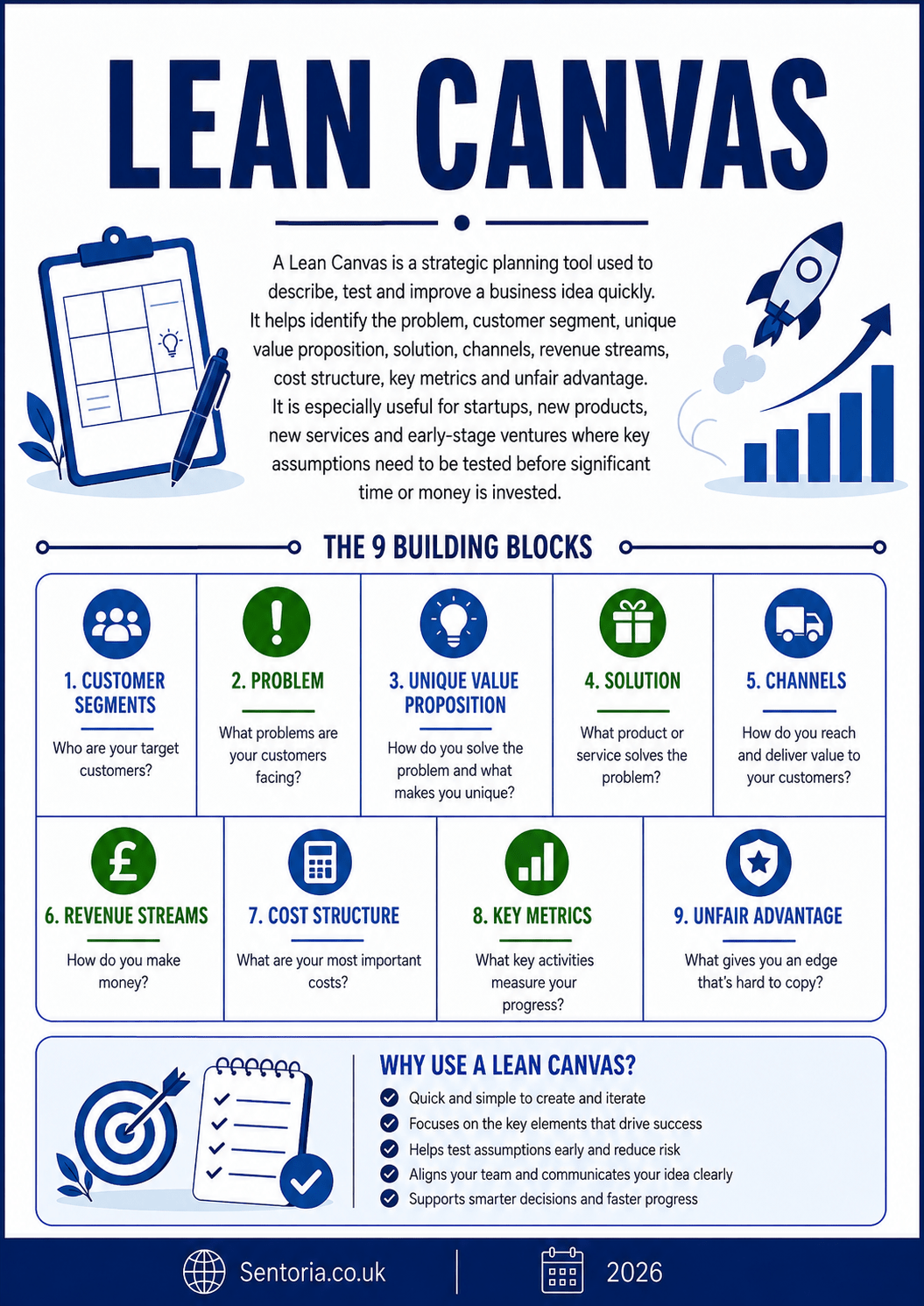
The Lean Canvas is a strategic planning tool used to describe, test and improve a business idea quickly.
At its simplest, Lean Canvas asks:
What problem are we solving, who are we solving it for, how will we reach them, how will we make money, and what assumptions must be tested before we invest too much time or money?
That makes it especially useful for startups, new products, new services, early-stage ventures, innovation projects, digital products, internal business ideas, social enterprises and any situation where there is uncertainty around customers, demand, pricing or delivery.
Lean Canvas is closely associated with Ash Maurya, who created it as a one-page business modelling tool. It is an adaptation of the Business Model Canvas, but with a stronger focus on early-stage uncertainty, problems, solutions, key metrics and unfair advantage.
Used properly, Lean Canvas is not just a planning template. It is a way of turning an idea into a set of assumptions that can be tested.
What is Lean Canvas?
Lean Canvas is a one-page framework for mapping the key parts of a business idea.
It usually contains nine blocks:
- Problem
- Customer Segments
- Unique Value Proposition
- Solution
- Channels
- Revenue Streams
- Cost Structure
- Key Metrics
- Unfair Advantage
The purpose is to help founders, managers and teams move quickly from idea to evidence.
The Business Model Canvas, created by Alexander Osterwalder and Yves Pigneur, is a broader strategic management tool used to describe, design, challenge and pivot business models. Lean Canvas adapts that thinking for situations where the biggest risk is not simply describing the business model, but proving that the problem, customer, solution and economics are real.
In simple terms:
Business Model Canvas explains how a business model works.
Lean Canvas helps test whether an early-stage business idea could work.
History and development of Lean Canvas
Lean Canvas was developed by Ash Maurya as part of his work on lean startup methods, customer development and business model validation. His book Running Lean focuses on taking an idea from concept towards product-market fit through systematic testing.
The Lean Canvas built on earlier business model thinking, especially the Business Model Canvas, but adjusted the emphasis for entrepreneurs and startups. Instead of focusing heavily on partners, activities and resources, Lean Canvas brings forward issues such as problem, solution, key metrics and unfair advantage.
That matters because early-stage ideas often fail for reasons that are not obvious in a traditional plan.
The team may build a product that customers do not want. The problem may not be painful enough. The customer segment may be too vague. The price may not work. The route to market may be too expensive. The business may have no meaningful advantage. The team may be measuring vanity metrics instead of real progress.
Lean Canvas was designed to expose those issues early, before too much money, time and emotional energy have been committed.
The nine blocks of Lean Canvas
1. Problem
The Problem block identifies the main problems the customer is experiencing.
This is one of the most important parts of Lean Canvas because many ideas start with a solution rather than a problem.
A weak problem statement might say:
“Businesses need better software.”
A stronger problem statement would say:
“Small business owners struggle to understand cash flow because their finance information is late, fragmented and written in technical language.”
The second version is more useful because it identifies a real customer, a specific difficulty and a reason the problem matters.
Good questions include:
- What problem are customers trying to solve?
- How painful is the problem?
- How often does it occur?
- What happens if it is not solved?
- Are customers already spending time or money on it?
- What alternatives do they currently use?
- Is the problem urgent, frequent or expensive enough to matter?
A Lean Canvas should normally identify the top one to three problems, not a long list of everything that might be inconvenient.
2. Customer Segments
Customer Segments are the specific groups of people or organisations the idea is designed to serve.
This block answers:
Who has the problem?
A common mistake is defining the customer too broadly.
For example:
“Small businesses” is too wide.
A clearer segment might be:
“Owner-managed businesses with five to fifty staff that have outgrown basic bookkeeping but do not yet have an internal finance director.”
The more precise the customer segment, the easier it is to test the idea.
Customer segments may include:
- Early adopters
- Paying customers
- Users
- Buyers
- Influencers
- Decision-makers
- Beneficiaries
- Funders
- Internal users
- Channel partners
In some models, the user and the payer are different. This is common in software, education, healthcare, charities and public services.
3. Unique Value Proposition
The Unique Value Proposition explains why the customer should care.
It answers:
Why should this customer choose this solution rather than doing nothing, using a substitute, or choosing another provider?
A good value proposition should be clear, specific and customer-focused.
Weak example:
“We provide innovative business support.”
Stronger example:
“We help owner-managed businesses see their cash position clearly, make better decisions and avoid financial surprises.”
The Unique Value Proposition should connect directly to the customer’s problem.
It should normally explain:
- Who the offer is for
- What problem it solves
- What outcome it creates
- Why it is different or better
- Why the customer should act now
This is not the place for vague claims such as “high quality”, “innovative”, “customer-focused” or “trusted partner” unless those claims are made specific and meaningful.
4. Solution
The Solution block describes the proposed product, service or approach.
In Lean Canvas, this block should usually be kept deliberately brief at first.
That is because the solution is still an assumption.
The aim is not to design everything in detail before testing. The aim is to identify a possible solution that can be validated with customers.
Examples of solution statements include:
- Monthly cash flow dashboard
- Fixed-fee advisory package
- Automated onboarding tool
- Simple booking platform
- Online training programme
- Specialist compliance checklist
- Community referral pathway
- Lightweight project management app
- Subscription maintenance service
- Early-stage prototype
The solution should not be overbuilt too early.
A key Lean Canvas discipline is to ask:
What is the smallest version of this solution we can test?
5. Channels
Channels explain how the organisation will reach customers.
This includes awareness, sales and delivery channels.
Possible channels include:
- Website
- Search engines
- Referrals
- Direct sales
- Partnerships
- Local networks
- Events
- Paid advertising
- App stores
- Marketplaces
- Agents
- Professional introducers
- Community groups
A strong idea can fail if the channel does not work.
For example, a product may solve a real problem, but if customers are too expensive to reach, the model may not be viable.
Channel questions include:
- Where do customers already look for solutions?
- How will they hear about us?
- How will trust be built?
- How will enquiries convert?
- What will customer acquisition cost?
- Can the channel scale?
- Is the channel owned, rented or dependent on a platform?
For early-stage ideas, channels should be tested quickly. It is risky to assume that customers will simply arrive.
6. Revenue Streams
Revenue Streams explain how the idea will make money.
This block answers:
What will customers pay for, how much will they pay, and how predictable will income be?
Revenue streams may include:
- One-off sales
- Subscriptions
- Retainers
- Usage fees
- Licensing
- Commission
- Advertising
- Transaction fees
- Memberships
- Service fees
- Grants
- Donations
- Public contracts
- Leasing
- Freemium upgrades
For charities, public bodies and social enterprises, revenue may not come from the service user. The payer may be a funder, commissioner, donor, grant-maker or public sector body.
Revenue questions include:
- Who pays?
- What do they pay for?
- How much will they pay?
- Is payment one-off or recurring?
- How quickly is cash collected?
- What evidence supports the price?
- What alternatives are customers already paying for?
- Does the revenue model fit the customer’s buying behaviour?
A common mistake is assuming that because customers like an idea, they will pay enough for it. Interest is not the same as revenue.
7. Cost Structure
Cost Structure records the main costs required to build, launch and operate the model.
Costs may include:
- Staff
- Software
- Product development
- Marketing
- Sales
- Hosting
- Premises
- Professional fees
- Stock
- Equipment
- Delivery
- Customer support
- Compliance
- Insurance
- Finance costs
The Cost Structure block should help answer:
Can this model work financially?
For early-stage ideas, costs should be split into:
- Startup costs
- Fixed operating costs
- Variable costs
- Customer acquisition costs
- Delivery costs
- Support costs
- Scaling costs
A business idea may look attractive until the cost of acquiring and serving customers is properly understood.
8. Key Metrics
Key Metrics identify the numbers that show whether the idea is working.
This is one of the most useful differences between Lean Canvas and traditional planning.
A new idea should not only be measured by revenue at the beginning. Early metrics may need to show whether customers understand, care, engage, convert, return and recommend.
Useful metrics may include:
- Customer interviews completed
- Problem validation rate
- Landing page sign-ups
- Conversion rate
- Cost per lead
- Trial activation
- Customer acquisition cost
- Retention
- Churn
- Repeat purchase
- Gross margin
- Lifetime value
- Referral rate
- Usage frequency
- Time to value
- Cash burn
- Break-even point
The key is to choose metrics that show real progress.
Vanity metrics, such as website visits or social media likes, may be useful at times, but they do not necessarily prove demand, value or viability.
9. Unfair Advantage
Unfair Advantage is what makes the idea difficult for others to copy.
This is often the hardest block to complete honestly.
Possible unfair advantages include:
- Proprietary technology
- Exclusive access to data
- Strong brand
- Network effects
- Deep specialist expertise
- Unique partnerships
- Regulatory permissions
- Patents or intellectual property
- Strong community trust
- Founder credibility
- Existing customer base
- Distribution advantage
- Hard-to-copy processes
- Long-standing relationships
Many early-stage ideas do not yet have a true unfair advantage.
That is not necessarily fatal, but it should be recognised.
Examples of weak unfair advantages include:
- “We care more”
- “We will work harder”
- “We have a better idea”
- “The product is simple”
- “We are passionate”
Those may be positive, but they are usually easy for competitors to claim.
A stronger unfair advantage is something competitors cannot easily buy, copy or claim.
Why Lean Canvas matters
Lean Canvas matters because many ideas fail before they are properly tested.
Teams often spend too much time building, branding, designing, planning and forecasting before they know whether customers care enough.
Lean Canvas helps prevent that by forcing early clarity.
It supports:
- Faster idea testing
- Clearer problem definition
- Better customer focus
- Early identification of risky assumptions
- More disciplined product development
- Better use of limited resources
- Stronger startup planning
- Clearer investor or stakeholder conversations
- Better pricing and channel thinking
- More honest discussion about advantage
The real value is not in filling in the nine boxes.
The real value is in identifying what must be tested.
When to use Lean Canvas
Lean Canvas is useful when an idea is uncertain and needs testing.
Good uses include:
- Startup ideas
- New product development
- New service design
- Digital products
- Software as a service
- Internal innovation projects
- Charity service pilots
- Social enterprise ideas
- Public service redesign
- Professional service packages
- Ecommerce concepts
- Subscription models
- New market entry
- Early-stage investment discussions
- Business model experiments
It is particularly useful before writing a long business plan or building a full product.
It is less useful where the business model is already mature, the market is well understood, and the main challenge is operational improvement. In those cases, tools such as Value Chain Analysis, Balanced Scorecard, process mapping or BCG Matrix may be more relevant.
Lean Canvas in different industries
Startups and early-stage ventures
Lean Canvas is most natural in startups because uncertainty is high.
A startup usually needs to test:
- Whether the problem is real
- Whether the customer segment is clear
- Whether customers will pay
- Whether the solution works
- Whether the channel is affordable
- Whether the business can scale
- Whether there is any defensible advantage
For startups, Lean Canvas should be treated as a living document. Each customer conversation, test, pilot and sale should update the Canvas.
SMEs and owner-managed businesses
For SMEs, Lean Canvas is useful when launching a new service, product or package.
An established business may already have customers, reputation and delivery capability, but a new idea still needs testing.
An SME might use Lean Canvas to assess:
- A new advisory service
- A subscription package
- A new local service
- A new ecommerce offer
- A new trade counter
- A new training programme
- A new software tool
- A new customer segment
For owner-managed businesses, Lean Canvas can stop management assuming that an idea will work simply because existing customers like the business.
Manufacturing
Manufacturers can use Lean Canvas for new products, niche services, technical support packages or new customer sectors.
A manufacturer might test:
- A new product line
- A maintenance service
- A faster fulfilment model
- A customisation option
- A sustainability-led product
- A new export market
- A direct-to-customer channel
- A technical advisory service
The Canvas should be linked to production capacity, tooling cost, supplier risk, quality control, stock holding and contribution margin.
A manufacturing idea may solve a real problem but fail if production costs, minimum order quantities or working capital requirements are too high.
Retail and ecommerce
Retail and ecommerce businesses can use Lean Canvas to test new product categories, online stores, subscription boxes, marketplaces or niche customer propositions.
Key assumptions may include:
- Search demand
- Customer acquisition cost
- Price sensitivity
- Repeat purchase
- Delivery cost
- Return rates
- Supplier reliability
- Gross margin
- Conversion rate
- Brand trust
For ecommerce, Lean Canvas should be supported by landing page tests, small stock tests, advertising experiments and customer feedback.
Professional services
For accountants, solicitors, consultants, architects and advisers, Lean Canvas can help test new service models.
Examples include:
- Monthly advisory retainers
- Fixed-fee packages
- Sector-specific services
- Online training
- Diagnostic reviews
- Outsourced finance support
- Business planning packages
- Compliance health checks
Professional firms often assume that clients need a service because the firm can provide it. Lean Canvas asks whether clients recognise the problem, value the solution and will pay for it.
For professional services, the Unfair Advantage block may include trust, sector expertise, client relationships, technical judgement or local reputation.
Charities and voluntary organisations
Charities can adapt Lean Canvas for service pilots, funding proposals and social enterprise ideas.
The blocks may need careful interpretation.
Customer Segments may include beneficiaries, funders, volunteers and commissioners. Revenue Streams may include grants, donations, contracts or earned income. Key Metrics may include impact, outcomes, engagement, referrals, retention, safeguarding indicators and cost per beneficiary.
A charity might use Lean Canvas to test:
- A new family support service
- A volunteer-led programme
- A social enterprise trading arm
- A digital advice service
- A community outreach model
- A corporate partnership offer
- A new fundraising proposition
For charities, the Canvas should sit alongside safeguarding, impact assessment, trustee oversight and funding strategy.
Public sector and local government
In public services, Lean Canvas can support innovation and service redesign.
It can help test:
- Whether a service problem is understood
- Which residents or users are affected
- What existing alternatives or workarounds exist
- Whether a proposed intervention reduces demand
- Which channels improve access
- What costs are involved
- What metrics show public value
For public bodies, Revenue Streams may be replaced or supplemented by funding, budget allocation or cost avoidance.
Unfair Advantage may include statutory powers, local data, trusted partnerships, democratic accountability or existing service infrastructure.
Lean Canvas should be used alongside consultation, equality duties, legal obligations, risk management and public value assessment.
Property and construction
Property and construction organisations can use Lean Canvas for development concepts, service innovations, tenant offers or new contracting models.
Examples include:
- Flexible workspace
- Mixed-use redevelopment
- Serviced industrial units
- Tenant support services
- Retrofit packages
- Maintenance subscription models
- Specialist construction services
- Digital project reporting
The Canvas can help test whether there is real demand before committing heavily to design, planning, construction or marketing.
For property projects, the Canvas should be linked to viability appraisal, planning risk, funding, legal review, stakeholder analysis and market evidence.
Technology and software
Lean Canvas is particularly useful for software and digital products.
A software team might use it to test:
- Problem urgency
- User segment
- Minimum viable product
- Pricing
- Acquisition channel
- Activation
- Retention
- Churn
- Customer support burden
- Technical advantage
For technology businesses, the danger is building features before validating the problem.
Lean Canvas helps shift the question from:
Can we build this?
to:
Should we build this, and for whom?
Healthcare and social care
Healthcare and social care organisations can use Lean Canvas carefully for service innovation, digital support, preventative services or access improvement.
Examples include:
- Remote monitoring
- Digital appointment triage
- Carer support tools
- Preventative wellbeing programmes
- Improved referral pathways
- Specialist care packages
- Staff training services
However, the tool must be used ethically. The aim is not simply commercial validation. It must consider safety, safeguarding, clinical governance, regulation, accessibility, equality and service user dignity.
Education and training
Education providers can use Lean Canvas for new courses, online learning products, employer-led training, membership models or skills programmes.
Key assumptions may include:
- Learner demand
- Employer need
- Funding availability
- Course pricing
- Delivery format
- Completion rates
- Learner outcomes
- Accreditation
- Tutor capacity
- Progression routes
For education, Key Metrics should include not only sales or enrolment, but also learner satisfaction, retention, completion and outcomes.
How to complete a Lean Canvas properly
1. Start with the problem and customer
The most important early question is:
Who has what problem?
Do not start with a detailed solution.
Start by defining:
- The customer segment
- The problem
- Existing alternatives
- The intensity of the problem
- The evidence that the problem matters
If the problem is weak, the rest of the Canvas will be weak.
2. Keep the first version rough
The first Lean Canvas should be completed quickly.
It is not meant to be perfect.
The purpose is to get assumptions out of people’s heads and onto one page.
A rough Canvas is more useful than a polished business plan full of untested assumptions.
3. Identify the riskiest assumptions
Not all assumptions matter equally.
The riskiest assumptions are the ones that could kill the idea.
These might include:
- Customers do not have the problem
- The problem is not painful enough
- Customers will not pay
- The channel is too expensive
- The solution is too costly to deliver
- Competitors can copy easily
- The market is too small
- The team lacks capability
- The economics do not work
- The regulatory barriers are too high
Lean Canvas should lead to a testing plan.
4. Test before building too much
Early testing may include:
- Customer interviews
- Problem interviews
- Landing pages
- Prototype demonstrations
- Manual service tests
- Pilot offers
- Letters of intent
- Pre-orders
- Pricing tests
- Small advertising tests
- Concierge experiments
- Minimum viable products
The aim is to gather evidence before large investment.
5. Use evidence to update the Canvas
The Canvas should change as learning improves.
For example:
- The customer segment may become narrower.
- The problem may be redefined.
- The value proposition may become clearer.
- The solution may be simplified.
- The channel may change.
- The price may be adjusted.
- The unfair advantage may prove weak.
- The idea may be stopped.
Changing the Canvas is not failure. It is the purpose of the exercise.
6. Link the Canvas to financial reality
Lean Canvas is not a substitute for numbers.
Once early assumptions have some evidence, the model should be linked to:
- Revenue forecast
- Pricing
- Gross margin
- Customer acquisition cost
- Lifetime value
- Break-even point
- Cash flow
- Development cost
- Working capital
- Capacity
A Lean Canvas idea may look promising but fail financially.
7. Define useful key metrics
Choose metrics that show real progress.
For example:
- Number of customer interviews is useful early.
- Problem validation rate is useful before solution design.
- Conversion rate is useful when testing demand.
- Retention is useful after launch.
- Gross margin is useful when testing viability.
- Referral rate is useful when testing customer delight.
Avoid relying only on easy metrics.
A thousand website visitors mean little if none convert.
8. Be honest about unfair advantage
This block should not be filled with wishful thinking.
If there is no unfair advantage yet, say so.
Then ask:
- What could become an unfair advantage?
- What could we build over time?
- What relationships, data, brand, systems or expertise could become difficult to copy?
- What should we protect?
Unfair advantage can develop, but it should not be invented.
9. Compare with alternatives
Customers always have alternatives.
They may use:
- A direct competitor
- A substitute
- A spreadsheet
- A manual process
- An existing supplier
- An internal workaround
- Doing nothing
- Delaying the decision
Lean Canvas should consider these alternatives because they affect demand, pricing and value proposition.
10. Decide whether to persevere, pivot or stop
A Lean Canvas process should lead to decisions.
After testing, the team may decide to:
- Continue with the idea
- Narrow the customer segment
- Change the problem
- Change the solution
- Change the channel
- Change the pricing model
- Build a smaller version
- Pause the idea
- Stop the idea completely
Stopping a weak idea early is often a good outcome. It saves resources for better opportunities.
Common mistakes in using Lean Canvas
Mistake 1: Starting with the solution
This is the most common mistake.
Someone has an idea for an app, service, product or platform and immediately starts designing it.
Lean Canvas should start with the customer and the problem.
Mistake 2: Defining the customer too broadly
If the customer segment is too broad, the problem becomes vague and testing becomes difficult.
A focused segment is easier to understand, reach and serve.
Mistake 3: Confusing interest with demand
Customers may say an idea is interesting.
That does not mean they will pay for it, switch to it, use it regularly or recommend it.
Demand needs stronger evidence.
Mistake 4: Filling the Canvas with guesses and treating them as facts
The first Canvas is mostly assumptions.
That is acceptable, provided the assumptions are tested.
It is dangerous when assumptions are treated as evidence.
Mistake 5: Ignoring existing alternatives
If customers already have a workaround, competitor or substitute, the new idea must be better enough to justify switching.
Doing nothing is often the strongest competitor.
Mistake 6: Weak key metrics
If the metrics do not show real progress, the team may fool itself.
Good metrics should show behaviour, value, retention, economics or learning.
Mistake 7: Unrealistic revenue assumptions
Early-stage ideas often overestimate revenue and underestimate sales difficulty.
Pricing, conversion, sales cycle and payment timing all need testing.
Mistake 8: Underestimating cost
A simple idea can still be expensive to market, sell, deliver, support and improve.
Cost Structure should include customer acquisition and ongoing service cost, not just product development.
Mistake 9: Inventing an unfair advantage
Many ideas do not start with a strong unfair advantage.
That is fine, but it should be acknowledged. Pretending otherwise weakens the analysis.
Mistake 10: Not updating the Canvas
A Lean Canvas that is completed once and never changed is not being used properly.
It should evolve as evidence emerges.
Limitations and weaknesses of Lean Canvas
Lean Canvas is useful, but it has limits.
It can oversimplify complex models
A one-page Canvas is useful for clarity, but some models involve complex regulation, stakeholders, partnerships, funding structures or delivery systems.
Those details may need separate analysis.
It can underplay operations
Lean Canvas focuses strongly on problem, solution, metrics and advantage.
It does not go as deeply into key activities, key resources and key partnerships as the Business Model Canvas.
That is one reason why both tools can be useful at different stages.
It depends on honest testing
Lean Canvas only works if assumptions are tested properly.
If teams simply fill in the boxes and then build what they wanted to build anyway, the tool adds little value.
It may not suit mature businesses as well
For mature businesses, the Business Model Canvas, Value Chain Analysis, Balanced Scorecard or BCG Matrix may be more suitable.
Lean Canvas is strongest when uncertainty is high and the idea needs validation.
It can over-focus on startups
The language of Lean Canvas is startup-friendly, but some organisations may need to adapt it.
Charities, public bodies, healthcare providers and education organisations may need to interpret revenue, customers, metrics and unfair advantage carefully.
It does not replace financial modelling
A Canvas can show the logic of an idea, but it cannot prove financial viability.
Cash flow, margin, funding, pricing and sensitivity testing still matter.
It does not replace customer research
Lean Canvas helps structure assumptions. It does not generate evidence by itself.
Customer interviews, market research, pilots and behavioural testing are still required.
It does not remove risk
Lean Canvas helps reduce uncertainty, but it does not guarantee success.
Execution, timing, competition, regulation, funding and capability still matter.
Lean Canvas compared with other strategic tools
Lean Canvas and Business Model Canvas
The Business Model Canvas describes the overall logic of a business model.
Lean Canvas is more focused on early-stage ideas, problem-solution fit, key metrics and unfair advantage.
Use Lean Canvas when the idea is uncertain and needs testing. Use Business Model Canvas when the wider operating model needs to be described or redesigned.
Lean Canvas and Value Proposition Canvas
The Value Proposition Canvas explores customer jobs, pains, gains, pain relievers and gain creators.
Lean Canvas is broader because it also includes channels, revenue, costs, metrics and unfair advantage.
Use the Value Proposition Canvas when the value proposition needs deeper customer analysis. Use Lean Canvas when testing the whole early-stage idea.
Lean Canvas and SWOT
SWOT identifies strengths, weaknesses, opportunities and threats.
Lean Canvas tests a specific business idea.
Use SWOT to understand strategic context. Use Lean Canvas to test whether a proposed idea has a viable problem, customer, solution and model.
Lean Canvas and PESTLE
PESTLE examines external political, economic, social, technological, legal and environmental factors.
Lean Canvas focuses on the business idea itself.
Use PESTLE to identify external forces that may affect the idea. Use Lean Canvas to test the idea against customer and commercial assumptions.
Lean Canvas and Porter’s Five Forces
Porter’s Five Forces examines industry structure and competitive pressure.
Lean Canvas examines whether a specific idea can work.
Use Five Forces to understand market attractiveness. Use Lean Canvas to test the proposed model within that market.
Lean Canvas and Blue Ocean Strategy
Blue Ocean Strategy looks for new market space and value innovation.
Lean Canvas can help test whether a blue ocean idea has a real customer problem, viable solution, affordable channel and defensible advantage.
Lean Canvas and BCG Matrix
The BCG Matrix reviews a portfolio of products, services or business units.
Lean Canvas tests one specific idea.
Use Lean Canvas before a new idea becomes part of the portfolio. Use BCG Matrix later to review whether it deserves continued investment.
Lean Canvas and Risk Register
Lean Canvas identifies assumptions and uncertainties.
A risk register records and manages risks.
The riskiest assumptions from Lean Canvas should often feed into the risk register.
Alternatives and complementary frameworks
Business Model Canvas
Useful for describing and improving the whole business model.
Best used when the model is more developed or when operational structure matters.
Value Proposition Canvas
Useful for deeper customer fit.
Best used when customer needs, pains and gains are not yet clear.
Lean Startup
Useful for testing ideas quickly through build-measure-learn cycles.
Best used alongside Lean Canvas to test assumptions.
Customer Development
Useful for understanding customers through interviews, discovery and validation.
Best used before building too much of the solution.
Jobs to be Done
Useful for understanding the progress customers are trying to make.
Best used when the problem needs deeper definition.
Minimum Viable Product
Useful for testing a solution with the smallest useful version.
Best used after the problem and customer have been reasonably validated.
Competitor Analysis
Useful for understanding alternatives, positioning and market expectations.
Best used before finalising the Unique Value Proposition and Unfair Advantage.
Financial modelling
Useful for testing whether the idea can make money or remain sustainable.
Best used once early assumptions have been partly validated.
A practical Lean Canvas template
A useful Lean Canvas template should include:
- Problem
- Customer Segments
- Unique Value Proposition
- Solution
- Channels
- Revenue Streams
- Cost Structure
- Key Metrics
- Unfair Advantage
- Key assumptions
- Evidence gathered
- Tests required
- Owner
- Deadline
- Decision
Example:
Idea: Monthly cash flow advisory package for owner-managed businesses.
Problem: Business owners lack timely, plain-English cash flow information and often make decisions too late.
Customer Segment: Owner-managed businesses with five to fifty staff and no internal finance director.
Unique Value Proposition: Clear monthly cash insight and practical advice to help owners make better decisions and avoid financial surprises.
Solution: Monthly dashboard, cash flow forecast, review meeting and action plan.
Channels: Existing clients, LinkedIn, referrals, local business networks and website content.
Revenue Streams: Monthly fixed-fee retainer.
Cost Structure: Staff time, reporting software, onboarding, marketing and review meetings.
Key Metrics: Pilot take-up, retention, gross margin, client feedback and referral rate.
Unfair Advantage: Existing trust with clients and professional finance expertise.
Next test: Offer pilot to ten existing clients and measure take-up, feedback and profitability.
Questions to ask during Lean Canvas work
Problem questions
- What problem are we solving?
- Who has this problem?
- How painful is it?
- How often does it happen?
- What does it cost the customer?
- What happens if it remains unsolved?
- What alternatives are currently used?
- Are customers actively trying to solve it?
- Have we heard this problem directly from customers?
- What evidence proves the problem exists?
Customer Segment questions
- Who is the customer?
- Who is the user?
- Who pays?
- Who influences the decision?
- Which group feels the problem most strongly?
- Which group is easiest to reach?
- Which group can pay?
- Which group should be targeted first?
- Are there early adopters?
- Is the segment narrow enough to test?
Unique Value Proposition questions
- Why should customers care?
- What outcome are we promising?
- What makes the offer different?
- Is the message clear?
- Is the value specific?
- Can customers understand it quickly?
- Does it address the main problem?
- Does it feel urgent?
- Is it believable?
- Can we test the message?
Solution questions
- What is the simplest solution we can test?
- What must be built now?
- What can wait?
- Could the solution be tested manually first?
- What does the customer need most?
- What features are unnecessary?
- What would prove the solution works?
- How quickly can we test it?
- What feedback do we need?
- What would make us change the solution?
Channel questions
- How will customers find us?
- Where do they already look?
- Who do they trust?
- Which channels are affordable?
- Which channels can be tested quickly?
- What will acquisition cost?
- Can the channel scale?
- Are we dependent on a platform?
- Which channel reaches early adopters?
- What evidence proves the channel works?
Revenue questions
- Who pays?
- What will they pay for?
- How much will they pay?
- Is income recurring or one-off?
- What pricing model fits the customer?
- What alternatives do they already pay for?
- How long is the sales cycle?
- When is cash collected?
- What gross margin is expected?
- What evidence supports the revenue assumption?
Cost questions
- What does it cost to build?
- What does it cost to deliver?
- What does it cost to acquire customers?
- What does it cost to support customers?
- Which costs are fixed?
- Which costs are variable?
- What happens as volume grows?
- What costs are being underestimated?
- What investment is required?
- What is the break-even point?
Key Metrics questions
- What would show real progress?
- What would show customer demand?
- What would show value?
- What would show retention?
- What would show commercial viability?
- Which metrics are only vanity metrics?
- What should be measured first?
- How often should metrics be reviewed?
- What result would make us continue?
- What result would make us stop?
Unfair Advantage questions
- What do we have that others cannot easily copy?
- Is it valuable to customers?
- Is it rare?
- Is it difficult to imitate?
- Is it protected?
- Does it depend on one person?
- Can it be strengthened?
- Can it be communicated?
- Could competitors catch up quickly?
- What advantage could we build over time?
The best way to think about Lean Canvas
Lean Canvas is not a shorter business plan.
It is a tool for exposing and testing assumptions.
A good Lean Canvas should be:
- Clear
- Specific
- Customer-focused
- Problem-led
- Assumption-aware
- Evidence-based
- Financially realistic
- Regularly updated
- Linked to testing
- Used for decisions
A weak Lean Canvas says:
“Here is our idea.”
A strong Lean Canvas asks:
“What must be true for this idea to work, and how will we test that quickly?”
Conclusion: Lean Canvas turns ideas into testable business models
Lean Canvas remains useful because it helps organisations avoid one of the most common strategic mistakes:
building too much before learning enough.
It gives teams a simple way to map the problem, customer, value proposition, solution, channels, revenue, costs, metrics and advantage. More importantly, it shows which assumptions need testing.
Used badly, Lean Canvas becomes another one-page form filled with guesses.
Used properly, it becomes a practical tool for learning. It helps founders, managers, charities, public bodies and innovation teams test ideas before investing heavily in them.
The real value is not in completing the Canvas.
The real value is in the evidence gathered afterwards.
A strong Lean Canvas helps an organisation move from saying, “We think this is a good idea,” to asking, “What have we proved, what remains uncertain, and what should we do next?”