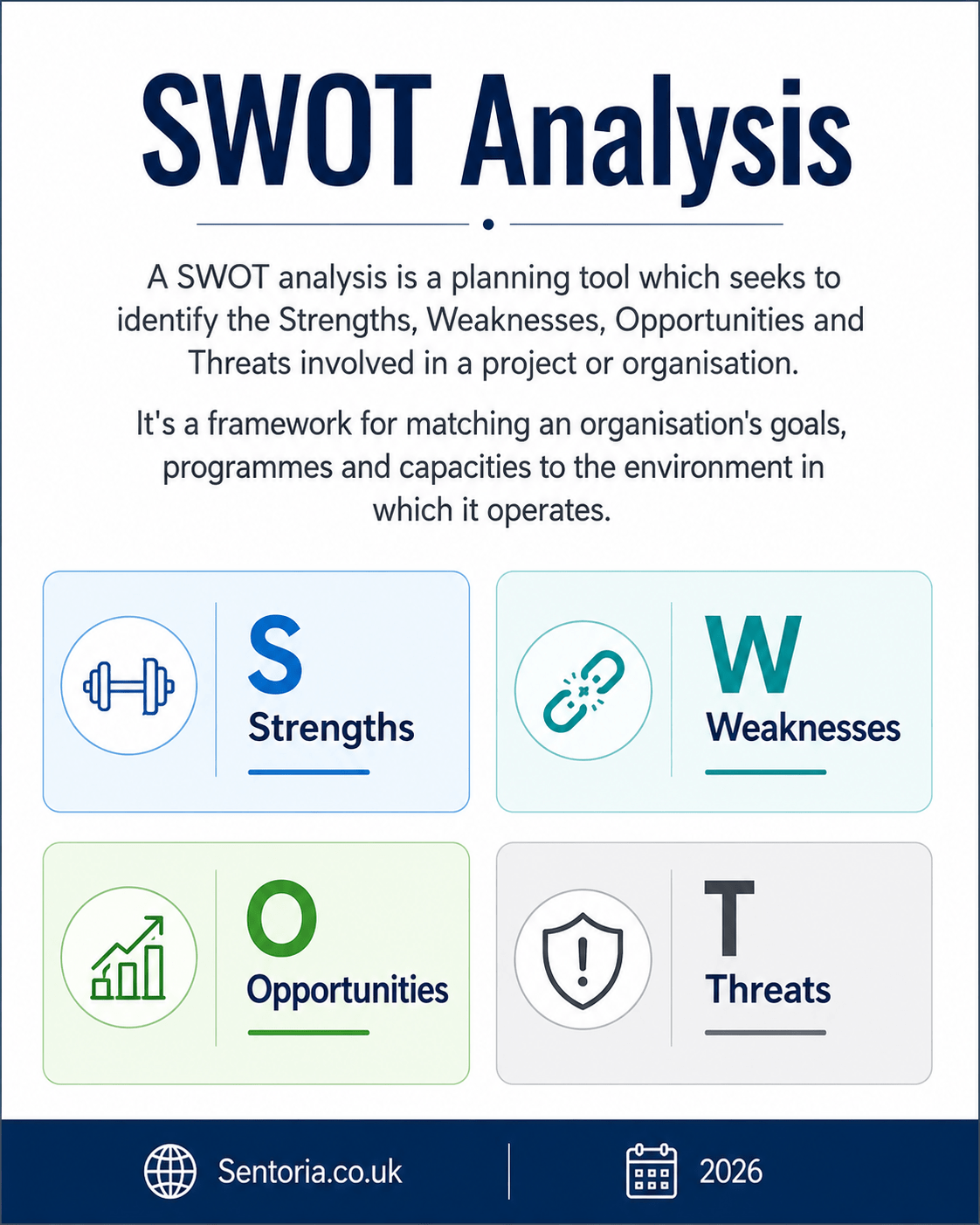
SWOT Analysis:
A Practical Guide to Using Strengths, Weaknesses, Opportunities and Threats Properly
A SWOT analysis is one of the best-known tools in business planning. It is simple enough to explain in a few minutes, but useful enough to support strategic planning, project reviews, marketing decisions, operational change, charity governance, public sector service design and personal development.
At its simplest, SWOT stands for Strengths, Weaknesses, Opportunities and Threats. The purpose is to help an organisation, team or project understand where it is now, what is helping it, what is holding it back, what external opportunities may be available, and what external risks may need to be managed. The framework is commonly presented as a four-box matrix, with strengths and weaknesses usually treated as internal factors, and opportunities and threats usually treated as external factors.
Used well, SWOT can be a powerful planning tool. Used badly, it becomes a list-making exercise that creates the illusion of strategy without leading to clear decisions. The difference lies not in the framework itself, but in how it is applied.
A SWOT analysis is a decision-making technique that identifies the strengths, weaknesses, opportunities, and threats of an organisation or project.
Strengthens
Characteristics of the business or project that give it an advantage over others
Weaknesses
Characteristics that place the business or project at a disadvantage relative to others
Opportunities
Elements in the environment that the business or project could exploit to its advantage
Threats
Elements in the environment that could cause trouble forthe business or project
What is a SWOT Analysis
A SWOT analysis is a structured way of examining four areas:
Strengths are the internal advantages, capabilities and resources that help an organisation or project succeed. These may include reputation, specialist knowledge, strong cash reserves, experienced staff, intellectual property, brand recognition, operational systems, customer loyalty, location, assets or supplier relationships.
Weaknesses are the internal limitations or vulnerabilities that may restrict performance. These could include poor systems, over-reliance on key individuals, weak financial controls, outdated technology, low margins, skills gaps, poor customer service, limited capacity or a lack of management information.
Opportunities are external developments that could be used to improve performance, grow, innovate or strengthen the organisation. These may include market trends, regulatory changes, new technology, competitor weakness, demographic change, funding availability, new partnerships, customer demand or shifts in public policy.
Threats are external pressures that may damage performance, increase risk or limit progress. These could include rising costs, new competitors, changes in regulation, labour shortages, cyber risk, economic downturn, supply chain disruption, reputational issues or changes in customer behaviour.
This split between internal and external factors is important. Strengths and weaknesses are usually things the organisation can influence directly. Opportunities and threats are usually things the organisation must respond to, prepare for or exploit.
Why SWOT analysis is useful
The main strength of SWOT is that it encourages clear thinking. It forces decision-makers to step back from day-to-day activity and consider the bigger picture.
It can help answer questions such as:
- What are we genuinely good at?
- Where are we vulnerable?
- What is changing around us?
- What risks are we not paying enough attention to?
- Which options deserve time, money and management focus?
- What should we stop doing?
- What should we do next?
This makes SWOT useful at the early stage of planning, particularly when a team needs to create a shared view of a situation. CIPD describes SWOT as a diagnostic management framework which helps organisations understand internal and external factors that can affect strategy and business decisions.
When to use a SWOT analysis
SWOT is most useful when there is a real decision to be made. It should not be used simply because a strategy document needs a familiar-looking box.
Good uses include:
- Strategic planning
For reviewing the position of a business, charity, public body or department before setting priorities. - Business planning
For assessing whether a new product, service, site, market or investment is viable. - Project planning
For identifying risks, capacity issues, stakeholder concerns and external dependencies before committing resources. - Marketing planning
- For reviewing brand position, customer perception, competitor activity and market opportunities.
- Turnaround planning
For identifying what can be protected, what must change, and what external threats require urgent action. - Charity and community planning
For reviewing funding, volunteer capacity, community need, partnerships and service risks. - Public sector and healthcare improvement
SWOT is used in quality improvement and service planning to identify what is working, what needs improvement, and what may affect implementation. Improvement Cymru, for example, presents SWOT as a tool that can be used before change, during a quality improvement project, in strategic planning and when considering alternative service models. - Personal development
Individuals can use SWOT to assess career strengths, skill gaps, future opportunities and risks to progression.
SWOT in different industries
The value of SWOT changes depending on the sector. The basic framework stays the same, but the questions should be tailored.
SMEs and owner-managed businesses
For SMEs, SWOT is often most valuable because management time and cash are limited. A good SWOT can highlight where the business should focus its effort.
Typical strengths may include close customer relationships, speed of decision-making, local reputation or specialist knowledge. Weaknesses may include weak systems, limited management depth, poor cash flow forecasting or over-reliance on the owner. Opportunities may include new markets, digital tools, outsourcing, partnerships or competitor withdrawal. Threats may include rising wages, energy costs, late payment, regulation or larger competitors.
The danger for SMEs is optimism bias. Owners often know the business intimately, but that can make it harder to challenge assumptions. A good SWOT should therefore include customer feedback, financial data and input from staff or advisers.
Manufacturing
In manufacturing, SWOT should be grounded in operational facts. Strengths might include production expertise, quality control, machinery, patents, supplier relationships or skilled labour. Weaknesses might include downtime, low automation, poor stock control, old equipment, capacity constraints or quality failures.
Opportunities may include reshoring, automation, export markets, product redesign, process improvement or new materials. Threats may include supply chain disruption, input price inflation, labour shortages, regulatory changes, exchange rates or overseas competition.
For manufacturing, SWOT should usually be combined with cost analysis, capacity planning, quality metrics and supply chain risk review.
Retail and ecommerce
In retail, a SWOT analysis should focus heavily on customer behaviour, pricing, brand, channels and stock.
Strengths may include location, product range, customer loyalty, online visibility, fulfilment speed or social media engagement. Weaknesses may include poor stock turnover, weak margins, slow website performance, limited customer data or high returns.
Opportunities could include marketplace selling, subscriptions, local delivery, product bundling, influencer partnerships or improved email marketing. Threats could include changing consumer confidence, larger online competitors, rent increases, supply costs or platform dependency.
Retail SWOTs are most useful when supported by margin analysis, customer data, stock ageing and competitor pricing.
Professional services
For accountants, solicitors, consultants, architects and other professional firms, SWOT often centres on people, reputation, relationships and capacity.
Strengths may include expertise, client trust, recurring work, referral networks or niche specialisms. Weaknesses may include limited marketing, partner dependency, recruitment challenges, outdated systems or inconsistent service delivery.
Opportunities may include advisory services, sector specialisation, automation, mergers, pricing changes or thought leadership. Threats may include fee pressure, technology disruption, regulatory change, succession issues or talent shortages.
The key is to distinguish between being “busy” and being strategically strong. A firm can have plenty of work and still be vulnerable if margins are poor, systems are weak or knowledge sits with too few people.
Charities and voluntary organisations
For charities, SWOT should look beyond income. It should consider mission, beneficiaries, trustees, staff, volunteers, safeguarding, funder expectations and community need.
Strengths may include community trust, committed volunteers, specialist knowledge or strong partnerships. Weaknesses may include short-term funding, limited reserves, staff burnout, dependence on one grant, weak impact reporting or governance gaps.
Opportunities may include new funding streams, partnerships, local needs assessments, commissioning opportunities or digital service delivery. Threats may include funding cuts, increased demand, volunteer shortages, regulation, reputational risk or rising delivery costs.
For charities, SWOT should be linked to reserves policy, risk registers, impact measurement and trustee decision-making.
Public sector and local government
In the public sector, SWOT can help assess services, policies and transformation projects. Strengths may include statutory powers, local knowledge, public accountability, existing infrastructure or skilled teams. Weaknesses may include budget pressure, legacy systems, procurement delays, fragmented data or political complexity.
Opportunities may include partnership working, digital transformation, preventative services, grant funding or better use of assets. Threats may include demand growth, demographic change, legal challenge, workforce pressures, public dissatisfaction or central government policy change.
A public sector SWOT must be evidence-based. It should not become a political wish list. It should reflect service data, financial constraints, statutory duties and stakeholder views.
Property and construction
For property and construction, SWOT can be used on projects, portfolios or development sites.
Strengths may include location, planning history, asset quality, tenant demand, access, funding or professional team capability. Weaknesses may include contamination, title issues, poor access, high build costs, weak demand, heritage constraints or infrastructure limitations.
Opportunities may include regeneration funding, planning policy support, change of use, sustainability upgrades, local demand or partnership models. Threats may include interest rates, planning objection, contractor failure, cost inflation, utilities constraints or market downturn.
In this sector, SWOT should be paired with financial appraisal, planning risk analysis, legal review and sensitivity testing.
Technology and software
For technology businesses, SWOT must be kept current because markets and products change quickly.
Strengths may include intellectual property, product capability, data, development speed, user experience or recurring revenue. Weaknesses may include technical debt, customer concentration, weak cyber security, poor documentation or limited sales capability.
Opportunities may include artificial intelligence, integrations, overseas markets, partnerships, automation or new pricing models. Threats may include platform changes, cyber attack, regulation, funding constraints, competitor innovation or customer churn.
A technology SWOT should be connected to product roadmaps, customer feedback, churn analysis and security risk management.
How to carry out a SWOT analysis properly
A useful SWOT analysis needs structure. The following process works well.
1. Define the objective
Start with a clear question.
For example:
“What is the best growth strategy for the next three years?”
“Should we launch this new service?”
“How do we improve profitability without damaging service quality?”
“What are the risks and opportunities in this redevelopment project?”
Without a clear objective, SWOT becomes too broad. The result is usually a generic list that does not lead to decisions.
2. Gather evidence
SWOT should not rely only on opinion. Useful evidence may include:
- Financial performance
- Customer feedback
- Staff feedback
- Competitor analysis
- Market research
- Operational data
- Website and marketing analytics
- Risk registers
- Compliance reports
- Economic and policy trends
- Supplier feedback
- Benchmarking
CIPD warns that SWOT can be undermined by insufficient data, too much unanalysed data, unfounded assumptions and difficulty accessing good internal information.
3. Involve the right people
A SWOT carried out by one person is usually weaker than one developed through a structured discussion. Different people see different things.
Senior managers may understand strategy and finance. Frontline staff may understand operational weaknesses. Customers may understand service quality. Finance teams may understand cash and margin pressure. External advisers may spot blind spots that insiders miss.
The best SWOT sessions are open enough to encourage honest input, but disciplined enough to avoid drifting into complaints or speculation.
4. Separate internal from external
Ask whether each point is within the organisation’s control.
A weak sales process is a weakness. A new competitor is a threat. Strong technical expertise is a strength. A growing market is an opportunity.
This distinction matters because internal and external factors require different responses. Internal issues can often be improved directly. External issues need positioning, mitigation, monitoring or exploitation.
5. Be specific
Vague SWOT points are not useful.
“Good staff” is too broad.
“Experienced technical team with low staff turnover and strong client relationships” is better.
“Competition” is too broad.
“Two national competitors are discounting aggressively in our core market” is better.
“Technology” is too broad.
“Cloud-based systems could reduce manual processing time in the finance team” is better.
Specific points make it easier to decide what action is needed.
6. Prioritise
Not every point matters equally. A SWOT with 40 points in each box is usually less useful than one with five or six important points in each category.
Each item should be assessed for significance. For opportunities and threats, consider likelihood, impact, timescale and strategic relevance. For strengths and weaknesses, consider whether they materially affect the objective.
A useful question is:
“Would this point change a decision?”
If not, it may not belong in the final SWOT.
7. Turn the SWOT into options
The real value comes after the four boxes have been filled in.
The next step is to ask:
- How can we use our strengths to exploit opportunities?
- How can we use our strengths to defend against threats?
- How can we improve weaknesses that prevent us taking opportunities?
- How can we reduce weaknesses that expose us to threats?
This is where SWOT becomes strategy. The TOWS approach develops this idea by matching internal and external factors to create strategic options, such as using strengths to pursue opportunities or reducing weaknesses to defend against threats.
8. Create an action plan
Every important SWOT point should lead to one of four outcomes:
- Take action now
- Investigate further
- Monitor
- Accept and document
For each action, identify the owner, deadline, cost, expected benefit and measure of success. Without this step, SWOT is only a workshop output.
Common mistakes in SWOT analysis
Mistake 1: Producing a list instead of a strategy
This is the biggest problem. Research by Hill and Westbrook found that many SWOT exercises produced long lists, weak descriptions, little prioritisation and limited follow-through into later strategy work.
A SWOT is not finished when the matrix is complete. It is finished when the organisation has made decisions.
Mistake 2: Confusing internal and external factors
A common error is putting opportunities in the strengths box or weaknesses in the threats box.
For example, “growing demand” is not a strength. It is an opportunity. “Poor cash collection” is not a threat. It is a weakness. The threat might be tighter credit terms from suppliers or higher interest rates.
Mistake 3: Being too positive
Some teams find strengths easy and weaknesses uncomfortable. This creates a distorted picture.
A good SWOT requires honesty. Weaknesses are not failures. They are management information.
Mistake 4: Ignoring competitors
A strength only matters strategically if it matters in context. Being “good at customer service” is valuable, but if every serious competitor is also good, it may not be a differentiator.
That is why SWOT often works best alongside competitor analysis or Porter’s Five Forces.
Mistake 5: Treating all opportunities as worth pursuing
Not every opportunity is strategic. Some are distractions.
A good opportunity should fit the organisation’s purpose, resources, capabilities, risk appetite and financial reality.
Mistake 6: Failing to quantify
Where possible, add numbers. For example:
- Revenue growth or decline
- Gross margin
- Customer retention
- Staff turnover
- Market share
- Enquiry conversion rate
- Debtor days
- Complaint levels
- Utilisation rates
- Cost inflation
Numbers make the SWOT more objective and reduce the risk of loud opinions dominating the discussion.
Limitations of SWOT analysis
SWOT is useful, but it has weaknesses.
It can oversimplify complex issues
The four-box format is easy to understand, but real business problems rarely fit neatly into four boxes. A factor can be both an opportunity and a threat. For example, artificial intelligence may create efficiency gains, but also increase competition and require investment.
It can become subjective
SWOT depends on judgement. Different people may classify the same issue differently. Without evidence, it can reflect bias, politics or the views of the most confident person in the room.
It does not rank priorities automatically
SWOT does not tell you which issue matters most. A minor weakness and a major strategic threat can appear visually equal unless the team adds prioritisation.
It does not provide the answer
SWOT helps organise thinking. It does not choose the strategy. Management still needs judgement, financial analysis, risk assessment and implementation discipline.
It can be too static
A SWOT is a snapshot at a point in time. In fast-moving sectors, that snapshot can become outdated quickly. CIPD recommends using SWOT alongside other techniques and incorporating it into an ongoing process for monitoring the business environment.
It may encourage internal thinking
Because strengths and weaknesses are easy to discuss internally, teams can spend too much time looking inward. A strong SWOT must give proper weight to customers, competitors, regulation, economics, technology and social change.
Alternatives and complementary tools
SWOT should not be the only tool in the strategy process. It works best when combined with other frameworks.
PESTLE analysis
PESTLE looks at external factors: Political, Economic, Social, Technological, Legal and Environmental. It is particularly useful for identifying opportunities and threats. CIPD recommends using PESTLE alongside tools such as SWOT, Porter’s Five Forces, competitor analysis and scenario planning.
Use PESTLE when the external environment is changing, such as during regulatory reform, economic uncertainty, technological disruption or workforce change.
Porter’s Five Forces
Porter’s Five Forces examines industry structure and competitive pressure. It looks at rivalry, new entrants, substitutes, supplier power and buyer power. Harvard Business School’s Institute for Strategy and Competitiveness describes it as a framework for understanding the competitive forces in an industry and how economic value is divided among industry participants.
Use Five Forces when assessing market attractiveness, pricing power, competitive pressure or whether to enter a sector.
TOWS analysis
TOWS is a development of SWOT. Rather than simply listing factors, it matches them to create strategic options. It asks how strengths can exploit opportunities, how strengths can reduce threats, how weaknesses can be improved to capture opportunities, and how weaknesses and threats can be minimised.
Use TOWS when you want to move from diagnosis to strategy.
Business Model Canvas
The Business Model Canvas is useful when the question is not just “what are our strengths and weaknesses?” but “how does this organisation actually create, deliver and capture value?” Strategyzer describes it as a strategic management and entrepreneurial tool for describing, designing, challenging and pivoting a business model.
Use it for start-ups, new ventures, service redesign, innovation and business model review.
Balanced Scorecard
A Balanced Scorecard helps translate strategy into objectives and measures. It is useful after SWOT, when the organisation needs to turn broad priorities into performance indicators and management reporting.
Use it when the issue is implementation, performance monitoring or strategic alignment.
Risk register
A risk register is more suitable where the main concern is risk control. SWOT may identify threats, but a risk register should assess likelihood, impact, controls, owners and mitigation.
Use it for governance, compliance, audit, project delivery and board reporting.
Scenario planning
Scenario planning explores different possible futures. It is useful when uncertainty is high and a single forecast would be misleading.
Use it for long-term planning, economic uncertainty, policy change, climate risk, technology disruption or major investment decisions.
SOAR analysis
SOAR stands for Strengths, Opportunities, Aspirations and Results. It is more positive and future-focused than SWOT. It may be useful for culture change, leadership development and workshops where the aim is to build momentum rather than diagnose risk.
The weakness is that it may underplay threats and weaknesses, so it should be used carefully where risk is material.
A practical SWOT template
A useful SWOT template should include more than four boxes. It should capture evidence, priority and action.
For each item, record:
- SWOT category
- Specific point
- Evidence
- Impact
- Likelihood, if relevant
- Priority
- Proposed action
- Owner
- Deadline
- Measure of success
For example:
Weakness
Manual invoice processing is taking too much finance team time.
Evidence
Average processing time is high, month-end is delayed, and staff are duplicating data entry.
Impact
Higher admin cost, slower reporting, increased error risk.
Action
Review automation options, map the process and prepare a cost-benefit case.
Owner
Finance Manager.
Deadline
30 days.
Measure of success
Reduction in processing time and fewer month-end adjustments.
Questions to ask in each section
Strengths
- What do we do better than competitors or comparable organisations?
- What do customers, clients, beneficiaries or stakeholders value most?
- What assets, skills, relationships or systems give us an advantage?
- Where are we most profitable or effective?
- What would be difficult for others to copy?
- What do our people take pride in?
- What evidence supports these strengths?
Weaknesses
- Where are we underperforming?
- What do customers or staff complain about?
- Where are costs too high or margins too low?
- What depends too much on one person, supplier or customer?
- What systems or processes are inefficient?
- Where do we lack skills, data or capacity?
- What risks are we avoiding talking about?
Opportunities
- What external changes could help us?
- What customer needs are not being met?
- What technology could improve performance?
- What partnerships could create value?
- What funding, policy or market changes are emerging?
- Which competitor weaknesses could we respond to?
- What opportunities fit our strengths?
Threats
- What could damage income, margin or service delivery?
- What are competitors doing?
- What costs are rising?
- What regulation or compliance issues are emerging?
- What technology could disrupt us?
- What happens if demand changes?
- What external risks would expose our weaknesses?
The best way to think about SWOT
The best SWOT analysis is not the longest. It is the one that leads to better decisions.
A strong SWOT should be:
- Objective
- Evidence-based
- Honest
- Specific
- Prioritised
- Linked to action
- Reviewed regularly
A weak SWOT is vague, subjective, overlong and disconnected from implementation.
Conclusion: SWOT is simple, but not simplistic
SWOT remains popular because it is accessible. It gives leaders, managers, trustees, project teams and advisers a shared language for discussing position, risk and opportunity.
But the simplicity of SWOT is also its danger. Filling in four boxes is easy. Making strategic choices is harder.
The real value comes from what happens next: prioritising the issues, testing the evidence, matching internal capabilities to external conditions, choosing what to do, assigning responsibility and measuring progress.
Used properly, SWOT is not just a planning exercise. It is a bridge between understanding the present and making better decisions about the future.