Market Research:
A Practical Guide to Understanding Markets, Customers, Competitors and Demand
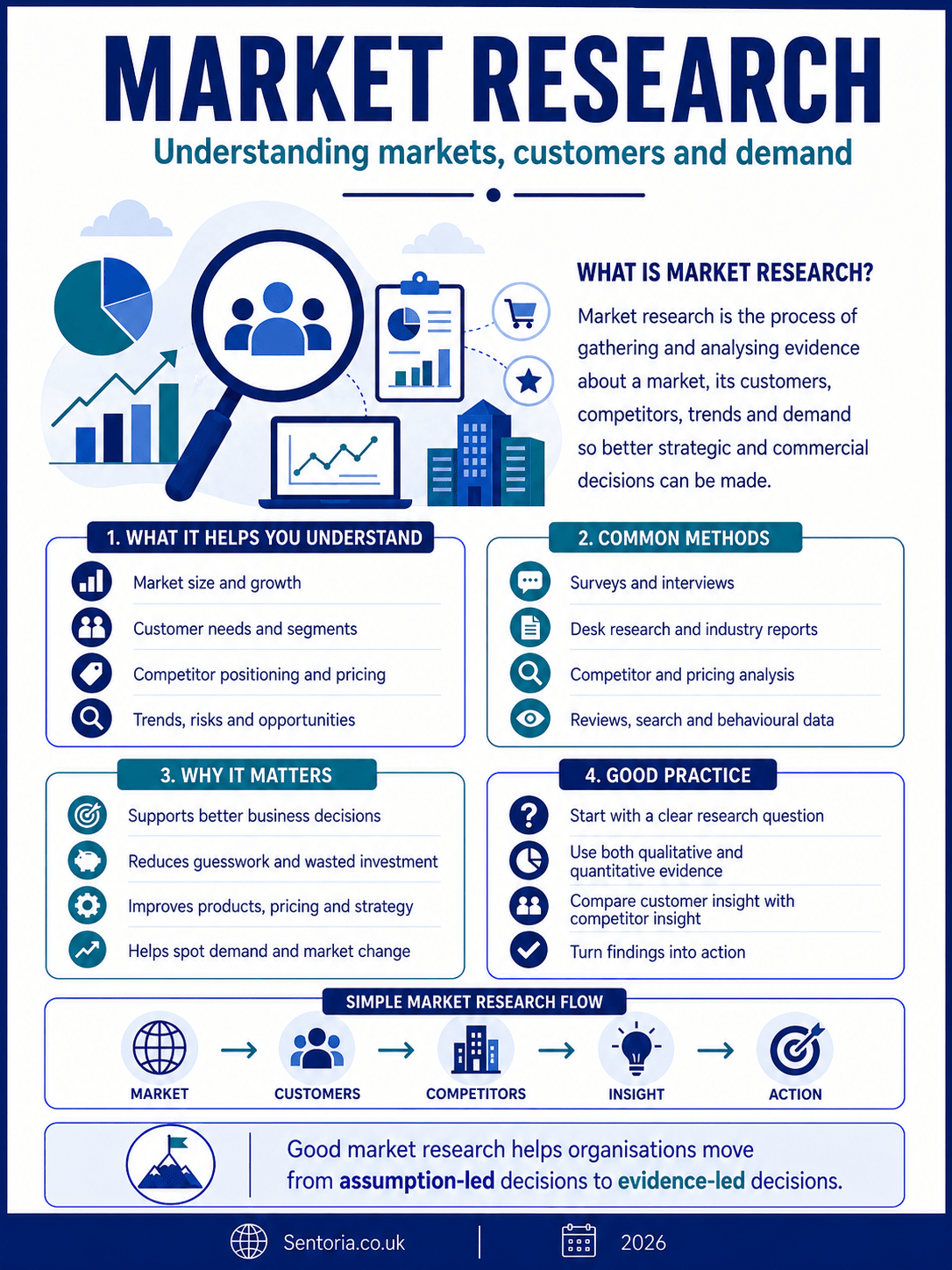
Market research is a practical business and strategy tool used to understand a market, its customers, competitors, trends, demand, pricing, risks and opportunities.
At its simplest, market research asks:
What is happening in the market, who are the customers, what do they need, who else is serving them, how is the market changing, and what should we do as a result?
That makes it useful for strategy, business planning, marketing, product development, pricing, customer research, competitor analysis, investment appraisal, service design, property decisions, charity planning, public sector services, technology, education and healthcare.
The Market Research Society describes itself as the UK professional body for research, insight and analytics, promoting professional standards through its Code of Conduct. That matters because good market research is not just collecting opinions. It is the disciplined gathering and interpretation of evidence to support better business, policy and organisational decisions.
Used properly, market research helps organisations move from assumption, instinct and internal opinion to evidence, insight and better decision-making.
What is market research?
Market research is the process of gathering, analysing and interpreting information about a market.
It may examine:
- Market size
- Market growth
- Customer needs
- Customer behaviour
- Customer segments
- Competitor activity
- Pricing
- Demand
- Trends
- Distribution channels
- Buying decisions
- Barriers to entry
- Brand perception
- Product or service gaps
- Regulation
- Technology change
- Economic conditions
- Substitutes
- Supply chains
- Opportunities and threats
Market research is broader than simply asking customers what they think.
It looks at the market as a whole.
That includes customers, non-customers, competitors, alternatives, trends, data, behaviour, pricing, regulation and external change.
Qualtrics describes market research as helping organisations reduce uncertainty by providing evidence for better decisions, rather than relying on assumptions or gut feel. It also notes that market research should go beyond what customers do and help explain why they do it.
In simple terms:
Market research helps an organisation understand the world outside itself.
That external view is essential because organisations can easily become too inward-looking.
They may understand their product, service or organisation very well, but misunderstand the market in which they operate.
Market research, customer research and competitor analysis
Market research is often confused with customer research and competitor analysis.
They are related, but they are not the same.
Market research
Market research looks at the whole market.
It asks:
What is happening in the market, and what does it mean for us?
It may include customers, competitors, pricing, trends, demand, regulation and external forces.
Customer research
Customer research focuses on customers and potential customers.
It asks:
Who are our customers, what do they need, what do they value, and how do they make decisions?
Customer research is usually part of market research, but it has a narrower focus.
Competitor analysis
Competitor analysis focuses on organisations offering alternatives in the market.
It asks:
Who else is serving this market, how are they positioned, what are they good at, and how do we compare?
Competitor analysis is also part of market research.
In simple terms:
Market research studies the market.
Customer research studies the customer.
Competitor analysis studies the alternatives.
A strong market research process will usually include all three.
History and development of market research
Market research developed from the need to understand buyers, demand, advertising effectiveness, competition and consumer behaviour.
Earlier forms of market research were often based on direct observation, sales records, customer conversations, newspaper advertising response, population data and trader experience. As markets became larger and more competitive, organisations needed more systematic ways to understand customer demand and market conditions.
The growth of mass advertising, consumer goods, polling, statistics and professional research methods helped market research develop into a recognised discipline. Over time, it moved beyond simply asking whether customers liked a product. It became a broader discipline covering segmentation, pricing, brand perception, customer behaviour, product testing, media response, market sizing and demand forecasting.
Digital technology has changed market research again.
Organisations can now use:
- Website analytics
- Search data
- Social media listening
- Online surveys
- Customer reviews
- Customer relationship management data
- Ecommerce behaviour
- App usage
- Digital advertising data
- Product analytics
- Competitor websites
- Public datasets
- AI-assisted analysis
- Online communities
- Large-scale behavioural data
However, more data does not automatically mean better insight.
A dashboard may show what is happening, but not why.
A survey may show what people say, but not what they will actually do.
A sales report may show what has sold, but not what demand has been missed.
That is why good market research combines data, interpretation, judgement and challenge.
Why market research matters
Market research matters because organisations often make decisions using incomplete information.
They assume:
- The market wants what they offer.
- Customers understand the value.
- Competitors are similar.
- Price is the main issue.
- Demand is large enough.
- Current customers represent future customers.
- The market will continue as it is.
- A new product will sell.
- A new location will work.
- A service gap exists.
- A brand is trusted.
- A market is growing.
- A competitor is weak.
- A customer segment is profitable.
- A new channel will generate leads.
Some assumptions may be right.
Many may be wrong.
Market research helps organisations:
- Understand demand
- Identify customer needs
- Test opportunities
- Reduce wasted investment
- Improve products and services
- Understand competitors
- Improve pricing
- Improve marketing
- Identify risks
- Find new market segments
- Improve sales conversion
- Support forecasting
- Strengthen strategy
- Improve customer experience
- Spot market change
- Support investment decisions
- Improve brand positioning
- Reduce uncertainty
- Inform roadmaps
- Make better decisions
Market research does not remove risk.
It reduces avoidable ignorance.
That is its real value.
When to use market research
Market research is useful whenever a decision depends on understanding the market.
Good uses include:
- Starting a new business
- Launching a new product
- Launching a new service
- Entering a new market
- Reviewing pricing
- Repositioning a brand
- Improving marketing
- Understanding competitors
- Testing customer demand
- Assessing market size
- Choosing a location
- Developing a product roadmap
- Preparing a business plan
- Supporting investment appraisal
- Improving customer segmentation
- Assessing a merger or acquisition
- Reviewing a charity service
- Planning a public service
- Testing a property development concept
- Reviewing strategic direction
It is especially useful where:
- The decision is material.
- The organisation is making assumptions.
- The market is changing.
- The organisation is considering investment.
- Customer behaviour is uncertain.
- Competitors are active.
- Sales are below expectation.
- Growth has slowed.
- A new proposition is being considered.
- The board needs evidence before approval.
It is less useful if research is carried out after the decision has already been made simply to justify it.
The main types of market research
1. Primary research
Primary research is research collected directly for a specific purpose.
Examples include:
- Customer interviews
- Prospect interviews
- Surveys
- Focus groups
- Product testing
- Concept testing
- Usability testing
- Field observation
- Mystery shopping
- Customer panels
- Brand perception studies
- Pricing research
- Lost customer interviews
- Market entry interviews
- Prototype testing
Primary research is useful because it can answer the organisation’s specific question.
For example:
Would local businesses use a flexible workshop space in this location?
Why are prospects choosing a competitor instead of us?
What would make customers pay for a premium service?
The weakness is that primary research takes time, costs money and can be biased if poorly designed.
2. Secondary research
Secondary research uses information that already exists.
Examples include:
- Government statistics
- Industry reports
- Trade body data
- Academic research
- Competitor websites
- Company accounts
- Planning documents
- Local authority reports
- Economic data
- Search trends
- Social media discussions
- Customer reviews
- News articles
- Market reports
- Regulatory publications
Secondary research is often a good starting point.
It helps understand the wider market before commissioning new research.
Its weakness is that the data may not exactly answer the question, may be outdated, or may not reflect the specific customer segment being considered.
3. Qualitative research
Qualitative research explores meaning, motivation, perception and experience.
It helps answer:
Why do people think, feel or behave this way?
Common qualitative methods include:
- Interviews
- Focus groups
- Open-ended survey questions
- Observation
- Customer journey discussions
- Ethnographic research
- Diary studies
- Review analysis
- Complaint analysis
- Sales call analysis
Qualitative research is useful when the organisation needs depth.
It can reveal customer language, emotional drivers, concerns, hidden barriers, unmet needs and decision-making processes.
Its weakness is that it usually involves smaller samples, so findings need careful interpretation.
4. Quantitative research
Quantitative research uses numbers and measurable data.
It helps answer:
How many, how much, how often, and how strongly?
Common quantitative methods include:
- Surveys
- Polling
- Sales analysis
- Market sizing
- Demand modelling
- Pricing tests
- Website analytics
- Conversion analysis
- Customer segmentation
- Brand awareness tracking
- A/B testing
- Customer satisfaction scoring
- Net Promoter Score
- Search volume analysis
- Statistical modelling
Quantitative research is useful where scale and measurement matter.
Its weakness is that numbers can be misleading if the sample is poor, the questions are biased, or the data is interpreted without context.
5. Behavioural research
Behavioural research examines what people actually do.
This may include:
- Purchases
- Repeat purchases
- Abandoned baskets
- Website clicks
- Search behaviour
- App usage
- Customer support requests
- Product usage
- Churn
- Referral behaviour
- Store movement
- Email engagement
- Conversion
- Returns
- Payment behaviour
Nielsen Norman Group distinguishes between attitudinal methods, which capture what users say, and behavioural methods, which observe what users do. That distinction is useful in market research because stated preference and actual behaviour can differ.
6. Attitudinal research
Attitudinal research examines what people think, feel or say.
Examples include:
- Brand perception
- Customer satisfaction
- Purchase intent
- Trust
- Preference
- Awareness
- Price perception
- Service expectations
- Emotional response
- Opinions about competitors
Attitudinal research is useful, but should not be treated as behaviour.
A person may say they would buy a product, but not actually buy it when money, timing, trust and alternatives are involved.
Good market research often combines attitudinal and behavioural evidence.
The key areas market research should cover
1. Market size
Market size estimates the total opportunity.
It may be measured by:
- Revenue
- Units sold
- Number of customers
- Number of businesses
- Number of households
- Service demand
- Geographical area
- Search demand
- Transaction volume
- Addressable market
Market size matters because an attractive idea may still fail if the market is too small.
A niche can be profitable, but it must still be large enough to support the organisation’s objectives.
2. Market growth
Market growth examines whether the market is expanding, stable or declining.
A growing market may create opportunity.
A declining market may still be attractive if competitors are leaving or if a specialist niche remains profitable.
Growth should not be assumed.
It should be evidenced.
3. Customer segments
Customer segments are groups of customers with similar needs, behaviours or characteristics.
Segmentation may be based on:
- Demographics
- Geography
- Industry
- Business size
- Behaviour
- Needs
- Value
- Usage
- Price sensitivity
- Decision-making style
- Profitability
- Channel preference
- Life stage
- Risk profile
- Attitudes
Good segmentation helps avoid treating the whole market as one group.
The average customer is often not very useful.
4. Customer needs
Market research should identify customer needs.
These may include:
- Functional needs
- Emotional needs
- Financial needs
- Convenience needs
- Risk reduction
- Trust
- Speed
- Advice
- Quality
- Simplicity
- Reliability
- Status
- Support
- Compliance
- Accessibility
Customers do not always buy the best technical product.
They buy the option that best fits their needs, constraints and confidence at the time of decision.
5. Buying behaviour
Market research should examine how customers buy.
Questions include:
- Who starts the buying process?
- Who makes the decision?
- Who influences the decision?
- Who pays?
- What triggers the purchase?
- What alternatives are considered?
- What information is needed?
- How long does the decision take?
- What creates trust?
- What creates hesitation?
- What causes customers to leave?
- What causes repeat purchase?
Buying behaviour is often more complicated than organisations expect.
This is especially true in business-to-business markets, professional services, public sector procurement and high-value consumer decisions.
6. Competitor positioning
Market research should examine who else serves the market.
This includes:
- Direct competitors
- Indirect competitors
- Substitutes
- New entrants
- Low-cost alternatives
- Premium providers
- Digital alternatives
- DIY options
- Public sector or voluntary sector alternatives
- In-house alternatives
Competitor research should not simply copy competitors.
It should help understand where the organisation can be different, better, more focused or more relevant.
7. Pricing
Pricing research explores what customers expect, accept and value.
It may examine:
- Current market prices
- Competitor prices
- Customer willingness to pay
- Price sensitivity
- Value perception
- Discounts
- Bundling
- Subscription models
- Premium pricing
- Payment terms
- Price anchoring
- Total cost of ownership
Pricing is not only a number.
It communicates value, quality, positioning and risk.
8. Market trends
Market research should identify trends affecting demand and competition.
These may include:
- Technology change
- Demographic change
- Regulation
- Economic conditions
- Social attitudes
- Environmental expectations
- Consumer behaviour
- Distribution channels
- Funding changes
- Workforce availability
- Supply chain disruption
- Local development
- Interest rates
- Inflation
- Digital adoption
Market trends help organisations avoid building plans for yesterday’s market.
Market research in different industries
SMEs and owner-managed businesses
For SMEs, market research should be practical and focused.
Small businesses often do not need expensive research reports. They need useful evidence.
Typical SME market research topics include:
- Is there demand for this service?
- Which customers are most profitable?
- Why do prospects not convert?
- What are competitors offering?
- What price will the market accept?
- What local demand exists?
- What customer groups are underserved?
- Which marketing channels work?
- What trends affect our sector?
- What should we stop offering?
Useful methods include:
- Customer interviews
- Lost quote follow-up
- Competitor website review
- Local search analysis
- Customer review analysis
- Sales data review
- Short surveys
- Social media listening
- Industry reports
- Testing small offers before full launch
For SMEs, the key is not to overcomplicate the work.
The research should support a real decision.
Manufacturing
Manufacturers use market research to understand demand, customer requirements, product opportunities, pricing, competitor capability and supply chain changes.
Typical topics include:
- Demand by sector
- Customer specification requirements
- Technical standards
- Competitor capability
- Pricing pressure
- Procurement criteria
- Product innovation
- Distributor behaviour
- Export opportunities
- Substitution risk
- Sustainability requirements
- Lead time expectations
- Quality expectations
- After-sales support
- Supply chain trends
A manufacturer might ask:
- Which sectors are growing?
- Which customers need specialist products?
- What quality standards matter most?
- Are customers willing to pay for shorter lead times?
- Which competitors are investing in automation?
- What product features are becoming expected?
- What environmental requirements are emerging?
For manufacturing, market research should link sales, product development, operations, procurement and capital investment.
Retail and ecommerce
Retail and ecommerce businesses need market research because customer behaviour, platforms, channels and competition change quickly.
Typical topics include:
- Product demand
- Search trends
- Customer segments
- Competitor pricing
- Delivery expectations
- Return behaviour
- Marketplace trends
- Customer reviews
- Brand perception
- Website conversion
- Social media trends
- Advertising costs
- Product range gaps
- Subscription opportunities
- Customer loyalty
Useful methods include:
- Search demand analysis
- Website analytics
- Competitor pricing review
- Review mining
- Customer surveys
- A/B testing
- Product testing
- Basket analysis
- Return reason analysis
- Social listening
For ecommerce, market research should not only ask whether people like a product.
It should examine demand, conversion, margin, returns, fulfilment and repeat purchase.
Professional services
Professional services firms use market research to understand client needs, sector opportunities, pricing, trust, competition and service positioning.
Typical topics include:
- Client needs
- Advisory opportunities
- Sector demand
- Fee expectations
- Competitor positioning
- Trust factors
- Referral behaviour
- Website enquiry behaviour
- Client pain points
- Service packaging
- Communication preferences
- Buyer decision process
- Client retention
- Technology expectations
- Market specialisms
For accountants, solicitors, consultants, architects and advisers, market research might ask:
- What do clients value most?
- Which sectors need more support?
- What problems are clients struggling with?
- What makes clients switch advisers?
- What services do clients not understand?
- How do competitors position themselves?
- What price models feel fair?
- What content builds trust?
Professional services firms often assume technical competence is the main differentiator.
Market research may show that responsiveness, clarity, plain English, commercial understanding and trust matter just as much.
Charities and voluntary organisations
Charities use market research to understand need, funding, beneficiaries, donors, volunteers, commissioners and community trends.
Typical topics include:
- Community need
- Beneficiary demand
- Service gaps
- Funder priorities
- Donor behaviour
- Volunteer motivations
- Commissioner expectations
- Local demographics
- Referral pathways
- Partnership opportunities
- Public awareness
- Impact evidence
- Unmet need
- Competing provision
- Sustainability
A charity might ask:
- What needs are increasing locally?
- Which groups are underserved?
- What do funders want to evidence?
- What motivates donors?
- What stops people accessing support?
- Which services overlap with others?
- Where could partnerships improve impact?
For charities, market research should be ethical, inclusive and sensitive.
It should also link to mission, funding strategy, reserves policy and service delivery.
Public sector and local government
Public bodies use market research to understand residents, service users, demand, suppliers, policy options and local conditions.
Typical topics include:
- Service demand
- Resident needs
- Digital exclusion
- Satisfaction
- Consultation evidence
- Local economy
- Housing need
- Supplier markets
- Procurement options
- Community priorities
- Equality impacts
- Behaviour change
- Public health trends
- Transport patterns
- Environmental needs
The GOV.UK Service Manual emphasises understanding user needs, planning research, preparing sessions, and sharing and analysing findings, which is a useful discipline for public service research.
For public bodies, market research should support transparency, accessibility, statutory duties, equality and public value.
Property and construction
Property and construction organisations use market research to understand demand, viability, occupiers, buyers, tenants, local need and competitor schemes.
Typical topics include:
- Rental demand
- Sales values
- Occupier requirements
- Tenant demand
- Local demographics
- Planning context
- Competing schemes
- Construction cost trends
- Investment demand
- Community needs
- Transport access
- Parking expectations
- Sustainability requirements
- Workspace trends
- Residential demand
A property business might ask:
- Is there demand for this type of space?
- What rent or sale values are realistic?
- Who are the likely occupiers?
- What amenities matter?
- What competing developments exist?
- What local concerns may affect planning?
- What design choices improve marketability?
- What phasing reduces risk?
For property and construction, market research should link to planning, viability, valuation, design, funding, stakeholder engagement and risk.
Technology and software
Technology businesses use market research to understand product-market fit, user problems, competitor products, pricing and adoption.
Typical topics include:
- User needs
- Product-market fit
- Market size
- Buyer personas
- Competitor features
- Pricing models
- Churn drivers
- Adoption barriers
- Integration needs
- Security concerns
- Platform dependency
- Customer acquisition cost
- Support expectations
- Product roadmap priorities
- Switching behaviour
A software business might ask:
- Is the problem painful enough for customers to pay?
- Which customer segment has the strongest need?
- What alternatives are customers using now?
- What features matter most?
- What prevents adoption?
- What pricing model is acceptable?
- Why do customers churn?
- Which competitors are gaining traction?
For technology businesses, market research should not become a feature wish list.
The deeper question is:
What problem is valuable enough to solve?
Healthcare and social care
Healthcare and social care organisations use market research to understand demand, service user needs, family expectations, workforce pressures, commissioning and regulatory context.
Typical topics include:
- Demand for care
- Demographic change
- Service user needs
- Family expectations
- Commissioner priorities
- Workforce availability
- Funding rates
- Competitor provision
- Quality expectations
- Accessibility
- Safeguarding confidence
- Communication needs
- Digital care adoption
- Local population health
- Regulatory pressures
Research in healthcare and care must be handled carefully because safety, dignity, safeguarding, confidentiality and consent matter.
Education and training
Education providers use market research to understand learner demand, employer needs, funding, course viability, competition and outcomes.
Typical topics include:
- Learner demand
- Employer skills needs
- Course choice
- Funding rules
- Apprenticeship demand
- Competitor provision
- Labour market trends
- Learner support needs
- Digital learning expectations
- Placement opportunities
- Progression outcomes
- Pricing
- Accessibility
- Curriculum relevance
- Qualification reform
Education market research should link to learner outcomes, employer demand, safeguarding, quality, funding and long-term sustainability.
How to carry out market research properly
1. Define the decision
Start with the decision the research will support.
Ask:
- What are we trying to decide?
- What do we already know?
- What assumptions are we making?
- What evidence is missing?
- Who will use the findings?
- What action may follow?
- How much risk is involved?
- What timescale applies?
- What budget is available?
- What would make the research useful?
Research without a decision can become interesting but unhelpful.
2. Define the market
Be clear about the market being researched.
A market may be defined by:
- Geography
- Customer segment
- Product category
- Service type
- Industry
- Price point
- Need
- Usage occasion
- Buyer type
- Channel
For example:
The market for professional accountancy services is too broad.
A more useful definition might be:
Owner-managed businesses in Huddersfield and West Yorkshire with turnover between £500,000 and £10 million seeking monthly management accounts, tax compliance and commercial finance support.
The clearer the market definition, the more useful the research.
3. Identify the research questions
Good research questions might include:
- How large is the market?
- Is the market growing?
- Who are the customers?
- What problem are they trying to solve?
- What alternatives do they currently use?
- How do they choose?
- What do they value?
- What price do they accept?
- Who are the competitors?
- What gaps exist?
- What trends are changing the market?
- What barriers exist?
- What risks matter?
- What evidence would support investment?
- What would make us different?
Research questions should be specific enough to guide the method.
4. Start with secondary research
Secondary research is usually the best starting point.
Review:
- Industry reports
- Public statistics
- Competitor websites
- Search demand
- Customer reviews
- Trade publications
- Local plans
- Economic data
- Regulatory publications
- Academic research
- Company accounts
- Social media discussion
- Market commentary
- Supplier information
- Internal data
This helps build context and avoid asking questions that have already been answered.
5. Add primary research where needed
Primary research should fill the evidence gaps.
Use:
- Interviews where depth is needed.
- Surveys where scale is needed.
- Focus groups where discussion is useful.
- Usability testing where experience matters.
- Observation where behaviour matters.
- Product tests where adoption is uncertain.
- Pricing research where willingness to pay matters.
- Lost customer research where conversion or retention is weak.
The method should fit the question.
Do not run a survey when interviews would be better.
Do not rely only on interviews when scale matters.
6. Use both qualitative and quantitative evidence
Good market research usually needs both.
Qualitative evidence explains meaning.
Quantitative evidence shows scale.
For example:
Qualitative research may reveal that customers find pricing confusing.
Quantitative research may show how many customers abandon the buying journey at the pricing page.
Together, they create stronger insight.
7. Sample carefully
Research is only as good as the people or data included.
Consider:
- Existing customers
- Lost customers
- Prospects
- Non-customers
- High-value customers
- Low-value customers
- Different segments
- Different locations
- Different age groups
- Different industries
- Different levels of experience
- Decision-makers
- Users
- Influencers
- Referrers
Poor sampling can mislead.
A survey of loyal customers may not explain why prospects do not buy.
A focus group of existing users may not reveal why non-users are not interested.
8. Avoid leading questions
Questions should be clear and neutral.
Weak question:
Would you buy our innovative and affordable new service?
Stronger question:
What would influence whether you would consider using this service?
Weak question:
Do you agree our pricing is good value?
Stronger question:
How do you judge whether this type of service is good value?
Leading questions produce weak evidence.
9. Analyse properly
Do not stop at raw findings.
Look for:
- Patterns
- Contradictions
- Themes
- Segments
- Behavioural evidence
- Emotional drivers
- Unmet needs
- Barriers
- Decision triggers
- Competitor strengths
- Price expectations
- Market gaps
- Risks
- Opportunities
- Implications
The goal is insight, not simply information.
10. Turn insight into action
Market research should lead to decisions.
Possible actions include:
- Launch the product
- Change the product
- Stop the product
- Reposition the offer
- Change pricing
- Target a different segment
- Improve the website
- Change marketing messages
- Build a new service
- Enter a new market
- Avoid a weak market
- Update the forecast
- Change the roadmap
- Add a risk to the risk register
- Commission further research
Research that does not affect action has limited value.
Common market research methods
Desk research
Desk research uses existing sources.
It is useful for market context, competitor review, statistics, trends and initial opportunity assessment.
Surveys
Surveys collect structured responses from a defined group.
They are useful for measuring attitudes, preferences, awareness, satisfaction and demand.
Interviews
Interviews explore customer, prospect or stakeholder views in depth.
They are useful for understanding needs, motivations and decision-making.
Focus groups
Focus groups explore views through group discussion.
They are useful for testing reactions, language and perceptions.
They can be weaker where dominant voices influence the discussion.
Competitor review
A competitor review examines positioning, pricing, products, service promises, channels, messaging, reviews and strengths.
It should identify difference, not simply copy others.
Customer review analysis
Review analysis examines public reviews, testimonials, complaints and social proof.
It can show what customers praise, dislike and expect.
Social listening
Social listening examines discussion on social media, forums and online communities.
It can reveal emerging language, concerns, trends and sentiment.
Search analysis
Search analysis examines what people search for online.
It can show demand, intent, language and seasonality.
Mystery shopping
Mystery shopping tests the buying or service experience.
It is useful for retail, hospitality, professional services, property, customer service and local businesses.
Product or concept testing
Concept testing examines customer reaction to a proposed product, service, message or offer.
It is useful before investing heavily.
Pricing research
Pricing research explores willingness to pay, value perception and price sensitivity.
It should be treated carefully because stated willingness to pay may not match real behaviour.
Common mistakes in market research
Mistake 1: Starting with the answer
Market research should not be used to justify a decision already made.
It should be used to learn.
Mistake 2: Defining the market too broadly
A broad market definition produces vague findings.
Be specific about geography, segment, need and offer.
Mistake 3: Relying only on customer opinion
Customers may not always behave as they say they will.
Use behavioural evidence where possible.
Mistake 4: Ignoring non-customers
Existing customers explain current success.
Non-customers may explain future growth.
Mistake 5: Ignoring competitors
A good idea may already be well served by competitors.
Research must consider alternatives.
Mistake 6: Using poor samples
A small or biased sample can produce misleading findings.
The sample should fit the decision.
Mistake 7: Asking leading questions
Leading questions create unreliable answers.
Neutrality matters.
Mistake 8: Confusing data with insight
A table of survey results is not insight.
Insight explains what the findings mean and what should happen next.
Mistake 9: Ignoring price and viability
Customers may like an idea, but not enough to pay for it at a viable price.
Market research should connect demand with economics.
Mistake 10: Not acting on the findings
Research without action wastes time and may frustrate participants.
The findings should influence decisions.
Limitations and weaknesses of market research
Market research is useful, but it has limits.
It cannot predict the future perfectly
Market research reduces uncertainty.
It does not remove it.
Customers, competitors, regulation and economic conditions can still change.
Customers may not know what they will do
People may say they would buy, switch, pay or recommend, but behave differently in real situations.
Research can be biased
Bias may come from sampling, question design, interpretation, timing, incentives or the researcher’s expectations.
Data can become outdated
Markets change.
Research should be refreshed when the environment changes.
Research can be too narrow
Research that only examines customers may miss competitors, substitutes, regulation or trends.
Research that only examines competitors may miss customer needs.
Research can be overcomplicated
Not every decision needs a large research project.
Research should be proportionate.
It can slow decisions if misused
Research should support decisions, not become an excuse to avoid them.
It does not replace judgement
Research informs judgement.
It does not make the decision automatically.
Leaders still need to interpret evidence, consider risk and make choices.
Market research compared with other strategic and management tools
Market research and customer research
Customer research focuses on customer needs, behaviour and experience.
Market research looks more broadly at the market, including customers, competitors, trends, demand and external factors.
Use customer research for depth on customers.
Use market research for broader market understanding.
Market research and competitor analysis
Competitor analysis studies alternatives and rivals.
Market research includes competitor analysis but also considers customers, demand, pricing, trends and market structure.
Market research and PESTLE
PESTLE examines political, economic, social, technological, legal and environmental factors.
Market research can use PESTLE to structure external analysis.
Market research and SWOT
SWOT identifies strengths, weaknesses, opportunities and threats.
Market research provides evidence for opportunities and threats, and may also reveal strengths and weaknesses.
Market research and Value Proposition Canvas
The Value Proposition Canvas connects customer jobs, pains and gains with the organisation’s offer.
Market research provides the evidence needed to complete it properly.
Market research and Business Model Canvas
The Business Model Canvas shows how an organisation creates, delivers and captures value.
Market research tests whether the customer segments, value propositions, channels, revenue streams and partnerships are realistic.
Market research and Lean Canvas
Lean Canvas is useful for early-stage ideas.
Market research helps test whether the problem, customer segment and solution assumptions are valid.
Market research and forecasting
Forecasting estimates future outcomes.
Market research provides evidence about demand, price, customer behaviour and growth assumptions.
Market research and roadmapping
Roadmapping turns strategy into phased action.
Market research helps decide what should be prioritised on the roadmap.
Market research and horizon scanning
Horizon scanning identifies emerging signals of change.
Market research examines current and near-future market conditions.
Use both where market change matters.
Alternatives and complementary frameworks
Customer research
Use customer research to understand customers, needs, behaviour, experience and decision-making.
Competitor analysis
Use competitor analysis to understand alternatives, positioning, pricing and competitive advantage.
PESTLE analysis
Use PESTLE to structure external market factors.
SWOT analysis
Use SWOT to connect market evidence with internal strengths and weaknesses.
Value Proposition Canvas
Use the Value Proposition Canvas to test whether the offer fits customer needs.
Business Model Canvas
Use the Business Model Canvas to test whether the market opportunity can become a viable business model.
Lean Canvas
Use Lean Canvas for early-stage ideas, startups and new service concepts.
Jobs to be Done
Use Jobs to be Done to understand the progress customers are trying to make.
Segmentation
Use segmentation to divide the market into meaningful customer groups.
Positioning map
Use a positioning map to compare competitors by price, quality, service, specialism or other dimensions.
A practical market research template
A useful market research template should include:
- Research title
- Purpose
- Decision supported
- Market definition
- Research questions
- Existing assumptions
- Customer segments
- Competitors
- Market size
- Market growth
- Trends
- Pricing evidence
- Customer needs
- Buying behaviour
- Data sources
- Research methods
- Key findings
- Insights
- Risks
- Opportunities
- Recommended actions
- Owner
- Review date
- Link to strategy, forecast or roadmap
Example:
Research title: Market assessment for a new monthly advisory service
Purpose: Assess demand, pricing and positioning for a monthly advisory service aimed at local SME owners.
Market definition: Owner-managed businesses in West Yorkshire with turnover between £500,000 and £10 million requiring regular financial insight and commercial decision support.
Research questions:
- What problems do SME owners face with financial decision-making?
- What advisory support do they currently use?
- What would they value enough to pay for monthly?
- Which competitors already serve this need?
- What price points are visible in the market?
- What language do customers use to describe the need?
Methods:
- Interviews with existing clients
- Lost prospect review
- Competitor website review
- Search demand review
- Pricing comparison
- Review of current service profitability
Key finding: SME owners do not necessarily ask for “advisory services”, but they do want clearer management information, cash flow guidance and plain-English support with decisions.
Insight: The service should be positioned around confidence, cash flow and better decisions, rather than technical advisory language.
Recommended actions:
- Pilot with five existing clients.
- Build a plain-English monthly reporting pack.
- Create three pricing tiers.
- Update website copy.
- Review pilot profitability after three months.
Owner: Managing Director.
Questions to ask during market research
Purpose questions
- What decision is this research supporting?
- What do we need to know?
- What assumptions are we testing?
- What evidence do we already have?
- What evidence is missing?
- Who will use the research?
- What action may follow?
- What is the risk of making the wrong decision?
- How much research is proportionate?
- What would make the research useful?
Market questions
- How is the market defined?
- How large is the market?
- Is the market growing or declining?
- What trends are shaping the market?
- What segments exist?
- Which segments are most attractive?
- What barriers to entry exist?
- What substitutes exist?
- What external factors matter?
- What is changing?
Customer questions
- Who are the customers?
- What do they need?
- What problem are they trying to solve?
- What do they value?
- What frustrates them?
- How do they buy?
- Who influences the decision?
- What alternatives do they consider?
- What creates trust?
- What makes them switch?
Competitor questions
- Who are the main competitors?
- How are they positioned?
- What do they offer?
- What prices do they charge?
- What claims do they make?
- What do customers praise?
- What do customers criticise?
- What channels do they use?
- What weaknesses are visible?
- Where might we be different?
Pricing questions
- What prices are visible in the market?
- What pricing models are used?
- What do customers consider good value?
- What is the customer comparing against?
- What is the cost of doing nothing?
- How price-sensitive is the segment?
- Is premium pricing possible?
- Are bundles or subscriptions relevant?
- What payment terms matter?
- What price would make the offer unviable?
Action questions
- What should we do as a result?
- What should we not do?
- What needs further testing?
- What should change in the offer?
- What should change in pricing?
- What should change in marketing?
- What should change in sales?
- What should be added to the roadmap?
- What risks should be added to the risk register?
- Who owns the next action?
The best way to think about market research
Market research is not just collecting data.
It is disciplined learning about the market.
A good market research process should be:
- Decision-led
- Evidence-based
- Properly scoped
- Customer-aware
- Competitor-aware
- Behaviour-aware
- Balanced between qualitative and quantitative evidence
- Clear about assumptions
- Linked to action
- Reviewed regularly
A weak market research process says:
“We looked at the market and think there is an opportunity.”
A strong market research process asks:
“What evidence shows there is demand, who will buy, why will they choose us, what alternatives exist, and what decision should we make?”
The key question is not simply:
Is there a market?
The better question is:
Is there a clearly defined, reachable and profitable market that we can serve better than the available alternatives?
Conclusion: market research turns external evidence into better decisions
Market research remains useful because organisations do not operate in isolation.
Customers change. Competitors move. Prices shift. Technology develops. Regulation changes. Demand rises and falls. New alternatives appear. Old assumptions weaken.
Used badly, market research becomes a few statistics, a survey, or selective evidence to support a decision already made.
Used properly, it becomes a practical management tool. It helps organisations understand customers, competitors, demand, pricing, trends, risks and opportunities.
The real value is not in producing a research report.
The real value is in using the insight to make better decisions.
A strong market research process helps an organisation move from saying, “We think there is an opportunity,” to asking, “What does the evidence show, what does the market need, and what should we do next?”