Porter’s Five Forces:
A Practical Guide to Understanding Competition, Profitability and Industry Attractiveness
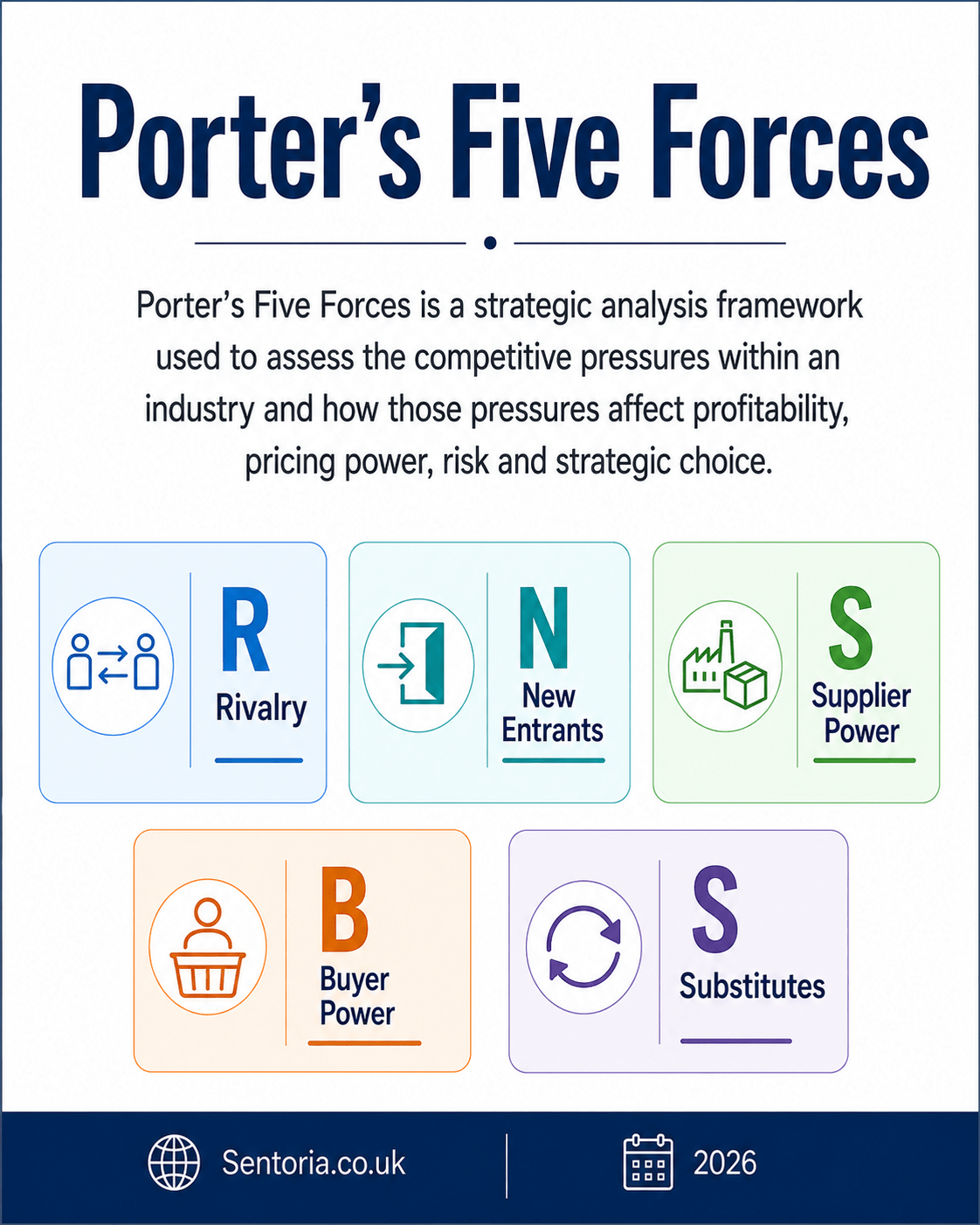
Porter’s Five Forces is one of the most important strategy tools in modern business thinking. It helps organisations understand the competitive pressures within an industry and how those pressures affect profitability, pricing power, risk and strategic choice.
At its simplest, Porter’s Five Forces asks a business to look beyond its immediate competitors and examine five wider forces that shape the market:
- Rivalry among existing competitors
- Threat of new entrants
- Bargaining power of suppliers
- Bargaining power of buyers
- Threat of substitute products or services
The framework was developed by Professor Michael E. Porter of Harvard Business School and first published in the Harvard Business Review in 1979 under the title How Competitive Forces Shape Strategy. Harvard Business School describes Five Forces as a framework for understanding the competitive forces at work in an industry and how economic value is divided among the different industry participants.
Used properly, Porter’s Five Forces is not just a competitor analysis tool. It is a way of understanding whether an industry is structurally attractive, where profit is likely to be captured, and what strategic position an organisation should take.
What is Porter’s Five Forces?
Porter’s Five Forces is a strategic analysis framework used to assess the competitive structure of an industry. It is based on the idea that competition is not only about direct rivals. A business may also be affected by powerful customers, powerful suppliers, new entrants, substitute products and wider industry rivalry.
This is one of the most useful aspects of the model. Many businesses define competition too narrowly. They focus on the company down the road, the nearest alternative provider or the obvious market rival. Porter’s model encourages a broader and more disciplined view. Competition can come from different directions, and those pressures can determine whether an industry is profitable, difficult, fragile or attractive. Porter’s original 1979 article argued that strategy formulation requires organisations to cope with competition in this broader sense, not just with direct competitors.
The model is particularly useful when assessing:
- Whether to enter a market
- Whether to invest in a product or service
- Why margins are high or low
- Why some industries are more profitable than others
- Where a business has bargaining power
- Where a business is vulnerable
- How an organisation should position itself
- Whether an industry is becoming more or less attractive
The five forces explained
1. Rivalry among existing competitors
This force looks at the intensity of competition between existing firms in the industry.
Rivalry is usually stronger when there are many competitors, low growth, limited differentiation, high fixed costs, price sensitivity or low switching costs. When rivalry is intense, businesses may be forced to reduce prices, spend heavily on marketing, increase service levels or accept lower margins.
Examples of strong rivalry include supermarkets, airlines, restaurants, estate agency, recruitment, consumer electronics and many areas of online retail.
Questions to ask:
- How many competitors are there?
- Are they similar in size and capability?
- Is the market growing, flat or shrinking?
- Do customers see meaningful differences between providers?
- Is competition based mainly on price?
- Are fixed costs high?
- Is it easy for customers to switch?
- Are competitors aggressive, disciplined or desperate?
High rivalry does not automatically mean an industry is unattractive, but it usually means a business needs a clear advantage. That advantage may be cost, brand, service, location, technology, customer loyalty, quality, expertise or focus.
2. Threat of new entrants
This force considers how easy it is for new competitors to enter the market.
If entry is easy, existing firms may face pressure from new businesses that bring extra capacity, fresh ideas, lower prices or different business models. If entry is difficult, existing firms may enjoy more protection and stronger profitability.
Barriers to entry may include:
- High start-up costs
- Regulation or licensing
- Brand loyalty
- Economies of scale
- Access to distribution
- Specialist knowledge
- Patents or intellectual property
- Planning restrictions
- Customer relationships
- Capital requirements
- Data advantages
- Network effects
For example, it is usually easier to start a small consultancy than to start an airline, build a national supermarket chain or enter a heavily regulated utility market.
The key question is not simply whether someone can enter the market. The better question is whether they can enter at scale, compete effectively and make acceptable returns.
3. Bargaining power of suppliers
This force considers how much power suppliers have over the businesses in the industry.
Suppliers are powerful when there are few alternatives, when their product or service is essential, when switching supplier is difficult, or when the supplier can increase prices without losing customers. Supplier power can reduce margins, create operational risk and limit strategic flexibility.
Supplier power may be high where:
- There are few suppliers
- Inputs are specialist or scarce
- Switching costs are high
- Suppliers have strong brands
- Suppliers control important technology
- Suppliers can sell directly to customers
- The buyer is not important to the supplier
- Supply is constrained by regulation, capacity or geography
Examples include specialist software providers, energy suppliers, key raw material suppliers, skilled subcontractors, professional platforms, payment processors and landlords in prime locations.
A business with weak supplier power may find that cost increases cannot be passed on to customers. That can place significant pressure on profitability and cash flow.
4. Bargaining power of buyers
This force considers how much power customers have.
Buyer power is high when customers can demand lower prices, better terms, higher service levels or more flexibility. This is especially likely where buyers are large, well-informed, price-sensitive or able to switch easily.
Buyer power may be high where:
- Customers have many alternatives
- Products are similar or commoditised
- Switching costs are low
- Customers buy in large volumes
- Customers are highly price-sensitive
- Customers can negotiate aggressively
- Customers can integrate backwards and provide the product or service themselves
- Customers have good market information
For example, a small supplier selling to a national retailer may have little bargaining power. A professional firm with a loyal client base and specialist expertise may have more pricing strength.
Understanding buyer power is essential because revenue is not the same as strategic strength. A business can have high turnover but still be vulnerable if a small number of customers control the relationship.
5. Threat of substitute products or services
Substitutes are not necessarily direct competitors. They are alternative ways for customers to meet the same need.
For example:
- Video conferencing can substitute for business travel
- Streaming can substitute for cinema or physical media
- Cloud software can substitute for manual bookkeeping
- Meal delivery can substitute for eating out
- Online learning can substitute for classroom training
- Used goods marketplaces can substitute for new retail purchases
- AI tools can substitute for some entry-level knowledge work
Substitution is dangerous because it can change demand without looking like traditional competition. A taxi firm may think it competes with other taxi firms, but it may also face substitution from ride-hailing apps, public transport, cycling, walking, remote meetings or car-sharing.
Questions to ask:
- What problem is the customer really trying to solve?
- Are there cheaper alternatives?
- Are there more convenient alternatives?
- Is technology changing the way customers behave?
- Could customers stop needing the product or service altogether?
- Are substitutes improving in quality?
- Are substitutes easier to access?
The threat of substitutes is often underestimated because businesses define their market too narrowly.
History and development of Porter’s Five Forces
Porter’s Five Forces was introduced by Michael E. Porter in his 1979 Harvard Business Review article How Competitive Forces Shape Strategy. The framework became one of the foundational tools of modern strategic management because it shifted attention from simple competitor comparison to the deeper economic structure of industries.
The model was strongly influenced by industrial organisation economics, which studies how industry structure affects firm behaviour and performance. Porter translated these economic ideas into a practical framework that managers could use to assess industry attractiveness and competitive position.
In 2008, Porter revisited the framework in The Five Competitive Forces That Shape Strategy, again in the Harvard Business Review. That updated article reinforced the idea that the five forces influence the profit structure of an industry by shaping how value is shared among competitors, customers, suppliers, entrants and substitutes.
Over time, the model has become widely used by businesses, consultants, universities and advisers. It is often taught alongside SWOT analysis, PESTLE analysis, value chain analysis and competitive advantage. It has also attracted criticism and adaptation, particularly in relation to fast-moving digital markets, platform businesses, complementors, innovation and strategic alliances.
One notable development is the idea of a “sixth force”, often associated with complementors. Complementors are products, services or organisations that increase the value of another product or service. For example, apps can increase the value of a smartphone, charging infrastructure can increase the value of electric vehicles, and software ecosystems can increase the value of hardware platforms. Recent work by Adam Brandenburger and Barry Nalebuff argues that complements remain an important issue in strategy, although Porter has treated complements as factors that work through the existing five forces rather than as a separate force.
Why Porter’s Five Forces matters
Porter’s Five Forces matters because profitability is not determined only by how well a business is managed internally. It is also shaped by the structure of the industry in which the business operates.
A well-run business in a structurally difficult industry may struggle to make strong returns. A moderately efficient business in a structurally attractive industry may make healthy profits. This does not mean management quality is unimportant. It means that industry structure matters.
The model helps decision-makers understand:
- Where profit is being captured
- Who has power in the value chain
- Why margins are under pressure
- Whether a market is worth entering
- Whether a business should differentiate, focus or compete on cost
- Which risks are structural rather than temporary
- Whether growth will create value or simply increase exposure
- How an organisation can defend or improve its position
This makes Five Forces especially useful before making major strategic decisions.
When to use Porter’s Five Forces
Porter’s Five Forces is useful when the main question is about market attractiveness, competition or industry profitability.
Good uses include:
- Entering a new market
- Launching a new product or service
- Reviewing business strategy
- Assessing industry profitability
- Evaluating acquisition opportunities
- Understanding margin pressure
- Reviewing pricing power
- Comparing different sectors
- Preparing an investor or board paper
- Testing whether a growth strategy is realistic
- Understanding customer or supplier power
- Reviewing competitive threats
- Assessing whether a market has become less attractive
- Identifying where a business can build defensible advantage
It is less useful when the main issue is internal performance, culture, operational efficiency, leadership, governance or cash management. For those questions, other tools may be more appropriate.
Porter’s Five Forces in different industries
SMEs and owner-managed businesses
For SMEs, Five Forces is useful because smaller businesses often underestimate external competitive pressure. They may focus on sales and cash flow without fully understanding why customers have pricing power, why suppliers can increase costs, or why new entrants are appearing.
A local SME might use Five Forces to assess whether it has genuine differentiation. For example, a small accountancy firm may face rivalry from other local firms, buyer power from price-sensitive clients, supplier power from software providers, new entrants using cloud-based systems, and substitutes from bookkeeping apps or AI-assisted tools.
The practical value for SMEs is clarity. The model helps owners identify whether they are competing on price, service, specialism, location, trust, convenience or relationship.
Manufacturing
Manufacturing businesses are heavily affected by supplier power, buyer power, capital requirements and substitution.
A manufacturer may face powerful suppliers of raw materials, energy or specialist components. It may sell to large customers that demand tight pricing and long payment terms. It may face new entrants from overseas or substitute materials and technologies.
Five Forces can help manufacturers assess whether they should invest in automation, move up the value chain, develop proprietary products, secure supply contracts, diversify customers or exit low-margin work.
In manufacturing, the analysis should be supported by cost data, capacity utilisation, supplier risk, customer concentration and margin analysis.
Retail and ecommerce
Retail is often a high-rivalry environment. Customers can compare prices quickly, switching costs are low, online competition is intense, and substitutes are widespread.
A retailer using Five Forces should examine price transparency, supplier terms, marketplace platforms, customer loyalty, delivery expectations, product differentiation and returns behaviour.
For ecommerce, the force of new entrants can be particularly important. Online stores can be launched quickly, but building brand trust, traffic, fulfilment capability and margin resilience is much harder.
A Five Forces analysis can help retailers decide whether to compete on price, range, convenience, local identity, customer experience, exclusivity or specialist knowledge.
Professional services
Professional services firms often appear protected by expertise, regulation and relationships, but they still face competitive forces.
Rivalry may come from other firms, freelancers, online platforms or larger providers. Buyer power may increase where clients see services as interchangeable. Supplier power may come from professional indemnity insurers, software providers, recruitment markets and specialist staff. Substitutes may include automation, AI tools, templates and in-house teams.
For accountants, solicitors, consultants, architects and advisers, Five Forces can help answer important questions:
- Are we genuinely differentiated?
- Are clients buying expertise or a commodity?
- Are we too dependent on a small number of clients?
- Can technology replace or enhance part of our service?
- Are recruitment and software suppliers reducing our margin?
- Should we specialise by sector or service line?
Charities and voluntary organisations
Porter’s Five Forces was developed for competitive business environments, but it can still be useful for charities if adapted carefully.
Charities may not be seeking profit, but they still operate in markets for funding, staff, volunteers, partnerships, contracts and public attention. Rivalry may exist for grants, donations, commissioning opportunities or volunteers. Buyer power may come from funders or commissioners. Supplier power may come from landlords, specialist staff, software providers or delivery partners. New entrants may include new charities, social enterprises or private providers. Substitutes may include public sector services, informal community support or digital alternatives.
For charities, the model should not be used crudely. The question is not “how do we beat competitors?” The better question is “what external forces affect our ability to deliver our mission sustainably?”
Public sector and local government
In the public sector, Five Forces can be useful when analysing commissioned services, supplier markets, outsourcing, local economic sectors or service delivery models.
For example, a council considering a procurement exercise may need to understand supplier power, the number of credible providers, barriers to entry, substitute delivery models and buyer power. A local authority assessing town centre strategy may need to understand retail rivalry, online substitution, landlord behaviour, consumer habits and new market entrants.
The public sector should use the model alongside statutory duties, public value, equality considerations and stakeholder analysis. Profitability is not always the aim, but sustainability, value for money and market resilience often are.
Property and construction
Property and construction are strongly shaped by industry structure.
Developers face supplier power from contractors, consultants, utilities and finance providers. Buyer power may come from tenants, purchasers, investors or anchor occupiers. New entrants may be restricted by land access, capital requirements, planning expertise and local relationships. Substitutes may include different locations, remote working, refurbishment rather than new build, or alternative uses for land.
Five Forces can help assess the attractiveness of a development, investment property sector, contractor market or occupational market.
For property decisions, it should sit alongside planning analysis, valuation, legal review, funding appraisal and sensitivity testing.
Technology and software
Technology markets are often where the limitations of Five Forces become most visible, but the model is still useful.
Supplier power may come from cloud infrastructure providers, app stores, data providers or specialist developers. Buyer power may depend on switching costs, integration, contract length and data lock-in. New entrants may appear quickly, but scaling is often difficult. Substitutes may come from AI tools, open-source software, platform changes or new user behaviour.
In software, network effects and complementors can be particularly important. A product may become more valuable because of integrations, developer ecosystems, data, user communities or complementary services.
For technology firms, Five Forces should be refreshed regularly and combined with ecosystem analysis, product strategy, cyber risk and innovation review.
Healthcare and social care
Healthcare and social care markets are shaped by regulation, commissioners, workforce shortages, public funding and demographic demand.
Buyer power may sit with public commissioners, private patients, insurers or families. Supplier power may come from clinical staff, agencies, landlords, technology systems and specialist equipment providers. Rivalry may come from public, private and charitable providers. New entrants may be limited by regulation, inspection, workforce availability and capital requirements. Substitutes may include digital health, home-based care, preventative services or informal family support.
In this sector, Five Forces must be used with care. It should not reduce care quality to market mechanics. It is best used to understand sustainability, workforce pressure, commissioning risk and service viability.
Education and training
Education and training providers face competition for students, funding, staff, partnerships and employer relationships.
Rivalry may come from schools, colleges, universities, online platforms, private training providers or employers themselves. Buyer power may sit with students, parents, employers, government funders or commissioning bodies. Supplier power may come from teachers, trainers, awarding bodies, technology platforms and premises. New entrants may use online delivery to reduce barriers. Substitutes may include apprenticeships, self-directed learning, employer training or AI-supported learning.
Five Forces can help education providers assess course viability, pricing, differentiation, delivery models and partnership strategy.
How to carry out a Porter’s Five Forces analysis properly
1. Define the industry clearly
This is the most important step.
Porter’s Five Forces should be applied at the industry or market level, not vaguely at the level of a whole economy or broad sector. A diversified company may need several Five Forces analyses, one for each distinct market.
For example, “retail” is too broad. “Independent premium menswear retail in West Yorkshire” is more useful. “Software” is too broad. “Cloud-based accounting software for UK microbusinesses” is more useful.
A clear industry definition should include:
- Product or service
- Customer group
- Geography
- Price point
- Distribution channel
- Relevant competitors
- Timescale
2. Identify the competitors and market boundaries
List the main direct competitors, but do not stop there. Consider adjacent competitors, emerging competitors, online alternatives, overseas competitors and non-traditional providers.
Ask:
- Who do customers compare us with?
- Who else solves the same customer problem?
- Who could enter this market?
- What would customers do if we did not exist?
- Are market boundaries changing?
This helps avoid the common mistake of defining competition too narrowly.
3. Assess each force separately
Work through each force in turn:
- Rivalry among existing competitors
- Threat of new entrants
- Supplier power
- Buyer power
- Threat of substitutes
For each force, identify whether it is low, medium or high. Then explain why.
Avoid simply ticking boxes. The reasoning matters more than the rating.
4. Gather evidence
A Five Forces analysis should be supported by evidence where possible.
Useful evidence includes:
- Market size and growth
- Competitor numbers
- Pricing trends
- Margin data
- Customer concentration
- Supplier concentration
- Switching costs
- Regulatory barriers
- Capital requirements
- Technology trends
- Contract terms
- Customer behaviour
- Substitute products
- New entrants and closures
Without evidence, the analysis can become opinion dressed up as strategy.
5. Identify the profit pressure points
The model should explain where profit is being lost or captured.
For example:
- Buyers may be forcing prices down
- Suppliers may be increasing input costs
- New entrants may be adding capacity
- Substitutes may be capping prices
- Rivalry may be increasing marketing spend
- Technology may be reducing barriers to entry
This is where the analysis becomes practical.
6. Consider how the forces are changing
A Five Forces analysis should not be static. Ask whether each force is becoming stronger or weaker.
For example:
- Are new technologies lowering entry barriers?
- Are customers becoming more price-sensitive?
- Are suppliers consolidating?
- Are substitutes becoming more credible?
- Is rivalry increasing because market growth has slowed?
- Are regulations raising or lowering barriers?
The trend may be more important than the current position.
7. Decide the strategic response
Once the forces are understood, the organisation should consider its options.
Possible responses include:
- Differentiate the offer
- Reduce cost to compete more effectively
- Focus on a niche
- Build customer loyalty
- Increase switching costs
- Secure supplier agreements
- Reduce customer concentration
- Move into a more attractive segment
- Build barriers to entry
- Partner with complementors
- Improve technology
- Exit an unattractive market
- Acquire competitors
- Reposition the business
The final output should be a decision, not just a diagram.
Common mistakes in Porter’s Five Forces analysis
Mistake 1: Treating it as a competitor list
Five Forces is not just about listing competitors. Direct rivalry is only one of the five forces. A business can be damaged by suppliers, customers, substitutes or new entrants even if direct rivalry appears manageable.
Mistake 2: Applying it to the company rather than the industry
The model is designed to assess industry structure. It can inform company strategy, but the starting point should be the market or industry, not the individual business.
For example, “Smith & Co Accountants” is not the industry. “Small business accountancy services in Huddersfield and surrounding areas” is closer to a useful market definition.
Mistake 3: Defining the industry too broadly
Broad labels such as “retail”, “technology”, “property” or “consulting” are usually too vague.
A useful analysis needs a defined market. The more precise the market definition, the more useful the conclusions.
Mistake 4: Ignoring substitutes
Substitutes are often the most dangerous force because they sit outside the obvious competitor set.
A cinema does not only compete with other cinemas. It also competes with streaming, gaming, restaurants, live events, social media and staying at home.
Mistake 5: Confusing symptoms with causes
Low margins may be the symptom. The cause may be buyer power, intense rivalry, low differentiation or supplier pressure.
Five Forces is useful because it helps identify the underlying cause.
Mistake 6: Failing to consider change over time
An industry may look attractive today but deteriorate quickly. New technology, regulation, consumer behaviour or supplier consolidation can change the forces.
A good analysis considers both the current position and the direction of travel.
Mistake 7: Using it without financial analysis
Five Forces should connect to profit, cash flow, pricing, margin and investment.
If the analysis does not help explain financial performance or strategic options, it is probably too theoretical.
Limitations and weaknesses of Porter’s Five Forces
Porter’s Five Forces is powerful, but it has limitations.
It can be too static
The model can encourage a snapshot view of an industry. That can be a problem in fast-moving markets where technology, regulation, platforms or customer behaviour change quickly.
This is why the model should be reviewed regularly and used alongside scenario planning and trend analysis.
It focuses on industry structure, not internal capability
Five Forces tells you about the market, but not whether your organisation has the resources, skills, culture, systems or leadership to compete effectively.
An industry may be attractive, but a specific organisation may still be poorly positioned. Equally, an industry may be difficult, but a strong business with a clear niche may still perform well.
It can underplay collaboration and ecosystems
Modern competition is not always a simple battle between rivals. Businesses may compete and collaborate at the same time. Platforms, partnerships, supply chains, ecosystems and complementors can be strategically important.
The debate around complementors and the “sixth force” reflects this issue. Brandenburger and Nalebuff have argued that complements play an essential role in strategy, particularly where one product or service increases the value of another.
It can be difficult to define the industry
Many modern businesses operate across multiple markets. A software company may also be a data business, a marketplace, a consultancy and a platform. A retailer may operate through stores, ecommerce, marketplaces and subscriptions.
If the industry is poorly defined, the analysis may be misleading.
It may not fully capture digital disruption
Digital markets can change quickly. Entry barriers may fall, platforms may dominate, data may create advantage, and customer behaviour may shift rapidly.
Five Forces still helps, but it should be combined with analysis of technology, network effects, data, ecosystems and user behaviour.
It does not produce the strategy by itself
Five Forces helps explain competitive pressure. It does not choose the right response.
Strategy still requires judgement, financial modelling, operational planning, leadership and implementation.
Porter’s Five Forces compared with SWOT and PESTLE
Porter’s Five Forces, SWOT and PESTLE are related, but they answer different questions.
PESTLE looks at the wider external environment: political, economic, social, technological, legal and environmental factors.
Porter’s Five Forces looks at the competitive structure of an industry.
SWOT combines internal and external thinking by considering strengths, weaknesses, opportunities and threats.
A practical sequence is:
- Use PESTLE to understand the wider external environment.
- Use Five Forces to understand the competitive structure of the market.
- Use SWOT to combine external opportunities and threats with internal strengths and weaknesses.
- Use options appraisal to decide what to do.
- Use an action plan, budget or Balanced Scorecard to implement and monitor progress.
This sequence prevents strategy from becoming too narrow. PESTLE looks outward at the wider world. Five Forces looks at industry economics. SWOT connects those external realities to internal capability.
Alternatives and complementary frameworks
SWOT analysis
SWOT is useful for combining internal and external factors. It helps identify strengths, weaknesses, opportunities and threats.
Use SWOT after Five Forces when you want to understand how your organisation’s internal capabilities match the competitive pressures in the market.
PESTLE analysis
PESTLE is useful for analysing the wider external environment. It considers political, economic, social, technological, legal and environmental factors.
Use PESTLE before or alongside Five Forces when wider external change may affect the industry.
Value chain analysis
Value chain analysis examines the activities through which an organisation creates value. Porter later developed value chain analysis in his 1985 work on competitive advantage.
Use value chain analysis when you want to understand where costs arise, where differentiation is created and where operational advantage may be built.
Resource-Based View
The Resource-Based View focuses on the internal resources and capabilities that allow a firm to achieve advantage. This includes assets, skills, knowledge, culture, systems, data, relationships and intellectual property.
Use it alongside Five Forces because a market may be attractive only if the organisation has the capability to compete.
Blue Ocean Strategy
Blue Ocean Strategy focuses on creating uncontested market space rather than competing directly in crowded markets.
Use it when Five Forces suggests that rivalry is intense and margins are structurally weak.
Scenario planning
Scenario planning explores different possible futures.
Use it when the industry is highly uncertain, such as in technology, regulation, climate, public funding, interest rates or consumer behaviour.
Competitor analysis
Competitor analysis looks more closely at individual competitors, including their pricing, positioning, strengths, weaknesses, strategy and likely response.
Use it after Five Forces when rivalry is important and specific competitor behaviour matters.
Business Model Canvas
The Business Model Canvas helps describe how an organisation creates, delivers and captures value.
Use it when Five Forces suggests that the current business model may need to change.
A practical Porter’s Five Forces template
A useful Five Forces analysis should do more than label each force as high, medium or low.
For each force, record:
- Force
- Key evidence
- Current strength of the force
- Direction of travel
- Impact on profitability
- Impact on pricing power
- Impact on risk
- Strategic implications
- Possible actions
- Owner
- Review date
Example:
Force: Bargaining power of buyers
Evidence: Three customers account for 60% of revenue. They regularly tender work and compare suppliers on price.
Current strength: High
Direction of travel: Increasing
Impact: Margin pressure and customer concentration risk
Strategic implication: The business is too dependent on a small number of powerful buyers
Action: Develop new customer segments, strengthen differentiation and review contract terms
Owner: Sales Director
Review date: Quarterly
Questions to ask in each section
Rivalry among existing competitors
- Who are the main competitors?
- Is the market growing or shrinking?
- Are competitors similar or clearly differentiated?
- Is price competition intense?
- Are fixed costs high?
- Do competitors have spare capacity?
- Are customers loyal?
- Are exit barriers high?
- Are competitors investing heavily in marketing or technology?
- Is rivalry becoming stronger or weaker?
Threat of new entrants
- How easy is it to enter the market?
- What capital is required?
- Are there regulatory barriers?
- Are there planning, licensing or compliance requirements?
- Do existing firms have strong brands?
- Are economies of scale important?
- Can new entrants access customers easily?
- Does technology lower entry barriers?
- Are customers willing to try new providers?
- Are new entrants already appearing?
Bargaining power of suppliers
- How many credible suppliers are available?
- Are inputs specialist or commoditised?
- How easy is it to switch supplier?
- Are suppliers increasing prices?
- Are suppliers consolidating?
- Do suppliers control important technology or data?
- Is the business important to its suppliers?
- Are alternative inputs available?
- Could suppliers sell directly to customers?
- How exposed is the business to supplier disruption?
Bargaining power of buyers
- How many customers are there?
- Are customers concentrated?
- Do customers buy in large volumes?
- Can customers switch easily?
- Are customers price-sensitive?
- Do customers see the product or service as differentiated?
- Do customers have strong information about alternatives?
- Can customers negotiate terms?
- Could customers provide the product or service themselves?
- Is buyer power increasing or decreasing?
Threat of substitutes
- What alternatives solve the same customer problem?
- Are substitutes cheaper?
- Are substitutes more convenient?
- Are substitutes improving?
- Is technology creating new alternatives?
- Could customers stop needing the product or service?
- Are substitutes easier to access?
- Do substitutes cap pricing?
- Are younger customers behaving differently?
- Could a substitute become mainstream?
The best way to think about Porter’s Five Forces
Porter’s Five Forces is not a diagram to complete for the sake of it. It is a disciplined way of understanding competition and profitability.
A good Five Forces analysis should be:
- Clearly scoped
- Evidence-based
- Focused on industry structure
- Honest about pricing power and margins
- Specific about customers and suppliers
- Alert to substitutes and new entrants
- Linked to strategic choices
- Reviewed as the market changes
The key question is not simply, “Who are our competitors?”
The better question is:
What forces shape profitability in this industry, and how should we position ourselves in response?
Conclusion: Porter’s Five Forces turns competition into strategic insight
Porter’s Five Forces remains useful because it challenges a narrow view of competition.
A business is not only affected by the firm next door or the most obvious rival. It is also affected by customers, suppliers, new entrants, substitutes and the overall intensity of industry rivalry. These forces shape pricing power, margins, investment requirements, risk and long-term attractiveness.
Used badly, Five Forces becomes a theoretical checklist. Used properly, it helps leaders understand where profit is being captured, where power sits, and how the business should respond.
The real value comes from turning the analysis into action. That may mean differentiating, focusing on a niche, improving cost position, strengthening customer loyalty, reducing supplier dependency, building barriers to entry, responding to substitutes or leaving an unattractive market.
Porter’s Five Forces does not replace judgement. It improves judgement by making the economics of competition clearer.
In a changing market, that clarity can be the difference between chasing growth that destroys value and choosing a position that gives the organisation a better chance of long-term success.