Resource-Based View:
A Practical Guide to Understanding Internal Advantage, Capabilities and Strategic Strength
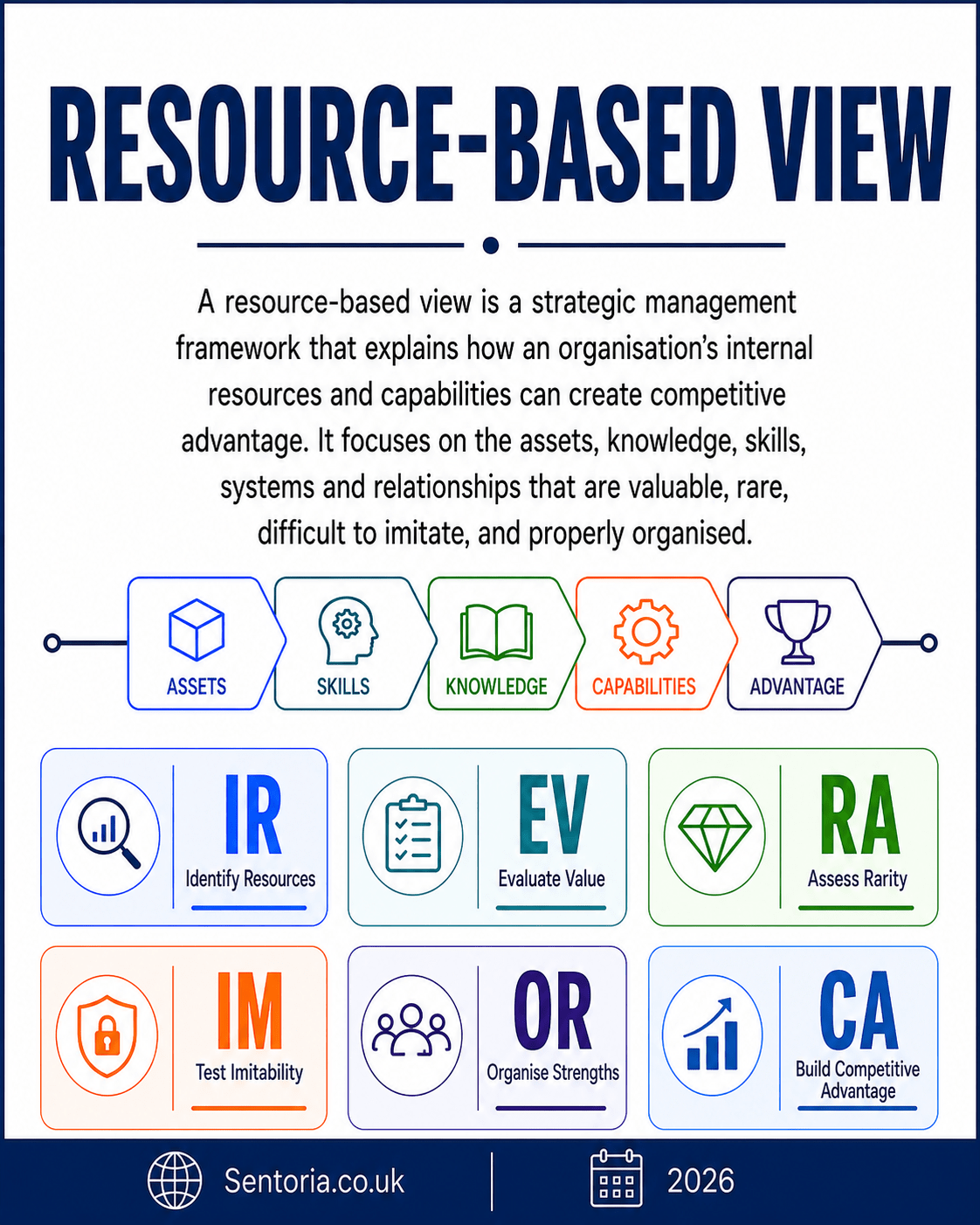
The Resource-Based View, often shortened to RBV, is a strategic management framework used to understand how an organisation’s internal resources and capabilities can create competitive advantage.
At its simplest, the Resource-Based View asks:
What do we have, what can we do, and which of those resources or capabilities are difficult for others to copy?
That makes it different from tools such as PESTLE and Porter’s Five Forces. Those frameworks look mainly outside the organisation. PESTLE examines the wider external environment. Porter’s Five Forces examines industry structure and competitive pressure. The Resource-Based View looks inward and asks whether the organisation has the resources and capabilities needed to compete, grow, adapt and perform.
In simple terms:
External analysis asks: what is happening around us?
Resource-Based View asks: what do we possess or do especially well that could give us an advantage?
Used properly, RBV helps organisations understand the real foundations of advantage: people, knowledge, systems, relationships, culture, data, reputation, intellectual property, assets, processes, technology and organisational know-how.
What is the Resource-Based View?
The Resource-Based View is a way of analysing an organisation from the inside out.
It suggests that sustainable advantage is more likely to come from resources and capabilities that are:
- Valuable
- Rare
- Difficult to imitate
- Properly organised and used
This idea is closely linked to the VRIO framework, which is often used as a practical way of applying RBV. VRIO stands for Value, Rarity, Imitability and Organisation. It helps managers test whether a resource or capability is likely to create disadvantage, parity, temporary advantage or sustained competitive advantage.
The Resource-Based View became especially influential through Birger Wernerfelt’s 1984 article A Resource-Based View of the Firm, which explored the usefulness of analysing firms from the resource side rather than only from the product side.
Jay Barney’s 1991 article Firm Resources and Sustained Competitive Advantage then became one of the key works in developing the framework. Barney examined the conditions under which firm resources can be sources of sustained competitive advantage.
What counts as a resource?
A resource is something the organisation owns, controls or can access that may help it achieve its objectives.
Resources may be tangible or intangible.
Tangible resources
Tangible resources are physical or financial assets.
Examples include:
- Cash
- Property
- Equipment
- Machinery
- Stock
- Vehicles
- Buildings
- IT hardware
- Land
- Production facilities
- Distribution infrastructure
- Financial reserves
Tangible resources are important, but they are not always enough to create lasting advantage. Competitors may be able to buy similar equipment, rent similar premises or access similar finance.
Intangible resources
Intangible resources are non-physical assets.
Examples include:
- Brand reputation
- Customer loyalty
- Intellectual property
- Data
- Relationships
- Culture
- Technical knowledge
- Specialist expertise
- Organisational routines
- Supplier relationships
- Trust
- Licences
- Processes
- Know-how
- Goodwill
- Local knowledge
Intangible resources are often more important strategically because they can be harder to copy. A competitor may buy the same software, but it cannot easily copy trust, culture, reputation, experience or long-standing relationships.
Human resources
People are a major part of the Resource-Based View.
This includes:
- Skills
- Experience
- Leadership
- Judgement
- Creativity
- Technical expertise
- Professional qualifications
- Customer relationships
- Team culture
- Problem-solving ability
However, people alone are not always a sustainable advantage if knowledge sits only in individuals. A strong organisation turns individual knowledge into organisational capability through systems, training, processes, documentation, culture and shared routines.
What is a capability?
A capability is what an organisation can do with its resources.
This distinction is important.
A resource is something the organisation has.
A capability is something the organisation can do.
For example:
- A CRM system is a resource.
- Using customer data to improve retention is a capability.
- Skilled staff are a resource.
- Delivering consistently high-quality advice is a capability.
- A strong brand is a resource.
- Converting trust into profitable, long-term customer relationships is a capability.
- Data is a resource.
- Turning data into insight and decisions is a capability.
The Resource-Based View is strongest when it focuses not only on resources, but on the capabilities that allow those resources to create value.
History and development of the Resource-Based View
The roots of RBV are often traced back to Edith Penrose, whose 1959 book The Theory of the Growth of the Firm had a major influence on later thinking about firm resources, growth and capabilities. Later academic work has described Penrose’s book as a major foundation for resource-based thinking in strategic management.
Penrose helped shift attention towards the firm as a collection of productive resources and managerial capabilities. That thinking was important because it suggested that the growth and performance of firms could not be explained only by external markets. Internal resources, knowledge and managerial ability mattered too.
The term Resource-Based View of the Firm was then popularised by Birger Wernerfelt in his 1984 article of the same name. Wernerfelt argued that firms could be analysed by looking at their resource position, not only their product position.
Jay Barney’s 1991 article developed the approach further by setting out how resources could be connected to sustained competitive advantage. Barney’s work became central to RBV because it explained that not all resources are strategically equal. Resources need particular qualities if they are to support long-term advantage.
The framework later developed into practical tools such as VRIN and VRIO. VRIN originally focused on whether resources were valuable, rare, imperfectly imitable and non-substitutable. VRIO later became a widely used practical version, asking whether resources are valuable, rare, costly to imitate, and whether the organisation is organised to exploit them.
Over time, RBV also influenced related fields such as dynamic capabilities, knowledge-based strategy, human capital strategy, innovation management and business model design.
The VRIO framework
VRIO is one of the most practical ways to apply the Resource-Based View.
It asks four questions.
1. Value
The first question is:
Is the resource or capability valuable?
A valuable resource helps the organisation exploit an opportunity, reduce a threat, improve efficiency, strengthen customer value, increase revenue, reduce cost or reduce risk.
Examples of valuable resources include:
- Strong customer relationships
- Proprietary technology
- Skilled staff
- Trusted brand
- Efficient systems
- Reliable data
- Specialist knowledge
- Prime location
- Strong cash position
- Effective supplier relationships
A resource that is not valuable cannot create advantage, even if it is unusual.
For example, an old system may be rare, but if it slows the organisation down, it is not a strategic strength.
2. Rarity
The second question is:
Is the resource or capability rare?
A resource is rare if few competitors have it or can access it.
For example:
- A unique licence
- A specialist team
- A trusted local reputation
- A proprietary dataset
- Long-standing customer relationships
- A distinctive culture
- A scarce technical skill
- A protected location
- A strong community network
- Deep sector expertise
If many competitors have the same resource, it may still be useful, but it is unlikely to create competitive advantage. It may only create competitive parity.
For example, basic accounting software may be necessary, but it is not rare. The advantage comes from how the firm uses it.
3. Imitability
The third question is:
Is the resource or capability difficult or costly to imitate?
A resource is more powerful strategically if competitors cannot easily copy it.
Resources may be difficult to imitate because of:
- Unique history
- Long experience
- Trust built over time
- Complex culture
- Tacit knowledge
- Legal protection
- Patents
- Brand reputation
- Relationships
- Network effects
- Data accumulated over time
- Causal ambiguity, where competitors cannot easily see why the organisation performs well
This is one of the most important parts of RBV. Some resources can be bought quickly. Others take years to build.
A competitor can copy a website design. It cannot instantly copy 20 years of client trust.
4. Organisation
The fourth question is:
Is the organisation properly organised to use the resource or capability?
This is often the overlooked part.
A business may have strong resources, but still fail to benefit from them because it lacks the systems, leadership, processes, incentives, governance or culture needed to use them properly.
For example:
- A firm may have excellent staff but poor workflow.
- A charity may have strong community trust but weak impact reporting.
- A manufacturer may have good machinery but poor production planning.
- A software company may have good data but no analytics capability.
- A public body may have valuable local insight but weak internal coordination.
The organisation element matters because resources do not create advantage automatically. They must be deployed well.
Why the Resource-Based View matters
The Resource-Based View matters because many organisations misunderstand their strengths.
They may say:
- “Our people are our strength.”
- “We provide great service.”
- “We have a good reputation.”
- “We know our market.”
- “We have strong relationships.”
- “We are flexible.”
- “We are innovative.”
These statements may be true, but they are not enough.
RBV asks a sharper question:
Are those strengths valuable, rare, difficult to imitate and properly organised?
This makes the analysis more disciplined.
It helps organisations identify:
- Which resources genuinely matter
- Which strengths are overstated
- Which capabilities need investment
- Which resources are underused
- Which advantages are vulnerable
- Which activities should be protected
- Which weaknesses limit strategic potential
- Which capabilities could support growth
RBV is useful because it connects strategy to internal reality. It prevents organisations from chasing opportunities they are not equipped to exploit.
When to use the Resource-Based View
The Resource-Based View is useful when an organisation needs to understand its internal sources of advantage.
Good uses include:
- Strategic planning
- Competitive positioning
- Business model review
- Capability assessment
- Growth planning
- Merger or acquisition review
- Succession planning
- Digital transformation
- Service development
- Restructuring
- Investment appraisal
- Recruitment and skills planning
- Brand development
- Innovation strategy
- Organisational development
It is particularly useful when combined with external analysis.
For example:
- Use PESTLE to understand external change.
- Use Porter’s Five Forces to understand industry pressure.
- Use Resource-Based View to understand internal advantage.
- Use SWOT to summarise the internal and external position.
- Use TOWS to turn analysis into strategic options.
- Use the Balanced Scorecard to track delivery.
Resource-Based View in different industries
SMEs and owner-managed businesses
For SMEs, RBV can be extremely useful because small businesses often compete against larger firms with more money, staff and systems.
An SME may not win through scale, but it may win through:
- Specialist knowledge
- Local reputation
- Personal service
- Speed of decision-making
- Customer relationships
- Flexibility
- Niche expertise
- Trust
- Founder experience
- Community presence
The key is to identify which of these are genuine strategic resources.
For example, “local reputation” may be valuable and difficult to imitate if it has been built over many years. However, if it depends entirely on the owner and is not supported by systems, marketing, staff capability and customer experience, it may be fragile.
For SMEs, RBV should lead to practical questions:
- What do we do that larger competitors cannot easily copy?
- Which relationships are strategically important?
- Are we too dependent on the owner?
- Which capabilities need documenting?
- Which resources should we invest in?
- Which strengths can support growth?
Manufacturing
In manufacturing, RBV can help identify whether advantage comes from equipment, technical skill, quality systems, production know-how, supplier relationships or process capability.
Resources and capabilities may include:
- Specialist machinery
- Skilled labour
- Quality certifications
- Production know-how
- Process efficiency
- Engineering expertise
- Supplier relationships
- Patents
- Technical design capability
- Reliable delivery performance
A manufacturer may have machinery that competitors can buy, but the real advantage may lie in how staff use it, how production is scheduled, how quality is controlled, and how problems are solved.
For manufacturing, RBV should be linked to value chain analysis, cost data, quality performance, capacity planning and customer requirements.
Retail and ecommerce
In retail and ecommerce, tangible resources such as stock and premises matter, but intangible resources often drive advantage.
These may include:
- Brand
- Customer data
- Product curation
- Supplier access
- Online visibility
- Customer loyalty
- Community
- Website usability
- Fulfilment capability
- Product knowledge
A retailer may not have exclusive products, but it may have a trusted brand, strong customer service, excellent product knowledge and repeat customer relationships.
For ecommerce, RBV should consider whether resources such as data, content, reviews, fulfilment systems and customer relationships are being used properly.
Professional services
For accountants, solicitors, consultants, architects and advisers, RBV is particularly relevant because advantage often depends on intangible resources.
These may include:
- Professional expertise
- Client trust
- Sector knowledge
- Reputation
- Referral networks
- Advisory capability
- Technical judgement
- Client relationships
- Knowledge systems
- Staff development
A professional firm may say that its people are its main asset. RBV asks whether the firm has turned individual expertise into organisational capability.
For example:
- Are processes documented?
- Is knowledge shared?
- Are junior staff trained properly?
- Does the firm have a distinctive niche?
- Are client relationships owned by the firm or by one individual?
- Can the service quality be delivered consistently?
This is especially important for succession, growth and valuation.
Charities and voluntary organisations
For charities, RBV can help identify the resources and capabilities that support mission delivery.
These may include:
- Community trust
- Volunteer network
- Safeguarding culture
- Local knowledge
- Fundraiser relationships
- Impact evidence
- Trustee expertise
- Staff commitment
- Partnership network
- Beneficiary insight
A charity may have strong community trust, but if it lacks funding diversity, impact reporting or governance capacity, that trust may not translate into sustainable delivery.
RBV can help trustees ask:
- What capabilities make our charity distinctive?
- Which resources are essential to our mission?
- Are we too dependent on one person, funder or partnership?
- Which strengths should we protect?
- Which capabilities need investment?
Public sector and local government
In the public sector, RBV can be adapted to focus on public value rather than profit.
Resources and capabilities may include:
- Local knowledge
- Data
- Statutory powers
- Professional expertise
- Community relationships
- Partnerships
- Service infrastructure
- Democratic accountability
- Procurement capability
- Policy expertise
A public body may not be seeking competitive advantage in the commercial sense, but it still needs capabilities to deliver outcomes, manage demand and use resources effectively.
RBV can help identify whether the organisation has the internal capacity to deliver policy ambitions, service redesign or transformation.
Property and construction
In property and construction, resources and capabilities may include:
- Land ownership
- Planning knowledge
- Funding access
- Professional team relationships
- Local reputation
- Contractor relationships
- Technical knowledge
- Development experience
- Asset management systems
- Tenant relationships
A property business may own land, but land alone may not create value. Value depends on planning capability, funding, design, delivery, leasing, community engagement and long-term asset management.
RBV can help identify which capabilities are missing before a project is taken forward.
Technology and software
In technology and software businesses, RBV is central because advantage often comes from intangible and knowledge-based resources.
These may include:
- Codebase
- Intellectual property
- Data
- Developers
- Product design capability
- User experience
- Integrations
- Customer community
- Technical architecture
- Security capability
- Brand
- Product roadmap
However, technology alone is rarely enough. A product may be easy to copy unless it is supported by data, network effects, switching costs, brand, customer success, integrations or deep user understanding.
For technology businesses, RBV should be combined with dynamic capabilities, because the ability to adapt may be more important than any single resource.
Healthcare and social care
In healthcare and social care, RBV should focus on quality, safety, trust and capability.
Resources and capabilities may include:
- Clinical expertise
- Care staff
- Safeguarding systems
- Patient trust
- Service user relationships
- Quality assurance
- Regulatory knowledge
- Workforce culture
- Partnerships
- Digital records
- Specialist facilities
- Training systems
A care provider’s advantage may not come from buildings or systems alone. It may come from culture, staff skill, consistency, compassion, safety and trust.
RBV should be used carefully in this sector. The aim is not simply competitive advantage, but sustainable, safe and high-quality care.
Education and training
In education and training, resources and capabilities may include:
- Teaching expertise
- Curriculum design
- Employer relationships
- Accreditation
- Digital learning capability
- Student support systems
- Reputation
- Data on learner outcomes
- Specialist facilities
- Partnerships
RBV can help an education provider understand what makes its offer distinctive and which capabilities are needed for future learner success.
For example, a provider may have strong teaching staff, but need better digital delivery, employer engagement or learner support to remain competitive.
How to carry out a Resource-Based View analysis properly
1. Define the strategic question
Start with a clear question.
For example:
- What are our real sources of advantage?
- What capabilities do we need to grow?
- Which resources should we protect?
- Are we organised to exploit our strengths?
- What makes us different from competitors?
- What internal weaknesses limit our strategy?
- Which capabilities need investment?
- Are we too dependent on one person, asset or relationship?
Without a clear question, RBV can become a vague list of strengths.
2. Identify resources
List the organisation’s resources.
Include:
- Physical resources
- Financial resources
- Human resources
- Intellectual property
- Data
- Brand and reputation
- Relationships
- Technology
- Processes
- Culture
- Knowledge
- Governance
- Partnerships
Be specific.
“Good people” is too broad.
“Experienced technical team with low turnover and strong customer relationships” is better.
3. Identify capabilities
Next, identify what the organisation can do with those resources.
Ask:
- What do we do especially well?
- What do customers value?
- What can we deliver consistently?
- What do competitors struggle to copy?
- What have we learned over time?
- What routines, systems or processes support performance?
- What combinations of resources create value?
Capabilities often come from combining resources.
For example, customer data, skilled staff, good systems and sector knowledge may combine to create strong advisory capability.
4. Test resources and capabilities using VRIO
For each resource or capability, ask:
- Is it valuable?
- Is it rare?
- Is it difficult to imitate?
- Are we organised to use it?
This helps separate genuine strategic strengths from ordinary resources.
A resource may be useful but not rare.
A resource may be rare but not valuable.
A resource may be valuable and rare, but not used properly.
The final category is often where opportunity sits.
5. Compare with competitors
RBV should not happen in isolation.
Ask:
- Do competitors have similar resources?
- Are their capabilities stronger?
- What can they copy?
- What can they not copy easily?
- Are we overestimating our uniqueness?
- Which strengths matter to customers?
- Which strengths are strategically irrelevant?
This connects RBV to competitor analysis and customer value.
6. Identify gaps
Once current resources and capabilities are clear, identify what is missing.
Gaps may include:
- Skills
- Systems
- Leadership
- Data
- Processes
- Technology
- Funding
- Brand awareness
- Partnerships
- Governance
- Management information
- Sales capability
This is where RBV becomes practical. It shows what needs to be built, bought, developed, protected or stopped.
7. Decide what to invest in
Not every resource deserves investment.
Prioritise resources and capabilities that:
- Support the strategy
- Improve customer value
- Strengthen differentiation
- Reduce risk
- Improve margins
- Create resilience
- Are difficult for competitors to copy
- Enable future growth
This helps avoid spreading resources too thinly.
8. Protect critical resources
Some resources need protection.
Examples include:
- Key staff
- Customer relationships
- Intellectual property
- Data
- Brand reputation
- Licences
- Supplier relationships
- Specialist knowledge
- Community trust
- Financial reserves
Protection may involve contracts, documentation, succession planning, training, cyber security, relationship management, governance or legal protection.
9. Build organisational capability
The “organisation” part of VRIO should lead to practical action.
Ask:
- Are responsibilities clear?
- Are systems good enough?
- Is knowledge shared?
- Are incentives aligned?
- Are processes documented?
- Are staff trained?
- Is management information reliable?
- Is the organisation structured to use its strengths?
If the answer is no, resources may be underused.
10. Link the analysis to strategy
The final step is to turn insight into strategic choices.
Possible actions include:
- Invest in training
- Document key processes
- Build a niche specialism
- Improve systems
- Protect intellectual property
- Strengthen customer relationships
- Reduce key person dependency
- Build data capability
- Develop partnerships
- Stop activities that do not fit capabilities
- Hire missing skills
- Improve governance
- Redesign the business model
- Enter markets where existing capabilities matter
The Resource-Based View should not stay as an internal audit. It should inform decisions.
Common mistakes in Resource-Based View analysis
Mistake 1: Listing resources without testing them
A list of assets is not RBV.
The value comes from testing whether resources are valuable, rare, difficult to imitate and properly used.
Mistake 2: Confusing ordinary resources with strategic resources
Every organisation needs basic resources.
For example, a website, accounting software, office equipment and standard processes may be necessary, but they may not create advantage.
Strategic resources are those that meaningfully affect performance, differentiation or resilience.
Mistake 3: Overstating uniqueness
Many organisations believe they are more distinctive than customers or competitors think they are.
RBV should be tested against market reality.
Mistake 4: Ignoring capabilities
Resources matter, but capabilities often matter more.
A business may have good systems, but poor process discipline. A charity may have strong community trust, but weak fundraising capability. A professional firm may have skilled people, but weak knowledge sharing.
Mistake 5: Ignoring organisation
This is one of the biggest mistakes.
A resource that is not properly used does not create advantage.
For example, data is not valuable if nobody analyses it. Skilled staff are not enough if workflows are poor. A strong brand is not enough if service delivery is inconsistent.
Mistake 6: Focusing only on internal strengths
RBV is inward-looking, but it should not ignore the external environment.
A resource is valuable only if it matters in the market or operating context.
Mistake 7: Not protecting key resources
Some organisations only realise the value of a resource when they lose it.
Examples include a key employee leaving, a customer relationship weakening, a licence expiring, data being lost, or reputation being damaged.
Mistake 8: Treating resources as static
Resources and capabilities change.
Skills become outdated. Technology changes. Competitors catch up. Customer expectations move. What was rare may become common.
Mistake 9: No link to investment
RBV should inform where resources are allocated.
If the analysis does not affect hiring, training, systems, marketing, partnerships or investment, it has not gone far enough.
Mistake 10: Ignoring culture
Culture can be a powerful capability, but it is often hard to describe and harder to copy.
However, culture can also be a weakness if it resists change, hides problems or depends too heavily on informal habits.
Limitations and weaknesses of the Resource-Based View
The Resource-Based View is useful, but it has limits.
It can be too inward-looking
RBV focuses on internal resources and capabilities.
That is useful, but dangerous if external change is ignored.
A business may have strong resources in a market that is shrinking. A charity may have strong delivery capability but face funding cuts. A manufacturer may have strong production skills but face technology disruption.
RBV should be combined with external analysis.
It can be hard to identify true advantage
It is not always obvious which resources create performance.
A business may succeed because of several resources working together, not one clear factor.
This can make analysis difficult.
It can be subjective
Managers may overvalue resources they are familiar with.
For example, a team may believe its service is excellent, while customers see it as average.
Evidence and customer feedback are important.
It can underplay speed of change
A resource that is rare today may not be rare tomorrow.
Technology, regulation, imitation, staff movement and market learning can erode advantage.
It may not explain how to build capabilities
RBV helps identify what matters, but it does not always explain how to create or develop new capabilities.
That is where organisational development, learning, recruitment, process improvement and dynamic capabilities become important.
It can be tautological if used badly
One criticism of RBV is that it can become circular if analysts say, “successful firms must have valuable resources because they are successful.”
To avoid this, resources should be identified and tested with evidence before assuming they explain performance.
It does not replace financial analysis
A resource may be strategically attractive but too expensive to develop or maintain.
RBV should be linked to budgets, cash flow, investment appraisal and performance measures.
It does not replace execution
Knowing that a capability matters is not the same as building it.
Implementation still requires leadership, resources, ownership, systems and discipline.
Resource-Based View compared with other strategic tools
Resource-Based View and SWOT
SWOT identifies strengths, weaknesses, opportunities and threats.
RBV provides a deeper way of analysing strengths and weaknesses.
Use RBV to make the internal side of SWOT more evidence-based and strategic.
Resource-Based View and PESTLE
PESTLE examines external political, economic, social, technological, legal and environmental factors.
RBV examines internal resources and capabilities.
Use PESTLE to identify external change. Use RBV to assess whether the organisation has the capability to respond.
Resource-Based View and Porter’s Five Forces
Porter’s Five Forces examines industry structure and competitive pressure.
RBV examines internal advantage.
Use Five Forces to understand whether the market is attractive. Use RBV to understand whether the organisation can compete successfully within that market.
Resource-Based View and Value Chain Analysis
Value chain analysis examines activities that create, deliver and support value.
RBV examines the resources and capabilities behind those activities.
Use value chain analysis to identify where value is created. Use RBV to understand which resources and capabilities make that value creation possible.
Resource-Based View and Business Model Canvas
The Business Model Canvas explains how an organisation creates, delivers and captures value.
RBV helps identify whether the organisation has the resources and capabilities needed to make that business model work.
Resource-Based View and Balanced Scorecard
The Balanced Scorecard translates strategy into objectives, measures, targets and actions.
RBV can help identify which internal capabilities should be measured and developed, especially in the learning and growth perspective.
Resource-Based View and Scenario Planning
Scenario planning tests strategy against different possible futures.
RBV can help assess which resources and capabilities remain useful across different scenarios.
Resource-Based View and Risk Register
Critical resource weaknesses often create risks.
For example:
- Key person dependency
- Weak data security
- Loss of specialist staff
- Supplier dependency
- Reputation risk
- Outdated technology
- Weak governance
These should feed into the risk register.
Alternatives and complementary frameworks
VRIO analysis
VRIO is the practical assessment tool most closely linked to RBV.
Use it to test whether resources and capabilities are valuable, rare, difficult to imitate and properly organised.
SWOT analysis
Useful for summarising internal and external factors.
Best used after RBV has clarified real strengths and weaknesses.
Value chain analysis
Useful for understanding where activities create value and incur cost.
Best used when the organisation needs to connect resources to operations.
Dynamic capabilities
Dynamic capabilities focus on the organisation’s ability to adapt, reconfigure resources and respond to change.
Use this where markets, technology or regulation are changing quickly.
Knowledge-based view
The knowledge-based view focuses specifically on knowledge as a key strategic resource.
Use it where expertise, intellectual property, learning or innovation are central.
Core competence analysis
Core competence analysis identifies deep organisational capabilities that support multiple products, services or markets.
Use it when deciding where the organisation should focus or diversify.
Benchmarking
Benchmarking compares resources, processes or performance against other organisations.
Use it to test whether perceived strengths are actually above market standard.
Capability maturity assessment
A maturity assessment looks at how developed a capability is.
Use it when the organisation needs to improve systems, processes, governance or digital capability.
A practical Resource-Based View template
A useful RBV template should include:
- Resource or capability
- Type: tangible, intangible, human, organisational or financial
- Description
- Evidence
- Value
- Rarity
- Imitability
- Organisation
- Current use
- Strategic importance
- Vulnerability
- Investment required
- Protection required
- Improvement action
- Owner
- Deadline
- Measure of success
- Review date
Example:
Resource or capability: Long-standing customer relationships
Type: Intangible and relational
Value: Supports retention, referrals and trust
Rarity: Stronger than many competitors due to local presence and continuity
Imitability: Difficult to copy quickly because relationships have developed over years
Organisation: Partly organised, but too dependent on the owner
Action: Introduce structured account management and document key relationship knowledge
Owner: Managing Director
Measure of success: Improved retention, increased referrals and reduced owner dependency
Review date: Quarterly
Questions to ask during Resource-Based View analysis
Resource questions
- What resources do we own or control?
- Which resources matter most to customers?
- Which resources support performance?
- Which resources reduce risk?
- Which resources are underused?
- Which resources are scarce?
- Which resources are expensive to maintain?
- Which resources are vulnerable?
- Which resources would be hard to replace?
- Which resources would competitors want to copy?
Capability questions
- What do we do especially well?
- What can we deliver consistently?
- What do customers trust us to do?
- What do competitors struggle to copy?
- What knowledge have we built over time?
- What processes support performance?
- What capabilities depend on individuals?
- Which capabilities are documented?
- Which capabilities need investment?
- Which capabilities are becoming outdated?
VRIO questions
- Is this resource valuable?
- Does it help exploit opportunities?
- Does it reduce threats?
- Is it rare?
- Do competitors have it?
- Is it difficult to imitate?
- Why is it difficult to copy?
- Is the organisation set up to use it?
- Are systems, people and processes aligned?
- Does it create sustained advantage or only temporary benefit?
Strategy questions
- Which resources support our strategy?
- Which capabilities should we build?
- Which strengths should we protect?
- Which weaknesses limit our options?
- Are we pursuing opportunities we are not equipped for?
- Are we underusing resources that could create value?
- What should we stop doing because it does not fit our capabilities?
- Which resources need investment?
- Which capabilities could create future advantage?
- What would make us harder to compete with?
Risk questions
- What happens if we lose this resource?
- Are we dependent on one person?
- Are we dependent on one supplier?
- Are we dependent on one customer relationship?
- Is our knowledge properly documented?
- Is our data protected?
- Is our reputation vulnerable?
- Are competitors catching up?
- Are resources becoming obsolete?
- Should any resource risk be added to the risk register?
The best way to think about the Resource-Based View
The Resource-Based View is not just a list of what an organisation owns.
It is a disciplined way of understanding internal advantage.
A good RBV analysis should be:
- Specific
- Evidence-based
- Honest
- Linked to customer value
- Tested against competitors
- Focused on capabilities, not just assets
- Clear about what is rare and difficult to copy
- Connected to investment and action
- Reviewed regularly
- Combined with external analysis
A weak RBV analysis says:
“We have good people and a good reputation.”
A strong RBV analysis asks:
“Which resources and capabilities genuinely create value, which are difficult for others to copy, and are we organised to use them properly?”
Conclusion: the Resource-Based View turns internal strengths into strategic insight
The Resource-Based View remains useful because strategy is not only about markets, competitors and external change.
It is also about what an organisation can actually do.
Two organisations may face the same market conditions but perform very differently because they have different resources, capabilities, cultures, systems, relationships and knowledge.
Used badly, RBV becomes a vague list of internal strengths.
Used properly, it becomes a practical strategic tool. It helps leaders understand what really drives performance, what should be protected, what needs investment, and where the organisation has the potential to build lasting advantage.
The real value is not in saying, “these are our resources.”
The real value is in asking:
Which resources and capabilities can help us create value, compete effectively, adapt over time, and deliver our strategy better than others?
A strong Resource-Based View analysis helps an organisation build strategy from the inside out, grounded not only in what the market offers, but in what the organisation is genuinely capable of doing well.