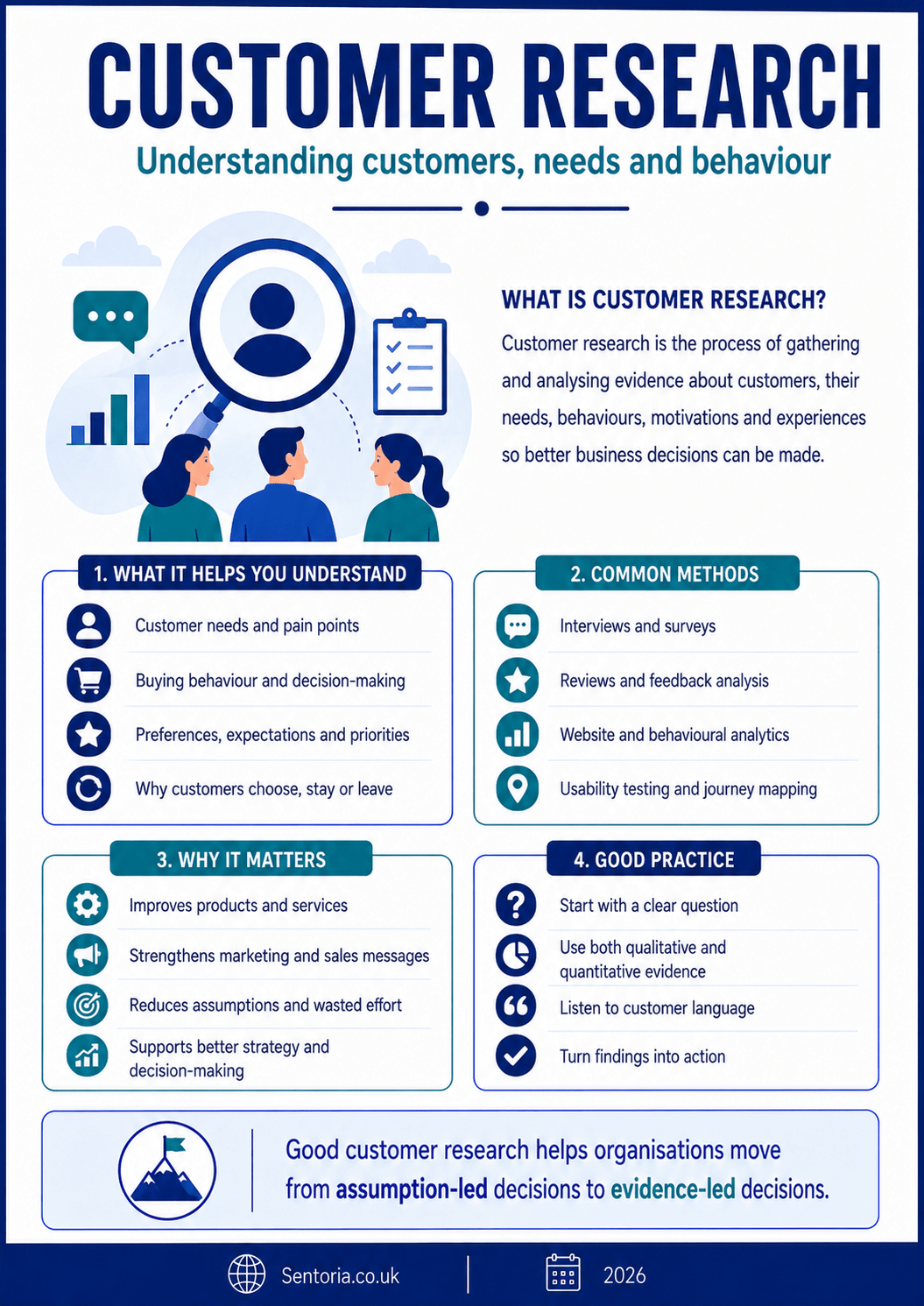
Customer Research:
A Practical Guide to Understanding Customers, Needs and Better Decisions
Customer research is a practical business and strategy tool used to understand customers, their needs, behaviours, expectations, problems, motivations and decision-making.
At its simplest, customer research asks:
Who are our customers, what do they need, what do they value, what problems are they trying to solve, and how can we serve them better?
That makes it useful for strategy, marketing, product development, customer service, pricing, sales, innovation, service design, branding, ecommerce, professional services, charity delivery, public sector services, technology, education and healthcare.
The GOV.UK Service Manual describes user research as the work of understanding user needs, planning research, preparing sessions, and sharing and analysing findings. That principle applies strongly to customer research: good decisions start with understanding the people you are trying to serve.
Used properly, customer research helps organisations move from assumption-led decision-making to evidence-led decision-making.
What is customer research?
Customer research is the process of gathering, analysing and using evidence about customers.
It may explore:
- Who customers are
- What customers need
- Why customers buy
- Why customers do not buy
- What customers value
- What problems customers face
- How customers make decisions
- How customers compare alternatives
- What customers think of the organisation
- What customers think of competitors
- How customers experience a product or service
- What frustrates customers
- What creates loyalty
- What causes complaints
- What creates trust
- What pricing feels acceptable
- What language customers use
- What channels customers prefer
- What support customers need
- What would make customers recommend the organisation
Customer research is not only about asking people whether they like something.
It is about understanding behaviour, context, needs and choices.
A customer might say they want low prices, but their behaviour may show that speed, convenience, trust or reassurance matter more.
A customer might say they are satisfied, but still leave when a better alternative appears.
A customer might say they understand the service, but still struggle to use it.
That is why customer research needs both listening and observation.
Customer research, market research and user research
Customer research is closely related to market research and user research, but they are not exactly the same.
Customer research
Customer research focuses on customers and potential customers.
It asks:
Who are our customers, what do they need, why do they choose, and how can we serve them better?
Market research
Market research is broader.
It may examine customers, competitors, market size, trends, pricing, demand, channels and wider market conditions.
Qualtrics describes market research as creating a deeper understanding of customers and their needs, including not only what customers do, but why they do it.
It asks:
What is happening in the market, and what does it mean for us?
User research
User research often focuses on how people use a product, service, website, app, system or process.
It asks:
Can people use this effectively, and does it meet their needs?
Nielsen Norman Group describes user research as being about improving product design based on evidence rather than opinions.
In simple terms:
Customer research helps understand the customer.
Market research helps understand the market.
User research helps understand the experience of using the product or service.
In practice, the three often overlap.
History and development of customer research
Customer research developed from market research, consumer psychology, sales analysis, advertising research, service design and user experience practice.
Earlier forms of customer research often focused on surveys, opinion polling, focus groups and sales data. Businesses wanted to know who bought products, what they thought, how much they might pay and how advertising affected behaviour.
As markets became more competitive, customer research became more sophisticated.
Organisations began to recognise that customers do not make decisions only on rational product features. They are influenced by trust, emotion, convenience, timing, social proof, risk, habit, identity, experience, price, service quality and perceived value.
Digital technology changed customer research again.
Organisations can now gather evidence from:
- Website analytics
- Customer relationship management systems
- Search data
- Social media
- Reviews
- Customer support conversations
- Email behaviour
- Purchase history
- App usage
- Usability testing
- Online surveys
- Behavioural data
- Customer journey tracking
- Customer interviews
- Community feedback
However, more data does not automatically mean more understanding.
A dashboard may show what customers did, but not always why they did it.
That is why modern customer research often combines quantitative data with qualitative insight.
Quantitative evidence shows patterns.
Qualitative evidence explains meaning.
Why customer research matters
Customer research matters because organisations often make assumptions about customers.
They assume:
- Customers understand the offer.
- Customers care about the same features as the organisation.
- Customers choose mainly on price.
- Customers know what they need.
- Customers read the website carefully.
- Customers understand the process.
- Customers trust the brand.
- Customers will tolerate complexity.
- Customers will behave like existing customers.
- Customers will recommend the service if they are satisfied.
Some assumptions may be right.
Many will be wrong or incomplete.
Customer research helps organisations:
- Understand real customer needs
- Improve products and services
- Improve marketing messages
- Improve pricing decisions
- Improve customer experience
- Reduce complaints
- Increase loyalty
- Identify unmet needs
- Improve sales conversion
- Reduce wasted marketing spend
- Improve website and digital journeys
- Support innovation
- Strengthen strategy
- Understand competitor choice
- Improve customer retention
- Identify new segments
- Reduce product failure
- Improve service design
- Challenge internal assumptions
- Make better decisions
Customer research is therefore not a marketing luxury.
It is a management tool.
When to use customer research
Customer research is useful whenever decisions depend on understanding customers.
Good uses include:
- Launching a new product
- Launching a new service
- Improving customer experience
- Repositioning a brand
- Reviewing pricing
- Improving a website
- Reducing customer complaints
- Increasing customer retention
- Understanding lost sales
- Improving sales conversion
- Testing marketing messages
- Designing a customer journey
- Entering a new market
- Reviewing competitor positioning
- Developing customer personas
- Improving onboarding
- Reducing churn
- Designing support services
- Improving accessibility
- Supporting strategic planning
It is especially useful where:
- Customer behaviour is changing.
- Sales are below expectation.
- Complaints are increasing.
- A new market is being considered.
- A product or service is being redesigned.
- There is disagreement internally.
- The organisation relies on assumptions.
- The customer journey is complex.
- The organisation wants to improve retention.
- The decision involves meaningful cost or risk.
It is less useful if research is carried out only to confirm a decision that has already been made.
Types of customer research
1. Qualitative customer research
Qualitative research explores meaning, motivation, experience and context.
It helps answer:
Why do customers think, feel or behave this way?
Common methods include:
- Customer interviews
- Focus groups
- Observation
- Usability testing
- Diary studies
- Customer journey mapping
- Open-text survey responses
- Complaint analysis
- Review analysis
- Sales call analysis
- Support conversation analysis
- Ethnographic research
Qualitative research is useful when the organisation needs depth.
It can reveal language, emotion, barriers, hidden needs and decision-making factors that numbers alone may miss.
2. Quantitative customer research
Quantitative research uses numbers and measurable data.
It helps answer:
How many, how often, how much, and how strongly?
Common methods include:
- Surveys
- Polls
- Website analytics
- Sales data
- Customer segmentation
- Net Promoter Score
- Customer satisfaction scores
- Customer effort scores
- Conversion analysis
- Churn analysis
- Pricing tests
- A/B testing
- Purchase behaviour analysis
- Support ticket data
- Retention analysis
Quantitative research is useful for measuring scale, frequency and trends.
It can show whether an issue affects a few customers or many.
3. Behavioural research
Behavioural research examines what customers actually do.
This matters because what customers say and what customers do can differ.
Examples include:
- Website click behaviour
- Purchase behaviour
- Repeat purchase patterns
- Abandoned baskets
- Search behaviour
- Product usage
- App usage
- Support requests
- Cancellation behaviour
- Time taken to complete a task
Behavioural research is particularly useful in ecommerce, software, digital services and customer journey improvement.
4. Attitudinal research
Attitudinal research examines what customers think, feel, believe or say.
Examples include:
- Customer satisfaction surveys
- Brand perception research
- Customer interviews
- Focus groups
- Feedback forms
- Review analysis
- Perception surveys
- Trust research
- Message testing
- Proposition testing
Nielsen Norman Group distinguishes between attitudinal and behavioural methods when choosing user experience research methods. This distinction is useful because research should consider both what people say and what people do.
5. Primary research
Primary research is research collected directly for the organisation’s own purpose.
Examples include:
- Interviewing customers
- Surveying prospects
- Running focus groups
- Testing a prototype
- Observing customer behaviour
- Running usability sessions
- Reviewing customer calls
- Conducting customer panels
- Running feedback workshops
- Testing a new proposition
Primary research is useful because it answers specific questions.
6. Secondary research
Secondary research uses existing information.
Examples include:
- Industry reports
- Competitor websites
- Public statistics
- Academic research
- Trade body reports
- Customer reviews
- Social media discussions
- Search trend data
- Regulatory reports
- Existing internal data
Secondary research is often faster and cheaper than primary research.
It is useful for context, but it may not answer the organisation’s specific question.
Customer research in different industries
SMEs and owner-managed businesses
For SMEs, customer research should be practical and proportionate.
A small business does not need a large research department. It does need to listen properly and test assumptions before spending money.
Typical SME customer research topics include:
- Why customers choose the business
- Why prospects do not convert
- Which services customers value most
- What price feels fair
- What frustrates customers
- What creates repeat business
- Which marketing messages work
- Which customer groups are most profitable
- What customers misunderstand
- What would make customers recommend the business
An SME might use:
- Short customer interviews
- Review analysis
- Lost quote follow-up
- Website enquiry analysis
- Customer satisfaction survey
- Sales call notes
- Complaint review
- Repeat purchase analysis
- Simple customer segmentation
- Competitor comparison
For SMEs, the key is action.
Do not research everything. Research the decision that matters.
Manufacturing
Manufacturers can use customer research to understand product requirements, quality expectations, service needs and buying decisions.
Typical manufacturing research topics include:
- Product specification needs
- Quality expectations
- Delivery expectations
- Price sensitivity
- Technical support needs
- Reasons for supplier choice
- Reasons for switching supplier
- Customer pain points
- Procurement decision criteria
- After-sales support expectations
A manufacturer might ask:
- Why do customers choose one supplier over another?
- What quality issues matter most?
- What delivery failures cause real problems?
- What technical information do customers need?
- What would make customers pay more?
- Which product improvements would create value?
- Which customers are most strategically important?
For manufacturing, customer research should connect sales, operations, quality, product development and account management.
Retail and ecommerce
Retail and ecommerce businesses need customer research because behaviour changes quickly.
Typical topics include:
- Product preferences
- Website usability
- Basket abandonment
- Pricing perception
- Delivery expectations
- Return reasons
- Product page clarity
- Review themes
- Search behaviour
- Customer loyalty
- Subscription interest
- Brand perception
- Customer service expectations
- Promotion response
- Competitor comparison
An ecommerce business might use:
- Website analytics
- Heatmaps
- Customer surveys
- Product review analysis
- Basket abandonment research
- A/B testing
- Usability testing
- Customer interviews
- Return reason analysis
- Loyalty data
For ecommerce, customer research should examine both behaviour and experience.
A conversion rate may fall because of price, delivery cost, poor product information, weak trust signals, slow site speed or confusing checkout.
Research helps identify which.
Professional services
Professional services firms can use customer research to understand client needs, trust, value, communication and service quality.
Typical topics include:
- Why clients choose the firm
- What clients value most
- What clients find confusing
- What creates trust
- What advice clients need
- How clients perceive fees
- What communication style works best
- What causes dissatisfaction
- Which services clients do not understand
- What would increase loyalty
For accountants, solicitors, consultants, architects and advisers, customer research might include:
- Client feedback interviews
- New client onboarding feedback
- Lost prospect review
- Service line research
- Fee perception research
- Client segmentation
- Review analysis
- Referral source analysis
- Website enquiry analysis
- Post-project feedback
Professional services firms often assume clients understand what they do.
Customer research may show that clients value clarity, responsiveness, plain English, trust and proactive advice more than technical detail.
Charities and voluntary organisations
Charities use customer research differently because their “customers” may include beneficiaries, donors, volunteers, funders, commissioners and community partners.
Typical topics include:
- Beneficiary needs
- Barriers to accessing support
- Service experience
- Donor motivation
- Volunteer experience
- Funder expectations
- Community need
- Referral pathways
- Impact evidence
- Partnership value
A charity might ask:
- What do beneficiaries need most?
- What stops people using the service?
- What support feels most valuable?
- What do donors care about?
- What makes volunteers stay?
- What evidence do funders need?
- What service gaps exist locally?
- Which communication channels work best?
For charities, customer research should be ethical, sensitive and inclusive.
It should not place unnecessary burden on vulnerable people.
Public sector and local government
Public bodies use customer research to understand residents, service users, communities and stakeholders.
Typical topics include:
- Resident needs
- Service access barriers
- Digital exclusion
- Satisfaction with services
- Reasons for complaints
- Community priorities
- Consultation responses
- Behaviour change
- Channel preferences
- Equality impacts
- Accessibility needs
- Trust in services
The GOV.UK Service Standard guidance emphasises understanding users’ needs, the problem being solved for them, and their whole experience of the service and the systems around it.
For public bodies, customer research should support fairness, accessibility, statutory duties, public value and better service design.
Property and construction
Property and construction organisations can use customer research to understand tenants, occupiers, buyers, communities, investors and stakeholders.
Typical topics include:
- Tenant needs
- Occupier requirements
- Buyer preferences
- Local community concerns
- Workspace expectations
- Parking and access needs
- Sustainability expectations
- Amenity preferences
- Lease decision factors
- Maintenance communication
- Design preferences
- Regeneration priorities
A property business might ask:
- What do tenants value most in a property?
- What causes dissatisfaction?
- What space requirements are changing?
- What makes a site attractive to occupiers?
- What do local communities want from regeneration?
- What would improve tenant retention?
- What service charge information needs to be clearer?
For property and construction, customer research should link to planning, design, leasing, asset management and stakeholder engagement.
Technology and software
Technology businesses depend heavily on customer research because product success depends on understanding user problems.
Typical topics include:
- User needs
- Pain points
- Product-market fit
- Feature priorities
- Usability
- Onboarding
- Churn reasons
- Pricing
- Customer support
- Product adoption
- Competitor switching
- Customer success
- Trust and security concerns
- Integration needs
- Workflow fit
A software business might use:
- User interviews
- Usability testing
- Product analytics
- Churn interviews
- Customer support analysis
- Feature request analysis
- Prototype testing
- Customer advisory groups
- A/B testing
- Journey mapping
For technology businesses, customer research should not be limited to asking what features customers want.
Customers may ask for features, but the deeper research question is:
What problem are they trying to solve?
Healthcare and social care
Healthcare and social care organisations use customer research to understand patient, service user, family, carer and staff experience.
Typical topics include:
- Access to care
- Communication
- Service user experience
- Family concerns
- Barriers to support
- Care preferences
- Digital access
- Complaints
- Safeguarding confidence
- Dignity and respect
- Waiting times
- Continuity of care
- Information clarity
- Trust
- Support needs
In healthcare and care, customer research must be handled carefully.
It should support safety, dignity, safeguarding, consent, confidentiality and professional judgement.
Education and training
Education providers can use customer research to understand learners, parents, employers, funders and staff.
Typical topics include:
- Learner needs
- Course choice
- Barriers to attendance
- Learner support
- Employer needs
- Placement quality
- Digital learning experience
- Course satisfaction
- Progression outcomes
- Communication preferences
- Safeguarding confidence
- Assessment experience
- Funding requirements
- Accessibility
- Curriculum relevance
For education, customer research should support learner outcomes, quality, safeguarding and employer relevance.
How to carry out customer research properly
1. Define the decision
Start with the decision the research will support.
Ask:
- What are we trying to decide?
- What do we need to understand?
- What assumptions are we testing?
- Who are the customers involved?
- What evidence do we already have?
- What evidence is missing?
- Who will use the findings?
- What action might follow?
- How quickly is the answer needed?
- What would make the research useful?
Research without a clear decision can become interesting but unfocused.
2. Define the customer group
Be clear who the research is about.
Customer groups may include:
- Existing customers
- Lost customers
- Prospective customers
- High-value customers
- Low-value customers
- Lapsed customers
- New customers
- Repeat customers
- Non-customers
- Decision-makers
- Influencers
- Users
- Buyers
- Referrers
- Beneficiaries
- Donors
- Tenants
- Service users
- Learners
- Residents
Do not assume all customers are the same.
Different customer groups may have different needs, behaviours and levels of value.
3. Choose the right method
The method should match the question.
Use interviews when you need depth.
Use surveys when you need scale.
Use analytics when you need behaviour.
Use usability testing when you need to understand whether people can use something.
Use review analysis when you want to understand satisfaction and frustration.
Use lost customer research when you need to understand why people leave.
Nielsen Norman Group maps user research methods across different dimensions and stages of product development, which is a useful reminder that the method should fit the question and timing.
4. Use both qualitative and quantitative evidence
Good customer research often combines both.
For example:
A survey may show that 35% of customers find onboarding confusing.
Interviews may explain why.
Website analytics may show where customers drop out.
Usability testing may show what causes the problem.
Support tickets may show how often customers ask for help.
Together, this creates a much stronger picture than one method alone.
5. Ask clear, neutral questions
Research questions should not lead the customer.
Weak question:
How much did you enjoy our excellent service?
Stronger question:
How would you describe your experience of using the service?
Weak question:
Would you buy our new premium package?
Stronger question:
What would make a premium package valuable enough for you to consider?
Good questions are:
- Clear
- Neutral
- Specific
- Open where depth is needed
- Simple
- Relevant
- Easy to answer
- Not leading
- Not double-barrelled
- Linked to the research purpose
6. Listen for customer language
Customer research is valuable because customers often use different language from organisations.
An organisation might talk about:
Integrated financial advisory solutions.
Customers might say:
I just want someone to explain what the numbers mean and what I should do next.
An organisation might talk about:
Multi-channel service access.
Customers might say:
I want to know who to contact and how quickly someone will reply.
Customer language helps improve:
- Website copy
- Sales conversations
- Service descriptions
- Proposals
- Emails
- Product pages
- FAQs
- Support scripts
- Advertising
- Onboarding
7. Look for behaviour, not only opinion
Customers may not always know what they will do.
They may say they would buy, but not buy.
They may say price is the issue, but choose a more expensive trusted provider.
They may say they want more choice, but become overwhelmed by options.
That is why behaviour matters.
Useful behavioural evidence includes:
- Purchase history
- Repeat purchases
- Churn
- Basket abandonment
- Website clicks
- Search queries
- Support requests
- Return behaviour
- Complaint patterns
- Referral behaviour
- Time on task
- Drop-off points
- Usage frequency
- Renewal rates
- Payment behaviour
8. Segment the findings
Do not treat all customers as one group.
Segment findings by useful categories.
Examples include:
- Customer type
- Industry
- Location
- Size
- Age
- Income
- Need
- Behaviour
- Value
- Frequency
- Loyalty
- Product use
- Channel
- Profitability
- Stage in journey
Segmentation helps avoid average answers.
The average customer may not actually exist.
9. Turn findings into insight
Raw research is not enough.
A finding says:
Customers mention price in 60% of lost sale interviews.
An insight says:
Price is often used as the stated reason for not buying, but interviews show the deeper issue is uncertainty about value and lack of confidence in the outcome.
Insights explain meaning.
They help decisions.
10. Turn insight into action
Customer research should lead to action.
Possible actions include:
- Change the product
- Improve the service
- Rewrite website copy
- Change pricing
- Improve onboarding
- Train staff
- Redesign the customer journey
- Fix usability problems
- Improve communication
- Change marketing messages
- Target a different segment
- Stop offering something customers do not value
- Improve support
- Test a new proposition
- Update the strategy
Research without action is wasted effort.
Common customer research methods
Customer interviews
Customer interviews are one-to-one conversations used to explore needs, motivations, experiences and decision-making.
They are useful for depth.
They can reveal why customers behave as they do.
Surveys
Surveys gather responses from a larger group.
They are useful for measuring satisfaction, preferences, frequency and trends.
They are less useful for deep understanding unless open-text responses are analysed carefully.
Focus groups
Focus groups bring a small group together to discuss views and experiences.
They can be useful for exploring reactions, language and group dynamics.
They can be weaker where dominant voices influence others.
Usability testing
Usability testing observes people trying to use a website, app, product, form or service.
It is useful for finding practical barriers.
Customer journey mapping
Customer journey mapping shows the stages a customer goes through before, during and after using a product or service.
It helps identify friction, confusion, emotions, delays and improvement opportunities.
Review analysis
Review analysis examines customer reviews, testimonials, complaints and feedback.
It can identify recurring themes in satisfaction and dissatisfaction.
Support ticket analysis
Support ticket analysis examines customer problems and questions.
It is useful because support requests often reveal where products, services or communication are unclear.
Lost customer research
Lost customer research examines why customers leave or do not buy.
It is useful because existing customers may not reveal the barriers that stopped others from converting.
A/B testing
A/B testing compares two versions of something to see which performs better.
Examples include:
- Website headlines
- Email subject lines
- Pricing presentation
- Calls to action
- Product page layouts
- Sign-up forms
A/B testing is useful for optimisation, but it explains what works better, not always why.
Customer analytics
Customer analytics uses customer data to understand behaviour, value, retention, conversion and patterns.
It is useful when the organisation has reliable data.
Common mistakes in customer research
Mistake 1: Starting with the answer
Research should not be used to justify a decision already made.
It should be used to learn.
Mistake 2: Asking leading questions
Leading questions produce unreliable answers.
Customers may tell the organisation what they think it wants to hear.
Mistake 3: Listening only to loud customers
The most vocal customers are not always representative.
Quiet customers, lost customers and non-customers may reveal important insights.
Mistake 4: Confusing satisfaction with loyalty
A satisfied customer may still leave.
Research should explore retention, trust, switching barriers and alternatives.
Mistake 5: Relying only on surveys
Surveys are useful, but they may not explain why customers behave as they do.
Use interviews, observation and behavioural data where depth is needed.
Mistake 6: Ignoring lost customers
Lost customers can be one of the best sources of insight.
They can explain what failed, what alternative they chose and what mattered.
Mistake 7: Treating all customers as the same
Different segments may have different needs.
Averages can hide important differences.
Mistake 8: Overvaluing what customers say they will do
Stated intention is not the same as behaviour.
Where possible, test actual behaviour.
Mistake 9: Not analysing properly
Collecting feedback is not the same as understanding it.
Find themes, patterns, contradictions and implications.
Mistake 10: Not acting on findings
Customers may become frustrated if asked for feedback repeatedly but nothing changes.
Research should lead to visible improvement.
Limitations and weaknesses of customer research
Customer research is useful, but it has limits.
Customers do not always know what they want
Customers can describe problems, frustrations and desired outcomes.
They may not always design the best solution.
Stated behaviour may differ from actual behaviour
Customers may say they would buy, switch or pay, but behave differently.
This is why behavioural evidence matters.
Research can be biased
Bias can come from poor sampling, leading questions, interviewer behaviour, response bias or internal interpretation.
Research can become outdated
Customer needs and expectations change.
Research should be refreshed when the market, service or customer behaviour changes.
It can over-focus on existing customers
Existing customers can help improve current services.
Non-customers may reveal growth opportunities.
It can be too narrow
Research that only examines one touchpoint may miss the wider customer journey.
It can be misinterpreted
Research findings need careful analysis.
A customer complaint may reveal a process issue, a communication issue, a pricing issue or an expectation issue.
It does not replace judgement
Customer research informs decisions.
It does not make decisions automatically.
The organisation still needs strategy, prioritisation and commercial judgement.
Customer research compared with other strategic and management tools
Customer research and competitor analysis
Competitor analysis looks at alternatives in the market.
Customer research explains why customers choose between those alternatives.
Use both to understand market position.
Customer research and Value Proposition Canvas
The Value Proposition Canvas maps customer jobs, pains and gains against products and services.
Customer research provides the evidence needed to complete it properly.
Customer research and Business Model Canvas
The Business Model Canvas describes how an organisation creates, delivers and captures value.
Customer research tests whether the customer segments, value propositions, channels and relationships are realistic.
Customer research and Lean Canvas
Lean Canvas is built around problem, solution, customer segments and unfair advantage.
Customer research helps test whether the problem is real and whether customers care enough to act.
Customer research and SWOT
Customer research can inform strengths, weaknesses, opportunities and threats.
For example, customer feedback may reveal a strength in service quality, a weakness in communication, an opportunity in unmet needs, or a threat from competitors.
Customer research and PESTLE
PESTLE examines external factors.
Customer research can show how external changes affect customer behaviour.
Customer research and Blue Ocean Strategy
Blue Ocean Strategy seeks uncontested market space.
Customer research can identify non-customers, unmet needs and features that customers value or ignore.
Customer research and forecasting
Customer research can improve forecasts by providing evidence about demand, conversion, retention and pricing.
Customer research and roadmapping
Customer research helps decide what should be prioritised on a product, service or strategy roadmap.
Customer research and Appreciative Inquiry
Appreciative Inquiry explores strengths and what works.
Customer research can identify where customers experience the organisation at its best and what conditions create that experience.
Alternatives and complementary frameworks
Market research
Use market research to understand the wider market, competitors, demand and trends.
User research
Use user research to understand how people use a product, service or system.
Customer journey mapping
Use customer journey mapping to understand the end-to-end experience.
Jobs to be Done
Use Jobs to be Done to understand the progress customers are trying to make and the job they are hiring a product or service to do.
Value Proposition Canvas
Use the Value Proposition Canvas to connect customer needs with the organisation’s offer.
Segmentation
Use segmentation to group customers by useful characteristics, needs or behaviours.
Personas
Use personas to summarise key customer types.
Personas should be evidence-based, not invented.
Service blueprinting
Use service blueprinting to connect the customer journey with internal processes, systems and roles.
Usability testing
Use usability testing to test whether customers can use a website, app, form or process.
A practical customer research template
A useful customer research template should include:
- Research title
- Purpose
- Decision supported
- Customer group
- Research questions
- Existing assumptions
- Method
- Sample
- Data sources
- Questions asked
- Key findings
- Customer quotes
- Behavioural evidence
- Segments identified
- Insights
- Implications
- Recommended actions
- Owner
- Review date
- Link to strategy, roadmap or product plan
Example:
Research title: Understanding why prospects do not convert after enquiry
Purpose: Improve conversion from website enquiry to paying customer.
Customer group: Prospects who enquired but did not proceed within the last six months.
Research questions:
- What problem were prospects trying to solve?
- What alternatives did they consider?
- What information was missing?
- What caused hesitation?
- What would have increased trust?
- What final reason stopped them proceeding?
Method: Short telephone interviews and enquiry data review.
Key finding: Prospects understood the service, but were unsure about the process, timescale and expected outcome.
Insight: The issue was not only price. The bigger barrier was uncertainty and lack of confidence.
Recommended actions:
- Add clearer process explanation to website.
- Create plain English “what happens next” email.
- Add client examples and outcomes.
- Train team to explain value earlier.
- Review conversion after three months.
Owner: Marketing Manager.
Questions to ask during customer research
Purpose questions
- What decision are we trying to make?
- What do we need to understand?
- What customer behaviour are we trying to explain?
- What assumption are we testing?
- What evidence do we already have?
- What evidence is missing?
- Who will use the findings?
- What action may follow?
- What would make the research useful?
- How will we know the research has answered the question?
Customer questions
- Who is the customer?
- Who is the user?
- Who is the buyer?
- Who influences the decision?
- Who pays?
- Who benefits?
- Who complains?
- Who leaves?
- Who recommends?
- Who are we not reaching?
Needs questions
- What problem is the customer trying to solve?
- What outcome do they want?
- What frustrates them?
- What do they value most?
- What are they worried about?
- What would make life easier?
- What do they not understand?
- What support do they need?
- What does success look like for them?
- What would make them choose us?
Behaviour questions
- How do customers find us?
- What do customers do before buying?
- What alternatives do they consider?
- Where do they hesitate?
- Where do they drop out?
- What do they buy again?
- When do they leave?
- What triggers a complaint?
- What creates a referral?
- What behaviour contradicts what customers say?
Experience questions
- What is the customer journey?
- Which steps are easy?
- Which steps are difficult?
- What creates trust?
- What creates confusion?
- What creates delay?
- What creates frustration?
- What creates confidence?
- What would customers improve?
- What does an excellent experience look like?
Action questions
- What should change as a result?
- What should be tested?
- What should be stopped?
- What should be improved?
- What should be added to the roadmap?
- What should be changed in marketing?
- What should be changed in sales?
- What should be changed in service delivery?
- Who owns the action?
- When will we review the impact?
The best way to think about customer research
Customer research is not just asking customers what they think.
It is disciplined learning about customers.
A good customer research process should be:
- Clear
- Evidence-based
- Decision-led
- Customer-centred
- Behaviour-aware
- Properly sampled
- Neutral in questioning
- Analysed carefully
- Linked to action
- Reviewed regularly
A weak customer research process says:
“We asked customers what they wanted.”
A strong customer research process asks:
“What do customers need, what do they actually do, what does that tell us, and what should we change?”
The key question is not simply:
What do customers say?
The better question is:
What do customers need, value and do, and how should that change our decisions?
Conclusion: customer research turns customer understanding into better decisions
Customer research remains useful because organisations are often too close to their own products, services and assumptions.
They know what they offer. Customers know what they experience.
Those are not always the same thing.
Used badly, customer research becomes a survey, a few selective quotes, or a way to confirm a decision already made.
Used properly, it becomes a practical management tool. It helps organisations understand needs, improve services, sharpen value propositions, reduce friction, strengthen loyalty, improve marketing and make better strategic decisions.
The real value is not in collecting customer feedback.
The real value is in learning from it and acting on it.
A strong customer research process helps an organisation move from saying, “We think customers want this,” to asking, “What evidence do we have, what are customers really trying to achieve, and what should we do differently as a result?”