TOWS Analysis: A Practical Guide to Turning SWOT into Strategy
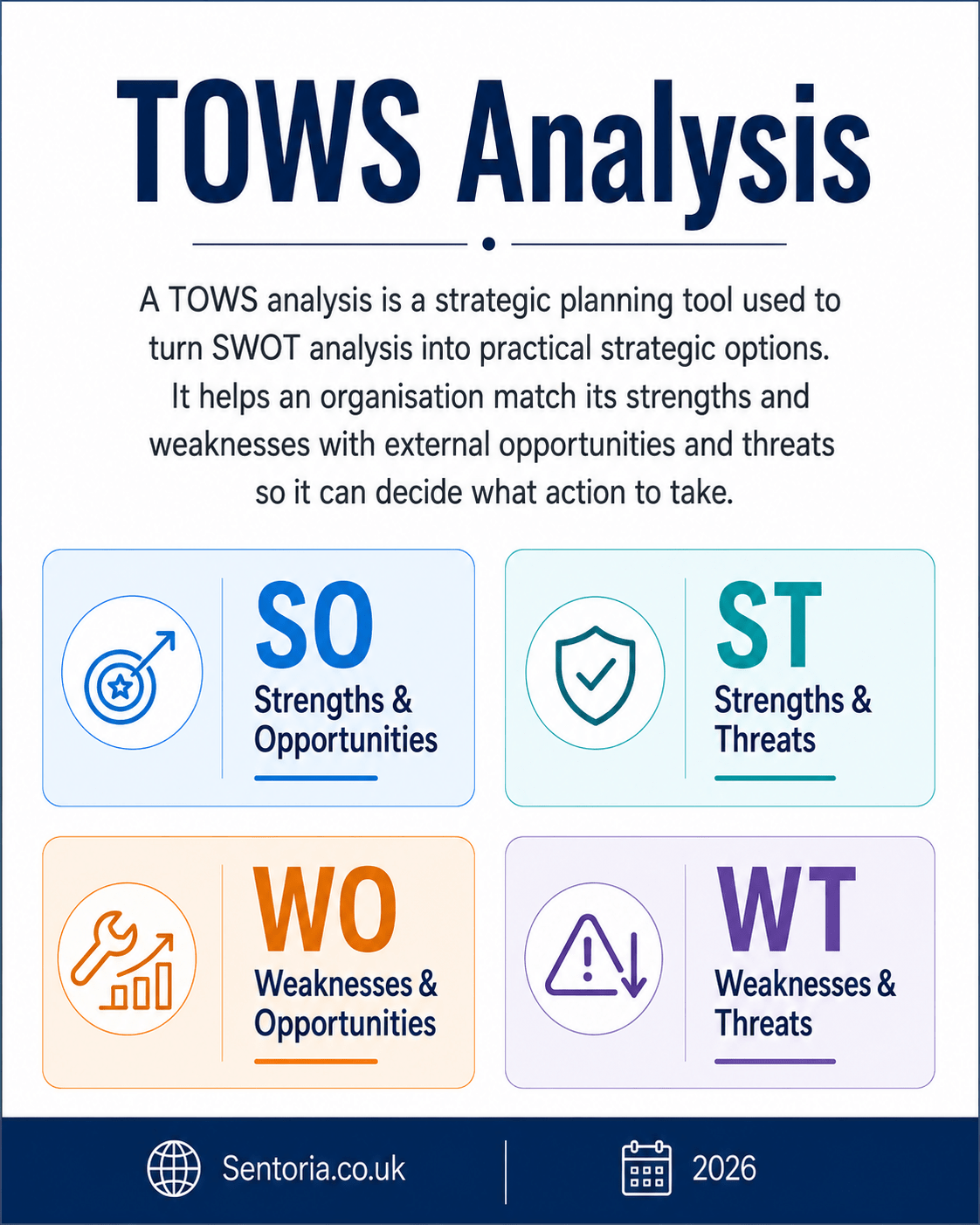
A TOWS analysis is a strategic planning tool used to convert SWOT analysis into practical strategic options.
Where SWOT identifies Strengths, Weaknesses, Opportunities and Threats, TOWS goes a step further. It asks how those factors interact with each other and what the organisation should do as a result.
In simple terms:
SWOT helps you understand the situation.
TOWS helps you decide what to do about it.
That distinction is important. A SWOT analysis can be useful, but it often stops at diagnosis. It produces a list of internal strengths and weaknesses, together with external opportunities and threats. TOWS takes those same factors and matches them together to generate possible strategies.
The original academic paper by Heinz Weihrich introduced the TOWS Matrix as a way of matching environmental threats and opportunities with an organisation’s weaknesses and strengths. Weihrich’s key point was that the individual factors were not new. What mattered was identifying the relationships between those factors and using those relationships as the basis for strategy.
Used properly, TOWS can help an organisation move from analysis to action.
What is a TOWS analysis?
A TOWS analysis is a matrix-based strategy tool that uses the same four components as SWOT:
Threats
Opportunities
Weaknesses
Strengths
The order is reversed from SWOT because TOWS places particular emphasis on the external environment first. It encourages decision-makers to consider what is happening outside the organisation, then decide how internal strengths and weaknesses affect the response.
The result is a four-part strategy matrix:
- SO strategies: Use strengths to take advantage of opportunities.
- ST strategies: Use strengths to reduce or respond to threats.
- WO strategies: Use opportunities to overcome weaknesses.
- WT strategies: Reduce weaknesses and avoid or minimise threats.
The University of Hertfordshire’s introduction to TOWS describes these four strategy groups as combinations of the SWOT categories, creating SO, ST, WO and WT strategies.
History and development of TOWS analysis
TOWS analysis was developed by Heinz Weihrich and published in 1982 in Long Range Planning under the title The TOWS Matrix: A Tool for Situational Analysis. The article appeared in Volume 15, Issue 2, pages 54 to 66.
The model emerged from the broader field of strategic planning. By the late twentieth century, SWOT analysis was already widely used as a way of identifying internal and external factors affecting an organisation. However, one of the weaknesses of SWOT was that it did not necessarily explain what should happen next.
TOWS was designed to deal with that problem.
Weihrich’s contribution was to take the familiar SWOT categories and use them more systematically. Instead of simply listing strengths, weaknesses, opportunities and threats, the TOWS Matrix asks decision-makers to match external factors with internal factors and then develop strategies from those relationships.
This made TOWS a more action-oriented tool. It shifted the emphasis from description to strategy formulation.
Over time, TOWS became particularly popular in business planning, marketing strategy, organisational development and management education. It is often taught alongside SWOT, PESTLE, Porter’s Five Forces, stakeholder mapping, VRIO analysis and the BCG Matrix. The University of Hertfordshire notes that TOWS should not usually be the only analysis undertaken and is best complemented by other tools such as PESTLE, VRIO, stakeholder mapping and the BCG Matrix.
TOWS compared with SWOT
SWOT and TOWS are closely connected, but they are not the same.
A SWOT analysis is usually used to identify the current position. It asks:
- What are our strengths?
- What are our weaknesses?
- What opportunities exist?
- What threats do we face?
A TOWS analysis asks the follow-up questions:
- How can we use our strengths to take advantage of opportunities?
- How can we use our strengths to reduce threats?
- How can we use opportunities to overcome weaknesses?
- How can we reduce weaknesses and avoid threats?
Professional Academy summarises the difference by describing TOWS as an action tool rather than simply an analysis tool, used to decide what to do with SWOT findings.
The simplest way to think about it is this:
SWOT produces insight.
TOWS produces strategic options.
That makes TOWS especially useful when a SWOT analysis has already been completed but has not yet been translated into decisions.
The four TOWS strategy types
1. SO strategies: Strengths and Opportunities
SO strategies use internal strengths to take advantage of external opportunities.
This is usually the most positive part of the TOWS Matrix. It focuses on growth, expansion, improvement and advantage.
Examples include:
- Using a strong brand to enter a growing market.
- Using spare production capacity to meet increasing demand.
- Using specialist expertise to launch a new advisory service.
- Using a loyal customer base to introduce a subscription model.
- Using strong reserves to invest while competitors are constrained.
- Using an experienced team to win new contracts.
- Using good local reputation to build partnerships.
SO strategies are often attractive because they match what the organisation already does well with opportunities that exist in the wider environment.
However, they should still be tested carefully. A strength is only useful if it is relevant to the opportunity. An opportunity is only worth pursuing if it fits the organisation’s purpose, resources and risk appetite.
2. ST strategies: Strengths and Threats
ST strategies use internal strengths to reduce, resist or respond to external threats.
These strategies are often defensive, but that does not make them negative. A strong organisation should use its advantages to protect itself from external pressure.
Examples include:
- Using strong customer relationships to defend against a new competitor.
- Using financial reserves to manage an economic downturn.
- Using operational efficiency to absorb cost increases.
- Using technical expertise to respond to regulatory change.
- Using a strong reputation to protect against reputational risk.
- Using diversified income to reduce dependency on one market.
- Using data and systems to manage cyber and compliance risks.
ST strategies are useful because external threats cannot always be removed. The organisation may not control inflation, regulation, competition, technology or consumer behaviour. But it may be able to use its strengths to reduce the impact.
3. WO strategies: Weaknesses and Opportunities
WO strategies use external opportunities to address internal weaknesses.
This is an important but often overlooked part of the matrix. It recognises that opportunities are not only about growth. They can also provide a route to improvement.
Examples include:
- Using grant funding to improve outdated systems.
- Using new technology to reduce manual administration.
- Using partnership opportunities to fill skills gaps.
- Using a growing market to justify investment in capacity.
- Using outsourcing to address a lack of specialist expertise.
- Using recruitment trends to strengthen management capability.
- Using digital tools to improve weak customer communication.
Oxford College of Marketing describes WO strategies as using opportunities to overcome weaknesses, such as outsourcing certain operations to address a lack of specific skills.
WO strategies are often practical and realistic. They accept that the organisation has weaknesses, but they look for external conditions that make those weaknesses easier to address.
4. WT strategies: Weaknesses and Threats
WT strategies deal with the most vulnerable part of the matrix. They consider situations where internal weaknesses are exposed by external threats.
This is where the organisation needs to reduce risk, limit exposure or make difficult decisions.
Examples include:
- Reducing dependency on a declining market.
- Exiting an unprofitable product line.
- Merging with another organisation to protect sustainability.
- Cutting costs where rising external pressure makes current operations unsustainable.
- Strengthening compliance where legal risk is increasing.
- Reducing customer concentration where a major customer may leave.
- Selling or repurposing assets where market demand has changed.
Oxford College of Marketing describes WT strategies as approaches that minimise weaknesses and avoid threats. In some cases, this may include strategic alliances or withdrawing from a market.
WT strategies can feel uncomfortable because they often expose difficult truths. However, they are essential. Many organisations fail not because they lack strengths, but because they ignore the combination of internal weakness and external pressure.
Why TOWS analysis matters
TOWS matters because many planning exercises fail at the point where analysis should become action.
A management team may complete a detailed SWOT. It may identify dozens of strengths, weaknesses, opportunities and threats. But then nothing happens. The SWOT is included in a board paper, strategy document or workshop summary, but it does not change priorities, budgets, responsibilities or behaviour.
TOWS helps close that gap.
It creates a bridge between diagnosis and strategy. It forces the organisation to ask:
- What do these factors mean together?
- Which strengths are strategically useful?
- Which weaknesses are most dangerous?
- Which opportunities are realistic?
- Which threats need active response?
- What should we actually do next?
That makes TOWS particularly useful for organisations that already understand their situation but need help choosing strategic options.
When to use a TOWS analysis
TOWS is useful when a SWOT analysis has already been prepared, or when an organisation needs to move quickly from assessment to action.
It can be used for:
- Strategic business planning
- Marketing strategy
- Charity strategy
- Project planning
- Turnaround planning
- Public sector service design
- New product or service development
- Market entry decisions
- Organisational restructuring
- Risk management
- Partnership planning
- Departmental reviews
- Personal career planning
- Board and trustee strategy sessions
The University of Hertfordshire notes that TOWS can be used at different levels, including the whole organisation, a department, a team, a process, a communications campaign or even by an individual.
This flexibility is one of the model’s strengths. The same basic logic can be applied to a national business strategy, a local charity, a finance department, a marketing campaign or a personal development plan.
TOWS analysis in different industries
SMEs and owner-managed businesses
For SMEs, TOWS is valuable because it turns practical business realities into choices.
A small business might have strong local relationships, good technical expertise and loyal customers. It may also have weaknesses such as limited cash reserves, weak systems or over-reliance on the owner. External opportunities might include digital marketing, local growth, competitor weakness or new funding. Threats might include rising costs, staff shortages, late payment or larger competitors.
A TOWS analysis helps the business turn those factors into strategy.
For example:
SO strategy: Use strong customer relationships to launch a premium service.
ST strategy: Use local reputation to defend against national competitors.
WO strategy: Use cloud software to improve weak financial reporting.
WT strategy: Reduce owner dependency before illness, retirement or burnout becomes a major threat.
For SMEs, the most useful TOWS strategies are usually practical, affordable and focused on cash, capacity, customers and resilience.
Manufacturing
In manufacturing, TOWS can help connect operational capability with market and supply chain change.
Strengths might include skilled labour, production expertise, quality control or specialist machinery. Weaknesses might include old equipment, high energy use, poor stock control or reliance on a few customers. Opportunities may include automation, reshoring, export demand, new materials or process improvement. Threats may include input price inflation, labour shortages, overseas competition and supply chain disruption.
A manufacturer might develop the following strategies:
SO strategy: Use specialist production capability to enter a higher-margin niche.
ST strategy: Use process efficiency to reduce the impact of rising input costs.
WO strategy: Use automation grants or investment incentives to address labour shortages.
WT strategy: Reduce dependence on one supplier where supply chain risk is increasing.
For manufacturing, TOWS should be linked to cost analysis, capacity planning, stock management, supplier risk and capital investment decisions.
Retail and ecommerce
Retail businesses operate in fast-moving environments where customer behaviour, price sensitivity and competition can change quickly.
Strengths might include brand, location, customer loyalty, product knowledge or fulfilment speed. Weaknesses might include low margins, poor stock systems, limited online presence or high returns. Opportunities may include ecommerce, local delivery, personalisation, subscriptions or marketplace selling. Threats may include online competition, rising rents, weak consumer confidence and price comparison.
Possible TOWS strategies include:
SO strategy: Use strong customer loyalty to develop a membership or subscription model.
ST strategy: Use product expertise and service quality to defend against low-cost competitors.
WO strategy: Use ecommerce tools to overcome limited physical footfall.
WT strategy: Reduce slow-moving stock where consumer confidence is weakening.
For retail, TOWS should be supported by margin data, stock ageing, customer behaviour, web analytics and competitor pricing.
Professional services
Professional services firms can use TOWS to turn reputation, expertise and relationships into strategic direction.
Strengths might include specialist knowledge, client trust, recurring income or sector expertise. Weaknesses might include limited marketing, over-reliance on partners, inconsistent systems or recruitment difficulties. Opportunities may include advisory services, automation, niche positioning, regulatory change or client demand for better insight. Threats may include fee pressure, AI tools, larger competitors, client insourcing and talent shortages.
Possible strategies include:
SO strategy: Use specialist expertise to create a higher-value advisory service.
ST strategy: Use trusted relationships to protect clients from switching to lower-cost providers.
WO strategy: Use automation to reduce administrative weakness and improve margins.
WT strategy: Reduce dependency on a small number of senior people before succession risk becomes critical.
For accountants, solicitors, consultants, architects and similar firms, TOWS is particularly useful when deciding whether to specialise, automate, grow, merge, outsource or reposition.
Charities and voluntary organisations
For charities, TOWS can be extremely useful because it connects mission, funding, capacity and external need.
Strengths may include community trust, committed staff, volunteers, lived experience, partnerships or strong outcomes. Weaknesses may include short-term funding, limited reserves, staff burnout, weak impact data or dependence on one funder. Opportunities may include new grants, partnerships, commissioning, social need or digital delivery. Threats may include funding cuts, rising demand, volunteer shortages, regulation or reputational risk.
Possible strategies include:
SO strategy: Use strong community trust to develop a new funded service.
ST strategy: Use partnership relationships to respond to funding uncertainty.
WO strategy: Use a new grant opportunity to improve impact reporting and governance.
WT strategy: Reduce service commitments where funding and staffing risks are becoming unsustainable.
For charities, TOWS should be linked to reserves policy, trustee risk registers, impact reporting, safeguarding and funding strategy.
Public sector and local government
In the public sector, TOWS can help turn environmental scanning into practical service options.
Strengths may include statutory powers, local knowledge, professional staff, public accountability or existing infrastructure. Weaknesses may include budget constraints, legacy systems, fragmented data, procurement delays or political complexity. Opportunities may include digital transformation, partnerships, preventative services, funding programmes or devolution. Threats may include rising demand, workforce shortages, legal challenge, public dissatisfaction or financial pressure.
Possible strategies include:
SO strategy: Use local data and statutory powers to target preventative services.
ST strategy: Use partnership networks to respond to rising demand.
WO strategy: Use digital transformation funding to address inefficient legacy systems.
WT strategy: Redesign vulnerable services where demand is rising and capacity is falling.
For public bodies, TOWS should be evidence-based and should sit alongside statutory duties, equality impact assessment, consultation, financial modelling and risk management.
Property and construction
Property and construction decisions are often shaped by the interaction between internal capabilities and external constraints.
Strengths may include land ownership, planning knowledge, funding access, local relationships or strong professional teams. Weaknesses may include title issues, high costs, site constraints, old buildings or limited management capacity. Opportunities may include regeneration funding, planning policy support, housing demand, sustainability upgrades or new occupier demand. Threats may include interest rates, contractor failure, build cost inflation, planning objections, utilities constraints or market downturn.
Possible strategies include:
SO strategy: Use land ownership and local knowledge to bring forward a regeneration scheme.
ST strategy: Use planning expertise to manage objection risk and policy complexity.
WO strategy: Use grant funding to address infrastructure or heritage constraints.
WT strategy: Phase development to reduce exposure to interest rate and build cost risk.
For property and construction, TOWS should be linked to financial appraisal, planning strategy, legal review, valuation, funding, procurement and sensitivity testing.
Technology and software
Technology businesses can use TOWS to connect product capability with market change.
Strengths might include intellectual property, software capability, data, user experience or development speed. Weaknesses might include technical debt, weak sales processes, poor documentation, cyber risk or customer concentration. Opportunities may include AI, integrations, platform partnerships, overseas markets or automation. Threats may include competitors, cyber attacks, regulation, platform dependency or rapid technological change.
Possible strategies include:
SO strategy: Use strong development capability to launch AI-enabled features.
ST strategy: Use technical expertise to respond quickly to competitor innovation.
WO strategy: Use partner integrations to overcome limited sales reach.
WT strategy: Reduce technical debt before security or reliability threats become serious.
For technology businesses, TOWS should be refreshed frequently because assumptions can become outdated quickly.
How to carry out a TOWS analysis properly
1. Start with a good SWOT
A TOWS analysis is only as strong as the SWOT it is based on.
If the SWOT is vague, biased or incomplete, the TOWS analysis will also be weak.
Before starting TOWS, make sure the SWOT is:
- Specific
- Evidence-based
- Prioritised
- Relevant to the decision
- Clear about internal and external factors
- Honest about weaknesses and threats
A SWOT with 40 vague points is less useful than one with five or six important points in each category.
2. Define the strategic question
Do not run a TOWS analysis in the abstract.
Start with a clear question, such as:
- How should we grow over the next three years?
- Should we enter this market?
- How do we improve sustainability?
- How do we respond to rising costs?
- How do we protect services with limited funding?
- How do we improve profitability?
- How do we reposition the organisation?
The strategic question controls the analysis. Without it, the TOWS Matrix can become too broad.
3. Prioritise the SWOT factors
Not every SWOT point should be carried into the TOWS Matrix.
Focus on the factors that are most material to the decision.
For each SWOT point, ask:
- Is it strategically important?
- Is there evidence for it?
- Does it affect the decision?
- Is it current?
- Is it specific enough?
- Can management do anything about it?
Only the most important factors should be used.
4. Build the TOWS Matrix
Create four sections:
- Strengths and Opportunities
- Strengths and Threats
- Weaknesses and Opportunities
- Weaknesses and Threats
Then work through each section systematically.
5. Develop SO strategies
Ask:
- Which strengths help us take advantage of which opportunities?
- Where do we have a clear advantage?
- Which opportunities fit our purpose and capability?
- Where could we grow or improve most effectively?
SO strategies should usually be positive, ambitious and growth-oriented, but still realistic.
6. Develop ST strategies
Ask:
- Which strengths help us respond to threats?
- What external pressures can we defend against?
- How can we use our strongest capabilities to reduce risk?
- Where can we protect income, reputation, service quality or market position?
ST strategies are about resilience and defence.
7. Develop WO strategies
Ask:
- Which opportunities could help us fix weaknesses?
- Could technology, funding, partnerships or market change help us improve?
- Which weaknesses are preventing us from taking opportunities?
- What investment or change would unlock future potential?
WO strategies are often improvement strategies.
8. Develop WT strategies
Ask:
- Which weaknesses are most exposed to external threats?
- What risks need urgent attention?
- What should we stop, reduce, exit or restructure?
- Where are we vulnerable if external conditions worsen?
- What contingency plans are needed?
WT strategies are often risk reduction strategies.
9. Test the options
A TOWS analysis will often generate several possible strategies. Not all of them should be adopted.
Test each option against:
- Strategic fit
- Financial impact
- Cost
- Risk
- Timescale
- Capacity
- Evidence
- Stakeholder support
- Legal or regulatory constraints
- Implementation difficulty
The best strategy is not always the most exciting one. It is the one that fits the organisation’s reality and has a credible route to delivery.
10. Convert strategies into actions
A TOWS analysis should lead to a clear action plan.
For each strategy, record:
- What will be done?
- Why it matters?
- Who owns it?
- What resources are needed?
- What is the deadline?
- What will success look like?
- What risks need managing?
- How will progress be reviewed?
Without this step, TOWS becomes another planning document rather than a management tool.
Common mistakes in TOWS analysis
Mistake 1: Treating TOWS as just another SWOT
TOWS is not simply SWOT written backwards.
The value lies in matching factors and generating strategic options. If the exercise only repeats the original SWOT list, it has missed the point.
Mistake 2: Using a weak SWOT
A vague SWOT leads to a vague TOWS.
For example, “good staff” is too broad. “Experienced technical team with low turnover and strong customer relationships” is more useful.
Similarly, “competition” is too broad. “Two national competitors are discounting aggressively in our core market” is more useful.
Mistake 3: Generating too many strategies
TOWS can produce a large number of possible strategies. That can be useful at first, but it becomes a problem if nothing is prioritised.
A good TOWS analysis should identify the most important strategic options, not every possible combination.
Mistake 4: Ignoring WT strategies
Teams often prefer the positive parts of the matrix, especially SO strategies.
That is understandable, but risky. WT strategies may be where the most serious issues sit. Ignoring them can leave the organisation exposed.
Mistake 5: Confusing ambition with capability
An opportunity may be attractive, but the organisation may not have the resources, skills, cash or time to pursue it.
TOWS should generate options, but those options still need testing.
Mistake 6: Failing to assign ownership
A strategy without an owner is usually only an aspiration.
Every agreed strategy should have responsibility, timescale, resources and review.
Mistake 7: Not updating the analysis
External conditions change. Internal strengths and weaknesses change too.
A TOWS analysis should be reviewed when there are major changes in funding, market conditions, regulation, technology, leadership, customer behaviour or organisational capacity.
Limitations and weaknesses of TOWS analysis
TOWS is useful, but it has limits.
It depends on the quality of the SWOT
TOWS does not create good insight by itself. It works with the factors provided. If the SWOT is poorly researched, the TOWS strategies may be weak or misleading.
It can become mechanical
There is a risk that teams simply match boxes because the matrix tells them to. Not every strength needs to be matched with every opportunity. Not every threat requires a new strategy.
Good judgement is still required.
It does not rank strategies automatically
TOWS helps generate options, but it does not decide which option is best.
The organisation still needs prioritisation, financial analysis, risk assessment and leadership judgement.
It can oversimplify complex problems
The four-box structure is useful, but real strategic issues are often messy. A factor can be both an opportunity and a threat. A weakness can also be a consequence of external pressures. A strength in one context may be irrelevant in another.
It can underplay implementation
TOWS is strongest at strategy formulation. It does not, by itself, deal with budgets, people, systems, project management, accountability or performance reporting.
That is why it should be followed by an action plan.
It can encourage optimism
SO strategies can be appealing because they focus on growth and advantage. However, the most attractive strategy is not always the most realistic. TOWS should be grounded in evidence, not enthusiasm.
TOWS compared with other strategic tools
TOWS and SWOT
SWOT identifies the factors. TOWS turns them into strategic options.
Use SWOT first. Use TOWS second.
TOWS and PESTLE
PESTLE analyses the external environment by considering political, economic, social, technological, legal and environmental factors.
Use PESTLE to identify opportunities and threats. Then use TOWS to match those external factors with internal strengths and weaknesses.
TOWS and Porter’s Five Forces
Porter’s Five Forces analyses industry structure, including rivalry, supplier power, buyer power, new entrants and substitutes.
Use Five Forces to understand competitive pressure. Then use TOWS to decide how the organisation should respond.
TOWS and VRIO
VRIO analyses internal resources by asking whether they are valuable, rare, difficult to imitate and organised effectively.
Use VRIO to test whether claimed strengths are genuine sources of advantage.
TOWS and the BCG Matrix
The BCG Matrix is used to assess a portfolio of products, services or business units based on market growth and relative market share.
Use it when deciding where to invest, maintain, harvest or exit.
TOWS and scenario planning
Scenario planning considers different possible futures.
Use scenario planning when the external environment is highly uncertain. Then use TOWS to consider how the organisation might respond under different scenarios.
TOWS and risk registers
A risk register identifies risks, controls, owners and mitigation.
Use TOWS to generate WT and ST strategies, then transfer relevant actions into the risk register.
A practical TOWS template
A useful TOWS template should include more than four boxes.
For each strategy, record:
- Strategy type: SO, ST, WO or WT
- Matched factors
- Proposed strategy
- Strategic rationale
- Expected benefit
- Cost or resource requirement
- Risk
- Priority
- Owner
- Deadline
- Measure of success
- Review date
Example:
Strategy type: WO
Weakness: Manual financial reporting is slow and inconsistent.
Opportunity: Affordable cloud reporting tools are available.
Proposed strategy: Implement a cloud-based reporting dashboard to improve management information.
Rationale: Uses available technology to address an internal weakness.
Expected benefit: Faster reporting, better decisions and reduced manual processing.
Owner: Finance Director.
Deadline: 90 days.
Measure of success: Monthly reports produced within five working days of month end.
Questions to ask in each TOWS section
SO strategies: strengths and opportunities
- Which strengths are most relevant to the opportunities available?
- Where can we grow from a position of advantage?
- What opportunities fit our purpose and capability?
- Can we use our reputation, skills, systems or assets more effectively?
- Which opportunities would deliver the strongest return?
- Which strengths are difficult for others to copy?
- What can we do now that competitors may struggle to do?
ST strategies: strengths and threats
- Which strengths help us manage external threats?
- How can we protect income, reputation or service quality?
- Can our relationships, reserves or expertise reduce risk?
- What threats are most likely to affect us?
- Which strengths give us resilience?
- How can we defend against competitors or market pressure?
- What should we strengthen before conditions worsen?
WO strategies: weaknesses and opportunities
- Which opportunities could help us fix weaknesses?
- Could technology, funding or partnerships help?
- Which weaknesses are preventing growth?
- What investment would unlock future potential?
- Can we outsource, collaborate or recruit to close a gap?
- Which weaknesses are most urgent?
- Which opportunities make improvement affordable or realistic?
WT strategies: weaknesses and threats
- Which weaknesses are most exposed to external threats?
- What could go seriously wrong if no action is taken?
- What should we stop doing?
- Where do we need contingency plans?
- Is exit, merger, restructuring or reduction required?
- Which risks need board or senior management attention?
- What action would reduce vulnerability most quickly?
The best way to think about TOWS
TOWS is a practical bridge between analysis and action.
A good TOWS analysis should be:
- Based on a strong SWOT
- Focused on a clear strategic question
- Evidence-based
- Honest about weaknesses and threats
- Creative in generating options
- Disciplined in prioritising them
- Linked to ownership and implementation
- Reviewed as conditions change
The key question is not simply:
What are our strengths, weaknesses, opportunities and threats?
The better question is:
How should we use what we know about our position to make better strategic choices?
Conclusion: TOWS turns analysis into strategic action
TOWS analysis is valuable because it tackles one of the biggest weaknesses of SWOT analysis: the gap between identifying issues and deciding what to do.
A SWOT analysis may tell an organisation where it stands. TOWS helps it decide how to move.
It does this by matching internal strengths and weaknesses with external opportunities and threats. The result is a set of strategic options: growth strategies, defensive strategies, improvement strategies and risk reduction strategies.
Used badly, TOWS can become another box-ticking exercise. Used properly, it helps leaders, managers, trustees and project teams turn evidence into action.
The real value comes after the matrix is complete. Strategies need to be tested, prioritised, funded, assigned and reviewed.
TOWS does not replace judgement. It improves judgement by forcing decision-makers to connect internal reality with external change.
In that sense, TOWS is not just a planning tool. It is a practical method for turning strategic awareness into better decisions.