Horizon Scanning:
A Practical Guide to Identifying Emerging Trends, Risks and Opportunities
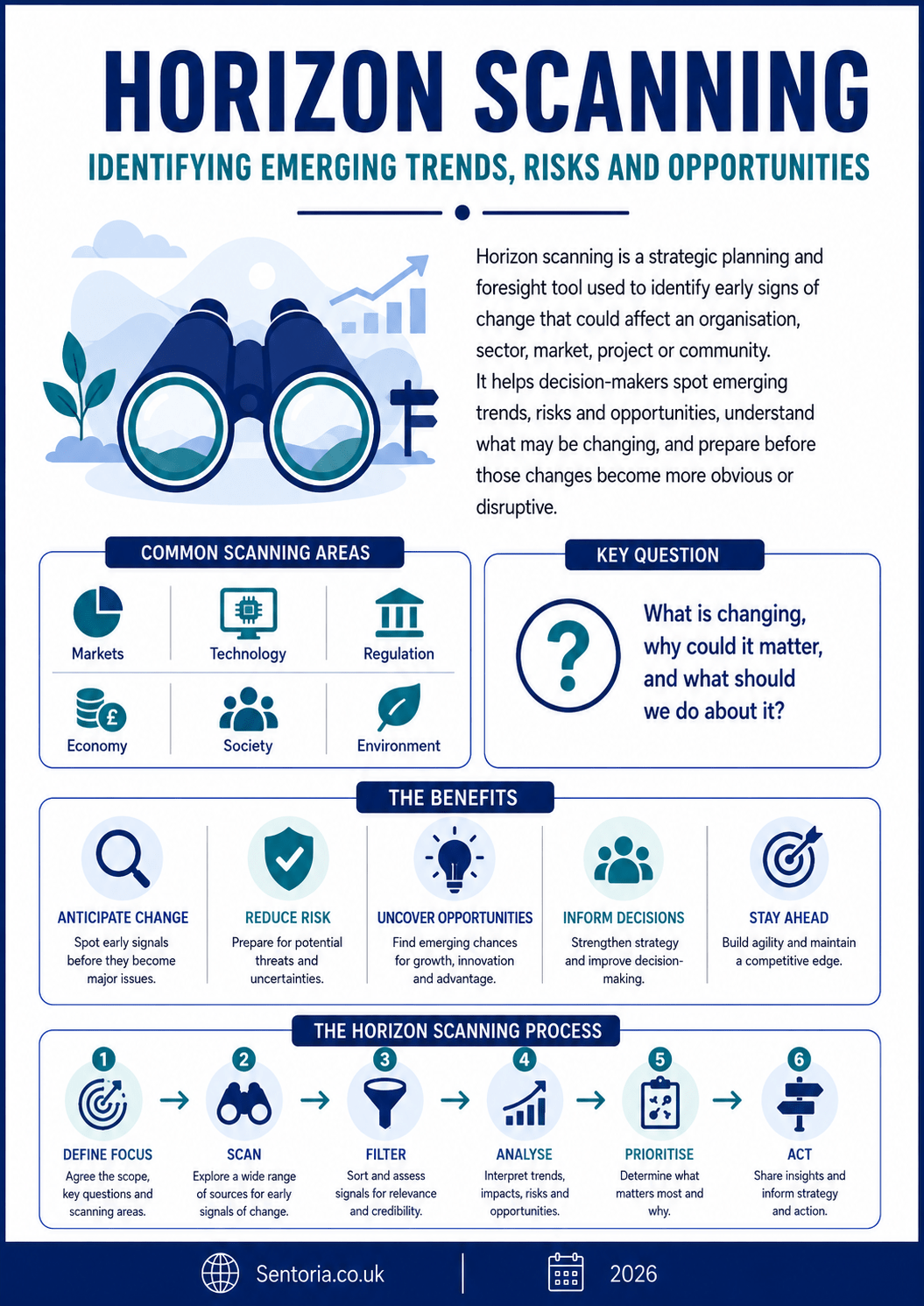
Horizon scanning is a strategic planning and foresight tool used to identify early signs of change that could affect an organisation, sector, market, project or community.
At its simplest, horizon scanning asks:
What is changing, what might change next, why could it matter, and what should we do about it?
That makes it useful for business strategy, charity governance, public sector planning, risk management, policy development, technology planning, property and construction, professional services, healthcare, education, investment decisions and board reporting.
The UK Government Futures Toolkit describes horizon scanning as the systematic collection of insights on emerging trends and weak signals of change to identify potential threats, risks and opportunities.
Used properly, horizon scanning helps organisations look beyond immediate pressures and prepare for change before it becomes obvious.
What is horizon scanning?
Horizon scanning is the structured process of looking for signals of change.
Those signals may relate to:
- Markets
- Customers
- Technology
- Regulation
- Politics
- Economics
- Society
- Demographics
- Environment
- Competitors
- Funding
- Workforce
- Supply chains
- Public attitudes
- Local communities
- Infrastructure
- Legal change
- Data and cyber risk
- Consumer behaviour
- Global trends
It is not the same as prediction.
Horizon scanning does not claim to know exactly what will happen. Instead, it helps organisations notice developments early, explore possible implications and decide whether action is needed.
The OECD describes horizon scanning as detecting emerging evidence and early signals of change in the present to help anticipate their potential future impacts.
In plain English:
Horizon scanning is about spotting what might be coming before it arrives fully.
That might include a new technology, a change in customer expectations, a political shift, a funding risk, a regulatory proposal, a competitor move, a social trend or an emerging operational threat.
History and development of horizon scanning
Horizon scanning developed from wider futures, foresight, policy and risk management practice.
Governments, defence organisations, regulators, scientific bodies and large businesses have long needed ways to think about emerging change. Traditional planning often focused on the current position and near-term forecasts. Horizon scanning developed because that was not enough.
Some changes build slowly before becoming obvious.
Others appear suddenly but have weak signals beforehand.
Examples include:
- New technologies before mass adoption.
- Demographic shifts before demand changes.
- Regulatory proposals before legal obligations arrive.
- Social attitudes before market behaviour changes.
- Supply chain pressures before shortages arise.
- Funding trends before grants reduce.
- Cyber threats before incidents occur.
- Environmental risks before costs increase.
The UK Government Office for Science has published Futures Toolkit guidance to help policymakers and analysts develop strategies that are robust in the face of an uncertain future. The Toolkit includes horizon scanning alongside other foresight methods such as scenarios, Delphi, Seven Questions and Three Horizons.
The European Commission describes horizon scanning as a structured approach to detecting and analysing emerging “game changers” at an early stage, including assessing and prioritising early signals for decision-making or further analysis.
Over time, horizon scanning has moved beyond government and academia. It is now used by businesses, charities, boards, professional firms, regulators, public bodies, universities, technology companies and local organisations that need to think beyond short-term activity.
Horizon scanning, strategic foresight and scenario planning
Horizon scanning is often used with other future-focused tools.
They are related, but they are not the same.
Horizon scanning
Horizon scanning identifies signals of change.
It asks:
What is emerging that could matter?
Strategic foresight
Strategic foresight is the wider discipline of using structured methods to think about possible futures and improve present-day decisions.
The OECD describes strategic foresight methods as including horizon scanning, megatrends analysis, scenario planning and other approaches used to anticipate future developments.
It asks:
How could the future develop, and how should we prepare?
Scenario planning
Scenario planning develops different plausible future situations.
It asks:
What different futures could emerge, and how would our strategy perform in each?
PESTLE analysis
PESTLE examines political, economic, social, technological, legal and environmental factors.
It asks:
What external forces are affecting us now or may affect us soon?
Risk register
A risk register records and manages specific risks.
It asks:
What could affect our objectives, how serious is it, and what are we doing about it?
In simple terms:
Horizon scanning finds the signals.
Foresight explores the future.
Scenario planning tests possibilities.
PESTLE structures the external environment.
The risk register manages specific risks.
What counts as a signal?
A signal is a piece of information that may indicate change.
Signals may be strong or weak.
Strong signals
Strong signals are already visible and supported by evidence.
Examples include:
- A new law has been passed.
- Interest rates have changed.
- A major competitor has entered the market.
- A public funding programme has closed.
- A new technology has been adopted widely.
- A customer segment is clearly growing.
- A supplier has announced price increases.
- A major infrastructure project has begun.
Strong signals are easier to spot because they are already visible.
Weak signals
Weak signals are early signs that something may be changing.
Examples include:
- A small but growing customer behaviour.
- Early policy consultation.
- New research findings.
- Emerging technology patents.
- Specialist industry discussion.
- A shift in language used by customers.
- Small competitor experiments.
- New funding priorities.
- Changes in recruitment patterns.
- Local community concerns before they become formal objections.
Weak signals are harder to interpret. Many may never become important. But some may develop into major trends, risks or opportunities.
The OECD has described horizon scanning as a method for detecting early indicators and weak signals that may evolve into transformative or disruptive developments.
Trends, megatrends, drivers and uncertainties
Horizon scanning often uses several related terms.
Trends
Trends are patterns of change over time.
Examples include:
- More remote working.
- Growing use of AI tools.
- Rising demand for sustainability.
- Increased online purchasing.
- Greater regulation of data.
- Ageing population.
- Declining high street footfall.
- Growth in subscription models.
Megatrends
Megatrends are large-scale, long-term changes.
Examples include:
- Climate change.
- Demographic ageing.
- Digital transformation.
- Urbanisation.
- Globalisation or fragmentation.
- Automation.
- Energy transition.
- Changing patterns of work.
Drivers of change
Drivers are forces that push change.
Examples include:
- Technology
- Regulation
- Economics
- Demographics
- Social values
- Environmental pressures
- Political decisions
- Infrastructure
- Competition
- Customer expectations
Uncertainties
Uncertainties are factors where the future direction is not clear.
Examples include:
- Future interest rates.
- Future regulation.
- Customer adoption of new technology.
- Government funding.
- Political stability.
- Market demand.
- Energy prices.
- Speed of AI adoption.
- Climate policy.
- Local planning decisions.
Horizon scanning should identify all four: trends, megatrends, drivers and uncertainties.
Why horizon scanning matters
Horizon scanning matters because organisations can become trapped by the present.
They focus on:
- Current customers
- Current costs
- Current competitors
- Current services
- Current systems
- Current problems
- Current funding
- Current projects
- Current regulations
- Current ways of working
That is understandable. Day-to-day pressures are real.
But strategy requires a wider view.
Horizon scanning helps organisations:
- Spot emerging risks earlier.
- Identify future opportunities.
- Avoid strategic surprises.
- Challenge assumptions.
- Improve board and trustee discussions.
- Support innovation.
- Prepare for regulation.
- Anticipate customer change.
- Strengthen risk management.
- Improve scenario planning.
- Test strategy.
- Inform investment decisions.
- Improve policy development.
- Build resilience.
- Make better long-term decisions.
The UK Civil Service Analysis Function has explained that regular scanning and synthesis of insights helps departments maintain awareness of emerging issues, avoid surprises and make more informed strategic choices.
That principle applies beyond government.
A business, charity or public body that scans the horizon is better placed to act early, adapt sensibly and avoid being caught off guard.
When to use horizon scanning
Horizon scanning is useful when an organisation needs to understand change beyond the immediate planning period.
Good uses include:
- Strategic planning
- Board away days
- Risk management
- Business planning
- Scenario planning
- Innovation strategy
- Product development
- Service redesign
- Public policy development
- Charity funding strategy
- Technology planning
- Workforce planning
- Market entry
- Property development
- Investment appraisal
- Business continuity planning
- Regulatory planning
- Competitor analysis
- Environmental scanning
- Community and stakeholder planning
It is especially useful where the organisation faces uncertainty.
It is less useful if treated as a one-off brainstorming exercise with no link to decisions.
Horizon scanning in different industries
SMEs and owner-managed businesses
For SMEs, horizon scanning should be practical and proportionate.
A small business does not need a large foresight department. It does need to notice changes that could affect customers, costs, cash flow, regulation, staffing and competition.
Typical SME scanning topics include:
- Customer demand
- Competitor behaviour
- Local economic conditions
- Interest rates
- Wage costs
- Supplier pricing
- Technology tools
- Tax and regulation
- Recruitment challenges
- Consumer expectations
- Local infrastructure
- Cyber threats
For example, an SME might scan for:
- Changes in Making Tax Digital requirements.
- New AI tools that could automate admin.
- Local development affecting footfall.
- Rising wage or energy costs.
- Competitors changing pricing models.
- New customer expectations around online booking.
- Regulatory changes affecting data or employment.
For SMEs, the value is not theoretical. It helps the owner ask:
What might affect us over the next one to three years, and what should we do now?
Manufacturing
Manufacturers operate in environments shaped by technology, energy, supply chains, regulation, labour and customer demand.
Typical scanning topics include:
- Automation
- Robotics
- Energy prices
- Material shortages
- Supplier concentration
- Environmental regulation
- Carbon reporting
- Export controls
- Skills availability
- Customer specification changes
- Additive manufacturing
- Quality standards
- Logistics disruption
- Product substitution
- Reshoring or nearshoring
Horizon scanning can help manufacturers identify:
- Which technologies may affect production.
- Which materials may become scarce or expensive.
- Which regulations may affect products or emissions.
- Which customers may change specifications.
- Which competitors may invest in automation.
- Which supply chains may become vulnerable.
For manufacturing, horizon scanning should link to investment planning, supplier strategy, workforce skills, risk registers and capital expenditure decisions.
Retail and ecommerce
Retail and ecommerce businesses face fast-moving changes in customer behaviour, technology, logistics and competition.
Typical scanning topics include:
- Consumer spending
- Search trends
- Social commerce
- Delivery expectations
- Returns behaviour
- Payment methods
- AI personalisation
- Marketplace rules
- Data regulation
- Sustainability expectations
- Local footfall
- Customer reviews
- Influencer trends
- Subscription models
- Competitor promotions
For ecommerce, horizon scanning may identify early shifts in:
- How customers search.
- What platforms they use.
- Which products are gaining attention.
- How delivery expectations are changing.
- How advertising costs are moving.
- How regulation may affect data, cookies or product claims.
Retailers that scan the horizon can avoid being surprised by changing customer expectations.
Professional services
Professional services firms need horizon scanning because clients, technology, regulation and delivery models are changing.
Typical scanning topics include:
- Tax changes
- Legal regulation
- AI and automation
- Client expectations
- Pricing models
- Data protection
- Cyber security
- Professional standards
- Recruitment and skills
- Remote advisory work
- Client sectors
- Funding and finance trends
- Outsourcing
- Digital signatures
- Sector consolidation
For accountants, solicitors, consultants, architects and advisers, horizon scanning can support:
- Service development.
- Client briefings.
- Risk management.
- Pricing.
- Staff training.
- Technology investment.
- Marketing content.
- Advisory opportunities.
For example, a firm might scan for tax announcements, Companies House reform, AI tools, sector-specific regulation and local economic trends affecting clients.
Charities and voluntary organisations
Charities need horizon scanning because funding, service demand, policy, demographics and community needs change.
Typical scanning topics include:
- Funder priorities
- Grant availability
- Local deprivation trends
- Public sector commissioning
- Volunteer availability
- Demographic change
- Safeguarding expectations
- Community needs
- Cost pressures
- Policy change
- Donor behaviour
- Digital fundraising
- Partnership opportunities
- Public trust
- Demand for services
For charities, horizon scanning can help trustees and management ask:
- Are beneficiary needs changing?
- Are funding sources becoming more uncertain?
- Are commissioners changing priorities?
- Are volunteers harder to recruit?
- Are costs rising faster than income?
- Are new partnership opportunities emerging?
- Are risks to reserves increasing?
This can strengthen strategic planning, reserves policy, funding strategy and impact reporting.
Public sector and local government
Public bodies use horizon scanning to identify emerging policy, demand, financial, demographic and social issues.
Typical scanning topics include:
- Demographic change
- Demand for services
- Housing need
- Public health trends
- Technology
- Climate resilience
- Local economy
- Transport patterns
- Funding settlements
- Legislation
- Community cohesion
- Workforce pressures
- Procurement risks
- Digital exclusion
- Infrastructure change
The UK Government Futures Toolkit is designed to help develop policies and strategies that are robust in the face of uncertain futures.
For local government and public bodies, horizon scanning can improve policy planning, service design, risk management and long-term financial planning.
Property and construction
Property and construction organisations operate in a world of long timeframes and changing external conditions.
Typical scanning topics include:
- Planning policy
- Interest rates
- Build costs
- Construction labour
- Environmental standards
- Energy performance requirements
- Tenant demand
- Housing demand
- Infrastructure projects
- Local regeneration
- Funding availability
- Contractor insolvency
- Building safety
- Materials supply
- Insurance and finance
For property projects, horizon scanning can inform:
- Site acquisition.
- Development appraisal.
- Planning strategy.
- Tenant mix.
- Funding assumptions.
- ESG requirements.
- Build cost risk.
- Community engagement.
- Exit strategy.
- Long-term asset management.
Because property decisions often involve large commitments and long lead times, horizon scanning is especially valuable.
Technology and software
Technology businesses need horizon scanning because the environment changes quickly.
Typical scanning topics include:
- Artificial intelligence
- Cyber threats
- Data regulation
- Cloud platforms
- Open source risks
- Developer tools
- User behaviour
- Competitor products
- Platform dependencies
- Privacy expectations
- Automation
- API changes
- Security standards
- Venture funding
- Skills demand
The OECD has described horizon scanning as a foundational element of strategic intelligence for forward-looking emerging technology policies, feeding foresight exercises and technology assessments.
For software businesses, horizon scanning can help identify technology opportunities, product threats, customer needs, regulatory risks and security priorities.
Healthcare and social care
Healthcare and social care organisations need horizon scanning because demand, regulation, workforce, technology and public expectations change.
Typical scanning topics include:
- Demographic ageing
- Workforce shortages
- Digital health tools
- Regulation
- Safeguarding expectations
- Funding pressures
- Public health trends
- Patient expectations
- Care models
- Data sharing
- AI diagnostics
- Infection control
- Medicines management
- Family expectations
- Inspection priorities
For care providers and health organisations, horizon scanning should support safe planning, workforce strategy, service quality, digital adoption and business continuity.
It should always sit alongside professional judgement, safeguarding and regulatory compliance.
Education and training
Education providers need horizon scanning because learner needs, funding, labour markets and technology change.
Typical scanning topics include:
- Skills shortages
- Employer demand
- Funding rules
- Apprenticeship policy
- Digital learning
- AI in education
- Learner expectations
- Demographic trends
- Safeguarding requirements
- Inspection focus
- Qualification reform
- Labour market needs
- Online competition
- Accessibility
- Progression pathways
For education and training, horizon scanning can inform curriculum planning, employer engagement, learner support, technology adoption and funding strategy.
How to carry out horizon scanning properly
1. Define the purpose
Start by deciding why the scan is being done.
Questions include:
- What decision will the scan support?
- What time horizon matters?
- What area are we scanning?
- Who will use the findings?
- What kind of change are we looking for?
- Are we looking for risks, opportunities or both?
- What are the boundaries?
- How will findings be reported?
- How often will the scan be updated?
- What action may follow?
Without a clear purpose, horizon scanning becomes unfocused research.
2. Set the time horizon
Different decisions need different timeframes.
Possible horizons include:
- 6 to 12 months for operational risks.
- 1 to 3 years for business planning.
- 3 to 5 years for strategy.
- 5 to 10 years for major investment, property and workforce planning.
- 10 years or more for public policy, infrastructure, climate and demographic planning.
The time horizon should match the decision.
A retailer may scan weekly or monthly for consumer trends. A property business may scan over several years. A local authority may need to scan over decades for demographics, housing, infrastructure and climate.
3. Decide what to scan
A useful structure is STEEP or PESTLE.
STEEP
- Social
- Technological
- Economic
- Environmental
- Political
PESTLE
- Political
- Economic
- Social
- Technological
- Legal
- Environmental
Other categories may include:
- Competitors
- Customers
- Funding
- Workforce
- Infrastructure
- Supply chains
- Local community
- Regulation
- Global events
- Industry standards
The structure should fit the organisation.
4. Gather information from diverse sources
Good horizon scanning uses varied sources.
These may include:
- Government publications
- Regulatory consultations
- Industry reports
- Academic research
- Customer feedback
- Competitor activity
- News sources
- Trade bodies
- Local authority plans
- Funding announcements
- Technology reports
- Patent filings
- Recruitment trends
- Social media signals
- Search trends
- Supplier briefings
- Expert interviews
- Conferences
- Professional networks
- Internal staff insight
The OECD notes that horizon scanning can involve weak signals and unconventional data sources, including patent analysis, crowd forecasting and generative AI, particularly in emerging critical risk work.
The key is diversity. If the organisation only scans familiar sources, it may only confirm what it already believes.
5. Capture signals consistently
Signals should be recorded in a simple format.
A useful signal record may include:
- Signal title
- Date identified
- Source
- Summary
- Category
- Time horizon
- Evidence strength
- Potential impact
- Level of uncertainty
- Relevance to organisation
- Possible opportunity
- Possible risk
- Linked strategy area
- Suggested action
- Owner
- Review date
This creates a scanning database or log.
It also stops useful insights being lost in emails, meetings or informal conversations.
6. Look for patterns
Individual signals matter, but patterns matter more.
Ask:
- Are several signals pointing in the same direction?
- Is a weak signal becoming stronger?
- Are changes appearing across different sectors?
- Are customers behaving differently?
- Are regulators using different language?
- Are competitors experimenting?
- Are costs moving consistently?
- Are staff or suppliers raising similar issues?
- Are local and national trends aligning?
- Are risks appearing in several places?
Horizon scanning is not just collecting articles. It is making sense of change.
7. Assess relevance and impact
Not every signal matters.
For each signal or trend, assess:
- How relevant is it?
- How likely is it to develop?
- How quickly could it affect us?
- What would the impact be?
- Is it a risk, opportunity or both?
- Which objectives could it affect?
- What evidence supports it?
- What is still uncertain?
- Who needs to know?
- What action may be required?
A simple scoring approach may help.
For example:
- Relevance: low, medium, high
- Impact: low, medium, high
- Time horizon: short, medium, long
- Confidence: low, medium, high
8. Explore implications
This is where horizon scanning becomes useful.
Ask:
- What could this mean for our strategy?
- What could this mean for customers or service users?
- What could this mean for income?
- What could this mean for costs?
- What could this mean for staff?
- What could this mean for technology?
- What could this mean for regulation?
- What could this mean for risk?
- What could this mean for competitors?
- What could this mean for partners?
A signal only becomes valuable when its implications are considered.
9. Turn findings into action
Horizon scanning should lead to decisions or further work.
Possible actions include:
- Add a risk to the risk register.
- Update the assumptions log.
- Create a scenario planning exercise.
- Review the business continuity plan.
- Develop a new service.
- Change investment priorities.
- Commission further research.
- Brief the board or trustees.
- Update the strategy.
- Review supplier arrangements.
- Start a pilot project.
- Develop staff skills.
- Monitor a trend more closely.
- Engage with stakeholders.
- Prepare a policy response.
Without action, horizon scanning becomes interesting but not useful.
10. Review regularly
Horizon scanning should be a routine, not a one-off.
Possible review cycles include:
- Monthly operational scan
- Quarterly strategic scan
- Annual board foresight review
- Pre-budget or pre-strategy scan
- Project milestone scan
- Risk committee scan
- Sector-specific scan after major announcements
The scan should be updated as signals strengthen, weaken or disappear.
Common mistakes in horizon scanning
Mistake 1: Treating it as prediction
Horizon scanning is not about predicting one certain future.
It is about identifying possible change and preparing better.
Mistake 2: Looking only at familiar sources
If an organisation only reads familiar trade updates, it may miss wider change.
Good scanning looks beyond the usual sources.
Mistake 3: Collecting information without analysis
A folder full of articles is not horizon scanning.
The value comes from interpreting signals and considering implications.
Mistake 4: Ignoring weak signals
Weak signals may be uncertain, but they can be important.
The point is not to act on every weak signal. The point is to notice and monitor them.
Mistake 5: Focusing only on threats
Horizon scanning should identify opportunities as well as risks.
A new technology, funding stream, customer behaviour or partnership model may create advantage.
Mistake 6: Focusing only on the far future
Horizon scanning is not only about distant futures.
Some signals affect decisions within months.
Mistake 7: Not involving diverse people
Different people notice different signals.
Staff, customers, service users, trustees, suppliers, advisers and external experts may all see different parts of the horizon.
Mistake 8: No link to strategy
Scanning is weak if it does not influence decisions.
The findings should feed strategy, risk, investment, service design or policy.
Mistake 9: Overreacting to every signal
Not every signal matters.
Some are noise. Some are temporary. Some are irrelevant.
Prioritisation is essential.
Mistake 10: Not updating the scan
A horizon scan becomes stale quickly.
Trends evolve. Evidence changes. Assumptions need review.
Limitations and weaknesses of horizon scanning
Horizon scanning is useful, but it has limits.
It cannot eliminate uncertainty
The future remains uncertain.
Horizon scanning improves awareness, but it does not provide certainty.
It can be biased
People may notice signals that confirm existing beliefs.
This is why diverse sources and challenge matter.
It can create information overload
There is too much information available.
The process needs clear scope, categories and prioritisation.
It can be too speculative
Some signals are interesting but not useful.
The organisation should focus on relevance and implications.
It can be ignored by decision-makers
Horizon scanning only matters if the findings are used.
If boards and managers do not act on insights, the process adds little value.
It may miss sudden shocks
Some events happen with little warning.
Horizon scanning helps, but it should sit alongside business continuity planning and risk management.
It may favour visible trends
Some deep changes are not obvious at first.
This is why scanning should include weak signals, expert input and outside perspectives.
It does not replace strategy
Horizon scanning informs strategy.
It does not decide the strategy by itself.
Horizon scanning compared with other strategic tools
Horizon scanning and PESTLE
PESTLE provides a structure for external analysis.
Horizon scanning identifies emerging signals and trends.
Use PESTLE to organise the scanning categories. Use horizon scanning to keep the external analysis current.
Horizon scanning and SWOT
SWOT identifies strengths, weaknesses, opportunities and threats.
Horizon scanning feeds the opportunity and threat side of SWOT.
It can also reveal internal weaknesses if the organisation is not prepared for change.
Horizon scanning and TOWS
TOWS turns SWOT into strategic options.
Horizon scanning can provide the external signals that inform those options.
Horizon scanning and scenario planning
Horizon scanning identifies signals.
Scenario planning builds plausible future situations from those signals.
Use horizon scanning before scenario planning to ensure scenarios are grounded in evidence.
Horizon scanning and risk register
Horizon scanning may identify emerging risks.
Those risks should be added to the risk register, scored, assigned owners and reviewed.
Horizon scanning and assumptions log
Horizon scanning can challenge assumptions.
For example, if a strategy assumes stable customer demand, scanning may reveal changing behaviour that needs review.
Horizon scanning and business continuity plan
Horizon scanning can identify emerging disruption risks.
These may include cyber threats, climate events, supplier vulnerability, workforce shortages or infrastructure pressures.
Horizon scanning and competitor analysis
Competitor analysis looks at current and likely competitor behaviour.
Horizon scanning looks wider, including new entrants, substitutes, customer change, technology and regulation.
Horizon scanning and Blue Ocean Strategy
Blue Ocean Strategy seeks new market space.
Horizon scanning can identify emerging customer needs, noncustomer trends and external changes that may create new opportunities.
Horizon scanning and OKRs
OKRs set focused objectives and measurable key results.
Horizon scanning can identify external changes that may require OKRs to be adjusted or new OKRs to be created.
Alternatives and complementary frameworks
PESTLE analysis
Use PESTLE to structure external scanning.
Best used when the organisation wants a broad view of political, economic, social, technological, legal and environmental factors.
Scenario planning
Use scenario planning to explore different possible futures.
Best used after horizon scanning has identified important uncertainties.
Three Horizons
Use Three Horizons to examine current systems, transition patterns and emerging future possibilities.
Best used when thinking about long-term change and transformation.
Delphi method
Use Delphi when expert judgement is needed across multiple rounds of structured questioning.
Best used where uncertainty is high and expert consensus or divergence matters.
Trend analysis
Use trend analysis to examine data over time.
Best used where measurable patterns exist.
Weak signal analysis
Use weak signal analysis to explore early signs of change.
Best used where disruption may start small.
Competitor analysis
Use competitor analysis to understand how competitors are moving.
Best used alongside horizon scanning where market position matters.
Scenario stress testing
Use scenario stress testing to test whether a strategy works under different future conditions.
Best used after scenarios have been created.
Risk register
Use the risk register to manage emerging risks identified through scanning.
A practical horizon scanning template
A useful horizon scanning template should include:
- Scan reference
- Date identified
- Signal or trend title
- Source
- Category
- Summary
- Evidence strength
- Time horizon
- Relevance
- Potential impact
- Opportunity
- Risk
- Affected objectives
- Linked assumptions
- Linked risks
- Recommended action
- Owner
- Review date
- Status
- Notes
Example:
Signal title: Increased use of AI tools in professional services.
Category: Technological.
Source: Industry reports, software vendor announcements and client enquiries.
Summary: AI tools are increasingly being used to automate document review, reporting, drafting and customer support.
Time horizon: 1 to 3 years.
Potential opportunity: Improve efficiency, develop new advisory services and reduce routine administration.
Potential risk: Competitors may reduce prices, clients may expect faster turnaround, and data protection risks may increase.
Recommended action: Review current processes, identify safe AI use cases, update data policies, train staff and monitor competitor adoption.
Owner: Operations Director.
Review date: Quarterly.
Questions to ask during horizon scanning
Scope questions
- What decision will this scan support?
- What timeframe matters?
- What geography matters?
- What sectors matter?
- What categories should be included?
- Who will use the findings?
- How often should scanning happen?
- What would count as a significant signal?
- What sources should be monitored?
- What should be excluded?
Signal questions
- What is changing?
- What is emerging?
- What is unusual?
- What is increasing?
- What is declining?
- What are customers doing differently?
- What are competitors testing?
- What are regulators discussing?
- What technologies are developing?
- What weak signals keep appearing?
Evidence questions
- What is the source?
- Is the source reliable?
- Is there more than one source?
- Is the signal supported by data?
- Is it anecdotal?
- Is it early-stage?
- Is it a strong trend or weak signal?
- Is there conflicting evidence?
- Is it relevant to us?
- What evidence is missing?
Impact questions
- What could this mean for our organisation?
- What could this mean for customers or service users?
- What could this mean for income?
- What could this mean for costs?
- What could this mean for staff?
- What could this mean for suppliers?
- What could this mean for regulation?
- What could this mean for technology?
- What could this mean for reputation?
- What could this mean for strategy?
Opportunity questions
- Could this create a new product or service?
- Could this open a new market?
- Could this improve efficiency?
- Could this improve customer experience?
- Could this create a partnership opportunity?
- Could this support funding or investment?
- Could this improve resilience?
- Could this strengthen reputation?
- Could this help us differentiate?
- Could this give us first-mover advantage?
Risk questions
- Could this create a new risk?
- Could this increase an existing risk?
- Could this weaken our current strategy?
- Could this affect cash flow?
- Could this affect compliance?
- Could this affect operations?
- Could this affect customer trust?
- Could this affect staff capacity?
- Could this affect suppliers?
- Should this be added to the risk register?
Action questions
- Should we monitor this?
- Should we research it further?
- Should we brief the board or trustees?
- Should we update the strategy?
- Should we change a risk rating?
- Should we test a new idea?
- Should we update an assumption?
- Should we prepare a scenario?
- Should we speak to customers or stakeholders?
- Who owns the next step?
The best way to think about horizon scanning
Horizon scanning is not fortune-telling.
It is disciplined curiosity.
A good horizon scanning process should be:
- Structured
- Regular
- Broad
- Evidence-informed
- Open to weak signals
- Linked to decisions
- Connected to strategy
- Connected to risk management
- Challenged by diverse perspectives
- Turned into action
A weak horizon scan says:
“Here are some interesting trends.”
A strong horizon scan asks:
“What is changing, why could it matter, what evidence do we have, and what should we do next?”
The key question is not simply:
What might happen in the future?
The better question is:
What early signs of change can we see now, and how should they affect the decisions we are making today?
Conclusion: horizon scanning turns early signals into better strategic decisions
Horizon scanning remains useful because change rarely waits for organisations to feel ready.
Customers shift. Regulations change. Technology develops. Costs rise. Funding moves. Competitors adapt. Public expectations evolve. Risks emerge.
Used badly, horizon scanning becomes a collection of interesting articles, trends and speculation.
Used properly, it becomes a practical strategic tool. It helps organisations identify emerging risks, spot opportunities, challenge assumptions, strengthen strategy, improve resilience and prepare for uncertainty.
The real value is not in scanning the horizon.
The real value is in acting on what the scan reveals.
A strong horizon scanning process helps an organisation move from saying, “We did not see that coming,” to asking, “What signals are already visible, what could they mean, and what should we do before the change fully arrives?”