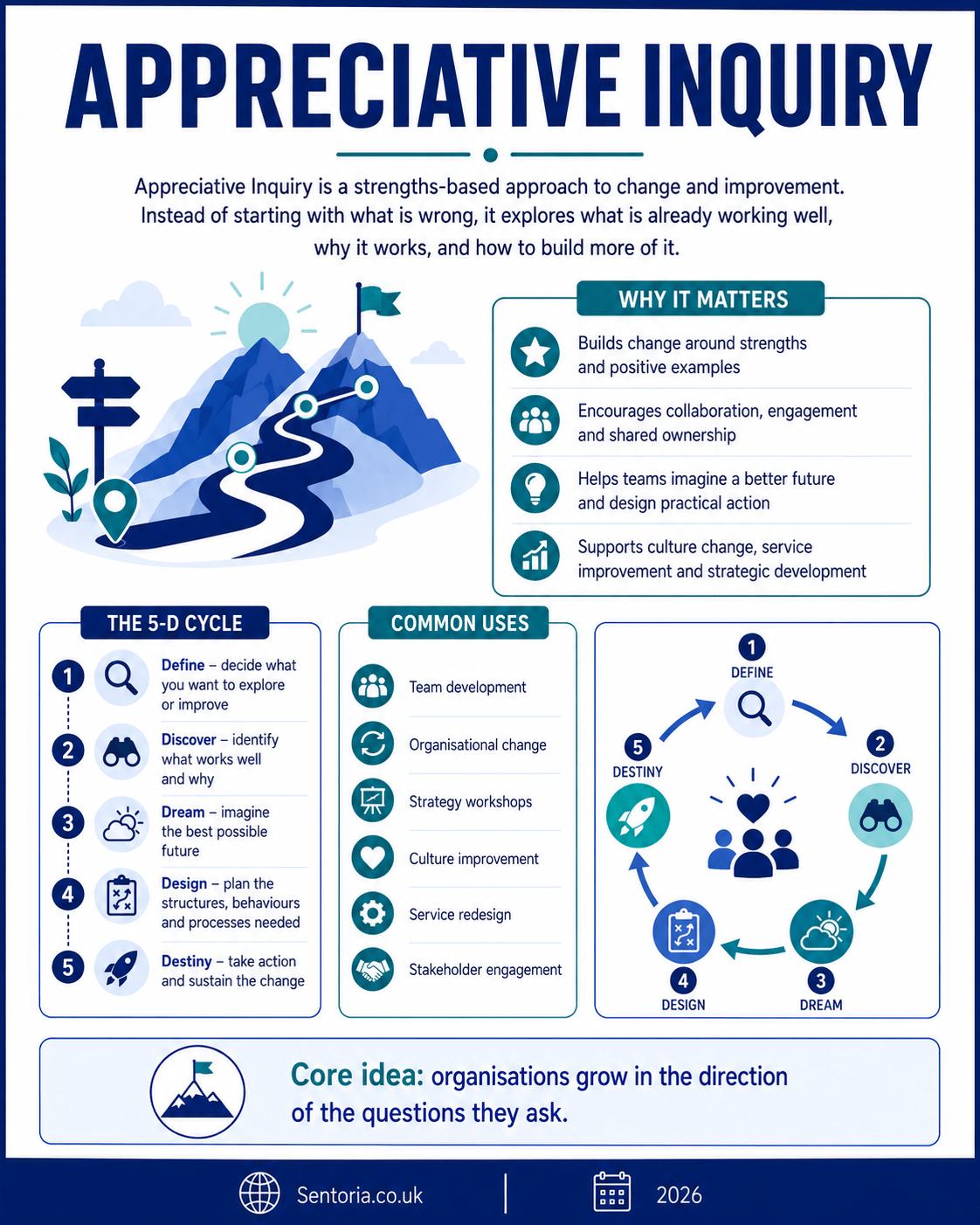
Appreciative Inquiry:
A Practical Guide to Building Change Around Strengths, Possibility and What Works
Appreciative Inquiry, often shortened to AI, is a strengths-based approach to organisational development, change and problem-solving.
At its simplest, Appreciative Inquiry asks:
What is already working well, why does it work, what future do we want to create, and how can we build more of it?
That makes it useful for leadership, organisational change, team development, strategy, culture, service improvement, charity governance, public sector transformation, education, healthcare, community development, customer experience, staff engagement and board planning.
Appreciative Inquiry is often described as a positive and collaborative approach to change. Rather than beginning with failure, deficit or blame, it begins by identifying strengths, successful experiences and the conditions that allow people and organisations to perform at their best. AI Commons describes the 5-D cycle as a practical process for change at levels ranging from one-to-one coaching to team building and whole-system change.
Used properly, Appreciative Inquiry is not about ignoring problems. It is about changing the starting point of the conversation so that improvement is built on evidence of what already gives life, energy and value to the organisation.
What is Appreciative Inquiry?
Appreciative Inquiry is a method for creating change by exploring strengths, successes, values, hopes and possibilities.
A traditional problem-solving approach often starts with:
- What is wrong?
- Why did it go wrong?
- Who is responsible?
- How do we fix the problem?
- How do we stop it happening again?
That can be useful, especially where there are serious risks, compliance failures, safeguarding concerns, safety issues or financial weaknesses.
Appreciative Inquiry starts differently.
It asks:
- When have we been at our best?
- What made that possible?
- What strengths already exist?
- What do people value most?
- What future do we want?
- What would it look like if we had more of what works?
- What practical steps would move us towards that future?
This makes the conversation more constructive.
It helps people move from blame, frustration or helplessness towards possibility, ownership and action.
A useful way to think about Appreciative Inquiry is:
Instead of asking only what problem needs fixing, it asks what strength can be built upon.
History and development of Appreciative Inquiry
Appreciative Inquiry developed within the field of organisational development.
It is most closely associated with David Cooperrider and Suresh Srivastva at Case Western Reserve University. Their 1987 work, Appreciative Inquiry in Organizational Life, helped establish Appreciative Inquiry as a different way of thinking about organisational change, moving away from purely deficit-based diagnosis towards inquiry into what gives life to organisations when they are at their best.
The approach became influential because many organisational change efforts were built around problems, gaps and weaknesses. That can identify issues, but it can also create defensiveness and fatigue. People can become trapped in a story that the organisation is broken.
Appreciative Inquiry offered a different premise:
Organisations grow in the direction of the questions they ask.
If people are only asked about failure, they may become focused on failure.
If they are asked about success, energy, values and possibility, they may discover resources that can be used for change.
Over time, Appreciative Inquiry has been applied in:
- Organisational development
- Leadership development
- Culture change
- Strategic planning
- Team building
- Community development
- Healthcare improvement
- Education
- Charity and voluntary sector work
- Public sector transformation
- Coaching
- Conflict resolution
- Innovation
- Staff engagement
- Whole-system change
The method is now commonly associated with the 4-D cycle and the expanded 5-D cycle. The familiar 4-D model includes Discover, Dream, Design and Destiny or Deliver. Later versions often add Define at the beginning, creating the 5-D model: Define, Discover, Dream, Design and Destiny.
Why Appreciative Inquiry matters
Appreciative Inquiry matters because the way a question is framed shapes the answer.
Many organisations spend a great deal of time asking negative questions:
- Why are staff disengaged?
- Why are customers unhappy?
- Why are projects late?
- Why are teams not performing?
- Why is communication poor?
- Why do changes fail?
- Why is morale low?
Those questions may be legitimate, but they can also create defensive answers.
Appreciative Inquiry reframes the conversation:
- When have staff felt most engaged?
- What created excellent customer experiences?
- When have projects worked well?
- What helps this team perform at its best?
- When has communication been clear and useful?
- What change has succeeded before?
- What gives people energy and commitment?
This does not deny problems.
It simply looks for evidence of capability.
That matters because organisations often already contain examples of the future they want to create.
A business that wants better customer service may already have pockets of excellent customer service.
A charity that wants stronger collaboration may already have examples of excellent partnership working.
A public body that wants more resident-focused services may already have teams that do this well.
A professional firm that wants better client relationships may already have advisers who are trusted, proactive and commercially useful.
Appreciative Inquiry helps find those examples, understand them and scale the conditions that made them possible.
The 5-D cycle of Appreciative Inquiry
The 5-D cycle is one of the most common Appreciative Inquiry frameworks.
It includes:
- Define
- Discover
- Dream
- Design
- Destiny
The Center for Appreciative Inquiry describes the 5-D process as Define, Discover, Dream, Design and Destiny, used to facilitate Appreciative Inquiry sessions and create shared vision and action.
1. Define
Define sets the focus of the inquiry.
It asks:
What do we want to explore, improve or create?
This is important because Appreciative Inquiry needs a clear topic.
The topic should be framed positively.
For example:
Weak topic:
Why is communication poor?
Stronger AI topic:
How can we create clearer, more useful and more trusted communication across the organisation?
Weak topic:
Why are staff disengaged?
Stronger AI topic:
What helps people feel motivated, valued and able to do their best work?
The Define stage should identify:
- The subject of inquiry
- The people involved
- The purpose of the work
- The desired direction
- The boundaries of the inquiry
- The practical output required
- How the findings will be used
A good Define stage prevents the process becoming vague or sentimental.
2. Discover
Discover explores the best of what already exists.
It asks:
When has this worked well, and what made it work?
This stage often uses interviews, workshops, storytelling and group discussion.
Typical Discover questions include:
- Tell me about a time when this team worked at its best.
- When have we delivered excellent service?
- What made that success possible?
- What strengths were being used?
- What conditions helped people perform well?
- What relationships mattered?
- What values were visible?
- What systems or behaviours helped?
- What can we learn from that experience?
- What should we do more of?
The Discover stage is evidence-based.
It does not ask people to pretend everything is fine. It asks them to find real examples of success and understand the factors behind them.
3. Dream
Dream imagines the preferred future.
It asks:
What could this look like if we built on our strengths?
This stage encourages people to think beyond current constraints.
Possible Dream questions include:
- What would the organisation look like at its best?
- What would customers, service users or beneficiaries experience?
- What would staff notice?
- What would leaders do differently?
- What would be easier, clearer or better?
- What would we be proud of?
- What would stakeholders say about us?
- What strengths would be visible every day?
- What would success look like in one year?
- What would success look like in five years?
The Dream stage is not fantasy.
It should be ambitious but grounded in what was discovered.
The point is to create a shared picture of what the organisation wants to build.
4. Design
Design turns the desired future into practical choices, structures, behaviours and commitments.
It asks:
What needs to be designed, changed or strengthened to make the dream possible?
This may include:
- Processes
- Roles
- Systems
- Services
- Behaviours
- Governance
- Communication
- Training
- Culture
- Customer journeys
- Decision-making
- Performance measures
- Meetings
- Policies
- Partnerships
Possible Design questions include:
- What must be in place for this future to happen?
- What processes would support it?
- What behaviours should become normal?
- What should leaders do more consistently?
- What should teams do differently?
- What systems or structures need changing?
- What should we stop doing?
- What should we start doing?
- What should we protect?
- What practical commitments can we make?
The Design stage turns positive thinking into operating reality.
5. Destiny
Destiny, sometimes called Deliver, focuses on action, learning and sustained change.
It asks:
What will we do, who will do it, and how will we keep momentum?
This stage may include:
- Action plans
- Owners
- Milestones
- Experiments
- Pilot projects
- Communication
- Review points
- Success measures
- Accountability
- Learning loops
Possible Destiny questions include:
- What is the first action?
- Who will lead it?
- Who needs to be involved?
- What can be piloted quickly?
- What will show progress?
- What support is needed?
- What could block momentum?
- How will we review progress?
- How will we keep people engaged?
- What will we celebrate and learn from?
This stage is where Appreciative Inquiry becomes practical change.
Without action, it remains an interesting conversation.
Appreciative Inquiry compared with traditional problem-solving
Traditional problem-solving is often based on finding and fixing deficits.
It can be effective when there is a clear fault, failure or gap.
For example:
- A process is broken.
- A control has failed.
- A safety issue exists.
- A deadline has been missed.
- A customer complaint must be resolved.
- A statutory duty has not been met.
- A system error needs correction.
Appreciative Inquiry is different.
It is more useful when the organisation needs energy, engagement, culture change, collaboration, learning or shared ownership.
Traditional problem-solving asks:
What is wrong and how do we fix it?
Appreciative Inquiry asks:
What is working and how do we build on it?
Both can be useful.
The mistake is thinking only one approach is valid.
A serious safeguarding issue should not be handled only through positive inquiry.
A culture change programme should not be handled only through fault-finding.
The right approach depends on the situation.
When to use Appreciative Inquiry
Appreciative Inquiry is useful where engagement, culture, collaboration and shared ownership matter.
Good uses include:
- Team development
- Staff engagement
- Leadership development
- Culture change
- Organisational values
- Strategy workshops
- Customer experience improvement
- Service redesign
- Charity development
- Public sector transformation
- Community engagement
- Board away days
- Partnership working
- Volunteer engagement
- Innovation workshops
- Coaching
- Conflict recovery
- Change programmes
- Mergers and integration
- Learning from success
It is especially useful where:
- Morale is low.
- Change fatigue is high.
- People feel blamed.
- The organisation needs a more constructive conversation.
- There are examples of good practice to build upon.
- The issue is complex and relational.
- Stakeholder ownership matters.
- The desired change requires behaviour and culture change.
It is less useful where there is an urgent compliance failure, immediate safety risk, fraud concern or unresolved serious incident requiring formal investigation.
In those cases, Appreciative Inquiry may still help later with learning and culture, but it should not replace proper investigation, accountability or risk control.
Appreciative Inquiry in different industries
SMEs and owner-managed businesses
For SMEs, Appreciative Inquiry can help business owners and teams identify what already works and use it to improve the wider business.
Typical uses include:
- Improving customer service
- Building a stronger team culture
- Reducing owner dependency
- Improving internal communication
- Developing managers
- Strengthening sales behaviours
- Improving staff retention
- Identifying what makes the business special
- Supporting growth
- Creating a clearer service proposition
An SME might ask:
- When have customers been most delighted?
- What did we do differently in those cases?
- When has the team solved a problem well?
- What strengths make this business valuable?
- What do staff enjoy doing well?
- What would the business look like if we had more of that?
- What can we design into our normal processes?
For owner-managed businesses, AI can be particularly useful because many strengths are informal. The business may work well because of personal relationships, judgement, responsiveness and trust. Appreciative Inquiry helps identify those strengths so they can be protected, developed and shared.
Manufacturing
Manufacturing businesses can use Appreciative Inquiry for quality improvement, safety culture, teamwork, production reliability and continuous improvement.
Typical uses include:
- Learning from high-performing shifts
- Improving safety culture
- Reducing rework by studying successful production runs
- Improving maintenance behaviours
- Strengthening supervisor communication
- Improving cross-functional working
- Supporting lean improvement
- Improving supplier collaboration
- Increasing staff engagement
- Building pride in workmanship
A manufacturer might ask:
- When has this production line performed at its best?
- What made that shift successful?
- What behaviours helped prevent defects?
- When have safety conversations worked well?
- What does excellent handover look like?
- What can we learn from the teams with the best quality results?
- How can we design more of those conditions into normal work?
For manufacturing, Appreciative Inquiry should complement data-driven quality, safety and operational control. It should not replace root cause analysis where defects or incidents require technical investigation.
Retail and ecommerce
Retail and ecommerce businesses can use Appreciative Inquiry to improve customer experience, retention, service culture and team performance.
Typical uses include:
- Understanding excellent customer reviews
- Improving customer service
- Strengthening brand experience
- Learning from successful promotions
- Improving fulfilment teamwork
- Reducing returns through positive examples
- Improving staff engagement
- Strengthening store culture
- Improving online customer journeys
- Building repeat purchase behaviour
A retailer might ask:
- Which customer experiences have created excellent reviews?
- What did we do that made the customer feel valued?
- When has fulfilment worked especially smoothly?
- What makes customers come back?
- Which products create the strongest loyalty?
- What would our ideal customer experience feel like?
- What can we build into training and process?
For ecommerce, AI can help connect data with human insight. Analytics may show what happened. Appreciative Inquiry can help understand why customers or teams responded positively.
Professional services
Professional services firms can use Appreciative Inquiry for client relationships, advisory development, quality, culture and team learning.
Typical uses include:
- Learning from excellent client feedback
- Developing advisory services
- Improving client onboarding
- Strengthening internal review culture
- Supporting staff development
- Improving cross-team communication
- Building a coaching culture
- Reducing deadline pressure through positive practice
- Clarifying firm values
- Improving client retention
For accountants, solicitors, consultants, architects and advisers, AI might ask:
- When have we delivered real value to a client?
- What made that engagement work well?
- When did a client trust our advice?
- What behaviours created that trust?
- Which client meetings felt most useful?
- What strengths do our best client relationships rely on?
- How can we design more of that into normal service delivery?
Professional services firms often focus heavily on errors, deadlines and compliance. That is necessary, but AI can add balance by studying excellent practice and scaling it.
Charities and voluntary organisations
Charities can use Appreciative Inquiry to strengthen mission, volunteering, impact, staff engagement, partnerships and trustee development.
Typical uses include:
- Volunteer engagement
- Staff wellbeing
- Service improvement
- Beneficiary voice
- Impact storytelling
- Partnership development
- Trustee away days
- Funding strategy
- Community engagement
- Culture and values work
A charity might ask:
- When have we made the biggest difference to a family, person or community?
- What made that possible?
- What do beneficiaries value most about our work?
- When have volunteers felt most connected?
- When have partnerships worked well?
- What strengths should we protect as we grow?
- What would our charity look like at its best?
For charities, Appreciative Inquiry is particularly powerful because it can reconnect people with purpose. However, it should still sit alongside safeguarding, risk management, financial control and proper governance.
Public sector and local government
Public bodies can use Appreciative Inquiry in service redesign, community engagement, workforce development and cultural change.
Typical uses include:
- Resident engagement
- Service improvement
- Staff morale
- Cross-department working
- Transformation programmes
- Partnership working
- Community development
- Leadership development
- Equality and inclusion conversations
- Preventative service design
A public body might ask:
- When have residents experienced the service at its best?
- What made that possible?
- When have teams worked across boundaries well?
- What conditions supported that collaboration?
- When has public engagement been constructive?
- What would a more responsive service look like?
- What can we design into future delivery?
For public services, AI can help create more constructive conversations with staff and communities, especially where traditional consultation becomes defensive or adversarial.
Property and construction
Property and construction organisations can use Appreciative Inquiry for stakeholder engagement, project learning, safety culture, tenant relationships and regeneration planning.
Typical uses include:
- Learning from successful projects
- Improving contractor relationships
- Strengthening safety culture
- Improving tenant communication
- Supporting regeneration engagement
- Identifying what makes a place work
- Improving project handovers
- Reducing conflict
- Creating shared vision
- Building community support
A property or construction team might ask:
- When has a project run especially well?
- What made the contractor relationship work?
- When have tenants felt properly informed?
- What creates trust with local stakeholders?
- When has site safety culture been strong?
- What would a successful regeneration outcome feel like?
- What should be built into the next phase?
For property and construction, AI should complement technical due diligence, risk registers, planning analysis, cost control and health and safety processes.
Technology and software
Technology teams can use Appreciative Inquiry for product development, user experience, agile teamwork, customer success and culture.
Typical uses include:
- Understanding excellent user outcomes
- Improving product adoption
- Learning from successful releases
- Strengthening agile retrospectives
- Improving developer collaboration
- Reducing support friction
- Building customer success culture
- Improving onboarding
- Supporting innovation
- Scaling good practice
A software team might ask:
- When have users adopted a feature quickly?
- What made that feature valuable?
- When has a release gone smoothly?
- What did the team do differently?
- When did support resolve an issue brilliantly?
- What does excellent collaboration look like here?
- How can we design more of that into product and process?
For technology businesses, AI can help balance the tendency to focus only on bugs, defects and technical debt. Those matter, but so does learning from what users love and teams do well.
Healthcare and social care
Healthcare and social care organisations can use Appreciative Inquiry for quality improvement, staff morale, patient experience, safeguarding culture and service redesign.
Typical uses include:
- Learning from excellent care
- Improving staff engagement
- Strengthening team communication
- Improving patient or service user experience
- Supporting quality improvement
- Building safer handover practices
- Improving family communication
- Strengthening supervision
- Reducing burnout
- Supporting compassionate leadership
A care provider might ask:
- When have we delivered care that made us proud?
- What made that care possible?
- When have handovers worked well?
- What helps staff feel supported?
- When have families felt reassured?
- What conditions support safe and dignified care?
- How can we build more of those conditions into everyday practice?
In healthcare and care, Appreciative Inquiry should never replace incident reporting, safeguarding procedures or clinical governance. It can, however, help organisations learn from excellence as well as from failure.
Education and training
Education providers can use Appreciative Inquiry for learner engagement, teaching quality, staff development, employer partnerships and curriculum improvement.
Typical uses include:
- Learning from successful teaching
- Improving learner engagement
- Strengthening employer partnerships
- Supporting staff development
- Improving learner progression
- Building inclusive culture
- Improving feedback
- Strengthening safeguarding culture
- Developing curriculum
- Improving attendance and retention
An education provider might ask:
- When have learners been most engaged?
- What made that learning experience successful?
- When have learners overcome barriers well?
- What support made the difference?
- When have employer partnerships worked best?
- What does excellent teaching look like here?
- How can we design more of that into delivery?
For education, Appreciative Inquiry can support improvement by focusing on what helps learners thrive, not only what causes underperformance.
How to carry out Appreciative Inquiry properly
1. Define the topic positively
Start by choosing the focus.
The topic should be important, relevant and framed positively.
For example:
Instead of:
Why is morale low?
Use:
How can we create a workplace where people feel valued, trusted and able to do their best work?
Instead of:
Why are customers complaining?
Use:
What creates excellent customer experiences, and how can we make them more consistent?
A positive topic does not ignore the problem. It reframes the inquiry around the desired direction.
2. Involve the right people
Appreciative Inquiry works best when it includes the people affected by the change.
This may include:
- Staff
- Managers
- Directors
- Trustees
- Volunteers
- Customers
- Service users
- Beneficiaries
- Suppliers
- Partners
- Community representatives
- Professional advisers
- Board members
- Frontline teams
- Support teams
The right mix depends on the topic.
If the issue affects frontline delivery, frontline voices must be included.
If the issue affects customers or beneficiaries, their experience should be understood.
3. Ask good questions
Questions are central to Appreciative Inquiry.
Good AI questions are:
- Open
- Positive
- Specific
- Experience-based
- Forward-looking
- Curious
- Non-blaming
- Practical
- Values-led
- Action-oriented
Examples include:
- Tell me about a time when this worked really well.
- What made that possible?
- What strengths were present?
- What did people do that helped?
- What conditions supported success?
- What did you value most?
- What could we learn from that?
- What would it look like if this happened more often?
- What would be different?
- What small step could we take now?
Poor AI questions are vague, leading or superficial.
For example:
Everything is great, isn’t it?
That is not inquiry. That is avoidance.
4. Collect real stories
Appreciative Inquiry relies on real examples.
Stories help identify what works in practice.
For example:
- A customer interaction that went exceptionally well
- A project that delivered under pressure
- A team that solved a difficult problem
- A volunteer who felt deeply connected to the mission
- A service user who received life-changing support
- A staff member who felt trusted and empowered
- A partnership that created real value
- A process that worked smoothly
- A manager who supported a team effectively
- A change that people embraced
Stories reveal conditions, behaviours and values that spreadsheets may miss.
5. Identify themes
After collecting stories, look for patterns.
Common themes might include:
- Trust
- Clear communication
- Good leadership
- Shared purpose
- Quick decision-making
- Strong relationships
- Customer understanding
- Practical support
- Empowerment
- Good systems
- Recognition
- Clear roles
- Learning culture
- Teamwork
- Flexibility
The aim is to understand what enables success.
6. Create a shared future
Use the themes to imagine the desired future.
Ask:
- What would it look like if these strengths were present every day?
- What would staff experience?
- What would customers or service users experience?
- What would be easier?
- What would be more effective?
- What would be more consistent?
- What would people be proud of?
- What would stakeholders notice?
- What would success feel like?
- What outcomes would improve?
This future should be inspiring, but not vague.
It should be clear enough to design action around.
7. Design practical changes
Turn the future into practical design choices.
This may include:
- Changing meeting structures
- Improving onboarding
- Redesigning customer communication
- Strengthening supervision
- Creating new service standards
- Updating processes
- Improving training
- Changing decision rights
- Creating recognition routines
- Improving reporting
- Redesigning roles
- Strengthening partnerships
- Improving feedback loops
- Changing performance measures
- Creating new pilot projects
This stage should connect the desired future to daily work.
8. Agree commitments
Appreciative Inquiry should lead to commitments.
These may be:
- Individual commitments
- Team commitments
- Leadership commitments
- Board commitments
- Service commitments
- Customer commitments
- Partnership commitments
- Process commitments
- Training commitments
- Governance commitments
Commitments should be specific enough to review.
For example:
Weak commitment:
We will communicate better.
Stronger commitment:
Team leaders will hold a 15-minute weekly update meeting every Monday morning to clarify priorities, risks and support needed.
9. Build momentum through action
Start with practical actions that create visible progress.
Examples include:
- Pilot a new approach.
- Share success stories.
- Change one meeting format.
- Improve one customer touchpoint.
- Create one new feedback loop.
- Recognise examples of desired behaviour.
- Train managers in appreciative conversations.
- Redesign one process.
- Build one partnership.
- Review progress after 30 days.
Momentum matters.
Appreciative Inquiry works best when people see that the conversation leads to action.
10. Review and learn
Review progress regularly.
Ask:
- What has changed?
- What is working?
- What have we learned?
- What should we do more of?
- What is still difficult?
- What support is needed?
- What should be adapted?
- What new strengths have emerged?
- What stories show progress?
- What should happen next?
The review should itself be appreciative, but honest.
Common Appreciative Inquiry techniques
Appreciative interviews
These are structured conversations focused on positive experience, strengths and possibility.
They often ask people to tell stories about when things worked well.
Storytelling workshops
Participants share examples of success and identify themes.
This is useful for culture, service improvement and team development.
Positive topic choice
The issue is framed around the desired future rather than the problem.
For example:
Creating excellent customer experiences rather than reducing complaints.
Strength mapping
The organisation identifies existing strengths, capabilities, relationships, values and success factors.
Dream workshops
Participants imagine what the organisation, team or service could look like at its best.
Design sessions
Participants translate the desired future into practical changes.
Appreciative retrospectives
Teams review what worked well, what made it possible, and how to build on it.
This is useful in project management, agile teams and continuous improvement.
Positive deviance inquiry
This looks for people or teams who are already achieving better results in the same conditions, then studies what they do differently.
Common mistakes in Appreciative Inquiry
Mistake 1: Treating it as positive thinking
Appreciative Inquiry is not simply being cheerful.
It is a structured inquiry into evidence of success and the conditions that make success possible.
Mistake 2: Ignoring real problems
AI should not be used to avoid difficult issues.
If there are serious risks, failures or harms, they must still be addressed.
Mistake 3: Asking vague questions
Questions such as “What is good?” are too broad.
Ask for specific stories and examples.
Mistake 4: Choosing the wrong topic
A poorly framed topic weakens the whole process.
The topic should be positive, important and actionable.
Mistake 5: Excluding key people
If the process only involves senior leaders, it may miss frontline reality.
AI works best when the right voices are included.
Mistake 6: Creating an unrealistic dream
The Dream stage should be ambitious, but it should still be connected to real strengths and organisational purpose.
Mistake 7: Failing to turn insight into action
A good workshop is not enough.
There must be practical design, ownership and follow-up.
Mistake 8: Using AI where investigation is needed
Appreciative Inquiry should not replace formal investigation, safeguarding action, health and safety review, fraud investigation or regulatory compliance.
Mistake 9: No leadership commitment
If leaders do not act differently after the process, people may become cynical.
Mistake 10: Not sustaining the change
AI is not a one-off event.
The learning should be built into systems, behaviours, meetings, governance and culture.
Limitations and weaknesses of Appreciative Inquiry
Appreciative Inquiry is useful, but it has limits.
It can feel uncomfortable in crisis
If people are dealing with serious harm, loss, failure or conflict, a positive framing may feel inappropriate unless handled carefully.
It can be misused to avoid accountability
Leaders may use AI language to avoid discussing failure.
That is not good practice.
It depends on skilled facilitation
Poor facilitation can make the process feel superficial.
A good facilitator helps people stay positive without becoming unrealistic.
It may underplay structural problems
Some issues are not solved by better conversations alone.
There may be real problems with funding, staffing, systems, governance, power, workload or inequality.
It can exclude dissenting voices
If the process becomes too positive, people may feel unable to raise concerns.
A strong AI process makes room for challenge, but frames it constructively.
It can become vague
Without clear design and action, AI can produce inspiring words but little change.
It does not replace risk management
Risk registers, issue logs, internal audit, safeguarding processes and compliance controls are still needed.
It may not suit every culture immediately
In some organisations, people may be sceptical of positive inquiry if they have experienced poor leadership, broken promises or change fatigue.
Trust may need rebuilding first.
Appreciative Inquiry compared with other strategic and management tools
Appreciative Inquiry and SWOT
SWOT identifies strengths, weaknesses, opportunities and threats.
Appreciative Inquiry focuses especially on strengths, success stories and preferred futures.
Use SWOT for broad diagnosis. Use Appreciative Inquiry to build energy and action around what works.
Appreciative Inquiry and SOAR
SOAR stands for Strengths, Opportunities, Aspirations and Results.
It is closely aligned with Appreciative Inquiry because both focus on strengths and desired outcomes.
Use SOAR as a strategic framework. Use Appreciative Inquiry as the conversational and change process behind it.
Appreciative Inquiry and problem-solving
Problem-solving identifies causes of failure and fixes them.
Appreciative Inquiry identifies causes of success and builds on them.
Both are useful. The right choice depends on context.
Appreciative Inquiry and root cause analysis
Root cause analysis looks backwards from a problem to understand why it happened.
Appreciative Inquiry looks at successful examples to understand what made them possible.
Use root cause analysis for failures. Use AI for learning from success and designing positive change.
Appreciative Inquiry and roadmapping
Roadmapping turns strategy into phased action.
Appreciative Inquiry can identify the desired future and strengths that the roadmap should build upon.
Appreciative Inquiry and backforecasting
Backforecasting starts with a desired future and works backwards.
Appreciative Inquiry can help define that future by involving people in Discover and Dream conversations.
Appreciative Inquiry and stakeholder analysis
Stakeholder analysis identifies who matters and how they may be affected.
Appreciative Inquiry can engage those stakeholders constructively in shaping the desired future.
Appreciative Inquiry and change management
Change management focuses on helping people move from current state to future state.
Appreciative Inquiry can strengthen change management by creating ownership, energy and shared meaning.
Appreciative Inquiry and Balanced Scorecard
The Balanced Scorecard tracks strategic performance.
Appreciative Inquiry can help identify the behaviours, strengths and cultural conditions needed to improve performance.
Appreciative Inquiry and OKRs
OKRs define objectives and key results.
Appreciative Inquiry can help create engagement around the objectives and identify strengths that support delivery.
Alternatives and complementary frameworks
SOAR analysis
Use SOAR to structure strengths-based strategy around strengths, opportunities, aspirations and results.
Best used where the organisation wants a positive alternative to SWOT.
SWOT analysis
Use SWOT for a balanced view of internal and external factors.
Best used where strengths and weaknesses both need consideration.
Root cause analysis
Use root cause analysis when there is a failure, defect, complaint, incident or issue that needs investigation.
Theory of change
Use theory of change to map how activities create outcomes and impact.
Best used in charities, public services and social impact work.
Design thinking
Use design thinking to understand users, prototype solutions and improve services or products.
It can work well with Appreciative Inquiry where customer or service user experience matters.
Change management frameworks
Use change management frameworks to plan communication, sponsorship, resistance management, training and adoption.
Roadmapping
Use roadmapping to turn the preferred future into phases, milestones and actions.
Stakeholder engagement
Use stakeholder engagement to make sure the right people are involved and heard.
Internal audit
Use internal audit where independent assurance is needed over controls, governance or risk management.
Risk register
Use a risk register to manage risks identified during AI discussions.
A practical Appreciative Inquiry template
A useful Appreciative Inquiry template should include:
- Inquiry topic
- Purpose
- Scope
- Participants
- Stakeholders
- Define question
- Discover questions
- Success stories collected
- Strengths identified
- Themes identified
- Dream statement
- Design principles
- Practical changes required
- Actions
- Owners
- Deadlines
- Measures of success
- Risks and barriers
- Review date
- Learning and next steps
Example:
Inquiry topic: Creating excellent client communication
Purpose: Improve client experience and reduce confusion during project delivery.
Discover question: Tell me about a time when a client felt fully informed, reassured and confident in our work. What made that happen?
Themes identified: Clear ownership, proactive updates, plain English, early warning of issues, fast responses, honest advice.
Dream statement: Clients feel informed, respected and confident because communication is clear, timely and useful.
Design principles:
- Every client has a named contact.
- Updates are sent before clients need to chase.
- Technical points are explained in plain English.
- Delays are communicated early.
- Client questions are acknowledged within one working day.
Actions:
- Create client update template.
- Agree communication standards.
- Train staff on plain English updates.
- Review feedback after three months.
Owner: Operations Manager.
Review date: Quarterly.
Questions to ask during Appreciative Inquiry
Define questions
- What topic do we want to explore?
- Why does it matter?
- How can we frame it positively?
- Who should be involved?
- What outcome do we want?
- What is in scope?
- What is out of scope?
- How will findings be used?
- What decision or action should follow?
- How will we know the inquiry has been useful?
Discover questions
- When have we been at our best?
- What made that possible?
- What strengths were present?
- What behaviours helped?
- What relationships mattered?
- What values were visible?
- What did customers, service users or stakeholders value?
- What conditions supported success?
- What can we learn from that example?
- What should we do more of?
Dream questions
- What would this look like at its best?
- What would people experience?
- What would customers or service users notice?
- What would staff feel proud of?
- What would be different from today?
- What strengths would be used more often?
- What would success look like in one year?
- What would success look like in five years?
- What would stakeholders say?
- What future is worth working towards?
Design questions
- What needs to be designed differently?
- What processes should change?
- What behaviours should become normal?
- What systems would support the future?
- What roles need clarity?
- What meetings or routines should change?
- What training is needed?
- What communication should improve?
- What should we stop doing?
- What should we start doing?
Destiny questions
- What action will we take first?
- Who owns it?
- What deadline applies?
- What resources are needed?
- What can be piloted?
- What will show progress?
- What might block momentum?
- How will we review progress?
- How will we keep people involved?
- What will we learn and adapt?
Governance questions
- Who is sponsoring the process?
- Who will approve actions?
- How will progress be reported?
- How will risks be managed?
- How will dissenting views be heard?
- How will the process avoid becoming superficial?
- How will outcomes link to strategy?
- How will actions link to owners and deadlines?
- How will learning be captured?
- How will change be sustained?
The best way to think about Appreciative Inquiry
Appreciative Inquiry is not positive thinking.
It is disciplined inquiry into what works.
A good Appreciative Inquiry process should be:
- Strengths-based
- Evidence-based
- Inclusive
- Practical
- Future-focused
- Honest
- Well-facilitated
- Linked to action
- Connected to strategy
- Reviewed regularly
A weak Appreciative Inquiry process says:
“Let’s only talk about the positives.”
A strong Appreciative Inquiry process asks:
“When have we been at our best, what made that possible, and how can we build more of it?”
The key question is not simply:
What is going well?
The better question is:
What can our best experiences teach us about the future we want to create and the actions we need to take now?
Conclusion: Appreciative Inquiry turns strengths into practical change
Appreciative Inquiry remains useful because organisations do not improve only by analysing failure.
They also improve by understanding success.
Every organisation has examples of good work, strong relationships, committed people, effective processes, trusted services and moments when things came together well. Those examples are not accidents. They contain clues.
Used badly, Appreciative Inquiry becomes superficial positivity.
Used properly, it becomes a practical organisational development tool. It helps people identify strengths, learn from success, imagine a better future, design practical changes and commit to action.
The real value is not in avoiding problems.
The real value is in creating a more constructive route to improvement.
A strong Appreciative Inquiry process helps an organisation move from saying, “What is wrong with us?” to asking, “When are we at our best, what makes that possible, and how do we build from there?”