Balanced Scorecard: A Practical Guide to Turning Strategy into Measurable Action
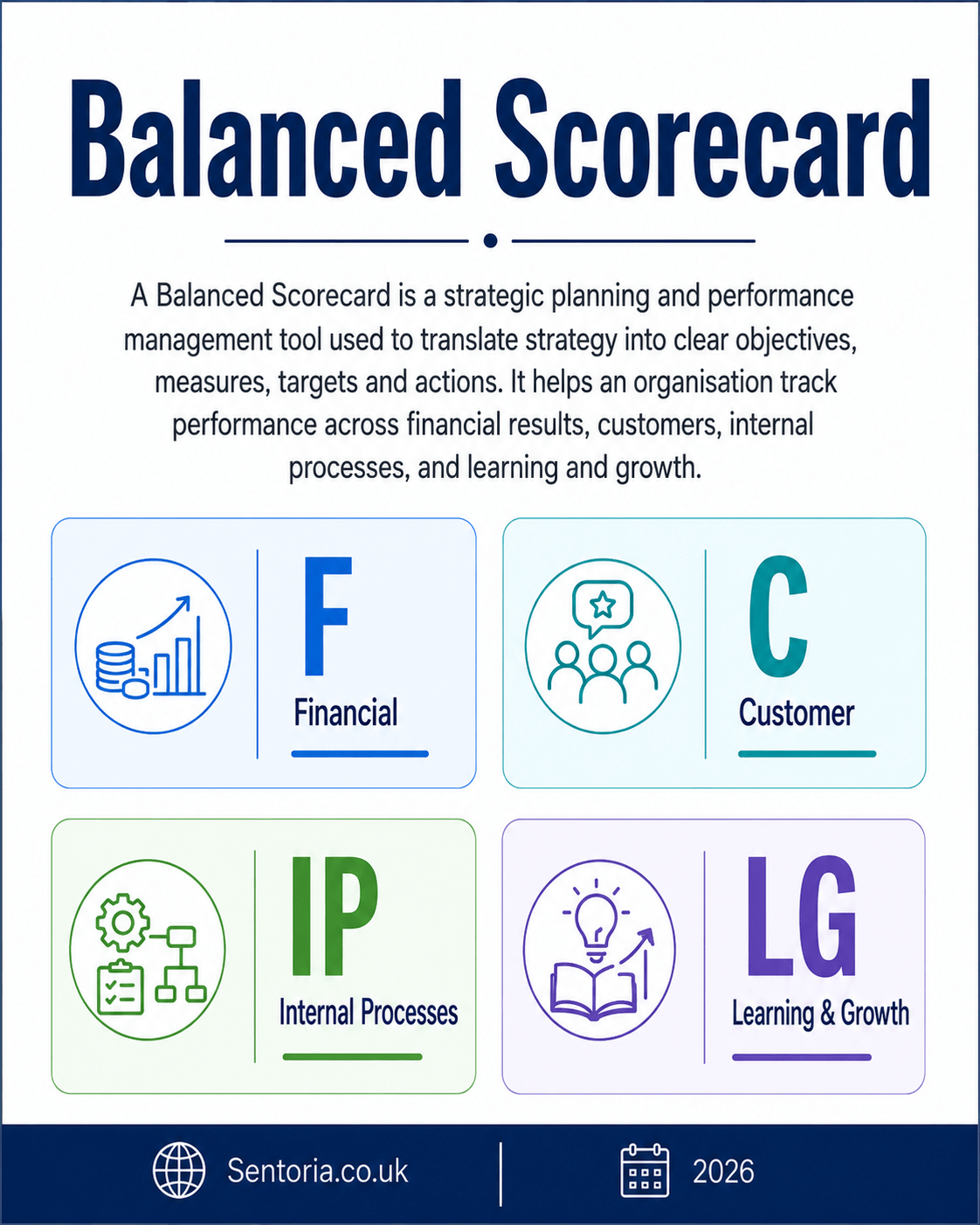
The Balanced Scorecard is a strategic planning and performance management tool used to translate an organisation’s strategy into clear objectives, measures, targets and actions.
It was developed to solve a common management problem: organisations often measure what is easiest to count, rather than what is most important to long-term success.
Traditional performance reporting tends to focus heavily on financial results. Profit, cash flow, revenue, costs and margins are all important, but they usually tell management what has already happened. They do not always explain whether the organisation is building the customer relationships, internal processes, skills, systems and capabilities needed for future performance.
The Balanced Scorecard addresses this by looking at performance from four linked perspectives:
- Financial
- Customer
- Internal Processes
- Learning and Growth
Kaplan and Norton’s original work introduced the Balanced Scorecard as a way of combining financial measures with customer, internal process, and innovation and learning measures, giving managers a broader view of performance.
Used properly, the Balanced Scorecard is not just a set of KPIs. It is a way of connecting strategy to day-to-day management.
What is the Balanced Scorecard?
A Balanced Scorecard is a framework that helps an organisation define what success looks like, measure progress and align activity with strategy.
It usually includes:
- Strategic objectives
- Measures or KPIs
- Targets
- Initiatives or actions
- Ownership
- Review arrangements
The purpose is to ensure that the organisation does not focus only on short-term financial results, while neglecting the things that create future performance.
For example, a business might report a healthy profit this year. However, if customer satisfaction is falling, staff turnover is rising, systems are outdated and internal processes are inefficient, future performance may already be weakening. The Balanced Scorecard helps make those wider indicators visible.
The Balanced Scorecard Institute describes the Balanced Scorecard as a strategic planning and management system used to focus on strategy and improve performance.
In simple terms:
A traditional performance report asks: “How did we perform?”
A Balanced Scorecard asks: “Are we delivering the strategy and building the capability to succeed in the future?”
History and development of the Balanced Scorecard
The Balanced Scorecard was developed by Robert S. Kaplan and David P. Norton in the early 1990s.
Their original article, The Balanced Scorecard: Measures that Drive Performance, was published in the Harvard Business Review in January 1992. It was based on research with companies that were trying to improve performance measurement beyond traditional financial reporting.
The early focus was performance measurement. Kaplan and Norton argued that managers needed a more balanced set of measures, because financial indicators alone were not enough to manage modern organisations.
The model then developed from a measurement tool into a strategic management system. In 1996, Kaplan and Norton published The Balanced Scorecard: Translating Strategy into Action, which set out how the framework could be used to connect strategy, measurement and implementation.
In their 1996 Harvard Business Review article, Using the Balanced Scorecard as a Strategic Management System, Kaplan and Norton explained that the Balanced Scorecard supplemented financial measures with three additional perspectives: customer, internal business processes, and learning and growth. They also described how it allowed organisations to track financial results while monitoring the capabilities needed for future growth.
The framework later developed further through the use of strategy maps. A strategy map shows how objectives connect across the four perspectives, helping an organisation explain how value is created. The Balanced Scorecard Institute describes a strategy map as a graphic showing cause-and-effect connections between strategic objectives.
Kaplan and Norton’s 2004 book Strategy Maps: Converting Intangible Assets into Tangible Outcomes developed this idea further, focusing on how intangible assets such as people, information, systems and culture can support strategic outcomes.
Over time, the Balanced Scorecard has been adapted for businesses, charities, public bodies, healthcare organisations, education providers, local government, professional firms and non-profit organisations. In many settings, it has shifted from being a simple performance dashboard to being a practical tool for strategy execution.
The four perspectives of the Balanced Scorecard
1. Financial perspective
The financial perspective asks:
How should we appear to shareholders, funders, trustees or financial stakeholders?
For a commercial business, this may include profit, revenue growth, cash flow, return on capital, margin, working capital and shareholder value.
For a charity or public body, the financial perspective may focus on sustainability, reserves, value for money, funding diversity, cost control and responsible use of resources.
Typical financial objectives include:
- Increase revenue
- Improve profitability
- Strengthen cash flow
- Reduce costs
- Improve margins
- Increase return on investment
- Diversify income
- Improve value for money
- Maintain adequate reserves
- Reduce financial risk
Financial measures are important because organisations need resources to survive. However, the Balanced Scorecard recognises that financial performance is often the result of performance in the other perspectives.
2. Customer perspective
The customer perspective asks:
How should customers, clients, beneficiaries, service users or stakeholders see us?
This perspective focuses on the people the organisation serves. It considers whether the organisation is delivering value to them.
Typical customer objectives include:
- Improve customer satisfaction
- Increase customer retention
- Improve service quality
- Strengthen brand reputation
- Increase market share
- Improve responsiveness
- Improve accessibility
- Increase trust
- Improve customer experience
- Reach new customer segments
Measures may include customer satisfaction scores, complaints, repeat purchase rates, referral levels, retention, service response times, net promoter score, beneficiary outcomes or stakeholder feedback.
This perspective is important because financial success often depends on whether customers continue to value what the organisation provides.
3. Internal process perspective
The internal process perspective asks:
Which internal processes must we excel at?
This perspective focuses on the activities, systems and processes that allow the organisation to deliver its value proposition.
Typical internal process objectives include:
- Improve operational efficiency
- Reduce errors
- Improve quality
- Speed up delivery
- Strengthen compliance
- Improve innovation processes
- Improve project delivery
- Reduce waste
- Improve safeguarding or risk controls
- Improve management reporting
Measures may include process cycle time, error rates, quality scores, compliance breaches, project delivery milestones, productivity, utilisation, stock turnover, audit findings or service delivery times.
This perspective is essential because strategy usually fails in execution. The organisation may know what it wants to achieve, but weak processes, poor systems or unclear accountability can prevent delivery.
4. Learning and growth perspective
The learning and growth perspective asks:
What capabilities must we build to improve and sustain performance?
This perspective focuses on people, culture, systems, knowledge, data, technology and organisational capacity.
Typical learning and growth objectives include:
- Improve staff capability
- Strengthen leadership
- Improve employee engagement
- Improve training
- Build digital capability
- Improve systems
- Strengthen data quality
- Improve organisational culture
- Support innovation
- Improve knowledge sharing
Measures may include staff engagement, staff turnover, training completion, skills assessments, system adoption, data quality, leadership development, internal promotion, absenteeism or innovation activity.
Some modern versions of the Balanced Scorecard rename this perspective Organisational Capacity, to reflect the broader internal capability needed to improve performance. The Balanced Scorecard Institute notes that organisational capacity may include human capital, tools and technology, infrastructure and governance.
This perspective matters because future performance depends on capability. If people, systems and culture are weak, the strategy may not be deliverable.
Why the Balanced Scorecard matters
The Balanced Scorecard matters because many organisations suffer from a gap between strategy and action.
A board or management team may agree a strategy. It may sound sensible. It may be written clearly. But when it reaches the day-to-day running of the organisation, it can become disconnected from budgets, targets, meetings, responsibilities and performance reporting.
The Balanced Scorecard helps close that gap.
It does this by translating strategy into:
- Objectives
- Measures
- Targets
- Initiatives
- Accountability
- Review
This matters because strategy is not delivered by words alone. It is delivered through decisions, resources, priorities, behaviour and performance management.
The Balanced Scorecard is also useful because it encourages balance. It reduces the risk of focusing on one area while neglecting another.
For example:
- A business may increase profit by cutting training, but damage future capability.
- A charity may increase service delivery, but weaken staff resilience.
- A council may reduce short-term cost, but increase long-term demand.
- A manufacturer may increase output, but reduce quality.
- A professional firm may grow revenue, but damage client service and staff morale.
The Balanced Scorecard encourages management to consider the whole system.
When to use a Balanced Scorecard
A Balanced Scorecard is useful when an organisation needs to move from strategy to implementation.
Good uses include:
- Strategic planning
- Board reporting
- Performance management
- Business transformation
- Departmental planning
- Charity governance
- Public sector service improvement
- Healthcare performance management
- Local authority performance reporting
- Professional services management
- Manufacturing performance improvement
- Retail performance management
- Technology business scaling
- Project or programme oversight
It is particularly useful where the organisation has too many disconnected KPIs, unclear strategic priorities or reports that do not explain whether strategy is being delivered.
It is less useful if the organisation has not yet clarified its strategy. A scorecard cannot fix a vague strategy. It can only translate a strategy that is already reasonably clear.
Balanced Scorecard in different industries
SMEs and owner-managed businesses
For SMEs, the Balanced Scorecard can bring discipline without creating unnecessary bureaucracy.
Many owner-managed businesses rely heavily on financial results, cash flow, sales and the owner’s judgement. Those things matter, but they may not give a full picture of performance.
An SME Balanced Scorecard might include:
Financial: gross margin, cash balance, debtor days, monthly recurring revenue, profit per job.
Customer: customer satisfaction, repeat business, referrals, complaints, customer retention.
Internal processes: job turnaround time, error rates, quote conversion, stock accuracy, invoice processing time.
Learning and growth: staff training, system adoption, owner dependency, employee retention, process documentation.
For SMEs, the scorecard should be short and practical. A small business does not need 40 KPIs. It needs a small number of measures that genuinely help management make better decisions.
Manufacturing
Manufacturing businesses can use the Balanced Scorecard to connect financial performance with quality, productivity, capacity and people.
Relevant measures may include:
Financial: gross margin, cost per unit, energy cost, working capital, stock holding, return on equipment investment.
Customer: on-time delivery, customer complaints, returns, quality perception, key account retention.
Internal processes: machine utilisation, downtime, scrap, rework, production cycle time, health and safety incidents.
Learning and growth: skills matrix completion, training, staff retention, continuous improvement ideas, automation capability.
For manufacturing, the Balanced Scorecard should be linked to production data, quality systems, supply chain risk, stock control and capital investment.
Retail and ecommerce
Retail and ecommerce businesses often have plenty of data, but not always a balanced view of performance.
A retail scorecard might include:
Financial: sales, margin, average order value, contribution per channel, stock turn, return rate cost.
Customer: customer satisfaction, repeat purchase, conversion rate, complaints, loyalty scheme engagement.
Internal processes: fulfilment time, stock accuracy, website performance, returns processing, supplier lead times.
Learning and growth: staff product knowledge, digital marketing capability, merchandising skills, technology adoption.
For ecommerce, the scorecard should pay particular attention to customer acquisition cost, lifetime value, fulfilment economics and returns.
Professional services
For accountants, solicitors, consultants, architects and advisers, the Balanced Scorecard can help move performance management beyond billings alone.
A professional services scorecard might include:
Financial: fees, recovery rate, profit per client, lock-up, work in progress, recurring revenue.
Customer: client satisfaction, retention, referrals, response times, advisory uptake.
Internal processes: turnaround time, compliance deadlines, review quality, workflow status, billing accuracy.
Learning and growth: technical training, advisory skills, staff development, system adoption, knowledge sharing.
This is particularly useful where a firm wants to shift from reactive compliance work to more proactive advisory services.
Charities and voluntary organisations
For charities, the Balanced Scorecard can support trustee oversight and strategic clarity.
A charity scorecard might include:
Financial: unrestricted reserves, funding diversity, budget performance, cost per service, grant dependency.
Beneficiaries and stakeholders: beneficiary outcomes, service access, satisfaction, safeguarding feedback, community reach.
Internal processes: casework quality, referral response times, volunteer management, compliance, impact reporting.
Learning and growth: staff wellbeing, volunteer training, trustee skills, digital capability, partnership development.
For charities, the scorecard should be adapted to mission, not forced into a commercial model. The customer perspective may need to include beneficiaries, funders, commissioners, volunteers and community stakeholders.
Public sector and local government
Public sector organisations can use the Balanced Scorecard to connect strategy, service quality, financial stewardship and organisational capability.
A public sector scorecard might include:
Financial: budget performance, savings delivery, value for money, cost per service, reserves.
Residents and service users: service satisfaction, response times, access, complaints, equality of access.
Internal processes: statutory compliance, case processing time, project delivery, procurement performance, risk controls.
Learning and growth: workforce capability, digital inclusion, data quality, staff engagement, leadership development.
Public sector use should reflect statutory duties, public value, equality, transparency and democratic accountability.
Property and construction
Property and construction businesses can use the Balanced Scorecard to monitor performance across finance, projects, occupiers, compliance and capability.
Relevant measures may include:
Financial: rental income, voids, project margin, capital expenditure, finance costs, cash flow.
Customers and occupiers: tenant satisfaction, lease renewals, enquiry conversion, defects response, arrears.
Internal processes: project milestones, planning progress, health and safety, maintenance response, contractor performance.
Learning and growth: development capability, project management skills, compliance knowledge, systems, professional team effectiveness.
For property projects, the scorecard should sit alongside project appraisals, cash flow forecasts, risk registers and planning programmes.
Technology and software
Technology businesses can use the Balanced Scorecard to avoid focusing only on revenue growth while ignoring product quality, customer retention and technical resilience.
A software scorecard might include:
Financial: monthly recurring revenue, annual recurring revenue, gross margin, burn rate, customer acquisition cost, lifetime value.
Customer: churn, net revenue retention, user satisfaction, support response time, onboarding completion.
Internal processes: deployment frequency, bug resolution, uptime, security incidents, product roadmap delivery.
Learning and growth: developer retention, technical debt reduction, AI capability, documentation, knowledge sharing.
For technology businesses, the scorecard should be reviewed frequently because product, customer and market assumptions can change quickly.
Healthcare and social care
Healthcare and social care organisations use balanced scorecard approaches to monitor quality, service delivery, performance and capability. NHS England and NHS Improvement’s quality improvement materials describe balanced scorecards as playing a key role in performance management, helping organisations measure, monitor and optimise performance using KPIs.
A healthcare or care scorecard might include:
Financial: budget performance, agency cost, cost per case, funding utilisation.
Patients and service users: patient experience, complaints, access times, outcomes, safeguarding feedback.
Internal processes: waiting times, clinical governance, incident reporting, care plan completion, inspection actions.
Learning and growth: staff training, retention, supervision, clinical skills, digital records adoption.
In healthcare and care settings, the scorecard must never reduce quality to numbers alone. Measures should support judgement, safeguarding, professional standards and patient outcomes.
Education and training
Education providers can use the Balanced Scorecard to connect learning outcomes, student experience, financial sustainability and organisational development.
A scorecard might include:
Financial: funding, course profitability, utilisation, cost per learner, budget performance.
Students and stakeholders: learner satisfaction, retention, progression, employer feedback, accessibility.
Internal processes: enrolment, assessment turnaround, safeguarding, quality assurance, attendance monitoring.
Learning and growth: tutor development, digital learning capability, curriculum innovation, staff engagement.
For education, the scorecard should be linked to learner outcomes, inspection requirements, funding rules and curriculum strategy.
How to create a Balanced Scorecard properly
1. Start with the strategy
A Balanced Scorecard should not start with KPIs. It should start with strategy.
Ask:
- What are we trying to achieve?
- What are the strategic priorities?
- What would success look like?
- What must change?
- What must be protected?
- What must improve?
- What are the most important outcomes?
If the strategy is unclear, the scorecard will become a random collection of measures.
2. Define the strategic objectives
For each perspective, define a small number of objectives.
For example:
Financial: improve profitability and strengthen cash flow.
Customer: improve retention and service experience.
Internal processes: reduce turnaround time and improve quality.
Learning and growth: improve staff capability and system adoption.
Objectives should be written as outcomes, not activities.
“Train staff” is an activity.
“Improve staff capability” is an objective.
“Install a new CRM” is an activity.
“Improve customer relationship management” is an objective.
3. Create a strategy map
A strategy map shows how objectives connect.
For example:
- Better staff training improves process quality.
- Better process quality improves customer satisfaction.
- Better customer satisfaction improves retention.
- Better retention improves revenue and profitability.
This is important because the Balanced Scorecard is not just four separate boxes. It is a cause-and-effect model of how the organisation believes strategy will be delivered.
HBS Online describes the strategy map as an early step in creating a Balanced Scorecard, linking financial, customer, process, and learning and growth perspectives.
4. Choose a small number of measures
Each objective needs one or more measures, but less is usually more.
A common mistake is creating too many KPIs. This makes reporting harder and reduces focus.
A practical scorecard might have:
- Two to four financial measures
- Two to four customer measures
- Two to four internal process measures
- Two to four learning and growth measures
The exact number depends on the organisation, but the principle is clear: the scorecard should highlight what matters most.
5. Include leading and lagging indicators
Lagging indicators tell you what has happened. Leading indicators help predict future performance.
Examples of lagging indicators include:
- Profit
- Revenue
- Customer churn
- Complaints
- Staff turnover
- Project overspend
Examples of leading indicators include:
- Sales pipeline
- Staff training completion
- Customer satisfaction
- Enquiry response time
- Preventative maintenance completion
- System adoption
A balanced scorecard should include both. Financial results may tell you whether the organisation performed last month or last year. Leading indicators help show whether future performance is being built.
6. Set targets
Measures need targets.
A target gives context. Without it, a number may be hard to interpret.
For example:
- Customer satisfaction of 82% may be good or poor depending on the target.
- Debtor days of 48 may be acceptable or worrying depending on the business model.
- Staff turnover of 18% may be normal in one sector and serious in another.
- A project delay of two weeks may be minor or critical depending on the programme.
Targets should be realistic, but challenging. They should also be reviewed when circumstances change.
7. Identify initiatives
Measures do not improve themselves.
For each objective, identify the initiatives that will drive improvement.
For example:
Objective: Improve customer retention.
Measure: Annual retention rate.
Target: 90%.
Initiative: Introduce structured account reviews and customer feedback process.
Objective: Reduce reporting delays.
Measure: Month-end reporting completion date.
Target: Five working days.
Initiative: Automate data extraction and standardise reporting templates.
The initiative is the action. The measure tracks whether it works.
8. Assign ownership
Every objective, measure and initiative should have an owner.
Without ownership, the Balanced Scorecard becomes a reporting document rather than a management system.
Ownership should be clear:
- Who is responsible?
- Who reports progress?
- Who can act if performance is off track?
- Who has authority to change resources or priorities?
- Who reviews the measure?
9. Build the scorecard into management routines
The Balanced Scorecard should be reviewed regularly.
This may include:
- Monthly management meetings
- Quarterly board reporting
- Departmental reviews
- Staff performance discussions
- Budget reviews
- Risk reviews
- Strategy refresh sessions
The key is to use the scorecard for decision-making, not just reporting.
10. Review and refine
A scorecard should evolve.
Measures may become irrelevant. Targets may need resetting. Objectives may change. New risks may emerge. Some indicators may prove unhelpful.
A good Balanced Scorecard is reviewed regularly and improved over time.
Common mistakes in using the Balanced Scorecard
Mistake 1: Starting with measures instead of strategy
This is the most common mistake.
A team starts by asking, “What KPIs should we use?” The better question is, “What strategy are we trying to deliver?”
KPIs should follow strategy, not replace it.
Mistake 2: Having too many measures
A scorecard with too many measures becomes a data dump.
The purpose is focus. A good scorecard should highlight the few measures that matter most.
Mistake 3: Measuring what is easy, not what matters
Some important things are difficult to measure. That does not mean they should be ignored.
For example, culture, trust, capability, customer experience and innovation are harder to measure than sales or costs, but they may be vital to long-term success.
Mistake 4: Ignoring cause and effect
The four perspectives should connect.
If staff capability improves, internal processes should improve. If internal processes improve, customers should notice. If customers notice, financial performance should improve.
If those links are not clear, the scorecard may be just a dashboard rather than a strategic tool.
Mistake 5: Treating the scorecard as a finance report
The Balanced Scorecard includes financial measures, but it is not a finance report.
It should also cover customers, processes, capability, people, systems and future performance.
Mistake 6: Using generic KPIs
Generic KPIs can be misleading.
The right measures depend on the organisation’s strategy. A premium service provider should not use the same scorecard as a low-cost volume provider. A charity should not blindly copy a commercial scorecard. A public body should reflect public value and statutory duties.
Mistake 7: Failing to act on the results
Measurement without action creates frustration.
If the scorecard shows poor performance, management must decide what to do: investigate, intervene, invest, change targets, adjust resources or revise the strategy.
Mistake 8: Not communicating it
A Balanced Scorecard should help people understand the strategy.
If only the board or senior management sees it, its value is limited. The scorecard should be communicated in a way that helps teams understand how their work contributes to wider objectives.
Limitations and weaknesses of the Balanced Scorecard
The Balanced Scorecard is useful, but it has limits.
It does not create strategy
The Balanced Scorecard translates strategy into objectives and measures. It does not, by itself, decide what the strategy should be.
If the strategy is weak, vague or unrealistic, the scorecard will not fix it.
It can become bureaucratic
If implemented badly, the Balanced Scorecard can create too many meetings, too many measures and too much reporting.
The aim should be better management, not more administration.
It can encourage target obsession
Targets can improve focus, but they can also distort behaviour.
If people are rewarded or judged too narrowly against KPIs, they may focus on hitting the number rather than delivering the real objective.
This is why scorecards should include judgement, narrative and review, not just traffic lights.
It can oversimplify complex performance
Not all performance can be captured in a small number of measures.
For example, public value, safeguarding, culture, innovation and community trust may require qualitative judgement as well as numerical indicators.
It depends on good data
A Balanced Scorecard is only as reliable as the data behind it.
Poor data quality, inconsistent definitions, manual reporting and unclear ownership can undermine confidence.
It may become static
A scorecard should reflect current strategy. If it is not reviewed, it can become outdated.
The measures that mattered three years ago may not be the measures that matter now.
It may ignore external change
The Balanced Scorecard is mainly an internal strategy execution tool. It does not replace external analysis.
It should be used alongside tools such as PESTLE, Porter’s Five Forces and SWOT to ensure strategy reflects the external environment.
Balanced Scorecard compared with other strategic tools
Balanced Scorecard and SWOT
SWOT identifies strengths, weaknesses, opportunities and threats.
The Balanced Scorecard translates strategy into measurable objectives and actions.
Use SWOT to understand the situation. Use the Balanced Scorecard to manage delivery.
Balanced Scorecard and PESTLE
PESTLE examines external political, economic, social, technological, legal and environmental factors.
The Balanced Scorecard focuses on implementation and performance.
Use PESTLE to understand external change. Use the Balanced Scorecard to track whether the organisation is responding effectively.
Balanced Scorecard and Porter’s Five Forces
Porter’s Five Forces examines competitive pressure and industry structure.
The Balanced Scorecard translates the chosen competitive strategy into objectives and measures.
Use Five Forces to understand market attractiveness. Use the Balanced Scorecard to deliver the strategic response.
Balanced Scorecard and TOWS
TOWS turns SWOT findings into strategic options.
The Balanced Scorecard turns the selected strategy into a performance management framework.
Use TOWS to decide what to do. Use the Balanced Scorecard to track whether it is happening.
Balanced Scorecard and Business Model Canvas
The Business Model Canvas explains how an organisation creates, delivers and captures value.
The Balanced Scorecard measures whether the organisation is successfully delivering that model and strategy.
Use the Canvas to understand the business model. Use the Balanced Scorecard to manage performance.
Balanced Scorecard and OKRs
OKRs, or Objectives and Key Results, are often used to set ambitious short-term priorities.
The Balanced Scorecard is usually broader and more structured, with perspectives that balance financial, customer, process and capability measures.
Use OKRs for focused execution cycles. Use the Balanced Scorecard for wider strategic performance management.
Balanced Scorecard and dashboards
A dashboard displays performance data.
A Balanced Scorecard is more strategic. It should connect measures to objectives, targets and initiatives.
A dashboard can support a Balanced Scorecard, but it is not automatically the same thing.
Alternatives and complementary frameworks
Strategy map
A strategy map shows the cause-and-effect logic of the strategy.
Use it before or alongside the Balanced Scorecard to show how objectives connect.
KPI dashboard
A KPI dashboard is useful for monitoring performance in real time or near real time.
Use it to display scorecard measures, but do not let it replace strategic discussion.
OKRs
OKRs are useful for setting clear, time-bound priorities.
Use them when teams need sharper focus on short-term execution.
Risk register
A risk register records risks, controls, owners and mitigation.
Use it alongside the Balanced Scorecard where poor performance indicates strategic or operational risk.
Business plan
A business plan sets out objectives, resources, market assumptions and financial forecasts.
Use the Balanced Scorecard to monitor whether the business plan is being delivered.
Budget and forecast
Budgets and forecasts are essential for financial control.
Use the Balanced Scorecard to ensure financial control is linked to customer, process and capability measures.
PESTLE and Five Forces
PESTLE and Five Forces help test whether the strategy is externally realistic.
Use them before designing the Balanced Scorecard, especially where market, regulatory or economic change is significant.
A practical Balanced Scorecard template
A useful Balanced Scorecard should include the following columns:
- Perspective
- Strategic objective
- Measure or KPI
- Baseline
- Target
- Initiative or action
- Owner
- Reporting frequency
- Current status
- Commentary
- Next action
- Review date
Example:
Perspective: Customer
Objective: Improve customer retention
Measure: Annual customer retention rate
Baseline: 82%
Target: 90%
Initiative: Introduce quarterly account reviews
Owner: Commercial Director
Frequency: Monthly
Status: Amber
Commentary: Retention has improved, but two key accounts remain at risk
Next action: Complete account recovery plans
Review date: Next management meeting
Questions to ask in each Balanced Scorecard perspective
Financial perspective
- What financial outcomes are most important?
- Are we trying to grow, stabilise, improve margin or reduce risk?
- What does financial sustainability look like?
- Which financial measures best reflect the strategy?
- What cash flow indicators matter?
- Are costs aligned with priorities?
- Are we investing enough in future capability?
- Are we measuring value for money?
- Which financial risks need monitoring?
- What targets are realistic but challenging?
Customer perspective
- Who are our most important customers or stakeholders?
- What do they value most?
- How do they judge our performance?
- How do we measure satisfaction and trust?
- Are we retaining the right customers?
- Are complaints increasing or reducing?
- Are we accessible and responsive?
- Do customers understand our value proposition?
- Are we reaching the right market segments?
- What customer outcomes support the strategy?
Internal process perspective
- Which processes are most important to strategy delivery?
- Where are delays, errors or inefficiencies occurring?
- Which processes affect customer experience?
- Which processes affect financial performance?
- Are compliance and risk controls working?
- Are systems supporting or slowing delivery?
- What should be automated or simplified?
- Are projects being delivered on time?
- Are responsibilities clear?
- Which process measures are leading indicators of future performance?
Learning and growth perspective
- What skills do we need to deliver the strategy?
- Are staff engaged and supported?
- Are leadership and management capabilities strong enough?
- Are systems fit for purpose?
- Is data reliable and timely?
- Are teams learning and improving?
- Are we retaining key people?
- Are we investing in training?
- Does the culture support the strategy?
- What capabilities must be built for future success?
The best way to think about the Balanced Scorecard
The Balanced Scorecard is not just a performance report.
It is a practical framework for connecting strategy, measurement and action.
A good Balanced Scorecard should be:
- Strategy-led
- Balanced across different perspectives
- Focused on a small number of important measures
- Clear about ownership
- Linked to targets and initiatives
- Supported by reliable data
- Used in management discussions
- Reviewed and refined regularly
A weak scorecard is just a list of KPIs.
A strong scorecard tells the story of how the organisation intends to succeed.
The key question is not simply:
What should we measure?
The better question is:
What must we achieve, what must we improve, and how will we know whether our strategy is working?
Conclusion: the Balanced Scorecard turns strategy into measurable progress
The Balanced Scorecard remains useful because it addresses one of the hardest parts of management: turning strategy into action.
It helps organisations avoid the trap of relying only on financial measures. Financial results matter, but they are only part of the picture. Customers, internal processes, people, systems, culture and capability all affect whether an organisation can succeed over the long term.
Used badly, the Balanced Scorecard becomes a bulky KPI document that nobody uses.
Used properly, it becomes a practical management tool. It helps leaders clarify priorities, align teams, monitor progress, identify problems early and make better decisions.
The real value is not in the template. It is in the conversation it creates.
A good Balanced Scorecard helps an organisation understand whether it is not only performing today, but also building the capability to perform tomorrow.