Competitor Analysis:
A Practical Guide to Understanding Rivals, Market Position and Strategic Advantage
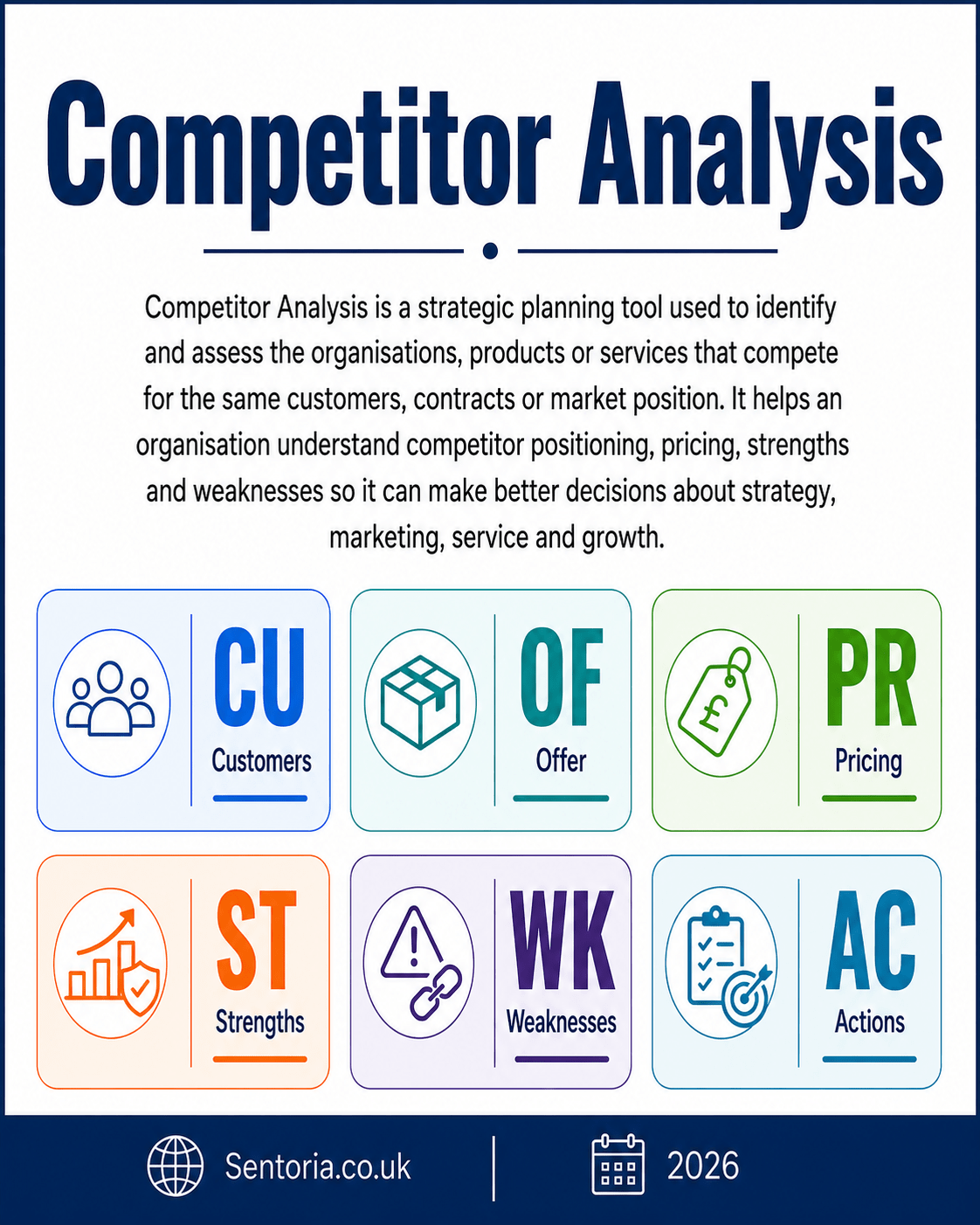
Competitor analysis is a strategic planning tool used to understand who an organisation competes with, how those competitors operate, where they are strong, where they are vulnerable, and how your own organisation should respond.
It is not about copying competitors. It is not about obsessing over what others are doing. It is about making better decisions by understanding the market more clearly.
At its simplest, competitor analysis asks:
Who are we competing against, what do they offer, why do customers choose them, and how can we position ourselves more effectively?
That makes it useful for business planning, marketing, pricing, product development, service improvement, sales strategy, investment decisions and strategic reviews.
Good competitor analysis looks beyond obvious direct rivals. A business may also face competition from indirect competitors, substitutes, new entrants, online platforms, changing customer behaviour and different ways of solving the same problem. Porter’s Five Forces is helpful here because it reminds us that competition is not limited to current direct competitors, but also includes customers, suppliers, potential entrants and substitute products or services.
Used properly, competitor analysis helps an organisation understand where it stands, where it can win, and where it needs to improve.
What is competitor analysis?
Competitor analysis is the structured process of identifying and assessing other organisations, products, services or alternatives that compete for the same customers, income, funding, attention, contracts or market position.
A competitor analysis may examine:
- Competitor products and services
- Pricing
- Market share
- Customer segments
- Positioning
- Brand reputation
- Marketing channels
- Sales process
- Customer experience
- Strengths and weaknesses
- Technology
- Distribution
- Partnerships
- Financial performance
- Reviews and customer feedback
- Geographic coverage
- Innovation
- Likely future moves
The purpose is not simply to collect information. The purpose is to turn information into insight.
A good competitor analysis should help answer practical questions:
- Why do customers choose competitors?
- What do competitors do better than us?
- What do we do better than them?
- Are we priced correctly?
- Is our offer clearly differentiated?
- Are there gaps in the market?
- Are we at risk from new entrants or substitutes?
- What should we change?
The UK Government’s business support guidance notes that understanding competitor market share can show which products or services are most popular, which competitors have influence, and whether a market is crowded or underserved.
History and development of competitor analysis
Competitor analysis has roots in military strategy, market research, industrial economics and business planning. Organisations have always needed to understand rivals, but the discipline became more formal as modern strategy and marketing developed during the twentieth century.
A major influence was Michael Porter’s work on competitive strategy. His 1979 Harvard Business Review article introduced the Five Forces framework, which expanded competitive analysis beyond direct rivals to include supplier power, buyer power, new entrants and substitutes. Harvard Business School describes Five Forces as a framework for understanding the competitive forces at work in an industry and how economic value is divided among industry participants.
Competitor analysis also developed alongside the field of competitive intelligence. Leonard Fuld’s 1985 book Competitor Intelligence: How to Get It, How to Use It is one of the recognised texts in the development of the field.
The professionalisation of competitive intelligence also grew in the 1980s. The organisation now known as SCIP was established in 1986 and later changed its name to Strategic and Competitive Intelligence Professionals to reflect a broader strategic role.
More recently, competitor analysis has changed because of digital data. Organisations can now monitor websites, search visibility, reviews, social media, job adverts, online pricing, customer sentiment, digital advertising and product changes much more easily than in the past.
This has made competitor analysis more accessible, but also more dangerous if used badly. The issue is no longer simply finding information. The challenge is interpreting it properly and staying within ethical and legal boundaries.
Types of competitors
A useful competitor analysis should consider different types of competitor.
Direct competitors
Direct competitors offer similar products or services to similar customers.
For example:
- One accountancy firm competing with another local accountancy firm.
- One café competing with another nearby café.
- One software provider competing with another software provider in the same niche.
- One residential landlord competing with other landlords in the same area.
- One charity competing for the same grant funding or service contract.
Direct competitors are usually the easiest to identify. They are also the competitors most businesses focus on first.
Indirect competitors
Indirect competitors serve the same customer need in a different way.
For example:
- A restaurant may compete indirectly with takeaway apps, meal kits and supermarket ready meals.
- A tax adviser may compete indirectly with online tax software.
- A gym may compete indirectly with home fitness apps.
- A training provider may compete indirectly with YouTube, online courses or employer-led training.
- A hotel may compete indirectly with serviced apartments or Airbnb-style accommodation.
Indirect competitors are often more important than they first appear because they show alternative ways customers can solve the same problem.
Substitute products or services
Substitutes are alternative solutions that can replace the need for the original product or service.
For example:
- Video calls substituting for business travel.
- Cloud accounting software substituting for some manual bookkeeping.
- Streaming services substituting for physical media.
- AI tools substituting for some routine research or drafting work.
- Online retail substituting for some physical shopping.
Substitution risk is often underestimated because substitutes may sit outside the traditional industry definition.
Potential new entrants
New entrants are organisations that may enter the market in future.
They may include:
- Start-ups
- Larger firms moving into a niche
- Overseas competitors
- Digital platforms
- Suppliers moving downstream
- Customers bringing work in-house
- Adjacent businesses adding new services
Potential entrants matter because they can change pricing, customer expectations and market capacity.
Aspirational competitors
Aspirational competitors are organisations you do not currently compete with directly, but which represent the standard, position or market level you want to reach.
They are useful for benchmarking.
For example, a small professional firm may study a larger regional firm to understand service lines, content strategy, pricing structure, recruitment and client experience.
Why competitor analysis matters
Competitor analysis matters because no organisation operates in isolation.
Customers compare. Funders compare. Employees compare. Investors compare. Search engines compare. Procurement teams compare. Communities compare.
An organisation may believe it has a strong offer, but the market may see something different. Competitor analysis helps close that perception gap.
It supports:
- Better positioning
- More informed pricing
- Stronger marketing
- Clearer differentiation
- Better product or service development
- Improved customer experience
- More realistic business planning
- Earlier warning of threats
- Identification of market gaps
- More disciplined strategic decision-making
For start-ups and small businesses, competitor research can help avoid mistakes, understand customer demand, assess pricing expectations and identify gaps in the market.
Competitor analysis is also important because competition changes. A competitor that looked weak three years ago may have improved. A new digital entrant may change customer expectations. A substitute may become mainstream. A larger organisation may enter the market. A local business may reposition itself.
Without regular review, assumptions become outdated.
When to use competitor analysis
Competitor analysis is useful whenever market position matters.
Good uses include:
- Starting a new business
- Launching a new product or service
- Entering a new market
- Reviewing pricing
- Preparing a marketing strategy
- Improving customer experience
- Writing a business plan
- Reviewing website and SEO performance
- Preparing for investment or funding
- Considering acquisition or merger opportunities
- Responding to falling sales
- Investigating margin pressure
- Improving tender or proposal success
- Reviewing strategic positioning
- Testing whether growth plans are realistic
It is especially useful where customers have choice, where differentiation is unclear, or where pricing pressure is increasing.
It is less useful if treated as a one-off exercise. Markets move, and competitor analysis should be refreshed regularly.
Competitor analysis in different industries
SMEs and owner-managed businesses
For SMEs, competitor analysis is especially useful because smaller businesses often have limited time, money and management capacity.
A small business needs to know where it can realistically compete. It may not be able to beat larger competitors on price, scale or advertising spend. But it may be able to win through service, responsiveness, local knowledge, specialist expertise, trust or flexibility.
An SME competitor analysis should ask:
- Who are the main local or niche competitors?
- What do they offer?
- How are they priced?
- How visible are they online?
- What do customers say in reviews?
- Where are they stronger?
- Where are they weaker?
- What can we do differently?
- Are we trying to compete with too many businesses at once?
- What position can we credibly own?
For SMEs, the output should be practical. It should influence pricing, website copy, service packages, customer service, sales conversations and local marketing.
Manufacturing
In manufacturing, competitor analysis should examine quality, cost, capacity, lead times, technical capability, supply chain, certifications and customer relationships.
Relevant questions include:
- Which competitors serve the same sectors?
- Are they competing on price, quality, speed or technical specialism?
- Do they have greater automation or lower costs?
- Do they have spare capacity?
- Are they vertically integrated?
- Do they hold important certifications?
- Are they moving into higher-value work?
- Are overseas suppliers changing the market?
- Are substitutes or new materials emerging?
- Are customers dual-sourcing to reduce risk?
For manufacturing, competitor analysis should be linked to cost analysis, capacity planning, investment in machinery, quality data and customer concentration.
Retail and ecommerce
Retail and ecommerce businesses operate in highly visible competitive environments. Customers can compare products, prices, reviews and delivery options quickly.
A retail competitor analysis should examine:
- Product range
- Pricing
- Promotions
- Stock availability
- Delivery options
- Returns policy
- Website performance
- Customer reviews
- Social media activity
- Loyalty schemes
- Marketplace presence
- In-store experience
- Brand positioning
For ecommerce, competitor analysis should also consider search visibility, paid advertising, conversion journeys, content quality, product photography, checkout experience and customer acquisition cost.
The danger in retail is simply copying discounts. Competing only on price can damage margin unless the business has a genuine cost advantage.
Professional services
For accountants, solicitors, consultants, architects and other advisers, competitor analysis should go beyond fee comparison.
Professional services are often bought on trust, expertise, responsiveness and perceived risk reduction.
A professional firm should consider:
- Which client segments competitors target
- How competitors present their expertise
- Whether they specialise by sector
- How clear their service packages are
- Whether they publish useful content
- How they use LinkedIn and local networks
- How easy it is to enquire
- Whether they promote fixed fees, retainers or advisory services
- What clients say in testimonials and reviews
- How they recruit and present their team
For professional services, competitor analysis can help clarify positioning. The key question is not “are we cheaper?” but “why should the right client choose us?”
Charities and voluntary organisations
Charities may not think of themselves as competitors, but they often operate in competitive environments.
They may compete for:
- Grants
- Donations
- Volunteers
- Public attention
- Commissioned contracts
- Corporate partnerships
- Skilled staff
- Community trust
A charity competitor analysis should be handled carefully. The aim is not to undermine other charities. The aim is to understand the funding and service environment so the charity can improve impact and sustainability.
Questions include:
- Which organisations serve similar beneficiaries?
- Which funders support similar work?
- What outcomes do other organisations report?
- Are there partnership opportunities?
- Are there service gaps?
- Are there duplicated services?
- How do other charities explain their impact?
- How do they recruit volunteers?
- What makes our charity distinctive?
- Could collaboration be better than competition?
For charities, competitor analysis should often become partnership analysis as well.
Public sector and local government
Public sector organisations do not usually compete in the same way as private businesses, but competitor analysis can still be useful.
It can support:
- Benchmarking services against other councils or public bodies
- Understanding supplier markets
- Reviewing commissioned services
- Comparing resident experience
- Assessing local economic sectors
- Improving recruitment competitiveness
- Understanding alternative delivery models
- Learning from best practice elsewhere
For public bodies, the language may be “comparative analysis”, “benchmarking” or “market analysis” rather than competitor analysis.
The aim is to improve value for money, service quality and strategic decision-making, not to copy another authority without considering local circumstances.
Property and construction
Property and construction competitor analysis should consider both market competition and project-specific alternatives.
A property business might assess:
- Competing sites
- Rental levels
- Sale values
- Tenant demand
- Specification
- Location
- Planning position
- Delivery timescales
- Developer track record
- Funding availability
- Contractor capacity
- Comparable schemes
A construction business might examine competitor pricing, specialisms, tender success, certifications, capacity, geographic coverage and client relationships.
For property and construction, competitor analysis should sit alongside valuation, planning analysis, legal review, financial appraisal and risk assessment.
Technology and software
Technology markets can change quickly, so competitor analysis needs regular updating.
A software business should review:
- Features
- Pricing model
- User experience
- Integrations
- Customer reviews
- Security credentials
- Product roadmap
- Support model
- Customer onboarding
- Developer ecosystem
- Churn signals
- Funding and hiring activity
- Platform dependency
- AI functionality
For technology businesses, the most dangerous competitor may not look like a traditional competitor. It may be a platform, open-source tool, AI feature, internal customer workaround or new workflow.
Healthcare and social care
Healthcare and social care competitor analysis must be handled carefully because quality, safety and ethics matter.
Relevant areas include:
- Service quality
- Inspection ratings
- Staffing model
- Waiting times
- Patient or service user experience
- Referral pathways
- Pricing or funding
- Specialisms
- Geographic coverage
- Reputation
- Digital access
- Partnerships
In care settings, competitor analysis should support quality improvement and sustainability. It should not encourage unsafe cost-cutting or a race to the bottom.
Education and training
Education and training providers compete for learners, funding, staff, employer relationships and reputation.
A competitor analysis might examine:
- Course offer
- Fees
- Funding routes
- Delivery format
- Online learning platform
- Accreditation
- Learner outcomes
- Employer links
- Student experience
- Marketing channels
- Progression routes
- Reputation
For training providers, competitor analysis should be linked to learner needs, employer demand, skills gaps and quality outcomes.
How to carry out competitor analysis properly
1. Define the purpose
Start with a clear question.
For example:
- Are we positioned clearly in the market?
- Should we launch this new service?
- Are our prices right?
- Why are we losing customers?
- What makes competitors more visible online?
- Which market segment should we target?
- How can we improve our proposal or tender success?
- Is there a gap in the market?
Without a clear purpose, competitor analysis becomes unfocused.
2. Define the market
Be clear about the market being analysed.
That may include:
- Geography
- Customer segment
- Product or service category
- Price level
- Channel
- Sector
- Use case
- Size of customer
For example, “accountancy firms” is too broad.
“Small business accountancy and tax advisory services in Huddersfield and surrounding areas” is more useful.
A clear market definition prevents irrelevant comparison.
3. Identify competitors
List different types of competitor:
- Direct competitors
- Indirect competitors
- Substitutes
- New entrants
- Aspirational competitors
- Digital competitors
- Low-cost competitors
- Premium competitors
Use customer interviews, search engines, social media, reviews, trade directories, Companies House, industry reports, tender results, local knowledge, supplier feedback and sales team intelligence.
The British Library’s Business & IP Centre notes that market information resources can help businesses research customers, competitors, industries, suppliers and funding.
4. Decide what to compare
Do not compare everything. Choose the areas that matter.
Possible comparison categories include:
- Product or service range
- Pricing
- Quality
- Customer segments
- Positioning
- Brand message
- Website
- Search visibility
- Reviews
- Social media
- Sales process
- Customer service
- Delivery
- Guarantees
- Technology
- Team
- Partnerships
- Financial strength
- Locations
- Innovation
The comparison should reflect the purpose of the analysis.
5. Gather evidence ethically
Use legitimate sources.
Examples include:
- Competitor websites
- Published accounts
- Public reviews
- Public pricing
- Brochures
- Social media
- Job adverts
- Trade directories
- Press releases
- Case studies
- Industry reports
- Public tenders
- Search results
- Customer feedback
- Store visits or mystery shopping, where lawful and ethical
Avoid improper methods. Do not seek confidential information, misrepresent yourself, induce employees to disclose sensitive information or engage in anti-competitive information exchange.
Competition law must be taken seriously. CMA guidance warns businesses to watch for cartels, other potentially anti-competitive agreements and abuse of a dominant position.
The CMA also states that it takes illegal price collusion and the exchange of confidential pricing information seriously.
6. Analyse, do not just collect
A spreadsheet of competitor facts is not enough.
The analysis should explain what the information means.
For example:
- Are competitors positioned more clearly?
- Are they cheaper because they have lower costs?
- Are they more expensive because they offer more value?
- Are they winning because they are more visible?
- Are they targeting a different customer segment?
- Are they stronger in trust, speed, convenience or expertise?
- Are there unmet customer needs?
- Is there a gap between what customers want and what competitors offer?
Insight matters more than data volume.
7. Assess strengths and weaknesses
For each major competitor, identify strengths and weaknesses.
Examples of competitor strengths:
- Strong brand
- Clear pricing
- Good reviews
- Specialist expertise
- Strong website
- Better technology
- Faster delivery
- Larger team
- Stronger partnerships
- Better funding
Examples of competitor weaknesses:
- Poor reviews
- Slow response
- Weak online presence
- Confusing offer
- Limited geography
- High pricing
- Poor customer service
- Outdated systems
- Limited specialism
- Weak content
This should lead naturally into your own strategic response.
8. Identify your own position
Competitor analysis should not only describe others. It should clarify your own position.
Ask:
- What are we known for?
- What do we want to be known for?
- Are we cheaper, premium, specialist, local, faster, broader or more personal?
- Is our positioning obvious from our website and marketing?
- Do customers understand our difference?
- Are we trying to compete in too many ways?
- Are we credible in the position we want?
A business with unclear positioning often struggles because customers cannot quickly see why it is different.
9. Convert insight into action
The output should lead to decisions.
Possible actions include:
- Improve the value proposition
- Adjust pricing
- Create clearer service packages
- Improve website messaging
- Strengthen reviews and testimonials
- Target a clearer niche
- Improve customer service
- Invest in technology
- Add or remove services
- Change marketing channels
- Train the sales team
- Improve proposal documents
- Develop partnerships
- Exit unattractive segments
- Monitor a specific competitor more closely
Without action, competitor analysis becomes research for its own sake.
10. Review regularly
Competitor analysis should be refreshed.
A light review might be monthly or quarterly for fast-moving markets. A deeper review might be annual or linked to strategic planning.
Triggers for review include:
- New competitor entry
- Price changes
- Loss of customers
- New product launches
- Changes in regulation
- Technology disruption
- Search ranking changes
- New reviews
- Competitor hiring
- Market slowdown
- Acquisition activity
- Major funding or investment announcements
Common mistakes in competitor analysis
Mistake 1: Only looking at obvious competitors
The most dangerous competitor may not be the business that looks most like yours.
It may be a substitute, a digital entrant, an in-house option or a different way of solving the customer’s problem.
Mistake 2: Copying competitors
Competitor analysis should inform strategy, not replace it.
Copying can create a weaker version of someone else’s positioning. The aim is to understand the market and make better choices.
Mistake 3: Focusing only on price
Price matters, but customers rarely buy on price alone.
They may also consider trust, convenience, speed, quality, risk, support, availability, brand, location, relationship and outcome.
Mistake 4: Ignoring customer perception
A business may think it is better than competitors, but customers may not see it that way.
Customer reviews, interviews, enquiries, lost sales and feedback are essential.
Mistake 5: Comparing too many things
A huge comparison table can look impressive but be strategically useless.
Focus on the factors that influence customer choice and business performance.
Mistake 6: Using weak or outdated information
Markets change. Websites change. Prices change. Reviews change. Services change.
Competitor analysis should be current enough to support the decision being made.
Mistake 7: Not separating facts from assumptions
Facts and assumptions should be kept separate.
Fact: “Competitor A publishes three service packages on its website.”
Assumption: “Competitor A is winning because its pricing is clearer.”
Both may be useful, but they are not the same.
Mistake 8: Ignoring legal and ethical boundaries
Competitor research should use lawful and ethical methods.
Do not exchange confidential pricing information with competitors, agree market behaviour, or use industry conversations as a way to reduce competitive uncertainty. CMA guidance makes clear that competition law risks include cartels and potentially anti-competitive agreements.
Mistake 9: No action plan
Competitor analysis without action is only a research exercise.
The value comes from deciding what to change, improve, protect or monitor.
Mistake 10: Becoming competitor-led
A business should understand competitors, but not be controlled by them.
The best strategy is still based on customer value, organisational strengths, financial reality and long-term purpose.
Limitations and weaknesses of competitor analysis
Competitor analysis is useful, but it has limits.
It can encourage imitation
If used badly, competitor analysis can lead to copying rather than differentiation.
A business that simply follows competitors may always be behind them.
It can miss customer needs
Competitor analysis looks at other providers. It does not automatically reveal what customers truly need.
It should be combined with customer research.
It can become too focused on the present
Competitor analysis often looks at current competitors and current offers.
It may miss future entrants, emerging substitutes or technology-led disruption.
It can create false confidence
A competitor may look weak from public information but be strong internally.
Another may appear strong online but be financially fragile.
Public information is useful, but incomplete.
It can overemphasise visible activity
Marketing is visible. Internal capability is not always visible.
A competitor with a polished website may still have poor operations. A competitor with little marketing may have strong referral relationships.
It can become legally risky if handled badly
The more competitor analysis touches pricing, markets, supply levels, tendering or strategic plans, the more important legal caution becomes.
Public information can generally be reviewed, but direct or indirect exchange of confidential competitive information is risky.
It does not replace strategy
Competitor analysis informs strategy. It does not create strategy by itself.
Management still needs judgement, financial analysis, customer insight and operational capability.
Competitor analysis compared with other strategic tools
Competitor analysis and SWOT
SWOT identifies strengths, weaknesses, opportunities and threats.
Competitor analysis can provide evidence for SWOT, especially around market position, competitor strengths and external threats.
Use competitor analysis to make SWOT more specific and evidence-based.
Competitor analysis and PESTLE
PESTLE examines external political, economic, social, technological, legal and environmental factors.
Competitor analysis examines rival organisations and alternatives.
Use PESTLE to understand the wider environment. Use competitor analysis to understand who else is competing within that environment.
Competitor analysis and Porter’s Five Forces
Porter’s Five Forces examines industry structure.
Competitor analysis examines specific competitors.
Use Five Forces to understand why the industry is attractive or difficult. Use competitor analysis to understand how individual organisations are positioned.
Competitor analysis and TOWS
TOWS turns SWOT findings into strategic options.
Competitor analysis can help identify opportunities and threats that feed into TOWS.
For example, a competitor weakness may create an SO strategy. A competitor strength may create an ST strategy.
Competitor analysis and Business Model Canvas
The Business Model Canvas explains how an organisation creates, delivers and captures value.
Competitor analysis can compare business models.
For example, two businesses may serve the same customers but use different channels, pricing models, resources or partnerships.
Competitor analysis and Balanced Scorecard
The Balanced Scorecard tracks strategy through objectives, measures, targets and actions.
Competitor analysis can help set realistic targets and identify areas where performance needs improvement.
Competitor analysis and risk register
Competitor activity may create strategic risks.
For example, a new entrant, aggressive discounting, loss of market share or substitute technology may need to be added to the risk register.
Competitor analysis and scenario planning
Scenario planning explores alternative futures.
Competitor analysis can help build scenarios around market entry, consolidation, price pressure, technology disruption or changing customer behaviour.
Alternatives and complementary frameworks
Customer research
Customer research helps identify what customers actually value.
Use it alongside competitor analysis so the strategy is not based only on assumptions about rivals.
Market research
Market research examines customer demand, market size, trends and buying behaviour.
The US Small Business Administration describes market research as a way to blend consumer behaviour and economic trends to confirm and improve a business idea.
Porter’s Five Forces
Useful for understanding wider industry pressure.
Best used before or alongside competitor analysis.
SWOT analysis
Useful for summarising internal and external strategic factors.
Best used after competitor analysis has produced evidence.
PESTLE analysis
Useful for examining wider external forces.
Best used when political, economic, social, technological, legal or environmental change affects competition.
Positioning map
A positioning map visually compares competitors across two dimensions, such as price and quality, or specialist and generalist.
Useful for identifying gaps in the market.
Benchmarking
Benchmarking compares performance, process or standards against other organisations.
Useful for operational improvement.
Value proposition canvas
Useful for understanding whether the offer fits customer needs.
Best used when competitor analysis shows unclear differentiation.
Business Model Canvas
Useful for comparing how different organisations create, deliver and capture value.
Best used when competitors operate with different models.
Pricing analysis
Useful when price is a major competitive factor.
Should be handled carefully and based on public information, customer research and cost analysis.
A practical competitor analysis template
A useful competitor analysis template should include:
- Competitor name
- Type of competitor: direct, indirect, substitute, new entrant or aspirational
- Target customers
- Product or service offer
- Pricing
- Value proposition
- Positioning
- Key strengths
- Key weaknesses
- Marketing channels
- Website and SEO visibility
- Customer reviews
- Sales process
- Geographic coverage
- Technology and systems
- Partnerships
- Financial or scale indicators
- Likely future moves
- Implications for us
- Recommended action
- Owner
- Review date
Example:
Competitor: Local professional services firm
Type: Direct competitor
Target customers: Owner-managed SMEs
Strengths: Clear packages, strong local visibility, regular LinkedIn content, good reviews
Weaknesses: Limited sector specialism, generic advisory offer, no obvious fixed-fee premium package
Implication: Opportunity to position more clearly around practical financial insight for growing SMEs
Action: Develop clearer advisory service page, publish sector-specific content, create comparison-free value messaging
Owner: Managing Director
Review date: Quarterly
Questions to ask during competitor analysis
Market definition
- What market are we analysing?
- Which geography matters?
- Which customer segment matters?
- Are we looking at local, regional, national or online competition?
- Are we comparing similar price points?
- Are we comparing similar service levels?
- Are we clear about the customer need?
- Are substitutes included?
- Are new entrants included?
- Is the market changing?
Competitor identification
- Who do customers compare us with?
- Who appears in search results?
- Who wins the tenders, contracts or customers we want?
- Who is growing?
- Who is losing visibility?
- Who has strong reviews?
- Who is advertising heavily?
- Who is hiring?
- Who is entering the market?
- Who could replace us in the customer’s mind?
Offer and positioning
- What does each competitor offer?
- How do they describe their value?
- Are they specialist or generalist?
- Are they premium, mid-market or low-cost?
- What promises do they make?
- What customer problems do they focus on?
- Is their message clear?
- What do they emphasise that we do not?
- What do we offer that they do not?
- Where is there a gap?
Pricing
- Is pricing public?
- Are prices fixed, bespoke, subscription or usage-based?
- Are competitors cheaper or more expensive?
- What appears to be included?
- Are they competing on price or value?
- Do customers understand the pricing?
- Are there hidden costs?
- Is our pricing easy to explain?
- Are we undercharging or overcharging?
- What price position do we want?
Customer experience
- How easy is it to enquire?
- How clear is the website?
- How fast is the sales process?
- What do reviews say?
- What complaints appear repeatedly?
- What do customers praise?
- Is the buying process simple?
- Is support visible?
- How do competitors build trust?
- What could we improve?
Marketing and visibility
- Which competitors rank in search results?
- What content do they publish?
- Which social channels do they use?
- How often do they post?
- What topics do they own?
- Are they using paid advertising?
- Do they have case studies?
- Do they use testimonials well?
- Are their calls to action clear?
- What can we learn without copying?
Strategic response
- What should we protect?
- What should we improve?
- Where can we differentiate?
- Which competitors should we monitor?
- Which customer segments are most attractive?
- Which segments should we avoid?
- What should we stop doing?
- What should we test?
- What action is most urgent?
- Who owns the response?
The best way to think about competitor analysis
Competitor analysis is not about fear. It is about clarity.
A good competitor analysis should be:
- Purpose-led
- Evidence-based
- Ethical
- Current
- Customer-focused
- Strategic
- Actionable
- Regularly reviewed
A weak competitor analysis is a list of rival websites and prices.
A strong competitor analysis explains what the market is telling you and what you should do about it.
The key question is not simply:
What are our competitors doing?
The better question is:
What does competitor activity tell us about customer choice, market position, risk and opportunity?
Conclusion: competitor analysis turns market awareness into better strategy
Competitor analysis remains one of the most useful tools in business planning because it forces an organisation to look outward.
It helps decision-makers understand who else is competing for the same customers, contracts, funding, staff, attention or market position. It highlights where competitors are strong, where they are weak, where the market is crowded, and where there may be space to do something different.
Used badly, competitor analysis leads to copying, price-chasing and reactive decision-making.
Used properly, it helps an organisation make clearer choices. It can improve positioning, pricing, marketing, service design, sales strategy, customer experience and long-term planning.
The real value is not in knowing every detail about every competitor. The real value is knowing what matters.
A strong competitor analysis helps an organisation understand where it can win, where it should avoid competing, and how it can create a position that customers genuinely value.