Roadmapping:
A Practical Guide to Turning Strategy into Phased Action
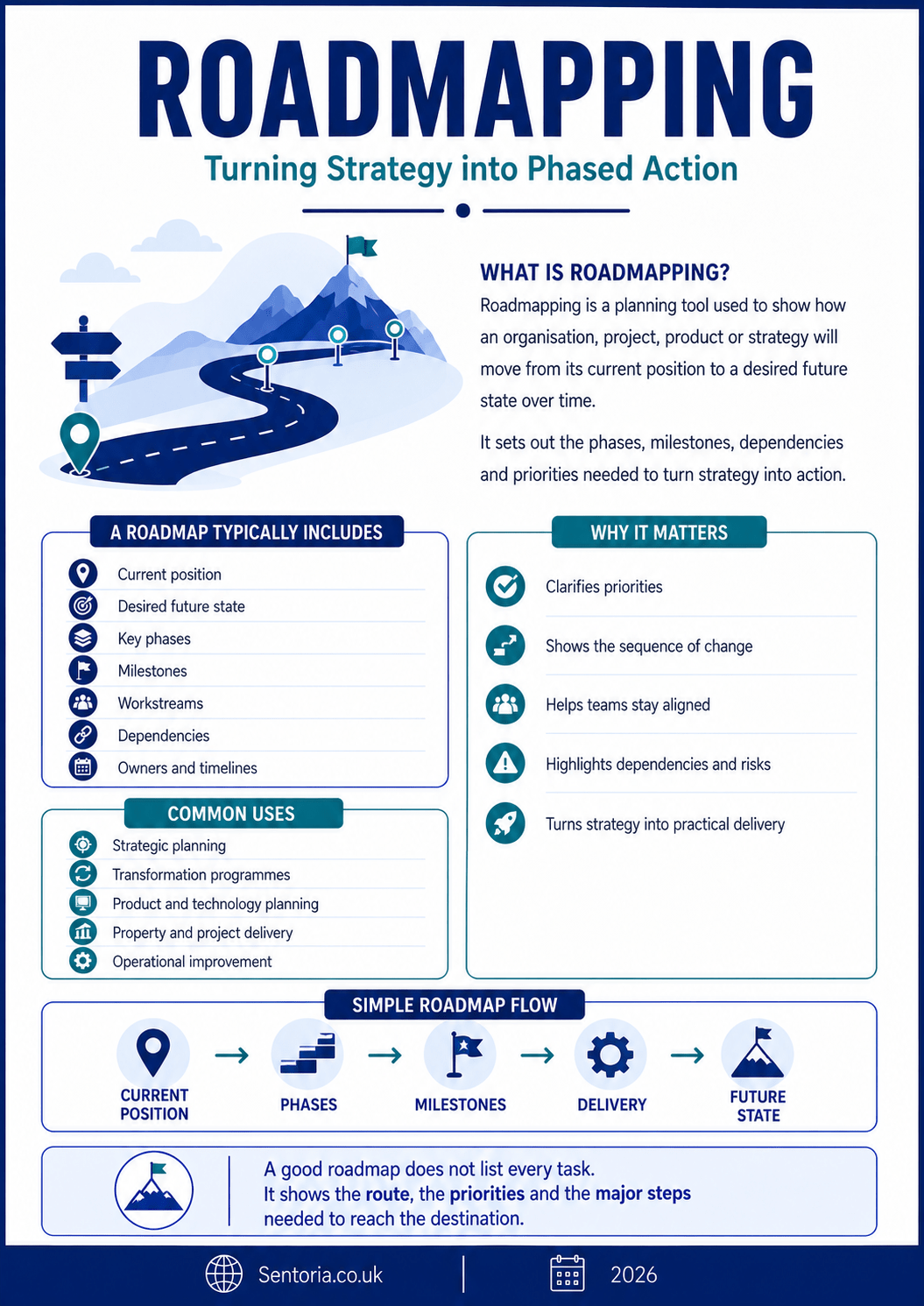
Roadmapping is a planning and management tool used to show how an organisation, project, product, service or strategy will move from its current position to a desired future state over time.
At its simplest, roadmapping asks:
Where are we going, what needs to happen, in what order, who is responsible, and how will we know we are making progress?
That makes it useful for strategy, business planning, transformation, product development, technology adoption, project management, charity planning, public sector programmes, property development, operational improvement, innovation and board reporting.
Used properly, roadmapping helps organisations turn ambition into a practical sequence of decisions, actions, milestones and dependencies.
It does not replace strategy. It helps deliver it.
What is roadmapping?
A roadmap is a structured plan that shows the journey from today to a future objective.
It normally includes:
- The current position
- The desired future position
- Key phases
- Milestones
- Workstreams
- Dependencies
- Resources
- Risks
- Owners
- Timelines
- Decisions required
- Measures of progress
A roadmap can be high-level or detailed.
A strategic roadmap may show the major stages of a three-year business plan.
A product roadmap may show planned features, releases and customer outcomes.
A technology roadmap may show system upgrades, integrations and data improvements.
A project roadmap may show phases, milestones, decision points and dependencies.
A property roadmap may show planning, funding, design, construction, leasing and completion stages.
The purpose is not to list every task. That is usually the role of a project plan or action plan.
The purpose of a roadmap is to show direction, sequence and priorities.
Roadmap, project plan and strategy
Roadmaps are often confused with strategy and project plans.
They are connected, but they are not the same.
Strategy
Strategy explains the direction and choices.
It asks:
What are we trying to achieve, and why?
For example:
We will grow advisory services for SME clients and reduce reliance on low-margin compliance work.
Roadmap
The roadmap explains the route.
It asks:
What major steps are needed to get there?
For example:
- Define advisory proposition.
- Segment existing clients.
- Pilot service with selected clients.
- Train staff.
- Build reporting templates.
- Launch monthly packages.
- Review pricing and profitability.
- Scale the service.
Project plan
The project plan explains detailed delivery.
It asks:
What tasks need to be done, by whom and by when?
For example:
- Draft client email by 12 June.
- Build reporting template by 20 June.
- Prepare pricing sheet by 25 June.
- Hold pilot review meeting by 30 June.
In simple terms:
Strategy sets direction.
The roadmap shows the journey.
The project plan manages the detail.
All three are useful, but they operate at different levels.
History and development of roadmapping
Roadmapping developed from strategic planning, product planning, technology planning and project management.
It became especially common in technology and product-led businesses because organisations needed a way to connect long-term vision with practical delivery. Product teams needed to show what was being developed, why it mattered, when it might happen, and how it related to customer needs and business goals.
Technology roadmaps also became important because systems, platforms, infrastructure and digital capability rarely change in one step. They usually require phases, investment, migration, testing, integration and training.
Over time, roadmapping moved into wider management use.
It is now used for:
- Strategy delivery
- Digital transformation
- Product development
- Business model change
- Operational improvement
- Property regeneration
- Public sector reform
- Charity sustainability
- Workforce planning
- Innovation planning
- Sustainability and net zero
- Customer experience improvement
The reason is simple.
Many organisations are good at describing what they want.
Fewer are good at showing how they will get there.
Roadmapping fills that gap.
Why roadmapping matters
Roadmapping matters because strategy often fails in the space between intention and execution.
An organisation may have a clear vision. It may know where it wants to be. It may have agreement at board or leadership level. But without a roadmap, delivery can become confused.
Common problems include:
- Too many priorities
- No clear sequence
- Unclear ownership
- Missed dependencies
- Unrealistic timing
- Weak communication
- Poor resource planning
- Projects competing with each other
- No link between strategy and delivery
- No clear milestones
- No decision points
- No visible progress
A roadmap helps by creating structure.
It supports:
- Clarity
- Prioritisation
- Communication
- Phasing
- Ownership
- Governance
- Resource planning
- Risk management
- Stakeholder alignment
- Progress monitoring
- Better decision-making
- Better board reporting
- Better project coordination
- Better change management
- Better use of limited resources
A good roadmap helps everyone understand not only the destination, but the route.
When to use roadmapping
Roadmapping is useful whenever an organisation needs to move from ambition to phased delivery.
Good uses include:
- Strategic planning
- Business transformation
- Digital transformation
- Product development
- Technology implementation
- Service redesign
- Property development
- Charity sustainability planning
- Public sector programmes
- Workforce planning
- Operational improvement
- Marketing strategy
- Customer experience improvement
- Financial improvement plans
- Systems integration
- Innovation planning
- Net zero planning
- Business model redesign
- Growth planning
- Turnaround planning
It is especially useful where:
- The goal is important.
- The work will take time.
- Several teams are involved.
- The route is not obvious.
- There are dependencies.
- Investment is needed.
- Stakeholders need to understand progress.
- The board needs oversight.
- The plan needs phasing.
- The organisation must make trade-offs.
It is less useful for very small tasks that can be handled through a simple action list.
Types of roadmap
Strategic roadmap
A strategic roadmap shows how an organisation will deliver its strategy over time.
It may include:
- Strategic themes
- Major initiatives
- Phases of delivery
- Milestones
- Investment needs
- Risks
- Dependencies
- Measures of success
- Governance points
- Review dates
This is useful for boards, leadership teams and senior managers.
Product roadmap
A product roadmap shows how a product or service will develop.
It may include:
- Customer problems
- Feature priorities
- Product releases
- User research
- Testing phases
- Technical improvements
- Customer feedback loops
- Market launches
- Adoption targets
- Commercial goals
A good product roadmap should not simply be a list of features. It should connect product development to customer value and business outcomes.
Technology roadmap
A technology roadmap shows how systems, data, infrastructure and digital capability will develop.
It may include:
- Current systems
- Target architecture
- System upgrades
- Data improvements
- Integrations
- Cyber security improvements
- Migration phases
- Training needs
- Supplier changes
- Decommissioning old systems
Technology roadmaps are useful because digital change often has many dependencies.
Transformation roadmap
A transformation roadmap shows how a major organisational change will be delivered.
It may include:
- Current operating model
- Future operating model
- People changes
- Process changes
- System changes
- Governance changes
- Communication plan
- Training
- Pilots
- Rollout phases
This is useful when the organisation needs to change how it works, not just deliver a single project.
Project roadmap
A project roadmap gives a high-level view of a project.
It may include:
- Initiation
- Design
- Approval
- Procurement
- Delivery
- Testing
- Launch
- Review
- Closure
- Benefits realisation
It sits above the detailed project plan.
Capability roadmap
A capability roadmap shows how an organisation will build the skills, systems, people and processes it needs.
It may include:
- Skills development
- Recruitment
- Training
- Systems
- Processes
- Governance
- Data
- Partnerships
- Knowledge management
- Leadership development
This is useful where the future strategy depends on building capability first.
Roadmapping in different industries
SMEs and owner-managed businesses
For SMEs, a roadmap can help turn broad business goals into practical steps.
Owner-managed businesses often have many competing priorities: sales, cash flow, staffing, systems, customers, tax, marketing, operations and delivery. A roadmap helps decide what happens first.
Typical SME roadmaps include:
- Growth roadmap
- Cash improvement roadmap
- Systems improvement roadmap
- Sales and marketing roadmap
- Recruitment roadmap
- Owner-dependency reduction roadmap
- Advisory service roadmap
- Customer retention roadmap
- Pricing improvement roadmap
- Exit or succession roadmap
Example:
Objective: Reduce owner dependency over three years.
Roadmap phases might include:
- Document key processes.
- Improve management reporting.
- Delegate routine decisions.
- Recruit or develop team leads.
- Introduce approval limits.
- Build customer relationship ownership across the team.
- Review progress quarterly.
For SMEs, the roadmap should be simple enough to use.
It should focus on the few changes that will make the biggest difference.
Manufacturing
Manufacturers can use roadmaps for production improvement, automation, quality, sustainability, supply chain resilience and capacity planning.
Typical manufacturing roadmaps include:
- Automation roadmap
- Quality improvement roadmap
- Maintenance improvement roadmap
- Production capacity roadmap
- Supplier resilience roadmap
- Energy reduction roadmap
- Skills development roadmap
- Stock control roadmap
- Digital manufacturing roadmap
- Product development roadmap
Example:
Objective: Improve production reliability over two years.
Roadmap phases might include:
- Analyse downtime data.
- Identify critical equipment.
- Implement planned maintenance.
- Train operators.
- Improve spare parts management.
- Introduce performance dashboards.
- Review supplier reliability.
- Reduce unplanned downtime.
For manufacturing, roadmapping should connect operations, finance, procurement, quality and workforce planning.
Retail and ecommerce
Retail and ecommerce businesses can use roadmaps for customer experience, product range, fulfilment, digital marketing and systems.
Typical roadmaps include:
- Ecommerce growth roadmap
- Customer retention roadmap
- Fulfilment improvement roadmap
- Product category roadmap
- Website improvement roadmap
- Data and analytics roadmap
- Brand development roadmap
- Returns reduction roadmap
- Stock management roadmap
- Marketplace strategy roadmap
Example:
Objective: Improve customer retention.
Roadmap phases might include:
- Analyse repeat purchase data.
- Identify high-retention product categories.
- Improve post-purchase communication.
- Introduce loyalty or membership proposition.
- Improve customer support response.
- Test subscription options.
- Monitor retention, margin and lifetime value.
For ecommerce, roadmaps should connect customer value, technology, stock, fulfilment, marketing and margin.
Professional services
Professional services firms can use roadmaps for service development, systems, quality, workflow, pricing and staff development.
Typical roadmaps include:
- Advisory service roadmap
- Client onboarding roadmap
- Practice management system roadmap
- Workflow improvement roadmap
- Client segmentation roadmap
- Pricing roadmap
- Quality review roadmap
- Staff training roadmap
- Digital documentation roadmap
- Marketing content roadmap
Example:
Objective: Build a monthly advisory service for SME clients.
Roadmap phases might include:
- Define service proposition.
- Identify suitable existing clients.
- Build reporting templates.
- Develop pricing model.
- Train staff.
- Pilot with selected clients.
- Gather feedback.
- Launch wider offer.
- Review profitability and retention.
For accountants, solicitors, consultants, architects and advisers, a roadmap helps move from ideas to consistent delivery.
Charities and voluntary organisations
Charities can use roadmaps for sustainability, funding diversification, service development, volunteer recruitment, governance and impact reporting.
Typical charity roadmaps include:
- Funding diversification roadmap
- Volunteer development roadmap
- Service sustainability roadmap
- Impact reporting roadmap
- Trustee recruitment roadmap
- Digital fundraising roadmap
- Safeguarding improvement roadmap
- Partnership roadmap
- Reserves rebuilding roadmap
- Community engagement roadmap
Example:
Objective: Reduce reliance on one major funder.
Roadmap phases might include:
- Map current income concentration.
- Identify funding gaps.
- Strengthen impact evidence.
- Build funding pipeline.
- Develop unrestricted income options.
- Build partnership proposals.
- Review reserves policy.
- Report progress to trustees quarterly.
For charities, roadmaps should link to mission, service users, funding, reserves, risk and trustee oversight.
Public sector and local government
Public bodies can use roadmaps for service transformation, digital inclusion, financial planning, place-based strategy and policy delivery.
Typical roadmaps include:
- Service redesign roadmap
- Digital transformation roadmap
- Savings delivery roadmap
- Workforce roadmap
- Climate action roadmap
- Housing strategy roadmap
- Community engagement roadmap
- Procurement improvement roadmap
- Data improvement roadmap
- Statutory service improvement roadmap
Example:
Objective: Shift a service from reactive response to early intervention.
Roadmap phases might include:
- Analyse demand.
- Identify preventable demand.
- Engage stakeholders.
- Design early intervention model.
- Pilot in one area.
- Measure impact.
- Adjust funding and staffing.
- Scale across the service.
- Review outcomes and equality impacts.
For public bodies, roadmaps should include governance, consultation, equality, value for money, statutory duties and political accountability.
Property and construction
Property and construction organisations can use roadmaps for development, asset management, refurbishment, leasing, planning and regeneration.
Typical roadmaps include:
- Site development roadmap
- Planning roadmap
- Construction delivery roadmap
- Asset improvement roadmap
- Leasing roadmap
- Tenant engagement roadmap
- Energy performance roadmap
- Maintenance backlog roadmap
- Regeneration roadmap
- Funding roadmap
Example:
Objective: Redevelop a mixed-use site over several phases.
Roadmap phases might include:
- Confirm vision and objectives.
- Complete feasibility work.
- Engage planning advisers.
- Prepare funding strategy.
- Undertake surveys.
- Submit planning application.
- Secure permissions.
- Procure contractors.
- Deliver enabling works.
- Phase construction and leasing.
For property and construction, roadmaps should link to planning risk, funding, cash flow, legal issues, stakeholders, programme and viability.
Technology and software
Technology businesses and digital teams use roadmaps extensively for product, platform, infrastructure and cyber security development.
Typical roadmaps include:
- Product roadmap
- Platform roadmap
- Cyber security roadmap
- Data roadmap
- AI adoption roadmap
- Customer onboarding roadmap
- Technical debt roadmap
- Integration roadmap
- Release roadmap
- User experience roadmap
Example:
Objective: Build a scalable product platform.
Roadmap phases might include:
- Review current architecture.
- Identify technical debt.
- Prioritise critical stability issues.
- Improve monitoring.
- Strengthen security controls.
- Redesign key infrastructure.
- Test scalability.
- Improve user onboarding.
- Release new features in phases.
For technology, the roadmap should balance customer value, technical stability, security and commercial goals.
Healthcare and social care
Healthcare and social care organisations can use roadmaps for quality improvement, workforce planning, digital records, safeguarding, service redesign and compliance.
Typical roadmaps include:
- Quality improvement roadmap
- Workforce stability roadmap
- Digital care records roadmap
- Safeguarding improvement roadmap
- Inspection readiness roadmap
- Medication safety roadmap
- Family communication roadmap
- Service continuity roadmap
- Training compliance roadmap
- Care model redesign roadmap
Example:
Objective: Improve continuity and quality of care.
Roadmap phases might include:
- Analyse staffing and continuity data.
- Review rotas.
- Identify training gaps.
- Improve supervision.
- Strengthen care planning.
- Improve family communication.
- Monitor quality indicators.
- Review progress with governance team.
In healthcare and care, roadmaps should always support safety, dignity, safeguarding and regulatory compliance.
Education and training
Education providers can use roadmaps for curriculum development, learner support, digital learning, employer engagement, safeguarding and quality improvement.
Typical roadmaps include:
- Curriculum roadmap
- Learner support roadmap
- Employer engagement roadmap
- Digital learning roadmap
- Course viability roadmap
- Safeguarding improvement roadmap
- Funding compliance roadmap
- Tutor development roadmap
- Quality assurance roadmap
- Learner progression roadmap
Example:
Objective: Improve learner progression into employment.
Roadmap phases might include:
- Review current progression data.
- Identify employer needs.
- Update curriculum.
- Build employer partnerships.
- Improve placement support.
- Strengthen learner coaching.
- Track outcomes.
- Review course performance.
For education, roadmaps should link to learner outcomes, funding, safeguarding, quality and employer demand.
How to create a roadmap properly
1. Define the purpose
Start by deciding what the roadmap is for.
Ask:
- What are we trying to achieve?
- Why do we need a roadmap?
- Who will use it?
- What decision will it support?
- What timeframe does it cover?
- Is it strategic, operational, product, technology or project-focused?
- What level of detail is needed?
- How will it be reviewed?
- Who owns it?
- What outcome should it create?
A roadmap without a clear purpose can become a decorative timeline.
2. Define the destination
A roadmap needs a destination.
The destination may be:
- A strategic objective
- A future operating model
- A product vision
- A service improvement
- A technology target
- A financial position
- A property development outcome
- A sustainability goal
- A customer experience goal
- A transformation outcome
Weak destination:
Improve our systems.
Stronger destination:
Within two years, create a single reliable customer and finance reporting system that reduces manual spreadsheet reporting and improves decision-making.
The stronger version gives direction.
3. Understand the current position
Before mapping the route, understand the starting point.
Assess:
- Current performance
- Current systems
- Current processes
- Current people and skills
- Current risks
- Current resources
- Current constraints
- Current customer or service user experience
- Current financial position
- Current governance
A roadmap built on a poor understanding of today will be unrealistic.
4. Identify the gap
Compare the current position with the destination.
Ask:
- What is missing?
- What must improve?
- What must change?
- What must stop?
- What must be created?
- What must be funded?
- What must be learned?
- What must be automated?
- What must be protected?
- What decisions are needed?
This gap becomes the basis for the roadmap.
5. Define workstreams
Workstreams group related activity.
Typical workstreams might include:
- People
- Process
- Technology
- Finance
- Customers
- Governance
- Data
- Operations
- Marketing
- Compliance
- Property
- Suppliers
- Training
- Communications
- Risk management
Workstreams help structure a roadmap without turning it into a long task list.
6. Break the roadmap into phases
A roadmap should show phases.
For example:
- Discover
- Design
- Pilot
- Build
- Launch
- Scale
- Review
Or:
- Foundation
- Development
- Implementation
- Optimisation
Or:
- Year one
- Year two
- Year three
The exact structure depends on the work.
Phasing helps the organisation avoid trying to do everything at once.
7. Identify milestones
Milestones are important points of progress.
Examples include:
- Business case approved
- Funding secured
- System selected
- Pilot completed
- Planning application submitted
- Staff trained
- First launch completed
- Customer feedback reviewed
- New process implemented
- Benefits measured
- Contract signed
- Key risk reduced
- Board decision made
- First phase delivered
- Review completed
Milestones should be meaningful.
They should show progress towards the destination.
8. Identify dependencies
Dependencies are things that must happen before something else can happen.
Examples include:
- Funding must be approved before procurement starts.
- Data must be cleaned before system migration.
- Planning permission must be secured before construction begins.
- Staff must be trained before the new process goes live.
- Customer research must be completed before product design.
- Supplier contracts must be agreed before implementation.
- Board approval must be obtained before spending.
- Legal advice must be received before signing.
- Infrastructure must be upgraded before scaling.
- Policies must be approved before rollout.
Dependencies are one of the main reasons roadmaps matter.
They help prevent unrealistic sequencing.
9. Assign ownership
Every major workstream and milestone should have an owner.
Ownership should be clear.
Record:
- Workstream owner
- Milestone owner
- Decision owner
- Executive sponsor
- Project manager
- Supporting teams
- Board or trustee oversight
- External adviser or supplier where relevant
A roadmap without owners will drift.
10. Link to resources
A roadmap should be realistic about resources.
Consider:
- Staff time
- Skills
- Budget
- External support
- Systems
- Data
- Management capacity
- Board time
- Supplier availability
- Training needs
- Cash flow
- Funding
- Equipment
- Premises
- Communications
Many roadmaps fail because they assume people can deliver major change alongside full-time operational work.
11. Identify risks
Every roadmap should link to risk management.
Risks may include:
- Funding not available
- Staff capacity insufficient
- Technology not working
- Supplier failure
- Delayed decisions
- Customer resistance
- Stakeholder opposition
- Cost increases
- Poor data quality
- Scope creep
- Regulatory change
- Loss of key staff
- Weak governance
- Unrealistic timetable
- Benefits not realised
Important risks should be recorded in the risk register.
12. Build in review points
A roadmap should not be fixed forever.
Review points allow the organisation to ask:
- Are we on track?
- Are assumptions still valid?
- Have risks changed?
- Are resources still available?
- Are milestones being met?
- Is the destination still right?
- What has been learned?
- What needs adjusting?
- What decisions are needed?
- Should anything stop?
Good roadmaps adapt without losing direction.
Common roadmapping techniques
Timeline roadmap
A timeline roadmap shows phases and milestones over time.
It is useful for board reporting, project communication and strategic delivery.
Now, next, later roadmap
A now, next, later roadmap groups work into:
- What we are doing now
- What comes next
- What comes later
This is useful where exact dates are uncertain but priorities need to be clear.
Theme-based roadmap
A theme-based roadmap organises work around strategic themes.
Examples include:
- Customer experience
- Financial sustainability
- Operational efficiency
- Digital improvement
- People and culture
This is useful for strategic roadmaps.
Product roadmap
A product roadmap shows how a product develops over time.
It should link features to customer problems, business outcomes and evidence.
Technology roadmap
A technology roadmap shows how systems, data, infrastructure and security will develop.
It is useful for IT planning, digital transformation and system replacement.
Capability roadmap
A capability roadmap shows how the organisation will build the capabilities required for future success.
It is useful for people, skills, systems and operating model change.
Transformation roadmap
A transformation roadmap shows the stages of major organisational change.
It usually includes people, process, systems, communication and governance.
Common mistakes in roadmapping
Mistake 1: Creating a roadmap without a strategy
A roadmap should support a strategic direction.
Without strategy, it becomes a list of activity.
Mistake 2: Making the roadmap too detailed
A roadmap should show the route, not every task.
Too much detail makes it hard to understand.
Mistake 3: Making it too vague
A roadmap that only contains broad themes may not help delivery.
There should be clear phases, milestones and owners.
Mistake 4: Ignoring dependencies
If dependencies are missed, the sequence may be unrealistic.
This is one of the most common causes of delay.
Mistake 5: Ignoring resources
A roadmap is not credible if nobody has time, money or capacity to deliver it.
Mistake 6: No ownership
Every important workstream and milestone needs an owner.
Mistake 7: Treating the roadmap as fixed
A roadmap should provide direction, but it should adapt as circumstances change.
Mistake 8: Confusing features with outcomes
This is especially common in product roadmaps.
A roadmap should not only say what will be built. It should explain what value will be created.
Mistake 9: Not communicating the roadmap
A roadmap hidden in a management document will not align people.
It should be communicated clearly to the relevant audience.
Mistake 10: Not reviewing progress
A roadmap needs regular review.
Otherwise, it becomes outdated and loses authority.
Limitations and weaknesses of roadmapping
Roadmapping is useful, but it has limits.
It can create false certainty
A roadmap can make the future look more predictable than it is.
The plan should be clear, but not pretend that nothing will change.
It depends on good assumptions
Roadmaps often rely on assumptions about funding, people, technology, customers, suppliers and timing.
Important assumptions should be recorded and tested.
It can become too rigid
If the roadmap is treated as fixed, it may stop the organisation responding to new evidence.
It can become too high-level
A roadmap that never connects to action will not deliver change.
It should link to project plans, OKRs, action logs or delivery plans.
It may hide resource pressure
A roadmap may look achievable until the organisation considers staff time and management capacity.
It can be dominated by leadership
If the roadmap is created only by senior leaders, it may miss practical delivery realities.
Staff, customers, service users, suppliers and stakeholders may need to be involved.
It does not replace delivery management
A roadmap shows the route.
It does not manage daily delivery.
Project plans, action logs and governance are still needed.
Roadmapping compared with other strategic and management tools
Roadmapping and backforecasting
Backforecasting starts with a desired future and works backwards.
Roadmapping then turns that future-back thinking into phases, milestones and actions.
Use backforecasting to define the route conceptually. Use roadmapping to present and manage the route.
Roadmapping and forecasting
Forecasting estimates what is likely to happen.
Roadmapping shows what the organisation intends to do.
Use forecasting to understand likely outcomes. Use roadmapping to plan deliberate action.
Roadmapping and strategy
Strategy defines direction and choices.
Roadmapping explains how the strategy will be delivered over time.
Roadmapping and OKRs
OKRs define focused objectives and measurable key results.
A roadmap may show the long-term journey, while OKRs define near-term priorities within that journey.
Roadmapping and project plan
A roadmap gives the high-level journey.
A project plan manages detailed tasks, dates and responsibilities.
Both are useful.
Roadmapping and risk register
A roadmap identifies stages of delivery.
A risk register identifies what could affect those stages.
Use the risk register to manage the risks that could disrupt the roadmap.
Roadmapping and assumptions log
Roadmaps rely on assumptions.
The assumptions log records what is being assumed and how those assumptions will be tested.
Roadmapping and issue log
An issue log records current problems.
Issues that delay or block roadmap milestones should be tracked and escalated.
Roadmapping and Balanced Scorecard
The Balanced Scorecard tracks strategic performance.
A roadmap can show the initiatives needed to improve performance across the scorecard perspectives.
Roadmapping and Business Model Canvas
The Business Model Canvas describes how an organisation creates, delivers and captures value.
A roadmap can show how the organisation will move from the current business model to a future business model.
Alternatives and complementary frameworks
Project plan
Use a project plan for detailed delivery management.
Best used beneath the roadmap.
Action log
Use an action log to track specific actions from meetings or reviews.
Best used for short-term follow-up.
Gantt chart
Use a Gantt chart to show tasks, timing and dependencies in more detail.
Best used for project delivery.
OKRs
Use OKRs to define near-term objectives and measurable outcomes.
Best used to drive quarterly progress within a roadmap.
Backforecasting
Use backforecasting to work backwards from a desired future.
Best used before creating a strategic roadmap.
Scenario planning
Use scenario planning to test whether the roadmap remains useful under different future conditions.
Risk register
Use a risk register to manage risks affecting roadmap delivery.
Assumptions log
Use an assumptions log to track important assumptions behind the roadmap.
Benefits realisation plan
Use a benefits realisation plan to track whether the roadmap is creating the intended value.
A practical roadmap template
A useful roadmap template should include:
- Roadmap title
- Purpose
- Owner
- Time horizon
- Current position
- Desired future position
- Strategic themes
- Workstreams
- Phases
- Milestones
- Dependencies
- Key decisions
- Resources required
- Risks
- Assumptions
- Measures of success
- Governance
- Review points
- Linked project plans
- Version control
Example:
Roadmap title: Advisory service development roadmap
Purpose: Build a structured monthly advisory service for SME clients over 18 months.
Current position: Advisory work is delivered informally and inconsistently.
Desired future position: Advisory services are packaged, priced, delivered consistently and generate recurring monthly income.
Workstreams:
- Service design
- Pricing
- Client segmentation
- Reporting templates
- Staff training
- Marketing
- Delivery process
Phases:
- Foundation: define service and identify pilot clients.
- Pilot: test with selected clients.
- Launch: promote to wider client base.
- Optimise: review profitability, feedback and retention.
Milestones:
- Service proposition approved.
- Pilot clients selected.
- Reporting template completed.
- First pilot meeting delivered.
- Pricing reviewed.
- Wider launch approved.
Owner: Managing Director.
Review frequency: Monthly.
Questions to ask when creating a roadmap
Purpose questions
- What is this roadmap for?
- What decision does it support?
- Who will use it?
- What level of detail is needed?
- What period does it cover?
- What outcome should it help deliver?
- Is it strategic, operational or project-focused?
- How will it be reviewed?
- Who owns it?
- How will it be communicated?
Destination questions
- Where are we trying to get to?
- What does success look like?
- How will we measure success?
- Why does this future position matter?
- Does it support the strategy?
- Is it realistic?
- Is it ambitious enough?
- Does the board or leadership team agree?
- Do stakeholders understand it?
- What would be different from today?
Current position questions
- Where are we now?
- What is working?
- What is not working?
- What capabilities do we have?
- What capabilities are missing?
- What resources are available?
- What risks already exist?
- What constraints are we facing?
- What assumptions are we making?
- What must be protected during change?
Sequencing questions
- What must happen first?
- What can happen later?
- What depends on something else?
- What decisions are needed before work starts?
- What must be piloted?
- What must be approved?
- What must be funded?
- What must be communicated?
- What must be stopped?
- What is the critical path?
Resource questions
- Who will deliver the roadmap?
- Do they have capacity?
- What budget is required?
- What skills are needed?
- What external support is required?
- What systems are needed?
- What data is needed?
- What training is needed?
- What management time is required?
- What happens if resources are not available?
Risk questions
- What could delay the roadmap?
- What could make it more expensive?
- What assumptions could be wrong?
- What dependencies could fail?
- What resistance might arise?
- What risks are outside appetite?
- What controls are needed?
- What contingency is required?
- What should be added to the risk register?
- What early warning signs should be monitored?
Review questions
- Are milestones being met?
- Are benefits being delivered?
- Are assumptions still valid?
- Are risks changing?
- Are resources still sufficient?
- Is the destination still right?
- What has been learned?
- What needs adjusting?
- What decisions are needed?
- Should anything be stopped or re-prioritised?
The best way to think about roadmapping
Roadmapping is not just drawing a timeline.
It is disciplined sequencing.
A good roadmap should be:
- Strategic
- Practical
- Clear
- Phased
- Owned
- Linked to resources
- Linked to risks
- Linked to decisions
- Easy to communicate
- Regularly reviewed
A weak roadmap says:
“Here are the things we plan to do.”
A strong roadmap asks:
“What is the route from where we are now to where we need to be, and what must happen in what order?”
The key question is not simply:
What is on the roadmap?
The better question is:
Does the roadmap show a credible, prioritised and resourced route to the desired outcome?
Conclusion: roadmapping turns ambition into a practical route
Roadmapping remains useful because many organisations have more ambition than capacity.
They know what they want to improve. They know change is needed. They may even know the destination. But without a roadmap, activity can become fragmented, reactive and poorly sequenced.
Used badly, a roadmap becomes a colourful timeline that is rarely reviewed.
Used properly, it becomes a practical management tool. It helps organisations clarify direction, phase work, identify dependencies, assign ownership, manage risk, communicate progress and turn strategy into action.
The real value is not in producing the roadmap.
The real value is in using it to make better decisions.
A strong roadmap helps an organisation move from saying, “We know where we want to go,” to asking, “What is the route, what must happen first, and how will we keep moving in the right direction?”