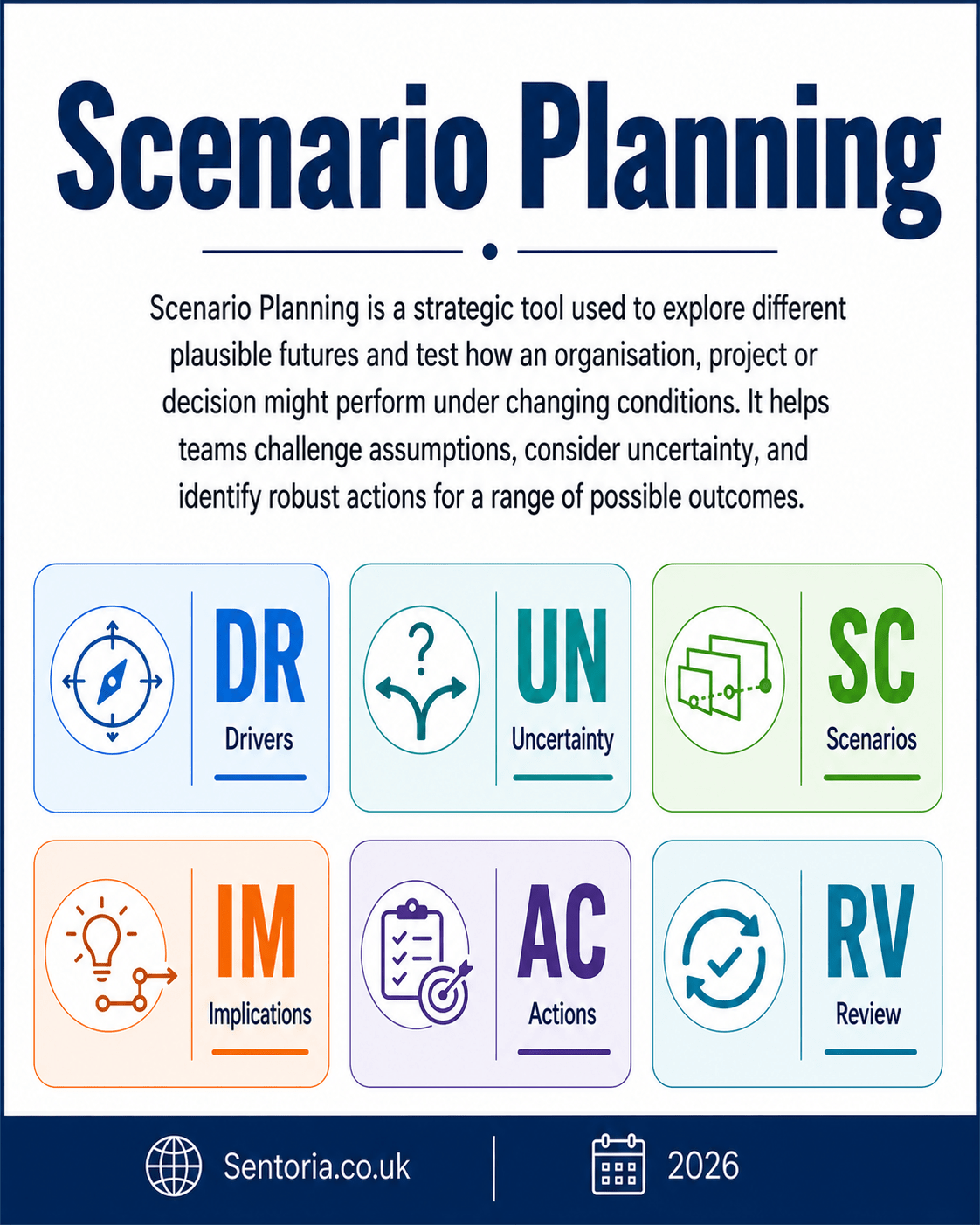
Scenario Planning:
A Practical Guide to Making Better Decisions in an Uncertain Future
Scenario planning is a strategic planning tool used to explore different possible futures and test how an organisation, project, policy or business model might perform under changing conditions.
It is not about predicting the future. It is about preparing for uncertainty.
At its simplest, scenario planning asks:
What could the future look like, what would that mean for us, and what should we do now?
That makes it particularly useful when the future is uncertain, complex or fast-moving. Forecasts often assume that the future will be a continuation of the past. Scenario planning takes a different approach. It accepts that several futures may be possible, and that good strategy should be robust enough to cope with more than one outcome.
Shell, one of the best-known users of scenario planning, describes scenarios as “what if?” explorations that help consider alternative views of the future. Shell also makes clear that scenarios are not forecasts, predictions, business plans or investment advice. They are designed to stretch thinking and test assumptions.
Used properly, scenario planning helps leaders avoid being trapped by a single view of the future.
What is scenario planning?
Scenario planning is a structured method for developing a small number of plausible future scenarios and using them to test strategy, policy, investment decisions, business plans or operating models.
A scenario is not simply a guess. It is a carefully constructed story about how the future might develop, based on key uncertainties, trends, drivers of change and assumptions.
Good scenarios are:
- Plausible
- Distinct from each other
- Relevant to the decision being made
- Challenging enough to test assumptions
- Evidence-informed
- Internally consistent
- Practical enough to support decisions
Scenario planning is particularly valuable because it encourages organisations to move beyond one “official future”. Instead of asking, “What do we think will happen?”, it asks, “What different things could happen, and how would we respond?”
The OECD describes scenario planning as developing multiple future scenarios to explore their possible implications for the present.
History and development of scenario planning
Scenario planning has roots in military, strategic and futures thinking. It is often associated with work carried out in the United States after the Second World War, particularly at the RAND Corporation, where Herman Kahn developed approaches to thinking systematically about possible futures and strategic uncertainty. The Oxford Futures Library identifies two important historical strands in scenario planning: the American approach, linked to RAND and the Institute for the Future, and the French approach, later brought together in corporate practice by Pierre Wack at Shell.
Scenario planning became especially well known through its use at Royal Dutch Shell. In the 1960s and 1970s, Shell developed scenario planning as a way of thinking about long-term uncertainty in the energy sector. Shell’s own history of scenarios describes Pierre Wack as a central figure in the early development of Shell’s scenario practice, challenging traditional management assumptions and encouraging executives to think differently about possible disruptions.
The Shell example became famous because scenario planning helped the company think more seriously about the possibility of oil market disruption before the 1973 oil crisis. The lesson was not that Shell had predicted the future precisely. The lesson was that it had rehearsed alternative futures, challenged assumptions and was better prepared when conditions changed.
Pierre Wack later wrote about scenarios for the Harvard Business Review. HBR identifies Wack as the retired head of the business environment division of Royal Dutch Shell’s planning department and notes that he developed the Shell system of scenario planning with Edward Newland.
Over time, scenario planning spread from energy and corporate strategy into public policy, government, healthcare, defence, climate planning, technology, urban development, education, charities and long-term investment. The UK Government Office for Science now includes futures and foresight tools, including scenario-based approaches, in its Futures Toolkit for policy makers and analysts. The toolkit is designed to help develop policies and strategies that are robust in the face of an uncertain future.
Why scenario planning matters
Scenario planning matters because organisations often make decisions using assumptions they have not properly tested.
Those assumptions may include:
- Demand will continue to grow.
- Costs will remain manageable.
- Customers will behave as they do now.
- Regulation will not change significantly.
- Technology will develop gradually.
- Funding will continue.
- Competitors will act predictably.
- Supply chains will remain stable.
- Staff will remain available.
- The economy will broadly follow expected trends.
Sometimes those assumptions prove broadly correct. Sometimes they do not.
Scenario planning helps organisations prepare for uncertainty by making assumptions visible and testing them against different possible futures.
It is especially useful where:
- The future is uncertain.
- The decision is important.
- The consequences of being wrong are significant.
- The organisation needs to act before certainty is available.
- There are several plausible directions of change.
- Long-term investment or policy choices are involved.
- Existing plans may be vulnerable to external disruption.
The value of scenario planning is not only the scenarios themselves. The real value is the strategic conversation they create.
Scenario planning compared with forecasting
Forecasting and scenario planning are related, but they are not the same.
A forecast usually tries to estimate the most likely future outcome. It may use data, trends, modelling, assumptions and probability.
Scenario planning explores several plausible futures. It does not try to identify one correct answer.
For example, a financial forecast may estimate revenue growth of 5% next year.
A scenario planning exercise might ask:
- What if demand grows strongly?
- What if demand stays flat?
- What if demand falls because of a recession?
- What if a new competitor changes pricing?
- What if regulation changes the market?
- What if technology changes customer behaviour?
Both forecasting and scenario planning are useful. Forecasting supports budgeting and planning. Scenario planning supports strategic resilience.
The problem comes when a forecast is treated as certainty. Scenario planning helps prevent that.
When to use scenario planning
Scenario planning is useful when uncertainty is high and the organisation needs to make strategic choices.
Good uses include:
- Long-term strategic planning
- Business model review
- Major investment decisions
- Public policy development
- Climate and sustainability planning
- Technology disruption planning
- Economic uncertainty
- Workforce planning
- Charity sustainability planning
- Property and regeneration projects
- Market entry decisions
- Supply chain resilience
- Risk management
- Crisis preparedness
- Board and trustee strategy sessions
The UK Government’s Futures Toolkit includes policy stress-testing, sometimes called wind tunnelling, as a method for testing strategy, policy or project options against scenarios, trends or future events to see how well they stand up to different external conditions.
Scenario planning is less useful where the decision is simple, short-term, low-risk or already well understood. It is most useful where there is real uncertainty and meaningful consequences.
Types of scenario planning
Exploratory scenarios
Exploratory scenarios examine different ways the future could unfold. They usually start from the present and look forward.
For example:
- A high-growth economy
- A low-growth economy
- A technology-led market
- A heavily regulated market
- A fragmented local economy
- A climate-constrained operating environment
Exploratory scenarios are useful when the organisation does not know which future is most likely and wants to test strategy across several possibilities.
Normative scenarios
Normative scenarios start with a desired future and work backwards.
For example:
- A net zero organisation by 2040
- A financially sustainable charity within five years
- A town centre with lower vacancy and stronger footfall
- A business with reduced owner dependency
- A public service designed around prevention rather than crisis response
These scenarios are useful where the organisation wants to understand what would need to happen to reach a preferred outcome.
Shell distinguishes between exploratory and normative scenarios in its current scenario materials. It describes exploratory scenarios as using plausible assumptions to explore possible futures, while normative scenarios assume a specific goal and work back to consider how it might be achieved.
Stress-test scenarios
Stress-test scenarios are designed to test whether a strategy can survive difficult conditions.
Examples include:
- Revenue falls by 20%.
- Interest rates remain high.
- A major supplier fails.
- A key funder withdraws.
- Energy costs rise sharply.
- A cyber attack disrupts operations.
- A new competitor enters the market.
- Regulation increases cost or complexity.
These scenarios are especially useful for risk management, business continuity and board assurance.
Wild card scenarios
Wild card scenarios consider low-probability but high-impact events.
Examples include:
- A pandemic
- War or major geopolitical disruption
- Sudden regulatory change
- Collapse of a major supplier
- Rapid adoption of disruptive technology
- Extreme weather event
- Financial crisis
- Major reputational incident
Wild cards should not dominate every planning process, but they can help organisations think about resilience and contingency planning.
Scenario planning in different industries
SMEs and owner-managed businesses
For SMEs, scenario planning is useful because smaller businesses often have less capacity to absorb shocks.
An SME might use scenario planning to test:
- What happens if sales fall?
- What happens if a key customer leaves?
- What happens if wage costs rise?
- What happens if the owner is unavailable?
- What happens if a competitor cuts prices?
- What happens if cash collection worsens?
- What happens if new technology changes customer expectations?
For SMEs, scenario planning should be practical and linked to cash flow, margins, capacity, customers and key person dependency.
A small business does not need a complex academic exercise. It needs clear scenarios that help the owner decide what to do now.
Manufacturing
Manufacturing businesses face uncertainty around energy, supply chains, labour, regulation, automation, materials and demand.
Scenario planning can help manufacturers consider:
- High energy cost scenario
- Supply chain disruption scenario
- Automation-led productivity scenario
- Labour shortage scenario
- Export growth scenario
- Demand contraction scenario
- Regulatory tightening scenario
- Reshoring opportunity scenario
For manufacturing, scenarios should be linked to cost modelling, supplier review, production capacity, stock policy, capital investment and workforce planning.
Retail and ecommerce
Retail and ecommerce businesses are exposed to consumer confidence, rent, stock, delivery costs, online competition and changing shopping behaviour.
Useful scenarios might include:
- Cost of living pressure reduces discretionary spending.
- Online acquisition costs rise.
- A marketplace changes fees or rules.
- Customers become more sustainability-focused.
- Footfall improves in local centres.
- Competitors discount aggressively.
- Delivery expectations become more demanding.
- Stock costs rise because of supply disruption.
For retail, scenario planning should be connected to margin, stock turn, customer acquisition cost, pricing, channels and returns.
Professional services
Professional services firms can use scenario planning to test how client needs, technology, regulation and talent markets may change.
For accountants, solicitors, consultants, architects and advisers, useful scenarios include:
- AI automates more routine work.
- Clients become more price-sensitive.
- Demand for advisory work increases.
- Recruitment becomes more difficult.
- Regulation becomes more complex.
- Larger firms move into local markets.
- Remote delivery becomes standard.
- Clients expect more fixed-fee pricing.
Scenario planning can help firms decide whether to specialise, invest in technology, change pricing, develop advisory services, strengthen client relationships or restructure teams.
Charities and voluntary organisations
For charities, scenario planning is particularly valuable because demand and funding can move in opposite directions.
Useful scenarios include:
- Demand increases but funding falls.
- A major grant ends.
- Public sector commissioning changes.
- Volunteer numbers decline.
- Local need becomes more complex.
- A new partnership opportunity emerges.
- Costs rise faster than income.
- Digital delivery becomes more important.
For charities, scenario planning should connect to reserves, funding strategy, staffing, safeguarding, volunteer capacity, trustee oversight and impact reporting.
Public sector and local government
Public sector organisations use scenario planning to support policy, service design and long-term resilience.
Useful scenarios might include:
- Rising demand and constrained budgets.
- Demographic change increases service pressure.
- Technology enables more preventative services.
- Climate adaptation becomes more urgent.
- Central government policy changes.
- Local economic conditions worsen.
- Public expectations shift.
- Partnerships become more important to delivery.
The UK Government Office for Science promotes futures thinking and foresight as a way of helping policy makers and analysts develop strategies that are robust under uncertainty.
Property and construction
Property and construction decisions often involve long timescales, high capital commitments and uncertainty.
Scenario planning can test:
- Interest rates remain high.
- Build costs rise further.
- Contractor availability worsens.
- Planning policy changes.
- Demand for office space falls.
- Residential demand strengthens.
- Sustainability requirements increase.
- Infrastructure investment improves local viability.
- Tenant demand shifts towards flexibility.
- Funding becomes more difficult.
For property, scenario planning should sit alongside financial appraisal, valuation, planning strategy, legal review, sensitivity testing and risk registers.
Technology and software
Technology businesses operate in uncertain markets where adoption, funding, competition and regulation can change quickly.
Useful scenarios include:
- AI accelerates customer expectations.
- Cyber regulation tightens.
- Customer churn increases.
- A platform dependency becomes a strategic risk.
- Funding becomes harder to secure.
- A competitor launches a cheaper substitute.
- Enterprise customers delay buying decisions.
- New integrations create growth opportunities.
For technology businesses, scenario planning should be linked to product strategy, cyber risk, unit economics, customer discovery and technical capacity.
Healthcare and social care
Healthcare and social care organisations face uncertainty around demand, staffing, funding, regulation, technology and public expectations.
Useful scenarios include:
- Demand increases because of demographic change.
- Workforce shortages worsen.
- Funding does not keep pace with cost.
- Digital health changes delivery models.
- Regulation tightens.
- Preventative care becomes more important.
- Public expectations rise.
- A serious incident changes operating requirements.
Scenario planning in healthcare and care should always be connected to quality, safety, safeguarding, workforce planning and service continuity.
Education and training
Education providers can use scenario planning to test assumptions about learners, funding, technology and skills needs.
Useful scenarios include:
- Online learning becomes more dominant.
- Employer demand shifts towards new skills.
- Funding changes.
- Student numbers fall.
- AI changes assessment and teaching.
- Local demographics change.
- Staff recruitment becomes harder.
- Regulatory or inspection expectations change.
For education, scenario planning should connect to curriculum design, learner outcomes, safeguarding, digital capability and financial sustainability.
How to carry out scenario planning properly
1. Define the decision or question
Start with a clear strategic question.
For example:
- How resilient is our five-year strategy?
- Should we invest in this new site?
- How might our market change over the next decade?
- What could affect our charity’s financial sustainability?
- How should we prepare for technology disruption?
- What future conditions could affect local service demand?
- Which business model is most robust?
Without a clear question, scenario planning can become too broad.
2. Set the time horizon
Choose a time period that fits the decision.
For example:
- One to two years for operational resilience.
- Three to five years for business strategy.
- Five to ten years for property, workforce or market planning.
- Ten years or more for climate, infrastructure or public policy.
The time horizon should be long enough for meaningful uncertainty to emerge, but not so long that the exercise becomes detached from practical decisions.
3. Identify key drivers of change
Drivers of change are the forces that may shape the future.
They may include:
- Economic conditions
- Technology
- Regulation
- Demographics
- Climate change
- Consumer behaviour
- Workforce trends
- Political priorities
- Competition
- Funding
- Social attitudes
- Supply chains
- Global events
- Local development
PESTLE analysis is often useful at this stage because it helps identify political, economic, social, technological, legal and environmental drivers.
4. Identify critical uncertainties
Not all drivers are equally uncertain.
Some may be important but relatively predictable. Others may be important and highly uncertain.
Scenario planning usually focuses on the drivers that are both:
- High impact
- High uncertainty
For example, interest rates may be highly relevant to a property project. Technology adoption may be highly relevant to a software business. Funding policy may be highly relevant to a charity. Demographic change may be highly relevant to healthcare.
5. Build a small number of scenarios
Most organisations should use between two and four scenarios.
Too few scenarios may not stretch thinking. Too many become confusing.
Each scenario should have:
- A clear name
- A short narrative
- Key assumptions
- Main drivers
- Implications for the organisation
- Warning signs that it may be emerging
- Strategic risks and opportunities
A scenario should be memorable. If people cannot remember it, they will not use it.
6. Make the scenarios distinct
Scenarios should not be minor variations of the same future.
For example, avoid:
- Good future
- Medium future
- Bad future
That is usually too simplistic.
A better set might include:
- High-growth but high-cost future
- Low-growth and risk-averse future
- Technology-disrupted future
- Regulation-heavy future
The aim is to explore different strategic conditions, not simply optimistic and pessimistic forecasts.
7. Test current strategy against the scenarios
Ask how the current strategy performs under each scenario.
For each scenario, consider:
- What works well?
- What fails?
- What assumptions break?
- What risks increase?
- What opportunities appear?
- What capabilities are missing?
- What investments become more or less attractive?
- What decisions would we regret?
- What should we do differently now?
This is where scenario planning becomes practical.
8. Identify robust actions
Robust actions are actions that make sense across several scenarios.
Examples include:
- Strengthen cash flow management.
- Reduce dependency on one customer or funder.
- Improve data quality.
- Build digital capability.
- Strengthen supplier resilience.
- Develop flexible staffing models.
- Improve customer relationships.
- Reduce energy use.
- Build reserves.
- Improve governance and risk monitoring.
Robust actions are valuable because they improve resilience without relying on one future being correct.
9. Identify contingent actions
Contingent actions are actions that should be taken if a particular scenario starts to emerge.
For example:
- If demand falls, reduce discretionary expenditure.
- If funding changes, activate partnership discussions.
- If regulation tightens, accelerate compliance investment.
- If technology adoption rises quickly, launch digital service options.
- If interest rates remain high, rephase capital investment.
These actions should be linked to trigger points.
10. Identify early warning indicators
Early warning indicators help the organisation monitor which scenario may be emerging.
Examples include:
- Customer enquiries
- Sales conversion
- Inflation
- Interest rates
- Staff vacancies
- Regulation announcements
- Competitor behaviour
- Technology adoption
- Funding decisions
- Supplier lead times
- Service demand
- Local economic indicators
Scenario planning should lead to monitoring, not just discussion.
11. Build scenarios into decision-making
Scenarios should be used in:
- Board reports
- Strategy reviews
- Risk registers
- Investment appraisals
- Budget planning
- Business continuity planning
- Service redesign
- Programme management
- Workforce planning
- Stakeholder engagement
The scenarios should not sit in a document and be forgotten.
Common mistakes in scenario planning
Mistake 1: Treating scenarios as predictions
Scenarios are not predictions.
Their purpose is to explore plausible futures and test strategy. If people ask, “Which scenario is the right one?”, they may be missing the point.
Mistake 2: Creating only optimistic and pessimistic cases
A simple best case, base case and worst case can be useful for financial modelling, but it is not the same as scenario planning.
Scenario planning should explore different types of future, not just better or worse versions of the same future.
Mistake 3: Ignoring uncomfortable futures
Scenario planning should challenge assumptions. If the scenarios only confirm what the organisation already wants to believe, the exercise has little value.
Mistake 4: Making scenarios too vague
A scenario called “economic uncertainty” is not enough.
A useful scenario explains what happens, why it happens, who is affected, what changes, and what it means for the organisation.
Mistake 5: Creating too many scenarios
Too many scenarios make the exercise hard to use.
Most organisations should focus on a small number of clear, distinct scenarios.
Mistake 6: Failing to link scenarios to decisions
Scenario planning is not creative writing.
The scenarios must be used to test strategy, identify risks, change priorities, inform investment and improve resilience.
Mistake 7: Not involving diverse perspectives
Scenario planning is stronger when it includes different views.
Finance, operations, frontline staff, customers, trustees, advisers, partners and external experts may all see different drivers of change.
Mistake 8: Failing to update scenarios
Scenarios should be reviewed as conditions change.
A scenario exercise from three years ago may still contain useful thinking, but the assumptions may need updating.
Limitations and weaknesses of scenario planning
Scenario planning is useful, but it has limits.
It does not predict the future
This is both a strength and a limitation. Scenario planning helps prepare for uncertainty, but it does not remove uncertainty.
It can be time-consuming
A good scenario planning exercise requires evidence, facilitation, discussion and judgement. For smaller decisions, a lighter approach may be more proportionate.
It can become too abstract
Some scenario exercises become intellectually interesting but practically weak.
The solution is to keep returning to the decision: what does this mean for what we do now?
It depends on the quality of assumptions
Weak assumptions produce weak scenarios.
The process should use evidence, data, external insight and challenge.
It can be biased
Teams may unconsciously favour futures that match their existing beliefs.
Good facilitation is important to challenge optimism bias, groupthink and political comfort.
It can create paralysis
If too many uncertainties are explored, decision-makers may feel that everything is uncertain and nothing can be done.
The answer is to identify robust actions, contingent actions and early warning indicators.
It does not replace financial modelling
Scenarios may describe future conditions, but major decisions still need numbers.
Scenario planning should be linked to financial forecasts, sensitivity analysis, cash flow modelling and risk assessment.
It does not replace strategy
Scenario planning tests and improves strategy. It does not automatically create strategy.
Leadership judgement is still required.
Scenario planning compared with other strategic tools
Scenario planning and SWOT
SWOT identifies strengths, weaknesses, opportunities and threats.
Scenario planning explores different future contexts in which those strengths, weaknesses, opportunities and threats may change.
Use scenario planning when the external environment is uncertain. Use SWOT to summarise strategic position.
Scenario planning and PESTLE
PESTLE identifies external drivers of change.
Scenario planning uses those drivers to build alternative futures.
Use PESTLE first to identify the forces shaping the future. Use scenario planning to explore how those forces might combine.
Scenario planning and Porter’s Five Forces
Porter’s Five Forces examines industry structure and competitive pressure.
Scenario planning can test how those forces might change over time.
For example, supplier power, buyer power or substitutes may look very different under different future conditions.
Scenario planning and TOWS
TOWS turns SWOT into strategic options.
Scenario planning can test those options against different futures.
A strategy that works in only one scenario may be fragile. A strategy that works across several scenarios may be more robust.
Scenario planning and Business Model Canvas
The Business Model Canvas describes how an organisation creates, delivers and captures value.
Scenario planning tests whether that business model remains viable under different futures.
For example, a model may fail if customer behaviour changes, costs rise, technology shifts or channels are disrupted.
Scenario planning and Balanced Scorecard
The Balanced Scorecard tracks strategy delivery through objectives, measures and actions.
Scenario planning helps identify whether those objectives remain appropriate under changing external conditions.
Scenario planning and risk registers
Risk registers identify and manage specific risks.
Scenario planning explores broader future contexts that may produce several related risks.
The outputs from scenario planning should often feed into the risk register.
Alternatives and complementary frameworks
PESTLE analysis
Useful for identifying external drivers of change.
Best used before scenario planning.
Horizon scanning
Horizon scanning looks for early signs of change, weak signals, emerging trends and potential disruptions.
Best used to keep scenarios current.
Forecasting
Forecasting estimates expected outcomes.
Best used for budgets, short-term planning and measurable trends.
Sensitivity analysis
Sensitivity analysis tests how a financial model changes when assumptions move.
Best used for investment appraisal, pricing, cash flow and project viability.
Stress testing
Stress testing examines how a plan performs under severe but plausible conditions.
Best used for financial resilience, risk management and business continuity.
Backcasting
Backcasting starts with a desired future and works backwards to identify the steps required.
Best used for net zero, transformation, long-term policy and organisational change.
Roadmapping
Roadmapping sets out stages towards a future goal.
Best used after scenario planning, when the organisation has selected a strategic direction.
Risk register
A risk register records, assesses and monitors risks.
Best used to turn scenario implications into managed actions.
A practical scenario planning template
A useful scenario planning template should include:
- Strategic question
- Time horizon
- Scope
- Key drivers of change
- Critical uncertainties
- Scenario names
- Scenario narratives
- Key assumptions
- Implications
- Risks
- Opportunities
- Strategic options
- Robust actions
- Contingent actions
- Early warning indicators
- Owners
- Review date
Example:
Strategic question: How resilient is our three-year growth plan?
Time horizon: Three years.
Critical uncertainties: Customer demand, cost inflation, staff availability and technology adoption.
Scenario 1: Steady Growth
Demand increases moderately, costs stabilise and recruitment remains manageable.
Scenario 2: Margin Squeeze
Demand remains, but costs and wages rise faster than prices.
Scenario 3: Digital Shift
Customers adopt digital alternatives quickly and expect faster service at lower cost.
Scenario 4: Low Confidence Market
Customers delay spending, competition increases and cash collection worsens.
Robust actions: Improve management information, strengthen cash flow forecasting, review pricing, invest in digital capability and reduce customer concentration.
Early warning indicators: Enquiry levels, gross margin, debtor days, staff vacancies, competitor pricing and customer feedback.
Questions to ask during scenario planning
Framing questions
- What decision are we trying to improve?
- What time horizon matters?
- What external changes could affect us?
- What assumptions are we relying on?
- What would make our current strategy fail?
- What would create unexpected opportunity?
- Who should be involved in the discussion?
Driver questions
- What political changes could matter?
- What economic conditions could shift?
- What social trends could affect demand?
- What technologies could disrupt us?
- What legal or regulatory changes could affect us?
- What environmental issues could become more important?
- Which drivers are most uncertain?
- Which drivers would have the greatest impact?
Scenario questions
- Are the scenarios plausible?
- Are they distinct enough?
- Are they relevant to the decision?
- Do they challenge current assumptions?
- Are they internally consistent?
- Are they memorable?
- Do they avoid simple good, medium and bad thinking?
Strategy testing questions
- Does our current strategy work in this scenario?
- What breaks first?
- Which customers or services are most affected?
- What happens to income, cost and cash flow?
- What risks increase?
- What opportunities appear?
- What capabilities would we need?
- What should we do now?
Monitoring questions
- What early signs would show this scenario is emerging?
- Which indicators should we track?
- Who will monitor them?
- How often should they be reviewed?
- What trigger points require action?
- What decisions can be delayed?
- What decisions need to be made now?
The best way to think about scenario planning
Scenario planning is not about being right.
It is about being less surprised.
A good scenario planning exercise should be:
- Focused on a real decision
- Based on important uncertainties
- Evidence-informed
- Challenging
- Practical
- Linked to strategy
- Connected to risk management
- Reviewed over time
A weak scenario planning exercise produces interesting stories but no decisions.
A strong scenario planning exercise changes how an organisation thinks, plans and acts.
The key question is not simply:
What will the future be?
The better question is:
What different futures could affect us, and what should we do now to be more resilient, adaptable and prepared?
Conclusion: scenario planning turns uncertainty into strategic preparedness
Scenario planning remains useful because the future rarely unfolds exactly as expected.
Markets change. Technology moves quickly. Regulation shifts. Public expectations evolve. Costs rise. Funding changes. Competitors behave differently. Crises occur. Opportunities appear unexpectedly.
The point of scenario planning is not to predict those changes perfectly. It is to help organisations prepare for more than one possible future.
Used badly, scenario planning becomes abstract storytelling.
Used properly, it becomes a practical strategic tool. It helps leaders challenge assumptions, test plans, identify vulnerabilities, spot opportunities, build resilience and make better decisions under uncertainty.
The real value is not the scenario document. It is the conversation, challenge and action that follow.
A strong organisation does not need to know the future with certainty. It needs to understand what could change, what would matter most, and what actions would make it better prepared.