Business Model Canvas:
A Practical Guide to Understanding, Testing and Improving a Business Model
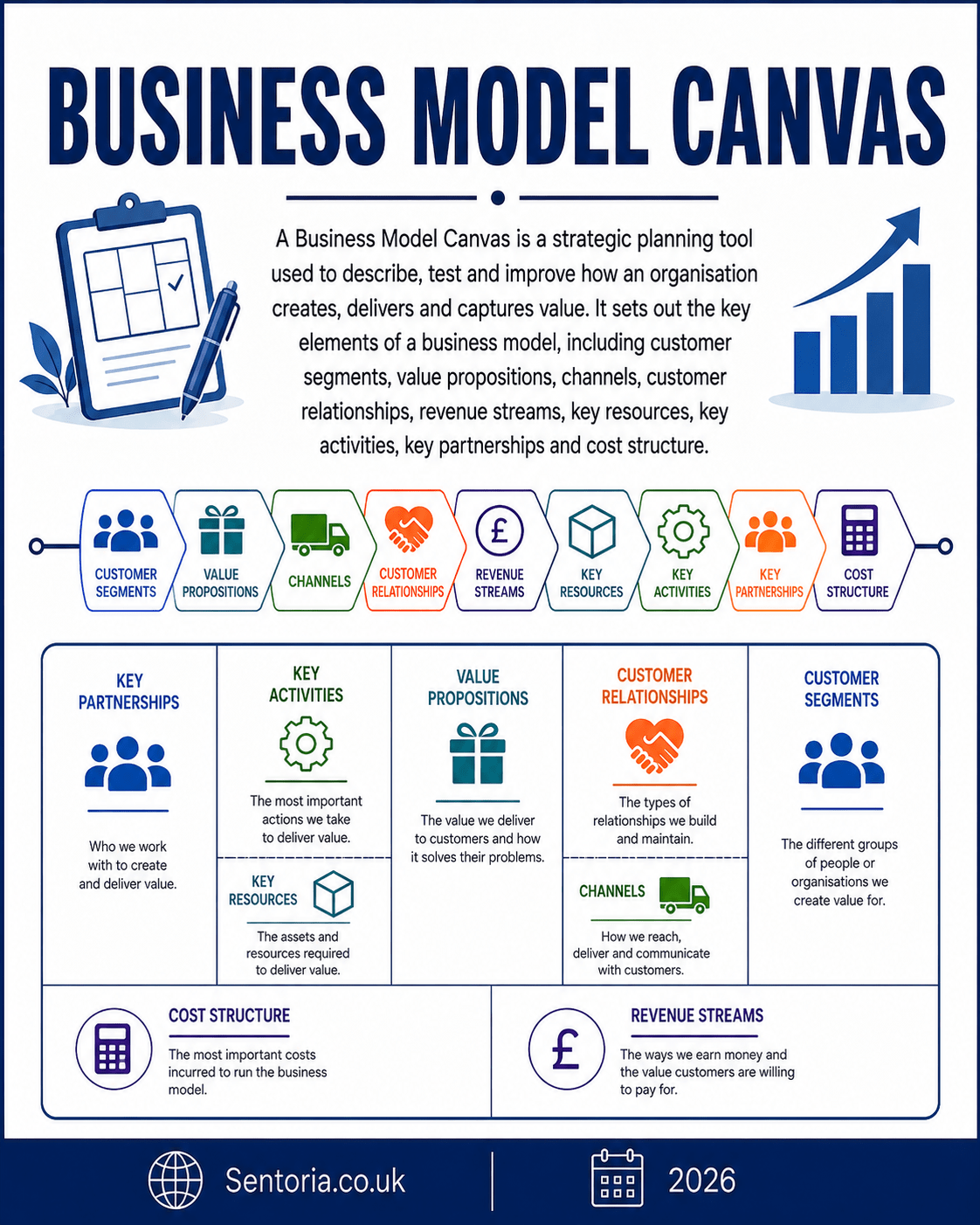
The Business Model Canvas is a strategic planning tool used to describe, test and improve how an organisation creates, delivers and captures value.
At its simplest, the Business Model Canvas asks:
Who do we serve, what value do we provide, how do we deliver it, and how does the organisation remain financially sustainable?
That makes it useful for startups, established businesses, charities, social enterprises, public services, professional firms, property projects, product launches and strategic reviews.
Strategyzer describes the Business Model Canvas as a strategic management and entrepreneurial tool that helps organisations describe, design, challenge, invent and pivot their business model. It comes from the book Business Model Generation and is widely used by startups and established organisations.
Used properly, the Business Model Canvas is not just a diagram. It is a practical way of making the logic of an organisation visible.
What is the Business Model Canvas?
A business model explains how an organisation creates value for customers, users, beneficiaries or stakeholders, and how it captures enough value to survive and grow.
The Business Model Canvas breaks that model into nine connected building blocks:
- Customer Segments
- Value Propositions
- Channels
- Customer Relationships
- Revenue Streams
- Key Resources
- Key Activities
- Key Partnerships
- Cost Structure
Strategyzer describes the Canvas as a visual tool covering value proposition, infrastructure, customers and finances, and as a structured way to define assumptions around the core parts of a business model.
The strength of the Canvas is that it allows people to see the whole model on one page. That matters because organisations often look at strategy in separate pieces. Sales looks at customers. Finance looks at income and cost. Operations looks at delivery. Marketing looks at channels. The Canvas brings these pieces together.
History and development of the Business Model Canvas
The Business Model Canvas is closely associated with Alexander Osterwalder and Yves Pigneur.
It developed from Osterwalder’s earlier academic work on business model ontology, which sought to create a structured way of describing business models. His doctoral work at the University of Lausanne focused on providing a basis for a managerial tool that could express a firm’s business logic.
The framework was later popularised through the book Business Model Generation, written by Alexander Osterwalder and Yves Pigneur. Google Books describes the book as a practical, highly visual guide for implementing strategic ideas and tools in organisations.
The Business Model Canvas became popular because it offered an alternative to long, static business plans. Instead of writing pages of narrative before testing an idea, teams could map the business model quickly, identify assumptions, challenge weak points and update the model as evidence emerged.
It also fitted well with the growth of lean startup thinking, design thinking, innovation management and business model experimentation. These approaches all share a similar idea: strategy should be tested, challenged and improved rather than assumed to be correct from the start.
The nine building blocks explained
1. Customer Segments
Customer Segments are the people, organisations or groups the business model is designed to serve.
This is the starting point because a business model only makes sense if it is clear who the customer or user is.
Questions to ask include:
- Who are we creating value for?
- Who are our most important customers?
- Are there different customer groups?
- Do different groups need different offers?
- Which customers are most profitable?
- Which customers are hardest to serve?
- Are the payer and the user the same person?
A common mistake is saying that the customer is “everyone”. That is usually not helpful. A strong business model normally has a clear view of who it is serving and why those people matter.
2. Value Propositions
The Value Proposition explains the value the organisation offers to each customer segment.
It answers the question:
Why should customers choose this product, service or organisation rather than another option?
Value may come from:
- Price
- Convenience
- Quality
- Speed
- Trust
- Expertise
- Design
- Simplicity
- Risk reduction
- Customer service
- Reliability
- Local knowledge
- Access
- Social impact
A weak value proposition is vague. For example, “we provide excellent service” is not enough.
A stronger value proposition is specific:
We help owner managed businesses understand their numbers, improve cash flow and make better decisions without financial jargon.
That explains who the service is for, what problem it solves and what value it creates.
3. Channels
Channels describe how the organisation reaches customers, communicates with them and delivers value.
Channels may include:
- Website
- Search engines
- Social media
- Direct sales
- Referrals
- Physical premises
- Events
- Partners
- Distributors
- Marketplaces
- Apps
- Telephone
- Face to face meetings
Channels matter because even a strong offer can fail if the right people do not know about it, cannot access it, or find the buying process difficult.
It is useful to separate channels into three types:
- Awareness channels
- Sales channels
- Delivery channels
A social media post may create awareness. A website may convert an enquiry. A meeting, software platform or delivery network may deliver the service.
4. Customer Relationships
Customer Relationships describe the type of relationship the organisation has with each customer segment.
This may include:
- Personal service
- Dedicated account management
- Self service
- Automated service
- Community
- Subscription relationship
- Advisory relationship
- Transactional relationship
- Long term partnership
- Aftercare and support
The right relationship depends on the type of customer and the economics of the model.
A low cost online retailer may rely heavily on automation. A professional services firm may rely on trust, personal contact and regular advice. A charity may need deep relationships with beneficiaries, funders, volunteers and partner organisations.
The key question is whether the relationship model fits the value proposition and the cost structure.
5. Revenue Streams
Revenue Streams explain how the organisation earns income.
Revenue may come from:
- One off sales
- Subscriptions
- Retainers
- Membership fees
- Usage fees
- Licensing
- Commission
- Advertising
- Leasing
- Grants
- Donations
- Public contracts
- Service charges
- Transaction fees
This section should not simply say “sales”. It should explain what customers are paying for, how prices are set, whether income is recurring or one off, and how predictable the revenue is.
For charities, social enterprises and public bodies, the revenue model can be more complex because the payer, beneficiary and user may be different people.
6. Key Resources
Key Resources are the assets required to make the business model work.
These may include:
- People
- Cash
- Premises
- Equipment
- Software
- Brand
- Data
- Intellectual property
- Stock
- Licences
- Systems
- Relationships
- Specialist knowledge
- Vehicles
- Digital platforms
The word “key” matters. Not every resource belongs in the Canvas. The focus should be on resources that are genuinely important to creating, delivering or capturing value.
For example, a consultancy may depend on expertise, reputation, relationships and knowledge. A manufacturer may depend on machinery, skilled staff, supply chains and working capital. A software business may depend on code, developers, data, cloud infrastructure and customer insight.
7. Key Activities
Key Activities are the most important things the organisation must do to deliver the business model.
These may include:
- Manufacturing
- Service delivery
- Product development
- Marketing
- Sales
- Customer support
- Logistics
- Quality control
- Compliance
- Fundraising
- Software development
- Training
- Account management
- Research
Key Activities should connect directly to the Value Proposition.
If the organisation promises speed, then fast response and efficient delivery are key activities. If it promises expertise, then training, knowledge management and technical review may be key activities. If it promises low cost, then procurement, process efficiency and automation may matter most.
8. Key Partnerships
Key Partnerships are the external relationships needed to make the model work.
These may include:
- Suppliers
- Contractors
- Professional advisers
- Technology providers
- Referral partners
- Distributors
- Funders
- Local authorities
- Universities
- Community organisations
- Logistics providers
- Payment providers
- Strategic alliances
- Joint venture partners
Partnerships can create value, reduce risk, provide access to customers, reduce cost or strengthen delivery.
However, they can also create dependency. If a business relies too heavily on one platform, supplier, funder, landlord or partner, the business model may be more fragile than it appears.
9. Cost Structure
Cost Structure describes the main costs required to operate the business model.
Costs may include:
- Staff
- Materials
- Rent
- Utilities
- Software
- Marketing
- Distribution
- Insurance
- Professional fees
- Finance costs
- Equipment
- Stock
- Compliance
- Technology infrastructure
A useful Canvas should distinguish between fixed costs and variable costs.
Fixed costs remain broadly the same regardless of activity. Variable costs rise or fall with activity.
This matters because a model with high fixed costs may need volume to survive. A model with high variable costs may struggle to improve margin. A subscription model may need strong retention. A project based model may need careful cash flow control.
Why the Business Model Canvas matters
The Business Model Canvas matters because it helps organisations see how the parts of the model fit together.
A business can have a good product but poor channels. It can have strong demand but weak margins. It can have loyal customers but too much dependency on one person. It can have a strong value proposition but no clear revenue model. It can have impressive income but a cost structure that makes growth unprofitable.
The Canvas helps reveal those tensions.
It supports:
- Clearer strategic thinking
- Better communication
- Stronger business planning
- Faster testing of ideas
- Better understanding of assumptions
- Improved pricing decisions
- Better customer focus
- More disciplined innovation
- Stronger funding or investment cases
- Better alignment between teams
Strategyzer notes that the Canvas helps users visualise and communicate the story of an existing business model, and design new business models for startups or established organisations.
When to use the Business Model Canvas
The Business Model Canvas is useful when the organisation needs to understand, explain, test or redesign how it works.
Good uses include:
- Starting a new business
- Launching a new product or service
- Reviewing an existing business model
- Preparing a business plan
- Testing a new idea
- Improving profitability
- Reviewing a charity or social enterprise
- Preparing for investment or funding
- Comparing strategic options
- Planning digital transformation
- Assessing a new market
- Reviewing a department or service
- Preparing a merger or acquisition review
- Redesigning a customer journey
- Improving operational focus
It is especially useful at the early stage of thinking, before too much time has been spent on detailed forecasts, long reports or fixed plans.
Business Model Canvas in different industries
SMEs and owner managed businesses
For SMEs, the Business Model Canvas can bring clarity to businesses that have grown organically.
Many small businesses start with a skill, trade, product or local opportunity. Over time, customers, staff, systems and services are added. The business may function, but the underlying model may not have been reviewed properly.
An SME Canvas can help answer:
- Which customers are most valuable?
- What do we do better than competitors?
- Are we priced correctly?
- Which services create margin?
- Which activities drain time?
- Are we too dependent on the owner?
- Are we using the right channels?
- Are we building a business or just creating work?
For SMEs, the Canvas should connect directly to cash flow, margin, customer retention and owner capacity.
Manufacturing
In manufacturing, the Canvas can connect production capability to customer value and financial return.
A manufacturer might use it to examine:
- Which customer segments are most profitable
- Whether the value proposition is price, quality, speed, reliability or customisation
- How products reach customers
- Which production activities create advantage
- Which resources are critical
- Which suppliers create risk
- How stock, labour and machinery affect cost
- Whether income is predictable or project based
For manufacturing, the Canvas should be supported by margin analysis, capacity planning, quality data, stock control and supplier risk review.
Retail and ecommerce
For retail and ecommerce, the Canvas is useful because it links product, customer, channel, relationship and margin.
A retailer might use it to assess:
- Who the core customers are
- Whether the offer is based on price, convenience, range, experience or expertise
- How customers discover the business
- How online and physical channels interact
- Whether relationships are transactional or loyalty based
- Whether income depends too heavily on discounts
- How stock, delivery and returns affect cost
- Whether marketplace dependency creates risk
For ecommerce, the Canvas often exposes issues around customer acquisition cost, return rates, delivery costs, weak differentiation and poor repeat purchase.
Professional services
For accountants, solicitors, consultants, architects and advisers, the Business Model Canvas helps move the discussion beyond a list of services.
A professional firm might use it to consider:
- Which clients it serves best
- Whether the value proposition is expertise, responsiveness, trust, sector knowledge or price
- How new clients are acquired
- Whether client relationships are transactional or advisory
- Whether income is recurring or one off
- Which people, systems and knowledge are critical
- What activities create the most value
- Whether technology can improve delivery
- Whether the cost structure supports profitability
For professional services, the Canvas often highlights the difference between being busy and having a scalable, profitable and resilient model.
Charities and voluntary organisations
The Business Model Canvas can be adapted for charities and voluntary organisations, but it should be used carefully.
A charity might use the Canvas to examine:
- Who the beneficiaries are
- Who the funders are
- Whether the beneficiary and payer are different
- What value is created for each stakeholder group
- Which channels reach service users
- Which relationships matter most
- Which income streams are reliable
- Which resources are essential
- Which activities are mission critical
- Which partnerships support delivery
- Whether the cost base is sustainable
For charities, the Canvas should reflect mission, impact, safeguarding, funding risk and long term sustainability.
Public sector and local government
In the public sector, the Canvas can support service design, transformation and value for money reviews.
A council or public body might use it to assess:
- Who the service users are
- What public value is being created
- How residents access the service
- Which relationships matter
- What funding supports delivery
- Which resources are essential
- Which activities are statutory, preventative or discretionary
- Which partners are needed
- Whether the cost structure is sustainable
- Whether the service model supports better outcomes
For public sector use, the Canvas should be combined with statutory duties, equality considerations, public consultation, risk management and democratic accountability.
Property and construction
In property and construction, the Canvas can be used to test development, investment and asset management models.
A property business might examine:
- Which occupiers, buyers or tenants are being served
- What the value proposition is
- Whether value comes from location, specification, flexibility, heritage, affordability or convenience
- How the scheme reaches the market
- What relationships are needed with tenants, agents, funders and authorities
- Whether income comes from rent, sale proceeds, development profit or service charges
- Which resources are essential, such as land, funding, planning consent and professional teams
- Which activities create value, such as planning, construction, leasing and asset management
- How build costs, finance costs and holding costs affect viability
For property projects, the Canvas should sit alongside financial appraisal, planning analysis, legal review, valuation and sensitivity testing.
Technology and software
For technology businesses, the Canvas is especially useful because the business model is often as important as the technology.
A software business might use it to consider:
- Which customer segments are most attractive
- Whether the value proposition solves a clear problem
- Whether the model is subscription, usage based, freemium, licensing or enterprise sales
- Which channels drive acquisition
- Whether customer relationships are self service, supported or account managed
- Which resources are essential, such as developers, code, data and infrastructure
- Which activities matter most, such as development, onboarding, support and security
- Which platforms or partners create dependency
- Whether the cost structure can scale
For technology businesses, the Canvas should be combined with customer discovery, product testing, churn analysis, unit economics and cyber risk review.
Healthcare and social care
Healthcare and social care organisations can use the Canvas to understand service models, funding structures and delivery constraints.
Relevant questions include:
- Who are the service users?
- Who pays for the service?
- What value is created for patients, families, commissioners and regulators?
- How are services accessed?
- What relationships are needed to maintain trust and quality?
- What revenue or funding streams support the model?
- Which people, premises, systems and licences are essential?
- Which activities are critical to safety and outcomes?
- Which partnerships support care delivery?
- Is the cost structure sustainable?
In this sector, the Canvas must be used alongside quality, safeguarding, regulatory compliance, workforce planning and professional judgement.
Education and training
For education providers, training businesses and online learning platforms, the Canvas can clarify the relationship between learners, employers, funders, delivery channels and outcomes.
Questions include:
- Who are the learners?
- Who pays?
- What learning outcome is being promised?
- How is the course delivered?
- What relationship is needed with learners?
- Is income from fees, subscriptions, funding, licensing or employer contracts?
- Which resources are essential, such as tutors, content, platform, accreditation or brand?
- Which activities create value?
- Which partnerships support credibility or delivery?
- Are costs aligned with learner numbers and course pricing?
For education, the Canvas should be linked to learner outcomes, quality assurance, accreditation, digital delivery and employer demand.
How to carry out a Business Model Canvas properly
1. Define the purpose
Start by deciding what the Canvas is for.
Are you mapping an existing business? Testing a new idea? Reviewing a service? Preparing a funding case? Comparing options? Improving profitability?
Good starting questions include:
- How does our current model work?
- Is this new idea viable?
- Which parts of the model are weak?
- How could we improve profitability?
- How could we scale?
- Where are the biggest assumptions?
- What needs testing before we invest?
Without a clear purpose, the Canvas can become too broad.
2. Define the scope
Be clear about what is being mapped.
An organisation may have more than one business model.
For example, a professional services firm may have one model for compliance work, one for advisory work, one for training and one for retained support. A charity may have one model for grant funded services and another for commissioned work.
Do not force several different models into one Canvas if they have different customers, value propositions, revenue streams or cost structures.
3. Start with the customer
The Canvas works best when it starts with the customer.
Ask:
- Who are we serving?
- What problem are they trying to solve?
- What outcome do they want?
- What alternatives do they have?
- What do they value enough to pay for?
- What frustrates them?
- How do they currently behave?
A common mistake is starting with the product. The better starting point is the customer problem.
4. Clarify the value proposition
The value proposition should be specific and testable.
Avoid vague claims such as:
- Great service
- High quality
- Trusted partner
- Innovative solution
- Good value
These may be true, but they are not enough.
A stronger value proposition explains:
- Who the offer is for
- What problem it solves
- What benefit it creates
- Why it is different or better
- Why the customer should care
5. Map the current model before redesigning it
If the organisation already exists, first map the current model honestly.
Do not jump straight to the desired future model.
The current Canvas may reveal important constraints, such as weak margins, poor channels, customer dependency, high delivery costs, outdated systems or over reliance on key people.
Once the current model is clear, create a second Canvas for the future model.
6. Identify assumptions
Every Canvas contains assumptions.
Examples include:
- Customers want this offer
- Customers will pay this price
- The channel will reach the right people
- The cost structure is manageable
- Partners will work with us
- We can deliver at the required quality
- Revenue will be recurring
- The market is large enough
- Customers will switch from alternatives
- The model can scale
The best Canvas exercises make these assumptions visible and decide which ones need testing.
7. Test the model
The Canvas should not remain theoretical.
Testing may include:
- Customer interviews
- Pilot projects
- Prototype offers
- Pricing tests
- Landing pages
- Market research
- Competitor analysis
- Financial modelling
- Supplier discussions
- Operational trials
- Funding discussions
- Minimum viable products
This is where the Canvas becomes useful. It helps identify what must be true for the model to work.
8. Link the Canvas to numbers
The Canvas is not a substitute for financial analysis.
It should be linked to:
- Revenue forecasts
- Gross margin
- Customer acquisition cost
- Lifetime value
- Contribution margin
- Break even point
- Working capital
- Cash flow
- Fixed costs
- Capacity
- Pricing
- Sensitivity analysis
A business model may look attractive visually but fail financially. The numbers matter.
9. Review the fit between the blocks
The nine blocks should support each other.
For example:
- A premium value proposition needs premium delivery.
- A low cost model needs a low cost operating structure.
- A subscription model needs retention focused relationships.
- A complex service needs skilled people and strong systems.
- A digital model needs scalable technology.
- A public service model needs strong partnerships and accountability.
The Canvas is not just nine boxes. It is a system.
10. Turn the Canvas into action
The final step is to decide what happens next.
Actions might include:
- Test customer demand
- Refine pricing
- Improve a channel
- Reduce cost
- Build a partnership
- Change the customer segment
- Strengthen resources
- Stop serving an unprofitable segment
- Improve delivery systems
- Change the revenue model
- Launch a pilot
- Prepare a financial model
Without action, the Canvas is only a workshop output.
Common mistakes in using the Business Model Canvas
Mistake 1: Treating it as a form filling exercise
The Canvas is not useful because the boxes are completed.
It is useful because it helps people think, challenge assumptions and make decisions.
Mistake 2: Being too vague
Statements such as “small businesses”, “excellent service” or “online marketing” are too broad.
The Canvas works best when entries are specific.
Mistake 3: Confusing customers and users
This is common in charities, public services, software, education and healthcare.
The user may not be the payer. The funder may not be the beneficiary. The buyer may not be the person using the service.
Each role needs to be understood.
Mistake 4: Ignoring evidence
A Canvas based only on internal opinion can be misleading.
Customer evidence, financial data, competitor information and operational experience should all be used.
Mistake 5: Forgetting cash flow
The Canvas includes revenue and costs, but it does not automatically deal with cash timing.
A model can be profitable on paper and still fail because cash is received too late, stock absorbs working capital, or growth requires funding.
Mistake 6: Leaving out competitors and substitutes
The standard Canvas does not explicitly include competitors, substitutes, regulation or wider market forces.
That does not make it weak, but it does mean it should be combined with tools such as PESTLE, Porter’s Five Forces and competitor analysis.
Mistake 7: Assuming the model is static
Business models change.
Customer needs, technology, regulation, costs, funding, competition and delivery methods all move over time.
A Canvas should be reviewed regularly.
Limitations and weaknesses of the Business Model Canvas
The Business Model Canvas is useful, but it has limits.
It simplifies reality
The simplicity of the Canvas is one of its strengths. It is also one of its weaknesses.
A real organisation may involve complex legal structures, financial arrangements, supply chains, stakeholder relationships, regulation, systems and risks. Not all of that complexity fits neatly into nine boxes.
It does not replace strategy
The Canvas explains how a business model works. It does not automatically decide whether the strategy is attractive.
A business may have a clear model but still face weak demand, intense competition or poor margins.
It does not fully assess external forces
The Canvas focuses mainly on the internal logic of the business model.
It should be combined with external analysis where market, regulatory, political, economic or technological change matters.
It does not automatically test customer demand
A completed Canvas may still be based on assumptions.
Customers may not want the offer. The pricing may be wrong. The channel may not work. The cost may be too high.
The Canvas should lead to testing.
It can underplay implementation
The Canvas can make a model look clean and simple.
Delivery is often harder.
Implementation may require people, systems, funding, governance, compliance, project management and cultural change.
It may need adapting for charities and public bodies
The standard Canvas is most natural for commercial organisations.
For charities, social enterprises and public bodies, it may need adapting to reflect beneficiaries, funders, commissioners, public value, impact and statutory obligations.
It does not provide detailed financial modelling
Revenue Streams and Cost Structure are useful headings, but they are not enough.
A proper business case still needs forecasts, margins, cash flow, sensitivity testing and funding requirements.
Business Model Canvas compared with other strategic tools
Business Model Canvas and SWOT
SWOT identifies strengths, weaknesses, opportunities and threats.
The Business Model Canvas explains how the organisation creates, delivers and captures value.
Use SWOT to understand strategic position. Use the Canvas to understand the business model.
Business Model Canvas and PESTLE
PESTLE analyses external political, economic, social, technological, legal and environmental factors.
The Canvas analyses the organisation’s model.
Use PESTLE before or alongside the Canvas when external change may affect customer demand, costs, regulation, technology or revenue.
Business Model Canvas and Porter’s Five Forces
Porter’s Five Forces examines industry structure and competitive pressure.
The Canvas examines how a specific organisation operates within that environment.
Use Five Forces to assess market attractiveness. Use the Canvas to assess whether the organisation’s model is strong enough to compete.
Business Model Canvas and TOWS
TOWS turns SWOT findings into strategic options.
Use TOWS when internal and external factors have been identified and the organisation needs to decide what to do. Use the Canvas when the option involves changing the business model itself.
Business Model Canvas and Value Proposition Canvas
The Value Proposition Canvas is a related Strategyzer tool that helps design, test and build the value proposition with more structure. Strategyzer describes it as a plug in tool to the Business Model Canvas.
Use it when the main uncertainty is whether the offer truly solves an important customer problem.
Business Model Canvas and Lean Canvas
Lean Canvas is a variation often used for early stage startup ideas.
It places more emphasis on problem, solution, key metrics and unfair advantage.
Use it when testing a new idea with high uncertainty.
Business Model Canvas and financial modelling
The Canvas provides the logic.
Financial modelling tests the numbers.
Both are needed. A Canvas without numbers can be unrealistic. A spreadsheet without a clear business model can be misleading.
Alternatives and complementary frameworks
Value Proposition Canvas
Useful for testing whether the offer fits customer jobs, pains and gains.
Best used when the value proposition needs sharpening.
Lean Canvas
Useful for early stage startup ideas and fast testing.
Best used where uncertainty is high and the model needs rapid validation.
PESTLE analysis
Useful for understanding external forces.
Best used where regulation, technology, economic conditions, social change or environmental factors may affect the model.
Porter’s Five Forces
Useful for understanding competitive pressure and industry profitability.
Best used when entering a market or assessing margin pressure.
SWOT analysis
Useful for summarising internal and external factors.
Best used after evidence has been gathered and before strategic options are chosen.
TOWS analysis
Useful for turning SWOT into action.
Best used when a team needs strategic options rather than diagnosis only.
Scenario planning
Useful where the future is uncertain.
Best used when the model may be affected by different possible futures, such as interest rates, regulation, technology, funding or customer behaviour.
Balanced Scorecard
Useful for turning strategy into objectives, measures, targets and actions.
Best used after the model and strategy have been agreed.
Risk register
Useful for recording and managing risks.
Best used when the Canvas identifies major dependencies, assumptions or vulnerabilities.
A practical Business Model Canvas template
A useful Business Model Canvas should answer the following questions.
Customer Segments
- Who are the customers?
- Which segments are most important?
- Which are most profitable?
- Which are hardest to serve?
- Are the payer and user the same person?
Value Propositions
- What problem are we solving?
- What benefit are we creating?
- Why should customers choose us?
- What makes us different?
- Is the value proposition proven or assumed?
Channels
- How do customers find us?
- How do we sell?
- How do we deliver?
- Which channels work best?
- Which channels are weak or too expensive?
Customer Relationships
- What relationship do customers expect?
- Is the relationship personal, automated or self service?
- How do we retain customers?
- How do we build trust?
- How expensive is the relationship model?
Revenue Streams
- How do we earn income?
- What are customers paying for?
- Is income recurring or one off?
- Are prices high enough?
- How predictable is revenue?
Key Resources
- What resources are essential?
- Which resources are scarce?
- Which resources create advantage?
- Which resources are owned, leased or outsourced?
- Where are the dependencies?
Key Activities
- What must we do well?
- Which activities create value?
- Which activities are costly but necessary?
- Which activities could be automated or outsourced?
- Which activities constrain growth?
Key Partnerships
- Who helps make the model work?
- Which partners reduce risk?
- Which partners create dependency?
- Are supplier terms sustainable?
- Do partnerships strengthen or weaken the model?
Cost Structure
- What are the main costs?
- Which costs are fixed?
- Which costs vary with activity?
- What drives margin?
- What happens to costs as the model grows?
Example of using the Business Model Canvas
Imagine a small professional services firm wants to move from one off compliance work to a monthly advisory model.
The Canvas might reveal:
Customer Segments
Owner managed businesses that want regular financial insight.
Value Proposition
Practical monthly financial advice, management information and tax planning without jargon.
Channels
Website, referrals, LinkedIn, local networking and existing client relationships.
Customer Relationships
Regular meetings, proactive contact and trusted adviser relationship.
Revenue Streams
Monthly retainers.
Key Resources
Qualified staff, software, templates, reporting tools and client relationships.
Key Activities
Monthly reporting, review meetings, forecasting, tax planning and advisory support.
Key Partnerships
Software providers, bookkeepers, legal advisers and finance brokers.
Cost Structure
Staff time, software, training, marketing and professional compliance.
This then raises practical questions:
- Will clients pay monthly?
- Which clients are suitable?
- Do staff have advisory skills?
- Can reporting be delivered efficiently?
- What price is needed for acceptable margin?
- How will the service be marketed?
- What needs testing before a full launch?
That is where the Canvas becomes useful. It turns a broad idea into a model that can be tested.
Questions to ask when reviewing a Business Model Canvas
Strategic questions
- Does the model make sense as a whole?
- Is the value proposition strong enough?
- Is the customer segment clear?
- Are revenue streams realistic?
- Is the cost structure sustainable?
- Is the model scalable?
- Is the model resilient?
- What could break it?
Customer questions
- Do customers have a real problem?
- Do they care enough to act?
- Will they pay?
- Are they easy to reach?
- Are they costly to serve?
- What alternatives do they have?
- Why would they choose us?
Financial questions
- What is the gross margin?
- What is the break even point?
- How much cash is needed?
- How quickly is cash collected?
- What happens if sales are slower than expected?
- What happens if costs rise?
- Which assumptions have the biggest financial impact?
Operational questions
- Can we deliver consistently?
- Do we have the right people?
- Do we have the right systems?
- What activities constrain growth?
- What should be outsourced?
- What must be controlled internally?
- Where are the risks?
Testing questions
- What are the biggest assumptions?
- Which assumptions are most risky?
- How can we test them cheaply?
- What evidence would prove the model works?
- What evidence would make us stop?
- What needs to be changed?
- What is the next experiment?
The best way to think about the Business Model Canvas
The Business Model Canvas is not a replacement for a business plan, strategy, financial model or risk review.
It is a practical tool for making the business model visible.
A good Canvas should be:
- Clear
- Specific
- Evidence based
- Customer focused
- Financially realistic
- Tested
- Reviewed regularly
- Linked to action
A weak Canvas is vague, optimistic and disconnected from evidence.
The key question is not simply:
Can we fill in the nine boxes?
The better question is:
Does this model genuinely create value for customers and capture enough value for the organisation to be sustainable?
Conclusion: the Business Model Canvas turns business logic into a practical picture
The Business Model Canvas remains useful because it helps organisations step back from day to day activity and understand how the whole model fits together.
It shows who the organisation serves, what value it offers, how it reaches customers, how it builds relationships, how it earns income, what resources and activities are needed, which partners matter and what costs are involved.
Used badly, it becomes a neat diagram that creates false confidence.
Used properly, it becomes a practical tool for discussion, challenge, testing and improvement.
The real value comes after the Canvas is completed. The assumptions need to be tested. The numbers need to be modelled. The risks need to be understood. The weak points need to be addressed. The actions need to be owned.
A strong business model is not just an idea. It is a working system for creating, delivering and capturing value.
The Business Model Canvas helps make that system visible, so better decisions can be made.