Blue Ocean Strategy:
A Practical Guide to Creating New Market Space and Making Competition Less Relevant
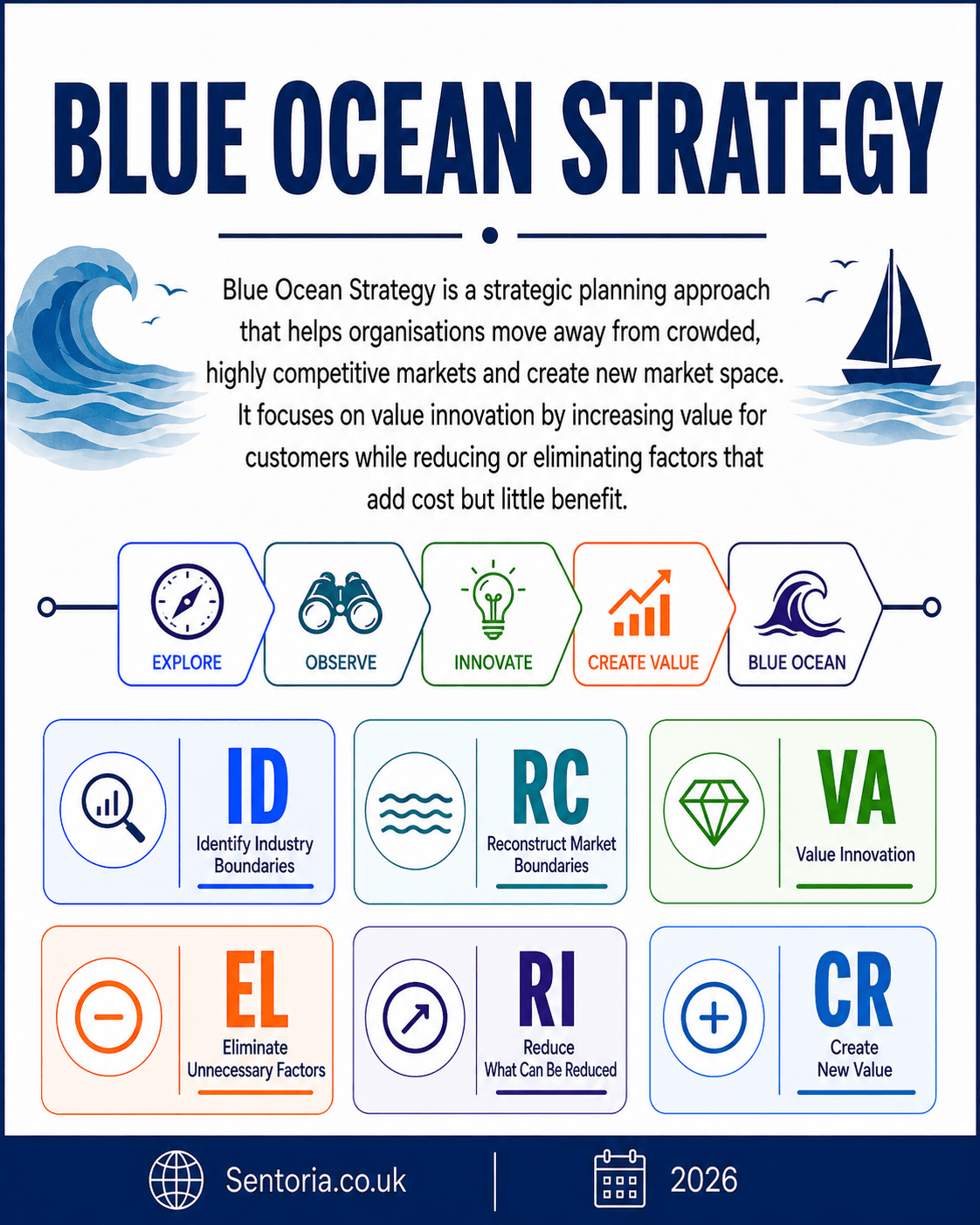
Blue Ocean Strategy is a strategic planning approach used to help organisations move away from crowded, highly competitive markets and create new demand in less contested market space.
At its simplest, Blue Ocean Strategy asks:
How can we create new value for customers in a way that competitors are not currently offering, while also changing the cost structure so the model is commercially attractive?
That makes it different from traditional competitive strategy. Many strategy tools focus on how to beat competitors. Blue Ocean Strategy asks whether the organisation can change the basis of competition altogether.
The official Blue Ocean Strategy materials define it as the simultaneous pursuit of differentiation and low cost to open up new market space and create new demand. The approach is based on the idea that market boundaries and industry structures are not fixed, but can be reconstructed by the actions and beliefs of organisations.
Used properly, Blue Ocean Strategy is not simply about being innovative. It is about creating a meaningful leap in value for customers, while also designing the business model so the organisation can deliver that value sustainably.
What is Blue Ocean Strategy?
Blue Ocean Strategy is a framework for creating new market space rather than competing head-to-head in existing market space.
The phrase uses two images:
Red oceans are existing markets where competitors fight over known demand. The market rules are understood, the competitors are visible, and organisations often compete on price, features, marketing spend, distribution, service levels or incremental improvements.
Blue oceans are new or less contested spaces where demand is created or expanded. The aim is not to win a bloody fight with competitors, but to make direct competition less relevant by changing what is offered, who it serves, and how value is delivered.
This does not mean competition disappears forever. Successful ideas attract attention. Competitors may imitate. Markets may mature. But Blue Ocean Strategy helps organisations think beyond the usual industry assumptions and ask how they could create a different value curve.
A key idea is that organisations should not accept industry boundaries as fixed. Instead, they should ask which assumptions can be challenged, which customer groups are underserved, which costs can be removed, and which new forms of value can be created.
History and development of Blue Ocean Strategy
Blue Ocean Strategy is closely associated with W. Chan Kim and Renée Mauborgne, professors at INSEAD. Their book Blue Ocean Strategy: How to Create Uncontested Market Space and Make the Competition Irrelevant was published by Harvard Business School Press in 2005.
The framework was first introduced to a wider management audience through their 2004 Harvard Business Review article, Blue Ocean Strategy. The article argued that competing in overcrowded industries is not the best route to sustained high performance, and that organisations should look for uncontested market space.
The concept developed from research into strategic moves across many organisations and industries. The official Blue Ocean Strategy website states that the approach is based on a decade-long study of more than 150 strategic moves across more than 30 industries over 100 years.
Over time, the framework has developed into a practical toolkit. These tools include the Strategy Canvas, the Four Actions Framework, the Eliminate-Reduce-Raise-Create Grid, the Six Paths Framework, the Buyer Utility Map and other methods for identifying new value and reducing strategic risk. The official Blue Ocean Strategy tools page describes these as practical market-creating tools designed to help organisations move from red oceans of competition to blue oceans of new market space.
Blue Ocean Strategy has also developed through later work, including Blue Ocean Shift, which focuses more heavily on how organisations can move from existing competitive positions to new market space through a structured process.
The core idea: value innovation
The central idea behind Blue Ocean Strategy is value innovation.
Value innovation means increasing value for customers while also reducing or removing costs that do not contribute enough value.
This is important because many organisations assume they must choose between two broad options:
- Offer more value at higher cost.
- Offer lower cost with fewer benefits.
Blue Ocean Strategy challenges that trade-off. It asks whether the organisation can do both:
- Increase the things that customers genuinely value.
- Reduce or eliminate the things that customers do not value enough.
- Create new factors that the industry has not offered.
- Redesign the model so the organisation is not simply adding cost.
The Four Actions Framework was developed by Kim and Mauborgne to reconstruct buyer value and challenge an industry’s strategic logic. It asks what should be eliminated, reduced, raised and created to break the trade-off between differentiation and low cost.
In simple terms:
Blue Ocean Strategy is not about adding more features.
It is about changing the value equation.
Red ocean strategy and blue ocean strategy
Red ocean strategy
A red ocean strategy focuses on competing within existing market boundaries.
Typical red ocean behaviour includes:
- Competing for existing customers.
- Benchmarking against rivals.
- Matching competitor features.
- Fighting on price.
- Increasing marketing spend to defend market share.
- Improving incrementally rather than changing the offer.
- Accepting industry rules as fixed.
- Trying to outperform competitors within the current model.
There is nothing automatically wrong with red ocean strategy. Many businesses operate successfully in competitive markets. Cost control, differentiation, service quality, operational excellence and brand strength still matter.
The problem is that red oceans can become crowded. When many organisations compete on similar factors, margins can fall, customers may see less difference between providers, and growth becomes harder.
Blue ocean strategy
A blue ocean strategy looks for new demand, new value and new market space.
Typical blue ocean behaviour includes:
- Challenging industry assumptions.
- Looking beyond existing competitors.
- Identifying noncustomers.
- Reconstructing buyer value.
- Removing unnecessary cost.
- Creating new factors of value.
- Changing the basis of competition.
- Designing a distinctive value curve.
The goal is not simply to be different. Difference without value is a distraction.
The goal is to be different in a way that customers care about and the organisation can deliver profitably or sustainably.
The main tools of Blue Ocean Strategy
1. Strategy Canvas
The Strategy Canvas is a visual tool used to show how competitors in an industry currently compete and how a new strategy could create a different value curve.
The official Blue Ocean Strategy materials describe the Strategy Canvas as a one-page visual analytic that shows how an organisation configures its offering to buyers compared with competitors. It is both a diagnostic tool and an action framework for building a blue ocean strategy.
A Strategy Canvas usually shows:
- The key factors the industry competes on.
- How different competitors perform against those factors.
- Where offerings look similar.
- Where the organisation could reduce, eliminate, raise or create factors.
- How the new value curve could stand apart.
For example, a professional services firm might discover that most competitors compete on similar factors: technical competence, responsiveness, fee levels, compliance support and local presence. A blue ocean approach might then ask whether a new value curve could be created around proactive financial insight, fixed monthly advisory support, plain-English reporting, sector specialism and owner-manager coaching.
2. Four Actions Framework
The Four Actions Framework asks four questions:
- Which factors should be eliminated?
- Which factors should be reduced well below industry standard?
- Which factors should be raised well above industry standard?
- Which factors should be created that the industry has never offered?
These four questions are designed to challenge the accepted logic of the industry and reconstruct buyer value.
This is one of the most practical parts of Blue Ocean Strategy because it forces trade-offs. It prevents the organisation from simply adding more.
For example:
A hotel might eliminate unnecessary luxury features that many guests do not value, reduce formal service elements, raise convenience and design, and create a new social or digital experience.
A charity might reduce bureaucracy for beneficiaries, raise accessibility, create new digital or community-based support, and eliminate duplicated assessment processes.
A manufacturer might reduce unnecessary customisation, raise reliability, create faster ordering or technical support, and eliminate low-value complexity.
3. Eliminate-Reduce-Raise-Create Grid
The ERRC Grid turns the Four Actions Framework into a simple practical table.
The official Blue Ocean Strategy materials describe the ERRC Grid as a tool that helps organisations focus simultaneously on eliminating and reducing, as well as raising and creating, to unlock new market space.
The grid has four boxes:
- Eliminate
- Reduce
- Raise
- Create
It is useful because it turns discussion into design.
A good ERRC Grid should be specific. Vague entries such as “improve service” or “reduce cost” are not enough. The grid should identify exactly what will change.
4. Six Paths Framework
The Six Paths Framework helps organisations look beyond conventional industry boundaries.
The official Blue Ocean Strategy materials describe it as a tool for reconstructing market boundaries and identifying commercially compelling blue ocean opportunities. It encourages managers to look across alternative industries, strategic groups, buyer groups, complementary products and services, the functional-emotional orientation of an industry, and time.
The six paths are useful because many organisations search for opportunity too narrowly.
They look at:
- Existing competitors.
- Existing customers.
- Existing products.
- Existing channels.
- Existing pricing.
- Existing assumptions.
The Six Paths Framework pushes the organisation to look elsewhere.
For example:
- What alternatives do customers use instead of our industry?
- What premium or budget groups exist in the industry?
- Who else influences the buying decision?
- What complementary services affect the customer experience?
- Is the industry mainly functional or emotional, and could that be changed?
- What trends are shaping the future?
5. Buyer Utility Map
The Buyer Utility Map helps organisations look at the buyer experience and identify where new utility can be created.
The official Blue Ocean Strategy materials describe the Buyer Utility Map as a demand-side tool that helps managers identify the utility spaces that could be unlocked. It considers the buyer experience cycle and utility levers.
This matters because many organisations focus only on the product or service itself. Customers experience much more than that.
They experience:
- Searching.
- Buying.
- Receiving.
- Using.
- Maintaining.
- Paying.
- Getting support.
- Disposing.
- Repeating.
- Recommending.
A blue ocean opportunity may sit in any part of that experience.
Why Blue Ocean Strategy matters
Blue Ocean Strategy matters because many organisations spend too much time trying to win within the existing rules of their market.
They ask:
- How can we beat competitors?
- How can we defend market share?
- How can we lower price?
- How can we add more features?
- How can we match what others offer?
- How can we appear slightly better?
Those questions can be useful, but they can also trap the organisation in the same competitive logic as everyone else.
Blue Ocean Strategy asks different questions:
- What assumptions does the industry take for granted?
- What do customers tolerate because nobody offers an alternative?
- Which noncustomers are ignored?
- Which factors add cost without adding enough value?
- Which new value could unlock demand?
- Which activities could be removed, reduced, raised or created?
- How can we make the offer both different and commercially viable?
This is particularly important when markets become crowded, commoditised or price-sensitive.
When to use Blue Ocean Strategy
Blue Ocean Strategy is useful when an organisation needs to rethink how it competes or creates value.
Good uses include:
- Launching a new product or service.
- Entering a crowded market.
- Repositioning an existing business.
- Responding to margin pressure.
- Developing a new business model.
- Looking for new customer groups.
- Redesigning a service.
- Improving customer experience.
- Escaping price-based competition.
- Creating a new offer for noncustomers.
- Reviewing a sector where all competitors look similar.
- Supporting innovation strategy.
- Exploring growth opportunities.
- Developing a charity or public service model.
- Challenging outdated industry assumptions.
It is less suitable where the organisation simply needs operational repair, compliance improvement or urgent crisis management. In those situations, other tools such as risk registers, process mapping, cash flow forecasting and operational turnaround planning may be more appropriate.
Blue Ocean Strategy in different industries
SMEs and owner-managed businesses
For SMEs, Blue Ocean Strategy can be powerful because smaller businesses often cannot outspend or outscale larger competitors.
A small business may struggle to compete on price, advertising budget, stock range or national reach. But it may be able to create a distinctive value curve by focusing on a specific customer group, removing unnecessary complexity, improving service, offering a more personal relationship, simplifying the buying process or combining services in a new way.
For example, an SME might ask:
- Which customers are poorly served by larger competitors?
- Which industry habits create frustration?
- Which services could be bundled differently?
- Which costs do customers not value?
- Which customer problems are competitors ignoring?
- Which noncustomers could be attracted by a simpler offer?
For SMEs, the blue ocean does not need to be global or revolutionary. It may be a local, niche or sector-specific opportunity.
Manufacturing
In manufacturing, Blue Ocean Strategy can help businesses move beyond price competition and commodity production.
A manufacturer might use it to consider:
- New technical support services.
- Faster ordering and delivery.
- Simplified product ranges.
- Customisation where it matters.
- Standardisation where it reduces cost.
- Sustainability-led differentiation.
- Maintenance, installation or training services.
- New customer groups currently ignored.
- Better integration with customer operations.
- Reduced complexity in specification and procurement.
For manufacturing, the challenge is to connect value innovation to operations. A new value curve must be deliverable through production, procurement, quality control, capacity and logistics.
Retail and ecommerce
Retail and ecommerce are often red-ocean environments. Customers can compare prices quickly, switching costs are low, and competitors can imitate visible features.
Blue Ocean Strategy can help retailers ask:
- Can we create a different buying experience?
- Can we remove friction from selection, purchase, delivery or returns?
- Can we serve a group that large retailers ignore?
- Can we turn expertise into a distinctive offer?
- Can we create community, subscription, curation or service around the product?
- Can we reduce choice overload while increasing confidence?
- Can we make the buying process simpler and more trusted?
For ecommerce, a blue ocean opportunity may lie less in the product and more in the customer experience, advice, delivery model, community, guarantee, personalisation or aftercare.
Professional services
For accountants, solicitors, consultants, architects and advisers, Blue Ocean Strategy can help firms move away from being seen as interchangeable providers.
Professional services firms often compete on expertise, responsiveness, reputation and price. But clients may struggle to see the difference.
A blue ocean approach might ask:
- Which client groups are underserved?
- Which services are treated as complex but could be simplified?
- Which client frustrations are accepted as normal?
- Could fixed-fee advisory models create new value?
- Could jargon-free communication become a differentiator?
- Could technology improve delivery without reducing trust?
- Could sector specialism create a clearer value curve?
- Could the firm support decisions, not just compliance?
For professional firms, Blue Ocean Strategy is not about gimmicks. It is about creating a service model that clients recognise as meaningfully different and useful.
Charities and voluntary organisations
Blue Ocean Strategy can be adapted for charities, but it needs care.
Charities are not usually trying to “beat” competitors in the commercial sense. However, they still operate in crowded environments for funding, attention, volunteers, partnerships and community trust.
A charity might use Blue Ocean Strategy to ask:
- Which beneficiaries are not being reached?
- Which access barriers could be removed?
- Which service elements create the greatest impact?
- Which reporting burdens could be simplified?
- Which partnerships could unlock new value?
- Which funders or commissioners are looking for new approaches?
- Which community needs are not being addressed by existing services?
For charities, the “blue ocean” may be a new service model, delivery partnership, funding proposition, community outreach approach or impact framework.
Public sector and local government
Public bodies can use Blue Ocean thinking to redesign services, improve resident experience and create better public value.
The public sector does not normally operate through conventional market competition. However, it still faces constraints, demand pressure, budget limitations, public expectations and service complexity.
A public sector blue ocean approach might ask:
- Which service assumptions need challenging?
- Which residents are not well served by current channels?
- Which steps create delay or frustration?
- Which activities add cost without improving outcomes?
- Could prevention create more value than crisis response?
- Could partnerships create a different service model?
- Could digital tools improve access without excluding vulnerable users?
For public bodies, Blue Ocean Strategy should be combined with statutory duties, equality considerations, consultation, risk management and public value assessment.
Property and construction
In property and construction, Blue Ocean Strategy can help developers, landlords and contractors rethink value.
A property business might ask:
- Which occupiers are underserved?
- Could flexible space meet demand better than traditional leases?
- Could heritage, sustainability or community use create new value?
- Could mixed-use models unlock demand?
- Which planning or design assumptions should be challenged?
- Could tenant support or shared services improve occupancy?
- Could underused assets serve a new market?
A construction business might ask:
- Can we simplify procurement for clients?
- Can we reduce project uncertainty?
- Can we offer better aftercare?
- Can we specialise in a neglected niche?
- Can digital reporting improve trust?
- Can sustainability capability become a differentiator?
For property and construction, blue ocean thinking must be tested against planning, finance, legal, delivery and market reality.
Technology and software
Technology businesses often talk about disruption, but not every technology product creates a blue ocean.
A software business might use Blue Ocean Strategy to ask:
- Which noncustomers find existing software too complex?
- Which workflows are still underserved?
- Which features can be removed to improve simplicity?
- Which customer pain points are ignored by large platforms?
- Could AI create new utility rather than just extra features?
- Could onboarding, support or integration be redesigned?
- Could the product serve a new user group?
For technology businesses, the danger is adding features that increase cost and complexity without increasing customer value. Blue Ocean Strategy encourages the opposite: focus, divergence and a clear value proposition.
Healthcare and social care
In healthcare and social care, Blue Ocean Strategy should be used carefully and ethically.
The goal should not be novelty for its own sake. It should be better outcomes, safer care, improved access, more sustainable delivery and reduced friction for patients, families and staff.
Possible questions include:
- Which patients or service users are poorly served?
- Which parts of the care journey create avoidable stress?
- Which processes could be simplified?
- Could prevention reduce later demand?
- Could digital support improve access?
- Could family communication be improved?
- Could staffing models be redesigned without compromising quality?
In this sector, Blue Ocean Strategy should always sit alongside safeguarding, regulation, clinical governance, quality assurance and workforce planning.
Education and training
Education and training providers can use Blue Ocean Strategy to rethink learning models, learner experience and employer value.
Questions include:
- Which learners are not well served by current provision?
- Which courses are too complex, expensive or inaccessible?
- Could delivery be more flexible?
- Could employers be involved differently?
- Could assessment be redesigned?
- Could digital learning support new groups?
- Could shorter, practical programmes unlock demand?
- Could learner support be a differentiator?
For education, blue ocean thinking should be linked to learner outcomes, quality assurance, funding, accreditation and employer needs.
How to carry out Blue Ocean Strategy properly
1. Define the strategic challenge
Start with a clear question.
For example:
- How can we grow without competing mainly on price?
- How can we create a distinctive offer in a crowded market?
- Which noncustomers could we serve?
- Which customer frustrations could we remove?
- Which parts of the industry model are outdated?
- How could we deliver more value at lower cost?
- How could we redesign our business model?
Without a clear challenge, Blue Ocean Strategy becomes a vague innovation exercise.
2. Map the current red ocean
Before creating a blue ocean, understand the current market.
Ask:
- Who are the main competitors?
- What factors does the industry compete on?
- Where do competitors look similar?
- What do customers expect as standard?
- What are customers forced to tolerate?
- What drives cost?
- What drives price?
- Where is the market crowded?
- Where is differentiation weak?
Use a Strategy Canvas to map this visually.
The aim is to see the current value curve clearly before trying to change it.
3. Understand customers and noncustomers
Blue Ocean Strategy is not only about existing customers.
It also asks who is not buying and why.
Noncustomers may include:
- People who find the current offer too expensive.
- People who find it too complex.
- People who do not trust existing providers.
- People who use a substitute.
- People who need a simpler or more accessible solution.
- People who are ignored by current providers.
- People who only use the product or service reluctantly.
- People who would buy if a barrier were removed.
This is often where opportunity sits.
4. Use the Six Paths Framework
Use the Six Paths Framework to challenge industry boundaries.
Ask:
- What alternative industries solve the same problem?
- What strategic groups exist within the industry?
- Who are the buyers, users and influencers?
- What complementary products or services affect the experience?
- Is the industry functional or emotional, and could that change?
- What trends could reshape the market over time?
The purpose is to stop looking only at direct competitors.
5. Use the Four Actions Framework
Apply the four questions:
- What should we eliminate?
- What should we reduce?
- What should we raise?
- What should we create?
This is where the strategy starts to take shape.
The best answers are usually specific, practical and bold enough to change the value curve.
6. Build the ERRC Grid
Turn the Four Actions answers into a simple grid.
For example:
Eliminate: unnecessary reports, over-complex packages, hidden fees.
Reduce: waiting times, jargon, customer effort, manual paperwork.
Raise: advice quality, responsiveness, transparency, support.
Create: fixed-price decision support, digital dashboard, proactive review meetings.
The grid should show both value creation and cost discipline.
7. Create a new value curve
Update the Strategy Canvas to show the proposed new offer.
A strong blue ocean value curve should usually show:
- Focus.
- Divergence from competitors.
- A clear message.
- Evidence that the offer creates value.
- A cost structure that can support delivery.
The official Blue Ocean Strategy materials note that an effective value curve has qualities such as focus, divergence and a compelling tagline.
8. Test commercial viability
A blue ocean idea still needs to work financially.
Test:
- Will customers value it?
- Will noncustomers be attracted?
- Can the organisation deliver it?
- Can costs be reduced enough?
- Can pricing support adoption?
- What investment is required?
- What capacity is needed?
- What risks exist?
- How quickly could competitors imitate it?
- What must be true for the idea to succeed?
This is where optimism must meet evidence.
9. Pilot before scaling
Do not assume the new value curve will work immediately.
Test through:
- Customer interviews.
- Prototype offers.
- Pilot projects.
- Landing pages.
- Limited launches.
- Pricing tests.
- Service trials.
- Partner discussions.
- Financial modelling.
- Feedback sessions.
Piloting helps reduce risk.
10. Align the organisation
A blue ocean strategy will fail if the organisation is not set up to deliver it.
Check:
- Skills.
- Systems.
- Processes.
- Culture.
- Pricing.
- Sales.
- Operations.
- Customer support.
- Governance.
- Measures.
- Incentives.
- Leadership.
The organisation must be aligned around the new value proposition.
Common mistakes in Blue Ocean Strategy
Mistake 1: Thinking it means having no competitors
Blue oceans do not stay empty forever.
The aim is to create new market space or change the basis of competition, not to assume competitors will never respond.
Mistake 2: Treating novelty as strategy
Being different is not enough.
The difference must matter to customers, attract demand and be deliverable.
Mistake 3: Adding without eliminating
Many organisations create extra features, extra service and extra complexity, but do not remove anything.
That increases cost and weakens the strategy.
The Four Actions Framework is useful because it forces elimination and reduction as well as raising and creating.
Mistake 4: Ignoring noncustomers
Existing customers are important, but they may also keep the organisation trapped in current industry logic.
Noncustomers can reveal barriers, frustrations and new demand.
Mistake 5: Copying famous examples
Blue Ocean Strategy is often explained through well-known case studies, but copying another organisation’s strategy is not the point.
The method must be applied to the organisation’s own customers, costs, capabilities and market.
Mistake 6: Ignoring operational reality
A compelling value curve is not enough.
The organisation must be able to deliver it consistently.
Mistake 7: Weak financial testing
A blue ocean idea may be attractive but uneconomic.
Pricing, costs, capacity, cash flow and investment must be tested.
Mistake 8: Underestimating imitation
If the idea is easy to copy, any advantage may be short-lived.
The organisation should consider brand, relationships, systems, data, capabilities, patents, partnerships, speed and execution quality.
Mistake 9: Confusing blue ocean with disruption
Blue Ocean Strategy does not always mean destroying an industry or replacing incumbents.
It can involve creating new demand, reframing value, serving noncustomers or changing the offer in a way that expands the market.
Mistake 10: Failing to execute
The strategy is only valuable if implemented.
Actions, owners, resources, targets and review are essential.
Limitations and weaknesses of Blue Ocean Strategy
Blue Ocean Strategy is useful, but it has limits.
It can sound easier than it is
Creating new market space is difficult.
It requires insight, creativity, evidence, operational capability and disciplined execution.
It can underplay competitor response
The phrase “making competition irrelevant” can be misunderstood.
Competitors may respond quickly, especially if the idea is visible and easy to copy.
It can encourage overconfidence
A team may believe it has found a blue ocean when it has only found a niche, a feature improvement or an untested idea.
Customer evidence matters.
It can be difficult to identify genuine new demand
Noncustomers may not buy simply because a new offer exists.
The organisation needs to understand why they are not buying and what would change their behaviour.
It may not suit every sector
Some sectors are heavily regulated, safety-critical, commoditised or structurally constrained.
Blue ocean thinking can still help, but the scope for reinvention may be limited by law, funding, procurement, safety or infrastructure.
It does not replace cost control
Blue Ocean Strategy includes cost discipline, but organisations sometimes focus only on the creative side.
A new value proposition that cannot be delivered sustainably is not a strategy.
It does not replace external analysis
Blue Ocean Strategy should still be informed by PESTLE, competitor analysis, customer research, Porter’s Five Forces and scenario planning.
It does not replace internal capability assessment
The organisation must have the resources and capabilities to deliver the new model.
Resource-Based View and value chain analysis can help test this.
Blue Ocean Strategy compared with other strategic tools
Blue Ocean Strategy and SWOT
SWOT identifies strengths, weaknesses, opportunities and threats.
Blue Ocean Strategy helps identify new opportunities by challenging industry assumptions and reconstructing value.
Use SWOT to summarise the position. Use Blue Ocean Strategy to rethink the market space.
Blue Ocean Strategy and PESTLE
PESTLE examines external political, economic, social, technological, legal and environmental factors.
Blue Ocean Strategy can use PESTLE insights to identify trends that may open new market space.
For example, technology, regulation, demographic change or environmental pressure may create new opportunities.
Blue Ocean Strategy and Porter’s Five Forces
Porter’s Five Forces examines competitive pressure within an industry.
Blue Ocean Strategy asks whether the organisation can move away from direct competition by creating new demand or changing industry boundaries.
Use Five Forces to understand the red ocean. Use Blue Ocean Strategy to explore how to move beyond it.
Blue Ocean Strategy and TOWS
TOWS turns SWOT findings into strategic options.
Blue Ocean Strategy can inform SO and WO strategies by identifying new ways to use strengths or overcome weaknesses through new market space.
Blue Ocean Strategy and Business Model Canvas
The Business Model Canvas shows how an organisation creates, delivers and captures value.
Blue Ocean Strategy can help redesign the value proposition, customer segments, channels, revenue streams and cost structure.
Blue Ocean Strategy and Balanced Scorecard
The Balanced Scorecard translates strategy into objectives, measures, targets and actions.
Use it after a Blue Ocean Strategy has been chosen to track implementation.
Blue Ocean Strategy and Resource-Based View
Resource-Based View examines internal resources and capabilities.
Blue Ocean Strategy needs this because the organisation must be able to deliver the new value curve.
Blue Ocean Strategy and Value Chain Analysis
Value chain analysis examines the activities that create, deliver and support value.
Blue Ocean Strategy can use value chain analysis to identify which activities should be eliminated, reduced, raised or created.
Blue Ocean Strategy and Scenario Planning
Scenario planning explores different possible futures.
Blue Ocean Strategy ideas should be tested against scenarios to see whether they remain attractive under different conditions.
Alternatives and complementary frameworks
Differentiation strategy
Useful when the organisation wants to stand apart in an existing market.
Best used when customers value differences and are willing to pay for them.
Cost leadership
Useful when the organisation can achieve lower costs than competitors.
Best used where scale, efficiency and operational discipline matter.
Focus strategy
Useful when the organisation targets a specific niche.
Best used when a defined customer group is underserved.
Jobs to be Done
Useful for understanding the progress customers are trying to make.
Best used when redesigning the value proposition around customer needs.
Value Proposition Canvas
Useful for matching customer jobs, pains and gains to products and services.
Best used when customer fit is uncertain.
Business Model Canvas
Useful for testing whether the new value curve can be delivered and captured through a coherent business model.
Design thinking
Useful for exploring customer needs, prototyping and testing solutions.
Best used where the customer experience needs to be redesigned.
Lean startup
Useful for testing new ideas quickly and cheaply.
Best used when uncertainty is high and evidence is needed before scaling.
Competitor analysis
Useful for understanding the existing red ocean.
Best used before building the Strategy Canvas.
Value chain analysis
Useful for identifying cost and activity changes required to support the new strategy.
A practical Blue Ocean Strategy template
A useful Blue Ocean Strategy template should include:
- Strategic challenge.
- Current market definition.
- Main competitors.
- Current factors of competition.
- Current Strategy Canvas.
- Customer frustrations.
- Noncustomer groups.
- Six Paths insights.
- Eliminate actions.
- Reduce actions.
- Raise actions.
- Create actions.
- New value curve.
- Target customer or noncustomer group.
- Value proposition.
- Pricing logic.
- Cost implications.
- Required capabilities.
- Risks.
- Pilot plan.
- Owner.
- Measures of success.
- Review date.
Example:
Strategic challenge: Move a professional services firm away from price-sensitive compliance work.
Current red ocean: Many local firms offer similar compliance services, with limited visible differentiation.
Noncustomer insight: Some growing SMEs do not want more compliance. They want practical, timely financial insight to support decisions.
Eliminate: Overly technical reporting and unclear fee extras.
Reduce: Manual information requests, jargon and reactive communication.
Raise: Regular advisory contact, plain-English insight and speed of reporting.
Create: Monthly decision-support package with dashboard, forecasting and tax planning review.
Expected result: Stronger differentiation, higher recurring revenue and better client retention.
Questions to ask during Blue Ocean Strategy work
Market questions
- What market are we currently competing in?
- Who are the main competitors?
- What factors does the industry compete on?
- Where do all competitors look similar?
- Where is competition most intense?
- Where are margins weakest?
- What assumptions does everyone accept?
- What frustrates customers?
- What do customers pay for but not value?
- What alternatives do customers use?
Customer and noncustomer questions
- Who are our best customers?
- Who refuses to buy from this industry?
- Who uses substitutes?
- Who finds the current offer too expensive?
- Who finds it too complex?
- Who is underserved?
- What stops noncustomers from buying?
- What would unlock demand?
- What customer effort could be removed?
- What new utility could be created?
Four Actions questions
- What should we eliminate?
- What should we reduce?
- What should we raise?
- What should we create?
- Which actions reduce cost?
- Which actions increase value?
- Which actions change the value curve?
- Which actions are realistic?
- Which actions are most distinctive?
- Which actions would customers actually notice?
Business model questions
- Can we deliver the new offer?
- What resources are required?
- What capabilities are missing?
- What costs will reduce?
- What costs will increase?
- What price will customers accept?
- How quickly can we test the idea?
- What risks need managing?
- What would competitors copy?
- What would make this hard to copy?
Implementation questions
- Who owns the strategy?
- What pilot should we run?
- What measures will show success?
- What systems need changing?
- What staff training is required?
- What marketing message is needed?
- What operational processes must change?
- What should we stop doing?
- What should we monitor?
- When will we review progress?
The best way to think about Blue Ocean Strategy
Blue Ocean Strategy is not about ignoring competition.
It is about refusing to let competitors define the limits of strategic thinking.
A good Blue Ocean Strategy should be:
- Customer-focused.
- Evidence-based.
- Clear about noncustomers.
- Specific about value creation.
- Disciplined about cost reduction.
- Different from the existing value curve.
- Deliverable through the organisation’s capabilities.
- Tested before scaling.
- Linked to a practical business model.
- Reviewed as competitors and customers respond.
A weak Blue Ocean Strategy says:
“Let’s do something innovative.”
A strong Blue Ocean Strategy asks:
“Which factors can we eliminate, reduce, raise and create to unlock new demand and deliver a distinctive, sustainable value proposition?”
Conclusion: Blue Ocean Strategy turns competition into market creation
Blue Ocean Strategy remains useful because many organisations become trapped by the accepted rules of their industry.
They compete on the same factors, target the same customers, copy the same messages, add the same features and fight for the same demand.
Used badly, Blue Ocean Strategy becomes a vague call for innovation.
Used properly, it becomes a practical strategic tool. It helps organisations understand the current competitive landscape, identify overlooked customers, challenge assumptions, reconstruct buyer value, reduce unnecessary cost and create a more distinctive position.
The real value is not in the phrase “blue ocean”. The real value is in the discipline behind it.
A strong Blue Ocean Strategy helps an organisation move from asking, “How do we beat our competitors?” to asking, “How do we create value in a way that changes the game?”
That shift can open up new customers, new models, new services and new growth.
But it only works when the idea is tested, the economics are sound, the organisation can deliver, and the strategy turns into action.