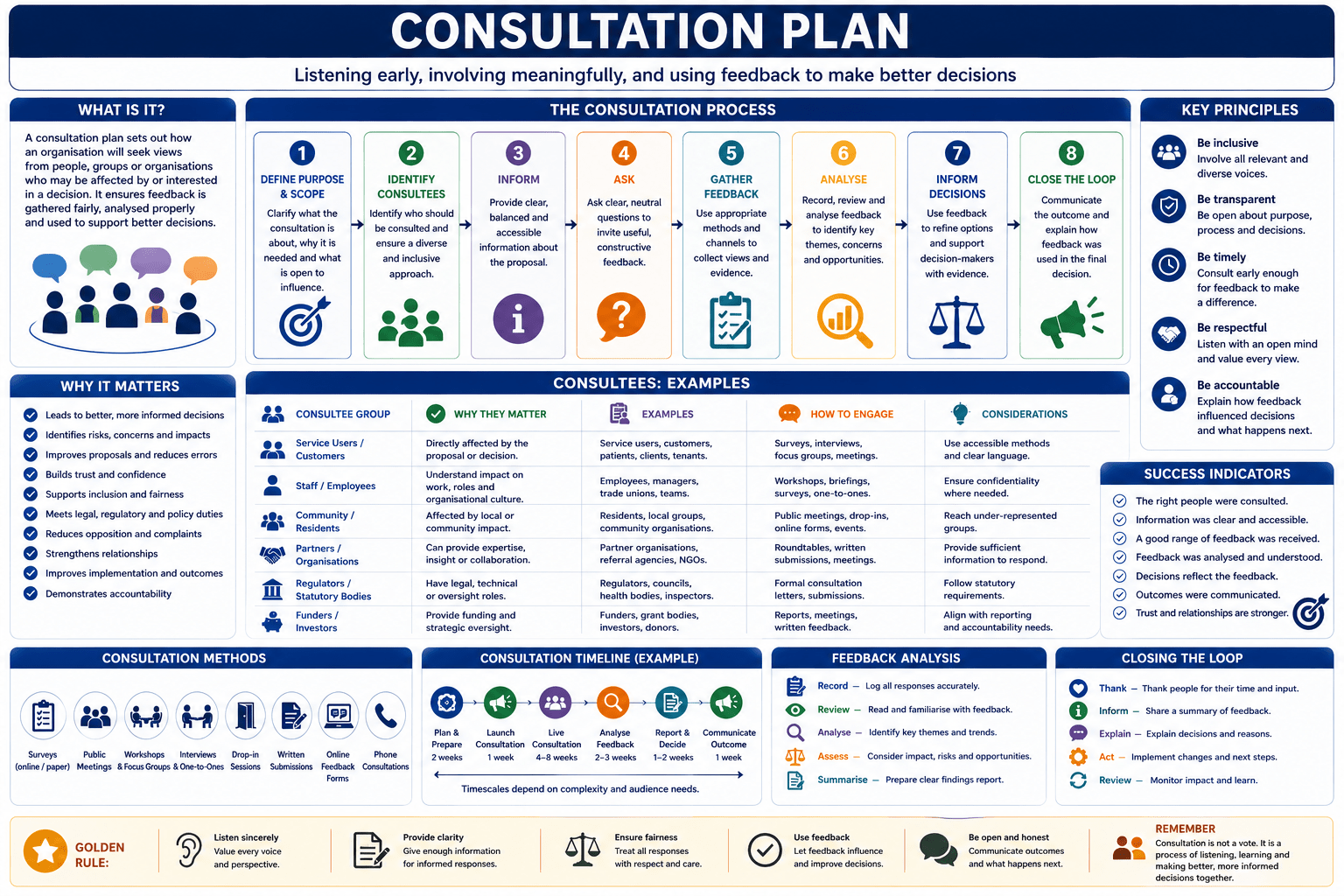
Consultation Plan:
A Practical Guide to Listening Properly, Managing Feedback and Supporting Better Decisions
A consultation plan is a practical management and governance tool used to set out how an organisation will seek, collect, analyse and respond to views before making or finalising a decision.
At its simplest, a consultation plan asks:
Who needs to be consulted, what are we asking them, how will we gather their views, and how will those views influence the final decision?
That makes it useful for public sector decisions, charity governance, property development, planning applications, organisational change, service redesign, policy development, customer engagement, staff restructuring, community projects, education, healthcare, housing, transport, risk management and board reporting.
Used properly, a consultation plan helps organisations make better decisions, understand concerns, improve proposals, reduce risk, demonstrate fairness and build trust.
It is not just a survey.
It is a structured plan for meaningful listening.
What is a consultation plan?
A consultation plan sets out how an organisation will invite views from people, groups or organisations who may be affected by, interested in, or able to contribute to a decision.
It normally explains:
- What is being consulted on
- Why consultation is needed
- Who should be consulted
- What questions will be asked
- What information consultees need
- How consultation will take place
- When consultation will happen
- How long the consultation will run
- How feedback will be recorded
- How responses will be analysed
- How the final decision will be made
- How consultees will be told the outcome
A consultation may relate to:
- A service change
- A proposed policy
- A property development
- A planning application
- A public sector decision
- A charity service redesign
- A school or education change
- A healthcare pathway
- A community project
- A staff restructure
- A transport proposal
- A pricing or charging change
- A new strategy
- A governance change
- A local campaign or regeneration project
The purpose is to make sure views are sought before the decision is finalised, not after.
A consultation plan should therefore be clear about what is open to influence and what is not.
Consultation plan, communications plan and stakeholder engagement plan
Consultation plans are closely linked to communications plans and stakeholder engagement plans, but they are not the same.
Consultation plan
A consultation plan focuses on seeking views before a decision is made or finalised.
It asks:
What feedback do we need, who should provide it, and how will it be considered?
Communications plan
A communications plan focuses on sharing information clearly.
It asks:
Who needs to know what, when, how and from whom?
Stakeholder engagement plan
A stakeholder engagement plan is broader.
It covers identifying stakeholders, understanding their interests, deciding how to involve them, managing relationships and responding to concerns.
It asks:
Who matters, what do they care about, and how should we engage with them?
In simple terms:
A communications plan tells people.
A consultation plan asks people.
A stakeholder engagement plan manages the wider relationship.
All three may be needed.
For example, a property development may need a communications plan to explain the proposal, a consultation plan to gather local views, and a stakeholder engagement plan to manage residents, tenants, planners, councillors, contractors and community groups.
Why consultation plans matter
Consultation plans matter because poor consultation can damage both the decision and the organisation’s credibility.
Common consultation problems include:
- Consulting too late
- Asking vague questions
- Consulting the wrong people
- Providing too little information
- Making the decision before listening
- Ignoring difficult feedback
- Failing to record responses properly
- Treating consultation as a tick-box exercise
- Not explaining how feedback was used
- Creating unrealistic expectations
- Excluding people who are harder to reach
- Using inaccessible language
- Failing to consider legal or equality duties
- Allowing loud voices to dominate
- Failing to close the loop
A consultation plan helps avoid these problems.
It supports:
- Better decisions
- Greater transparency
- Stronger trust
- Better understanding of risk
- Better stakeholder confidence
- More inclusive decision-making
- Improved service design
- Better community relationships
- Reduced complaints
- Reduced legal and reputational risk
- Better implementation
- Stronger governance
- Clearer evidence for boards or trustees
- Better communication
- More credible decision-making
Good consultation does not mean everyone will agree.
It means the organisation has listened properly, considered feedback fairly, and explained the outcome honestly.
When to use a consultation plan
A consultation plan is useful whenever a decision may affect people, communities, service users, customers, staff or stakeholders, and their views should be sought before the decision is made or finalised.
Good uses include:
- Service redesign
- Public consultation
- Charity service changes
- Staff restructuring
- Community engagement
- Planning applications
- Property redevelopment
- Transport changes
- Policy development
- Budget decisions
- Healthcare service changes
- Education provision changes
- Housing proposals
- Environmental projects
- Digital service changes
- New strategies
- Local regeneration
- Customer service changes
- Governance changes
- Major operational changes
It is especially useful where:
- The decision is sensitive.
- People may be negatively affected.
- There are competing interests.
- Legal consultation duties may apply.
- Community trust matters.
- The proposal is complex.
- Implementation depends on cooperation.
- The organisation needs evidence before approval.
- There is risk of opposition.
- The board, trustees or decision-makers need assurance.
It is less useful when used after the real decision has already been made.
That is not consultation.
That is communication.
Consultation in different industries
SMEs and owner-managed businesses
For SMEs, consultation is usually informal, but it can still be valuable.
Small businesses may consult customers, staff, suppliers, advisers, lenders or local stakeholders before changing something important.
Typical SME consultation topics include:
- Price increases
- Service changes
- New products
- Opening hours
- Delivery options
- Website changes
- Customer service improvements
- Staff working patterns
- New systems
- Premises moves
- Payment terms
- Product range changes
- Customer support changes
- Local community impact
- Business restructuring
An SME might ask:
- Which customers will be affected?
- What do staff think will work in practice?
- What concerns will suppliers have?
- Would customers prefer one option over another?
- What objections are likely?
- What could improve the proposal?
- What should be tested before full implementation?
- What communication is needed after the decision?
For SMEs, consultation should be simple, focused and practical.
It should support a real decision, not become an unnecessary formality.
Manufacturing
Manufacturing businesses may need consultation with staff, customers, suppliers, contractors, regulators and local communities.
Typical consultation topics include:
- Shift pattern changes
- New equipment
- Production changes
- Product specification changes
- Quality improvement
- Health and safety procedures
- Site expansion
- Environmental impact
- Supplier changes
- Workforce training
- Maintenance shutdowns
- Automation
- Warehouse changes
- Packaging changes
- Delivery arrangements
A manufacturer might ask:
- How will proposed changes affect production teams?
- What do operators know that management may miss?
- What concerns do customers have about specification changes?
- What risks do suppliers see?
- What health and safety issues need consultation?
- What training is needed?
- What feedback should be gathered before implementation?
- How will practical suggestions be captured?
For manufacturing, consultation should connect operational knowledge with management decisions.
The people closest to the process often understand practical risks best.
Retail and ecommerce
Retail and ecommerce businesses can use consultation to improve customer experience, product range, pricing, fulfilment and service design.
Typical consultation topics include:
- Returns policies
- Delivery options
- Product range changes
- Website redesign
- Loyalty schemes
- Subscription offers
- Customer service changes
- Store layout
- Opening hours
- Payment options
- Product packaging
- Sustainability choices
- Accessibility
- Promotional strategy
- Customer support channels
A retailer might ask:
- What frustrates customers most?
- What would improve the buying journey?
- Which delivery options matter?
- What would make returns easier?
- What support do customers need before buying?
- What do staff hear from customers repeatedly?
- Which changes could increase trust?
- Which proposals might create confusion?
For ecommerce, consultation should be combined with behavioural data.
Customers may say they want something, but website behaviour may show a different priority.
Professional services
Professional services firms can consult clients, staff, partners, referrers and professional advisers before changing services, fees, systems or client communication.
Typical consultation topics include:
- Fee structures
- Advisory service development
- Client onboarding
- Communication standards
- Portal or software changes
- Service packages
- Client reporting
- Deadline processes
- Staff workflow
- Quality review processes
- Client feedback systems
- New service lines
- Fixed fee arrangements
- Referral partnerships
- Practice management systems
For accountants, solicitors, consultants, architects and advisers, consultation might ask:
- What do clients value most?
- What do clients find confusing?
- What would improve communication?
- What service options would clients pay for?
- What do staff think will work operationally?
- What causes delays or frustration?
- What should be piloted before full rollout?
- What concerns need addressing before launch?
Professional services depend on trust.
Consultation can show clients that changes are being made with their needs in mind, not only for internal convenience.
Charities and voluntary organisations
Charities often need careful consultation because decisions may affect beneficiaries, volunteers, funders, staff, trustees, commissioners and community partners.
Typical consultation topics include:
- Service redesign
- Service closure
- Funding changes
- Volunteer roles
- Community need
- Beneficiary access
- Safeguarding improvements
- Impact reporting
- New projects
- Partnership arrangements
- Eligibility criteria
- Service priorities
- Strategy development
- Reserves policy impact
- Fundraising approach
A charity might ask:
- Who is most affected by the proposed change?
- How can beneficiaries be consulted safely and sensitively?
- What do volunteers need to understand?
- What do funders need to know?
- What alternative options exist?
- What risks might trustees need to consider?
- What feedback should influence the final decision?
- How will the charity explain difficult decisions?
For charities, consultation should be ethical, accessible and proportionate.
It should not overburden vulnerable people or create expectations that cannot be met.
Public sector and local government
Public bodies frequently need consultation because decisions affect residents, service users, businesses, community groups, elected members and partner organisations.
Typical consultation topics include:
- Budget decisions
- Service redesign
- Transport changes
- Planning policy
- Housing strategies
- Environmental schemes
- Community safety
- Public health
- Digital services
- Waste collection changes
- Parking schemes
- School organisation
- Local plans
- Leisure services
- Equality impacts
A public body might ask:
- Who has a legal right to be consulted?
- Which groups are most affected?
- How will hard-to-reach voices be included?
- What information is needed for an informed response?
- How will responses be analysed?
- How will equality impacts be considered?
- What options are genuinely open?
- How will the final decision be explained?
For public bodies, consultation should be fair, transparent, accessible and evidence-based.
It should also be clear about what decision-makers can and cannot change.
Property and construction
Property and construction projects often require consultation with tenants, neighbours, residents, local businesses, planning authorities, community groups and statutory consultees.
Typical consultation topics include:
- Planning applications
- Redevelopment proposals
- Construction impacts
- Site access
- Parking
- Noise
- Traffic
- Heritage impact
- Environmental impact
- Tenant works
- Regeneration schemes
- Public realm
- Housing mix
- Commercial space
- Community facilities
A property business might ask:
- Who will be affected by the proposal?
- What concerns are likely?
- What can be changed before submission?
- What information will help people understand the scheme?
- Which stakeholders should be consulted early?
- What objections could be reduced through design changes?
- How will feedback be recorded?
- What commitments can reasonably be made?
For property and construction, consultation can reduce risk, improve design and build trust.
It cannot remove all objections, but it can improve the quality of the proposal and the credibility of the process.
Technology and software
Technology projects often require consultation with users, customers, staff, support teams, data protection leads, cyber security teams and senior sponsors.
Typical consultation topics include:
- New system implementation
- Software rollout
- User experience
- Data migration
- Support model changes
- Product roadmap
- Feature changes
- Customer onboarding
- AI adoption
- Cyber security changes
- Portal redesign
- App improvements
- Internal workflow
- Digital accessibility
- Training needs
A technology team might ask:
- Who will use the system daily?
- What problems do users experience now?
- What concerns do support teams have?
- What training will be needed?
- What accessibility issues exist?
- What feedback should be gathered during testing?
- What risks could affect adoption?
- How will user feedback change the rollout plan?
Technology consultation should not be limited to senior decision-makers.
The people who use and support the system often know what will succeed or fail in practice.
Healthcare and social care
Healthcare and social care consultation must be handled with care because service users, patients, families, carers, staff and regulators may be affected.
Typical consultation topics include:
- Service changes
- Care pathways
- Family communication
- Staffing models
- Digital care records
- Safeguarding improvements
- Quality improvement
- Inspection response
- Complaints processes
- Patient experience
- Access arrangements
- Appointment systems
- Care package changes
- Policy changes
- Community health services
A care provider might ask:
- How will people receiving care be affected?
- What do families need to understand?
- How can consultation be accessible and sensitive?
- What safeguarding considerations apply?
- What do staff think is practical?
- What regulatory expectations must be considered?
- How will concerns be escalated?
- How will feedback influence the decision?
In healthcare and care, consultation should protect dignity, safety, confidentiality, safeguarding and professional judgement.
Education and training
Education providers may consult learners, parents, carers, staff, employers, funders, regulators and community partners.
Typical consultation topics include:
- Course changes
- Course closures
- New programmes
- Curriculum design
- Timetable changes
- Learner support
- Digital learning
- Safeguarding policies
- Employer partnerships
- Placement arrangements
- Funding changes
- Accessibility
- Quality improvement
- Attendance policies
- Assessment arrangements
An education provider might ask:
- Which learners are affected?
- What do parents or carers need to know?
- What do employers need from the course?
- What do tutors think will work?
- What support needs may arise?
- What equality or accessibility issues exist?
- How will learner voice influence the proposal?
- How will the outcome be communicated?
For education, consultation should support learner outcomes, safeguarding, quality, accessibility and employer relevance.
What a consultation plan should include
1. Purpose
The plan should begin with a clear purpose.
For example:
The purpose of this consultation plan is to seek views from affected service users, staff, volunteers, funders and partner organisations before trustees make a final decision on the proposed service redesign.
The purpose should explain:
- What is being consulted on
- Why consultation is needed
- Who the consultation is for
- What decision it will support
- What outcome is expected
Without a clear purpose, consultation can become unfocused.
2. Scope
The plan should explain what is in scope and out of scope.
In scope might include:
- The proposed options
- The impact on affected groups
- Practical implementation concerns
- Alternative suggestions
- Accessibility issues
- Risk and mitigation
- Communication needs
Out of scope might include:
- Decisions already made
- Legal requirements that cannot be changed
- Matters outside the organisation’s control
- Individual employment consultation handled separately
- Unrelated service issues
Scope matters because consultees need honesty.
If something cannot be changed, say so.
3. Consultation objectives
Consultation objectives explain what the organisation wants to learn or achieve.
Examples include:
- Understand stakeholder views
- Identify concerns
- Test proposed options
- Improve the proposal
- Understand impact
- Identify risks
- Meet legal duties
- Gather local knowledge
- Understand accessibility issues
- Build trust
- Support better implementation
- Inform board or trustee decision-making
- Understand alternative options
- Improve communication
- Reduce unintended consequences
Weak objective:
Consult stakeholders about the change.
Stronger objective:
Gather views from affected service users and partner organisations on the proposed change, identify practical concerns, and provide trustees with a summary of feedback before final approval.
4. Consultees
The plan should identify who will be consulted.
Possible consultees include:
- Customers
- Staff
- Service users
- Beneficiaries
- Volunteers
- Trustees
- Funders
- Regulators
- Suppliers
- Contractors
- Tenants
- Residents
- Local businesses
- Community groups
- Partner organisations
- Professional advisers
- Public bodies
- Elected representatives
- Families and carers
- Hard-to-reach groups
The list should be specific.
“Residents” may need to be split into immediate neighbours, wider community, local businesses, tenants, affected road users and community groups.
Different groups may need different methods.
5. Information provided
People can only respond properly if they understand the proposal.
The consultation should provide:
- Background
- Reason for the proposal
- Options considered
- Preferred option, if there is one
- What is open to change
- What is not open to change
- Likely impacts
- Benefits
- Risks
- Costs where relevant
- Timetable
- Decision process
- How to respond
- Closing date
- Contact details
Information should be clear, balanced and accessible.
Consultation is weakened if people are asked for views without enough information.
6. Consultation questions
Questions should be clear, neutral and useful.
Good questions might include:
- Do you understand the proposal?
- What impact would the proposal have on you or your organisation?
- What benefits do you see?
- What concerns do you have?
- Are there practical issues we should consider?
- Are there alternative options?
- What would improve the proposal?
- What support or communication would be needed?
- Are there equality, access or safeguarding concerns?
- Is there anything else decision-makers should consider?
Avoid leading questions.
Weak question:
Do you agree that this sensible proposal should proceed?
Stronger question:
What are your views on the proposal, including any benefits, concerns or suggested changes?
7. Consultation methods
The plan should explain how views will be gathered.
Methods may include:
- Survey
- Written consultation document
- Public meeting
- Workshop
- Focus group
- Interview
- One-to-one meeting
- Online feedback form
- Email response
- Telephone consultation
- Drop-in session
- Staff briefing
- Community event
- User panel
- Stakeholder forum
- Social media feedback
- Printed forms
- Accessible format consultation
- Translated materials
- Consultation website page
The method should fit the audience.
A vulnerable service user group may need supported conversation rather than a long written form.
A technical stakeholder may need a detailed consultation document.
A wider public consultation may need a simple online response route.
8. Timescale
The plan should set out the consultation timetable.
This should include:
- Preparation date
- Launch date
- Information release date
- Events or meetings
- Reminder dates
- Closing date
- Analysis period
- Report date
- Decision date
- Outcome communication date
The consultation period should be long enough for meaningful responses.
The right length depends on complexity, sensitivity, legal duties, accessibility needs and stakeholder availability.
9. Feedback recording and analysis
The plan should explain how responses will be recorded and analysed.
This may include:
- Response log
- Feedback database
- Theme analysis
- Quantitative survey summary
- Qualitative comments
- Equality impact themes
- Risk themes
- Stakeholder group analysis
- Issues raised
- Suggested changes
- Objections
- Supportive responses
- Alternative proposals
- Management response
- Decision-maker summary
Analysis should be fair and transparent.
Do not only count responses.
The strength, evidence and relevance of feedback also matter.
One well-evidenced concern may be more important than many identical short responses.
10. Reporting and decision-making
The plan should explain how consultation findings will be reported.
The report should normally include:
- Consultation purpose
- Consultees involved
- Methods used
- Number of responses
- Main themes
- Concerns raised
- Supportive feedback
- Alternative suggestions
- Equality or access issues
- Risks identified
- Changes recommended
- Management response
- Decision required
- Limitations of consultation
- Next steps
Decision-makers should see both supportive and critical feedback.
The consultation report should not be written only to justify the preferred outcome.
11. Closing the loop
Consultees should be told what happened after the consultation.
This may include:
- Summary of feedback
- Main themes
- Changes made
- Reasons for the final decision
- Why some suggestions were not adopted
- Next steps
- Implementation timetable
- Contact point
- Review arrangements
Closing the loop is essential.
If people take time to respond and never hear the outcome, trust is damaged.
Types of consultation
Informal consultation
Informal consultation gathers views without a formal process.
It may include:
- Conversations
- Staff discussions
- Customer calls
- Meetings
- Early stakeholder engagement
- Feedback sessions
It is useful for early exploration.
It should still be recorded where the feedback influences decisions.
Formal consultation
Formal consultation follows a structured process.
It usually includes:
- A consultation document
- Defined questions
- Clear timetable
- Response method
- Analysis process
- Report to decision-makers
- Published outcome
It is useful where decisions are significant, sensitive or subject to legal requirements.
Public consultation
Public consultation seeks views from the wider public or a community.
It is common in public sector, planning, transport, environmental and community projects.
It should be accessible and clear.
Staff consultation
Staff consultation seeks views from employees or workers.
It may relate to restructuring, workplace changes, systems, policies or working arrangements.
Where employment rights are involved, formal HR and legal requirements must be followed.
Service user consultation
Service user consultation seeks views from people who use a service.
It is common in charities, public services, healthcare, social care and education.
It must be accessible, ethical and sensitive.
Community consultation
Community consultation seeks views from local residents, community groups, businesses and organisations.
It is common in planning, regeneration, public services and local campaigns.
It should include quieter voices, not only the loudest objections.
Technical consultation
Technical consultation seeks views from specialists, regulators, professional bodies or statutory consultees.
It is useful where technical evidence, safety, planning, legal or regulatory issues matter.
Common consultation methods
Survey
A survey gathers structured responses.
It is useful for reaching a larger audience.
It should be clear, neutral and not too long.
Written consultation document
A written document explains the proposal and asks for responses.
It is useful for formal consultation.
It should include background, options, questions and response details.
Workshop
A workshop allows discussion and exploration.
It is useful for co-design, staff consultation, service redesign and community problem-solving.
Focus group
A focus group gathers views from a small group.
It is useful for exploring experience, concerns and language.
Interview
An interview provides depth.
It is useful for sensitive topics or important stakeholders.
Public meeting
A public meeting allows open discussion.
It can be useful, but can also be dominated by strong voices.
Good facilitation is important.
Drop-in session
A drop-in session allows people to ask questions individually.
It is useful for property, planning, community and service changes.
Online feedback form
An online form allows easy response.
It should be supported by other methods where digital exclusion is a risk.
Written submissions
Written submissions allow detailed responses.
They are useful for technical stakeholders, partner organisations and formal consultees.
Common mistakes in consultation plans
Mistake 1: Consulting too late
Consultation should happen while feedback can still influence the decision.
Late consultation feels tokenistic.
Mistake 2: Not being clear what is open to change
If some matters are fixed, say so.
People need to know where their feedback can make a difference.
Mistake 3: Asking leading questions
Leading questions weaken trust and reduce the quality of feedback.
Questions should be neutral.
Mistake 4: Providing too little information
People need enough information to respond properly.
Vague proposals create vague feedback.
Mistake 5: Consulting only the usual voices
The loudest or easiest-to-reach people may not represent everyone affected.
Harder-to-reach groups may need specific methods.
Mistake 6: Ignoring negative feedback
Critical feedback may reveal important risks.
It should be considered properly.
Mistake 7: Counting responses without analysing meaning
Numbers matter, but themes, evidence and impact also matter.
A consultation is not always a vote.
Mistake 8: Failing to record feedback
If feedback is not recorded, it cannot be analysed, reported or defended.
Mistake 9: Creating unrealistic expectations
Do not imply that every suggestion will be adopted.
Consultation informs decisions. It does not always determine them.
Mistake 10: Not closing the loop
People should know what happened after consultation.
Failure to explain the outcome damages trust.
Limitations and weaknesses of consultation plans
Consultation plans are useful, but they have limits.
They cannot guarantee agreement
Good consultation does not mean everyone will support the outcome.
Some decisions remain difficult.
They can become tokenistic
If the decision is already made, consultation loses credibility.
They can be dominated by strong voices
Public consultation can attract the most motivated respondents.
The plan should consider quieter or more affected groups.
They require time and resource
Meaningful consultation takes planning, facilitation, analysis and reporting.
It should be resourced properly.
They can raise expectations
People may expect their preferred outcome to be adopted.
The process must be clear about how decisions will be made.
They can be misinterpreted as a vote
Consultation gathers views and evidence.
It is not always a referendum.
Decision-makers must consider feedback alongside law, finance, risk, strategy and duties.
They depend on trust
If trust is low, people may doubt the process.
Trust is improved through honesty, fairness and follow-through.
They do not replace leadership or governance
Consultation informs decisions.
It does not remove the responsibility of boards, trustees, councillors, directors or managers to decide.
Consultation plan compared with other strategic and management tools
Consultation plan and communications plan
A communications plan shares information.
A consultation plan seeks views.
Use communication to explain the proposal. Use consultation to gather feedback.
Consultation plan and stakeholder engagement plan
A stakeholder engagement plan is broader and may include communication, consultation, involvement and relationship management.
A consultation plan focuses specifically on the consultation process.
Consultation plan and stakeholder analysis
Stakeholder analysis identifies who matters.
The consultation plan explains who will be consulted and how.
Consultation plan and risk register
Consultation can reveal risks.
Risks raised through consultation should be added to the risk register where appropriate.
Consultation plan and issue log
If concerns have already become active problems, they should be recorded in the issue log.
Consultation plan and customer research
Customer research seeks insight about customers.
Consultation seeks views on a specific proposal, decision or change.
They can overlap, but they are not the same.
Consultation plan and roadmapping
A roadmap shows the phases of delivery.
A consultation plan may identify consultation points before key decisions on the roadmap.
Consultation plan and change management
Change management helps people move from current state to future state.
Consultation can support change by involving people before implementation.
Consultation plan and equality impact assessment
Consultation can provide evidence about how different groups may be affected.
This can inform equality, accessibility and fairness considerations.
Consultation plan and business case
A business case supports a decision.
Consultation evidence can strengthen the business case by showing stakeholder views, risks and options considered.
Alternatives and complementary frameworks
Stakeholder analysis
Use stakeholder analysis to identify who should be consulted.
Stakeholder engagement plan
Use stakeholder engagement planning where consultation is part of wider relationship management.
Communications plan
Use a communications plan to explain the consultation clearly and consistently.
Survey design
Use survey design principles to create clear, neutral and useful questions.
Focus groups
Use focus groups where deeper discussion is needed.
Equality impact assessment
Use equality impact assessment where the proposal may affect different groups differently.
Risk register
Use the risk register to record risks identified through consultation.
Issue log
Use an issue log for active concerns raised during consultation.
Decision log
Use a decision log to record how consultation evidence influenced final decisions.
A practical consultation plan template
A useful consultation plan should include:
- Consultation title
- Purpose
- Background
- Decision being considered
- Scope
- What is open to influence
- What is not open to influence
- Consultees
- Consultation objectives
- Information to be provided
- Consultation questions
- Consultation methods
- Accessibility arrangements
- Timetable
- Response channels
- Feedback recording process
- Analysis method
- Reporting process
- Decision-making process
- Communication of outcome
- Risks
- Owner
- Review date
Example:
Consultation title: Consultation plan for proposed service redesign
Purpose: Seek views from service users, staff, volunteers, funders and referral partners before trustees decide whether to approve the proposed redesign.
Decision being considered: Whether to change the service model from open access support to a targeted referral-based model.
What is open to influence: Eligibility criteria, referral process, communication approach, transition support and implementation timetable.
What is not open to influence: The need to reduce operating costs to remain financially sustainable.
Consultees: Current service users, former service users, staff, volunteers, trustees, funders, referral partners and local community organisations.
Methods: Small group sessions, one-to-one calls, staff workshops, online survey and written submissions.
Key questions:
- What impact would the proposed change have?
- What benefits or concerns do you see?
- What practical issues should trustees consider?
- What support would be needed during transition?
- Are there alternative options that should be considered?
Analysis: Feedback log, theme analysis and summary report to trustees.
Outcome communication: Written summary explaining feedback received, decision made, changes to the proposal and next steps.
Owner: Chief Executive.
Review date: After consultation closes.
Questions to ask when creating a consultation plan
Purpose questions
- Why are we consulting?
- What decision will consultation support?
- What is still open to influence?
- What has already been decided?
- What outcome do we need from consultation?
- Who will use the feedback?
- What legal or governance duties apply?
- What risks need managing?
- What would make the consultation meaningful?
- How will we know the consultation has worked?
Consultee questions
- Who is affected?
- Who may have useful evidence?
- Who may object?
- Who may support?
- Who has legal or regulatory standing?
- Who is hard to reach?
- Who may need accessible formats?
- Who may need support to respond?
- Who should be consulted early?
- Who might be missed?
Information questions
- What background do people need?
- What options should be explained?
- What impacts should be described?
- What evidence should be shared?
- What constraints should be made clear?
- What is the timetable?
- What decisions are fixed?
- What decisions remain open?
- How should people respond?
- Who can answer questions?
Question design questions
- Are the questions clear?
- Are they neutral?
- Are they specific enough?
- Do they invite useful feedback?
- Are they too long?
- Are they accessible?
- Do they cover impact?
- Do they allow alternative suggestions?
- Do they avoid leading language?
- Will the answers help decision-makers?
Analysis questions
- How will responses be recorded?
- How will themes be identified?
- How will different stakeholder groups be analysed?
- How will equality or access issues be considered?
- How will objections be reported?
- How will supportive feedback be reported?
- How will evidence be weighed?
- How will repeated responses be handled?
- How will limitations be explained?
- How will findings be presented to decision-makers?
Outcome questions
- Who will make the final decision?
- How will feedback influence the decision?
- How will changes be recorded?
- How will consultees be told the outcome?
- How will rejected suggestions be explained?
- What next steps will be communicated?
- What implementation issues remain?
- What risks should be updated?
- What should be reviewed later?
- What have we learned for future consultation?
The best way to think about a consultation plan
A consultation plan is not just a feedback exercise.
It is a decision-support process.
A good consultation plan should be:
- Clear
- Honest
- Timely
- Inclusive
- Proportionate
- Accessible
- Well-documented
- Neutral in questioning
- Linked to decision-making
- Properly closed out
A weak consultation plan says:
“We asked people what they thought.”
A strong consultation plan asks:
“Who needed to be heard, what did they say, what did we learn, and how did that influence the final decision?”
The key question is not simply:
Have we consulted?
The better question is:
Have we consulted the right people, at the right time, with the right information, and used their feedback properly?
Conclusion: consultation plans turn listening into better decisions
Consultation plans remain useful because decisions are rarely made in isolation.
Projects, services, policies and organisational changes affect people. Those people may have experience, concerns, evidence and ideas that decision-makers need to understand.
Used badly, consultation becomes a tick-box exercise carried out too late to matter.
Used properly, it becomes a practical governance and management tool. It helps organisations listen properly, understand impact, improve proposals, manage risk, build trust and make better decisions.
The real value is not in saying that consultation happened.
The real value is in learning from it.
A strong consultation plan helps an organisation move from saying, “We need to ask people,” to asking, “Who needs to be heard, what do we need to learn, and how will their feedback improve the decision?”