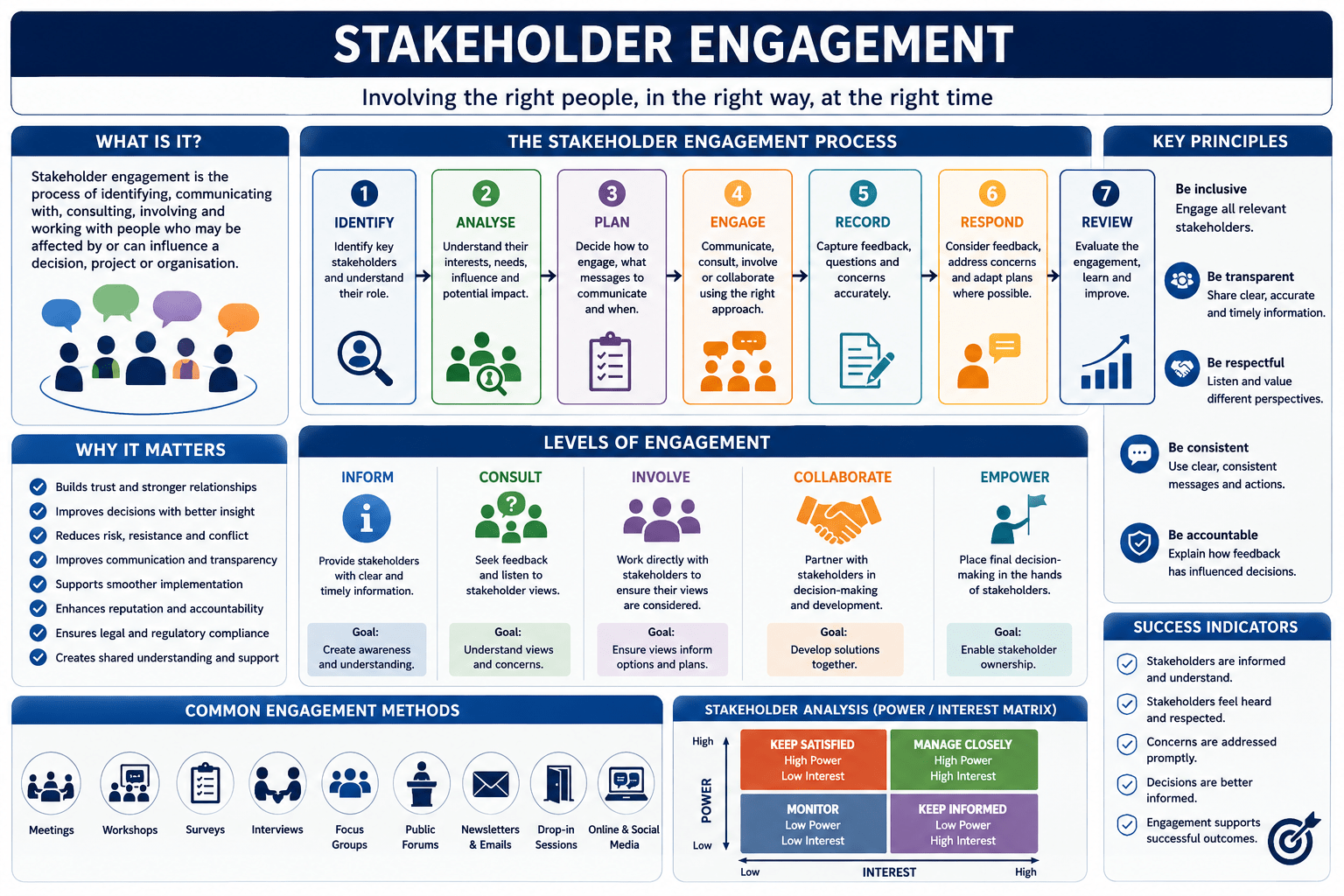
Stakeholder Engagement Plan:
A Practical Guide to Building Trust, Managing Expectations and Supporting Better Decisions
A stakeholder engagement plan is a practical management and communication tool used to identify who needs to be involved, informed, consulted or influenced during a project, strategy, service, decision or organisational change.
At its simplest, a stakeholder engagement plan asks:
Who matters, what do they care about, how could they affect or be affected by the work, and how should we engage with them?
That makes it useful for strategy, project management, change management, property development, charity governance, public sector consultation, business planning, customer service, internal communications, risk management, community engagement, professional services, technology implementation, healthcare, education and board reporting.
Used properly, a stakeholder engagement plan helps organisations communicate clearly, build trust, reduce resistance, understand concerns, improve decisions and avoid surprises.
It is not just a list of names.
It is a plan for meaningful, proportionate and purposeful engagement.
What is a stakeholder engagement plan?
A stakeholder engagement plan sets out how an organisation will engage with the people, groups or organisations affected by, interested in, or able to influence a decision, project or activity.
Stakeholders may include:
- Customers
- Staff
- Managers
- Directors
- Trustees
- Shareholders
- Funders
- Regulators
- Suppliers
- Contractors
- Partners
- Service users
- Beneficiaries
- Local residents
- Community groups
- Tenants
- Landlords
- Investors
- Professional advisers
- Public bodies
- Elected representatives
- Media
- Volunteers
- Trade bodies
- Internal departments
The plan should explain:
- Who the stakeholders are
- Why they matter
- What their interests are
- How much influence they have
- How they may be affected
- What concerns they may raise
- What information they need
- How they should be engaged
- When engagement should happen
- Who is responsible
- What messages should be communicated
- How feedback will be recorded
- How concerns will be managed
- How engagement will be reviewed
- How outcomes will influence decisions
The purpose is to help the organisation engage deliberately rather than reactively.
Without a plan, stakeholder engagement often happens too late, too informally, or only after a problem has emerged.
Stakeholder engagement plan and stakeholder analysis
Stakeholder engagement plans are closely linked to stakeholder analysis, but they are not the same.
Stakeholder analysis
Stakeholder analysis identifies and assesses stakeholders.
It asks:
Who matters, what are their interests, and how much influence do they have?
It usually includes stakeholder mapping, power and interest assessment, likely attitude, level of impact and potential risks.
Stakeholder engagement plan
The stakeholder engagement plan turns the analysis into action.
It asks:
How will we communicate, consult, involve and manage stakeholders in practice?
In simple terms:
Stakeholder analysis helps you understand the people involved.
A stakeholder engagement plan helps you engage with them properly.
Stakeholder analysis without an engagement plan may produce insight but no action.
An engagement plan without proper analysis may involve the wrong people in the wrong way.
Both are needed.
Why stakeholder engagement plans matter
Stakeholder engagement plans matter because decisions rarely affect only the people making them.
A project may affect staff workloads.
A new system may affect customers.
A property development may affect residents, tenants, planners and contractors.
A charity service change may affect beneficiaries, funders, volunteers and trustees.
A restructuring may affect employees, unions, service users and regulators.
A new pricing model may affect customers, sales teams and finance.
If stakeholders are ignored, the organisation may face:
- Resistance
- Confusion
- Mistrust
- Poor decisions
- Delays
- Complaints
- Reputational damage
- Legal challenge
- Funding risk
- Project failure
- Poor adoption
- Staff disengagement
- Community opposition
- Customer loss
- Regulatory concern
Stakeholder engagement helps reduce these risks.
It supports:
- Better communication
- Better understanding of concerns
- Better project delivery
- Better decision-making
- Stronger trust
- Greater transparency
- More realistic planning
- Better risk management
- More effective change
- Improved accountability
- Stronger relationships
- Better consultation
- Better service design
- Improved reputation
- Greater likelihood of successful implementation
Good engagement does not mean every stakeholder will agree.
It does mean they are more likely to understand the decision, feel heard, and know how their views were considered.
When to use a stakeholder engagement plan
A stakeholder engagement plan is useful whenever a decision, project or change affects people beyond the immediate delivery team.
Good uses include:
- Strategic planning
- Project management
- Organisational change
- Restructuring
- Business transformation
- New system implementation
- Property development
- Planning applications
- Service redesign
- Charity service changes
- Public sector consultation
- Community engagement
- Product launches
- Pricing changes
- Supplier changes
- Contract renewals
- Mergers and acquisitions
- Policy changes
- Risk management
- Crisis communication
- Internal communications
- Customer experience improvement
- Volunteer engagement
- Board governance
- Technology adoption
It is especially useful where:
- The decision is sensitive.
- Stakeholders may be affected negatively.
- There are competing interests.
- Trust is important.
- The work is high profile.
- The project depends on cooperation.
- There is a legal or consultation requirement.
- Stakeholder resistance could cause delay.
- The organisation needs feedback.
- Communication needs to be consistent.
It is less useful when treated as a tick-box communication exercise.
Stakeholder engagement should influence understanding, decisions, implementation or relationships.
Stakeholder engagement in different industries
SMEs and owner-managed businesses
For SMEs, stakeholder engagement is often informal, but that does not mean it should be unplanned.
A small business may rely on close relationships with customers, staff, suppliers, lenders, landlords, advisers and local contacts.
Typical SME stakeholder engagement issues include:
- Price increases
- Service changes
- New product launches
- Staff changes
- Supplier disruption
- Customer complaints
- Premises moves
- Funding requirements
- System changes
- Business growth
- Succession planning
- Customer retention
- Recruitment
- Local reputation
- Cash flow pressure
An SME might ask:
- Which customers need early communication?
- Which staff need to understand the reason for change?
- Which suppliers are critical?
- Which stakeholders could be affected by delays?
- Which relationships need protecting?
- What concerns are likely?
- What communication should come from the owner?
- What should be documented?
For SMEs, stakeholder engagement should be practical and personal.
It should not become over-engineered, but it should reduce misunderstanding and protect important relationships.
Manufacturing
Manufacturing businesses need stakeholder engagement across customers, suppliers, staff, contractors, regulators, quality teams and logistics partners.
Typical engagement issues include:
- Production changes
- Quality issues
- Supplier delays
- New equipment installation
- Health and safety changes
- Shift pattern changes
- Product changes
- Customer specification changes
- Automation
- Site expansion
- Environmental compliance
- Energy use
- Maintenance shutdowns
- Contractor work
- Workforce training
A manufacturer might ask:
- Which customers need notice of production changes?
- Which suppliers need clearer forecasts?
- Which staff are affected by new equipment?
- What training is needed before implementation?
- Which regulators or auditors need information?
- What safety communication is required?
- How will concerns from operators be captured?
- What feedback should be built into the implementation plan?
For manufacturing, stakeholder engagement should connect operations, quality, health and safety, procurement, customers and workforce planning.
Retail and ecommerce
Retail and ecommerce businesses need stakeholder engagement with customers, staff, suppliers, fulfilment partners, technology providers, marketplaces and marketing teams.
Typical engagement issues include:
- Pricing changes
- Delivery changes
- Product launches
- Product recalls
- Website changes
- Returns policy changes
- Supplier delays
- Stock shortages
- Customer complaints
- Loyalty schemes
- Store closures
- Brand repositioning
- Marketplace changes
- Data use
- Customer service processes
A retailer might ask:
- What do customers need to know?
- How should service teams handle questions?
- Which suppliers may be affected?
- What website messaging is required?
- What social media response may be needed?
- What are the likely customer objections?
- How will feedback be monitored?
- What changes should be tested before launch?
For ecommerce, stakeholder engagement should include customers, internal teams and platform dependencies.
A small change to delivery pricing, returns policy or website navigation can affect sales, complaints and trust.
Professional services
Professional services firms need stakeholder engagement around clients, staff, partners, regulators, referrers, insurers and professional bodies.
Typical engagement issues include:
- New service lines
- Fee changes
- Client onboarding
- Scope changes
- Regulatory changes
- File handovers
- Practice management systems
- Staff restructuring
- Mergers
- Quality improvement
- Professional indemnity issues
- Client communication standards
- Advisory service launches
- Referral relationships
- Deadline management
For accountants, solicitors, consultants, architects and advisers, a stakeholder engagement plan might ask:
- Which clients need proactive communication?
- What concerns will clients have?
- Which staff need training before the change?
- Which partners or directors must sponsor the change?
- How will client feedback be captured?
- What professional standards apply?
- What messages need to be consistent?
- What should be handled individually rather than by mass email?
Professional services depend on trust.
Stakeholder engagement should therefore be clear, timely and personal where appropriate.
Charities and voluntary organisations
Charities have complex stakeholder environments because they often serve beneficiaries, report to funders, rely on volunteers, employ staff, and are governed by trustees.
Typical stakeholders include:
- Beneficiaries
- Families
- Funders
- Donors
- Trustees
- Volunteers
- Staff
- Referrers
- Commissioners
- Partner charities
- Local authorities
- Community groups
- Safeguarding partners
- Regulators
- Local communities
Typical engagement issues include:
- Service changes
- Funding uncertainty
- Restructuring
- Volunteer recruitment
- Safeguarding improvements
- New projects
- Closure or reduction of services
- Impact reporting
- Community campaigns
- Partnership work
- Fundraising appeals
- Governance changes
- Beneficiary feedback
- Strategic planning
- Reputation management
A charity might ask:
- Who will be affected by the service change?
- How do we engage beneficiaries sensitively?
- What do funders need to understand?
- What role should trustees play?
- How do we keep volunteers informed?
- What safeguarding considerations apply?
- What feedback should influence the decision?
- How do we communicate difficult decisions honestly?
For charities, stakeholder engagement must balance compassion, transparency, safeguarding, mission, funding reality and governance.
Public sector and local government
Public bodies often have formal stakeholder engagement, consultation and accountability requirements.
Typical stakeholders include:
- Residents
- Service users
- Elected members
- Officers
- Partner agencies
- Contractors
- Community groups
- Businesses
- Schools
- Health bodies
- Charities
- Regulators
- Government departments
- Local media
- Equality groups
Typical engagement issues include:
- Service redesign
- Budget decisions
- Planning policies
- Transport changes
- Public consultations
- Community safety
- Housing
- Regeneration
- Environmental policy
- Digital services
- Procurement
- Equality impact
- Emergency planning
- Statutory services
- Public complaints
A public body might ask:
- Who has a legal right to be consulted?
- Which groups are most affected?
- How will hard-to-reach voices be included?
- What information must be accessible?
- How will responses be analysed?
- How will feedback influence the decision?
- What equality impacts need consideration?
- How will the final decision be explained?
For public bodies, stakeholder engagement should be transparent, inclusive, evidence-based and proportionate.
Property and construction
Property and construction projects often depend heavily on stakeholder engagement.
Typical stakeholders include:
- Landowners
- Tenants
- Neighbours
- Local residents
- Planning authorities
- Contractors
- Funders
- Architects
- Engineers
- Surveyors
- Utilities providers
- Highways authorities
- Environmental bodies
- Community groups
- Local businesses
- Heritage groups
- Elected representatives
- Insurers
- Investors
- Managing agents
Typical engagement issues include:
- Planning applications
- Site access
- Construction disruption
- Noise
- Parking
- Traffic
- Heritage concerns
- Environmental impact
- Tenant works
- Rent reviews
- Service charges
- Refurbishment
- Regeneration
- Safety
- Phasing
A property business might ask:
- Who will be affected by the works?
- Who can influence planning outcome?
- What concerns are likely from neighbours?
- What information do tenants need?
- What statutory consultation applies?
- How will disruption be communicated?
- Who should be engaged before formal submission?
- What commitments can reasonably be made?
For property and construction, stakeholder engagement can reduce objections, delays, misunderstandings and reputational damage.
It should be honest about what can and cannot be changed.
Technology and software
Technology projects often fail because stakeholder engagement is too limited.
Typical stakeholders include:
- Users
- Customers
- Product teams
- Developers
- Support teams
- Sales teams
- Data protection officers
- Cyber security teams
- Finance
- Operations
- Suppliers
- Senior sponsors
- Regulators
- Implementation partners
- Training teams
Typical engagement issues include:
- New system implementation
- Software rollout
- Product launches
- Feature changes
- Data migration
- Cyber security improvements
- User training
- Process redesign
- Customer onboarding
- Support model changes
- AI adoption
- Integration projects
- Platform migration
- Service outages
- Product roadmap changes
A technology team might ask:
- Who will actually use the system?
- Who will support users after launch?
- What concerns do users have?
- What training is needed?
- What data risks exist?
- What communication is needed before go-live?
- What feedback will be captured during testing?
- What resistance could affect adoption?
For technology projects, stakeholder engagement should not only focus on senior sponsors.
The people using and supporting the system often determine whether implementation succeeds.
Healthcare and social care
Healthcare and social care organisations need stakeholder engagement because safety, dignity, trust and communication are central.
Typical stakeholders include:
- Patients
- Service users
- Families
- Carers
- Staff
- Clinicians
- Care workers
- Regulators
- Commissioners
- Safeguarding partners
- Local authorities
- Health bodies
- Volunteers
- Advocacy groups
- Community organisations
Typical engagement issues include:
- Service changes
- Care planning
- Inspection response
- Safeguarding improvements
- Staffing changes
- Digital care records
- Family communication
- Quality improvement
- Complaints
- Policy changes
- Training
- New models of care
- Medication safety
- Discharge planning
- Continuity of care
A care provider might ask:
- Who is affected by the change?
- How will service users be supported to understand it?
- What do families need to know?
- What staff training is required?
- What safeguarding issues need consideration?
- What regulatory expectations apply?
- How will feedback be recorded?
- How will concerns be escalated?
In healthcare and care, engagement must be sensitive, accessible, lawful and person-centred.
Education and training
Education providers need stakeholder engagement with learners, parents, employers, staff, funders, regulators and community partners.
Typical stakeholders include:
- Learners
- Parents
- Employers
- Tutors
- Support staff
- Safeguarding leads
- Funding bodies
- Inspectors
- Local authorities
- Community groups
- Partner providers
- Placement providers
- Alumni
- Governors
- Professional bodies
Typical engagement issues include:
- Curriculum changes
- Course closures
- New courses
- Employer partnerships
- Learner support
- Digital learning
- Safeguarding
- Attendance improvement
- Funding changes
- Quality improvement
- Inspection readiness
- Placement arrangements
- Assessment changes
- Learner progression
- Accessibility
An education provider might ask:
- Which learners are affected?
- What do employers need?
- What information do parents or carers need?
- Which tutors must be involved in design?
- What safeguarding considerations apply?
- What consultation is required?
- How will learner voice influence the decision?
- How will feedback be communicated?
For education, stakeholder engagement should connect to learner outcomes, safeguarding, quality, funding and employer relevance.
What a stakeholder engagement plan should include
1. Purpose
The plan should begin with a clear purpose.
For example:
The purpose of this stakeholder engagement plan is to ensure that staff, service users, funders, trustees and partner organisations are informed, consulted and involved appropriately during the proposed service redesign.
The purpose should explain:
- What is being done
- Why engagement is needed
- What the engagement should achieve
- What decisions it will support
- What outcomes are expected
Without a clear purpose, engagement may become unfocused.
2. Scope
The plan should explain what is in scope and out of scope.
For example:
In scope:
- Communication with affected staff
- Consultation with service users
- Briefing funders
- Engagement with referral partners
- Trustee decision-making
Out of scope:
- Issues not related to the service redesign
- Decisions already made by the board
- Individual HR consultation handled under separate process
- Wider organisational strategy review
Scope matters because stakeholders need to know where their input can influence outcomes.
3. Stakeholder list
The plan should identify stakeholders clearly.
This may include:
- Stakeholder name
- Group
- Role
- Interest
- Influence
- Likely attitude
- Impact level
- Communication need
- Engagement method
- Owner
The list should be specific enough to be useful.
For example, “customers” may be too broad.
It may be better to split customers into:
- High-value customers
- New customers
- At-risk customers
- Customers affected by the change
- Prospective customers
- Long-standing customers
Different groups may need different engagement.
4. Stakeholder interests and concerns
The plan should identify what stakeholders care about.
Possible interests include:
- Cost
- Quality
- Access
- Safety
- Service continuity
- Jobs
- Reputation
- Compliance
- Timeliness
- Impact
- Funding
- Environmental effects
- Community benefit
- Risk
- Personal effect
Possible concerns include:
- Lack of information
- Loss of service
- Higher cost
- Disruption
- Reduced quality
- Poor consultation
- Lack of transparency
- Safety concerns
- Job security
- Unclear accountability
- Planning impact
- Digital exclusion
- Reputation damage
- Poor implementation
- Broken promises
Understanding concerns helps the organisation communicate honestly and prepare properly.
5. Engagement objectives
Each stakeholder group should have a clear engagement objective.
Examples include:
- Inform
- Consult
- Involve
- Collaborate
- Reassure
- Secure approval
- Gather feedback
- Understand concerns
- Build support
- Manage expectations
- Meet legal duties
- Improve design
- Reduce risk
- Support adoption
- Strengthen trust
Different stakeholders may need different objectives.
Not every stakeholder needs the same level of engagement.
6. Engagement methods
The plan should set out how engagement will happen.
Methods may include:
- One-to-one meetings
- Workshops
- Surveys
- Public meetings
- Staff briefings
- Email updates
- Newsletters
- Website updates
- Social media posts
- Focus groups
- Consultation documents
- Board reports
- Community drop-in sessions
- Customer interviews
- Training sessions
- Frequently asked questions
- Telephone calls
- Video briefings
- Steering groups
- Formal notices
The method should fit the stakeholder and the issue.
A sensitive concern may need a meeting, not a generic email.
A large group may need a briefing note or survey.
A formal consultation may need documented questions and response analysis.
7. Key messages
The plan should identify the main messages.
Good messages should be:
- Clear
- Accurate
- Honest
- Consistent
- Relevant
- Plain English
- Proportionate
- Timely
- Sensitive
- Actionable
Key messages might include:
- Why change is needed
- What is proposed
- What has not yet been decided
- What has already been decided
- How stakeholders can comment
- What the timetable is
- What support is available
- What risks are being managed
- Who to contact
- What happens next
Good engagement is weakened by vague or inconsistent messages.
8. Timing
The plan should set out when engagement will happen.
This may include:
- Pre-decision engagement
- Formal consultation
- Design stage engagement
- Implementation updates
- Go-live communication
- Post-implementation review
- Ongoing relationship management
Timing is critical.
Engagement that happens after decisions are effectively final may feel tokenistic.
Engagement that happens too early without enough information may create confusion.
The timing should match the decision process.
9. Responsibilities
The plan should identify who is responsible for engagement.
Responsibilities may include:
- Overall engagement owner
- Senior sponsor
- Communications lead
- Stakeholder relationship owner
- Project manager
- Board or trustee lead
- HR lead
- Customer service lead
- Community engagement lead
- Technical lead
- Legal adviser
- Data protection lead
Clear ownership prevents stakeholders being missed.
10. Feedback management
The plan should explain how feedback will be recorded, analysed and used.
This may include:
- Feedback log
- Issue log
- Consultation response summary
- Theme analysis
- Stakeholder concerns register
- Decision tracker
- Frequently asked questions
- Board report
- Action log
- Risk register updates
Stakeholders should know whether their feedback can influence the decision and how it will be considered.
A common cause of mistrust is asking for views and then failing to explain what happened to them.
Levels of stakeholder engagement
Not all stakeholders need the same level of engagement.
A useful scale might include:
1. Inform
Stakeholders need clear information, but are not expected to influence the decision directly.
Examples include:
- General updates
- Announcements
- Progress reports
- Website updates
- Newsletters
Use this where stakeholders need awareness but have limited involvement.
2. Consult
Stakeholders are asked for views, concerns, evidence or feedback.
Examples include:
- Surveys
- Consultation documents
- Feedback sessions
- Interviews
- Public consultation
Use this where stakeholder input can improve understanding or influence decisions.
3. Involve
Stakeholders are actively involved in shaping options, design or implementation.
Examples include:
- Workshops
- User groups
- Staff design sessions
- Service user panels
- Tenant meetings
- Project working groups
Use this where practical insight is needed.
4. Collaborate
Stakeholders work jointly with the organisation.
Examples include:
- Partnership boards
- Co-design groups
- Joint delivery teams
- Community partnerships
- Strategic alliances
Use this where shared ownership is needed.
5. Empower
Stakeholders are given decision-making power within agreed limits.
Examples include:
- Community-led projects
- Participatory budgeting
- User-led service design
- Staff-led improvement groups
- Board-delegated working groups
Use this where the organisation is genuinely prepared to share control.
The engagement level should be honest.
Do not say stakeholders are being consulted if the decision has already been made.
Do not promise collaboration if the organisation is only prepared to inform.
How to create a stakeholder engagement plan properly
1. Define the decision or project
Start by defining what the plan relates to.
Ask:
- What is being decided or delivered?
- Why is it important?
- What is changing?
- Who may be affected?
- What decisions have already been made?
- What decisions remain open?
- What risks exist?
- What timetable applies?
- What legal duties apply?
- What would successful engagement achieve?
Stakeholder engagement should be linked to a real decision, project or change.
2. Identify stakeholders
Create a full list of stakeholders.
Use different sources:
- Project documents
- Customer lists
- Staff structures
- Supplier records
- Contract registers
- Board papers
- Risk registers
- Community contacts
- Planning documents
- Complaint records
- Service user data
- Funders
- Partners
- Professional advisers
- Previous consultations
Do not only list obvious stakeholders.
Some important stakeholders are quiet until they are affected.
3. Analyse stakeholders
Assess each stakeholder or stakeholder group.
Consider:
- Interest
- Influence
- Impact
- Support
- Concerns
- Information needs
- Relationship quality
- Preferred communication method
- Potential objections
- Potential contribution
- Legal rights
- Vulnerability
- Accessibility needs
- Cultural or language needs
- Timing needs
This analysis determines the engagement approach.
4. Prioritise stakeholders
Not all stakeholders can receive the same level of attention.
Prioritisation should consider:
- Level of impact
- Level of influence
- Legal or regulatory importance
- Relationship importance
- Risk
- Vulnerability
- Ability to improve the decision
- Ability to delay or block progress
- Need for information
- Level of concern
A simple power and interest matrix can help.
For example:
- High power, high interest: manage closely.
- High power, low interest: keep satisfied.
- Low power, high interest: keep informed and involved where appropriate.
- Low power, low interest: monitor and provide proportionate updates.
The matrix is helpful, but it should not be used mechanically.
Low-power stakeholders may still be highly affected and should not be ignored.
5. Set engagement objectives
For each stakeholder group, decide what engagement should achieve.
Examples include:
- Increase awareness
- Gather feedback
- Understand concerns
- Build support
- Improve the proposal
- Meet consultation duties
- Prepare for implementation
- Reduce misinformation
- Secure approval
- Build partnership
- Improve trust
- Support behaviour change
- Prepare staff
- Improve customer experience
- Reduce project risk
Objectives should be specific.
Weak objective:
Engage staff.
Stronger objective:
Ensure affected staff understand the proposed changes, have an opportunity to raise concerns, and receive clear information about timescales, support and next steps.
6. Choose engagement methods
Select methods that match the objective and stakeholder.
Examples:
- Senior stakeholder: one-to-one briefing.
- Staff team: workshop or briefing session.
- Customers: email update and feedback form.
- Service users: accessible consultation session.
- Local residents: community drop-in.
- Trustees or board: formal report and decision paper.
- Funders: tailored briefing and meeting.
- Suppliers: contract review meeting.
- Regulators: formal notification or compliance report.
- General public: website update and consultation notice.
The method should be proportionate.
7. Develop key messages
Key messages should be prepared before engagement starts.
They should answer:
- What is happening?
- Why is it happening?
- Who is affected?
- What is the timetable?
- What decisions are still open?
- How can stakeholders respond?
- What support is available?
- What happens next?
- Who can be contacted?
- How will feedback be used?
Messages should be adapted for different stakeholder groups, but the core facts should remain consistent.
8. Plan the timetable
Engagement should be timed carefully.
The timetable should include:
- Preparation
- Initial communication
- Consultation or feedback period
- Analysis of responses
- Decision points
- Follow-up communication
- Implementation updates
- Post-implementation review
Consider dependencies.
For example:
- Staff should not hear major news from customers.
- Funders may need briefing before public announcements.
- Tenants may need notice before works begin.
- Regulators may need formal notification.
- Board approval may be needed before consultation starts.
- Feedback must be reviewed before final decisions.
9. Record and analyse feedback
Feedback should be captured properly.
Record:
- Who provided feedback
- Date received
- Stakeholder group
- Key issue raised
- Theme
- Risk or opportunity
- Response required
- Owner
- Decision impact
- Follow-up action
Analyse themes rather than only individual comments.
Look for:
- Repeated concerns
- Misunderstandings
- Practical suggestions
- Risks not previously identified
- Accessibility issues
- Strong objections
- Supportive feedback
- New options
- Implementation barriers
- Communication gaps
Feedback should inform decisions where appropriate.
10. Close the loop
Stakeholders should be told what happened after engagement.
This may include:
- Summary of feedback received
- Changes made as a result
- Reasons why some suggestions were not adopted
- Final decision
- Next steps
- Implementation timetable
- Contact point
- Review arrangements
Closing the loop builds trust.
Failing to close the loop creates frustration and cynicism.
Common stakeholder engagement methods
One-to-one meetings
Useful for high-influence stakeholders, sensitive issues, funders, regulators, senior leaders, major customers or affected individuals.
Workshops
Useful for co-design, staff engagement, service improvement, project planning and collaborative problem-solving.
Surveys
Useful for gathering structured feedback from larger groups.
They should be short, clear and designed around the decision.
Focus groups
Useful for exploring views in more depth with a small group.
They can reveal concerns, language and priorities.
Public meetings
Useful for open community engagement, but they can become dominated by strong voices.
They should be well facilitated.
Drop-in sessions
Useful for property, planning, community projects and service changes.
They allow stakeholders to ask questions individually.
Newsletters and email updates
Useful for regular information sharing.
They are less useful for sensitive dialogue unless supported by other methods.
Consultation documents
Useful where formal feedback is needed.
They should explain the proposal, evidence, options and questions clearly.
Frequently asked questions
Useful for consistency.
FAQs should be updated as new questions emerge.
Steering groups
Useful where ongoing involvement and oversight are required.
They should have clear terms of reference.
Digital engagement
Useful for reach and convenience.
It may include online surveys, webinars, digital forums, project pages and social media updates.
Digital engagement should not exclude stakeholders who cannot access or use digital channels.
Common mistakes in stakeholder engagement plans
Mistake 1: Starting too late
Engagement after decisions are effectively made can feel tokenistic.
Stakeholders should be involved early enough to matter.
Mistake 2: Confusing communication with engagement
Sending information is not the same as engaging.
Engagement often requires listening, responding and adapting.
Mistake 3: Ignoring low-power stakeholders
Stakeholders with low influence may still be heavily affected.
They should not be overlooked.
Mistake 4: Overpromising influence
Do not imply stakeholders can change decisions if they cannot.
Be honest about what is open and what is fixed.
Mistake 5: Using the same method for everyone
Different stakeholders need different approaches.
A public meeting, formal letter, staff workshop and funder briefing serve different purposes.
Mistake 6: Not recording feedback
If feedback is not recorded, it cannot be analysed or used properly.
Mistake 7: Not closing the loop
Stakeholders need to know what happened after they gave feedback.
Mistake 8: Ignoring difficult voices
Critical stakeholders may reveal important risks.
Avoiding them can make problems worse.
Mistake 9: Using unclear language
Jargon, vague promises and technical language weaken trust.
Plain English matters.
Mistake 10: Treating engagement as a one-off event
Many projects need ongoing engagement.
Stakeholder views, concerns and influence may change over time.
Limitations and weaknesses of stakeholder engagement plans
Stakeholder engagement plans are useful, but they have limits.
They cannot guarantee agreement
Good engagement does not mean everyone will support the decision.
Some stakeholders may remain opposed.
They can become bureaucratic
A long plan is not automatically a good plan.
The plan should be practical and proportionate.
They depend on trust
If trust is already low, engagement may be harder.
The organisation may need to rebuild credibility through openness and follow-through.
They can be dominated by loud voices
Some stakeholders may speak more strongly than others.
The plan should include quieter or harder-to-reach groups.
They can raise expectations
Engagement can create expectations that every suggestion will be adopted.
The organisation must be clear about the level of influence.
They require time and resource
Good engagement takes preparation, listening, analysis and follow-up.
It should be resourced properly.
They may expose conflict
Engagement can reveal competing interests.
That is not a reason to avoid it.
It is a reason to manage it carefully.
They do not replace decision-making
Stakeholder engagement informs decisions.
It does not remove the responsibility of leaders, boards, trustees or managers to make decisions.
Stakeholder engagement plan compared with other strategic and management tools
Stakeholder engagement plan and stakeholder analysis
Stakeholder analysis identifies stakeholders and assesses their interest, influence and impact.
The engagement plan sets out how to communicate, consult and involve them.
Use analysis first, then create the plan.
Stakeholder engagement plan and communications plan
A communications plan focuses on messages, channels and timing.
A stakeholder engagement plan is broader because it includes listening, consultation, involvement, feedback management and relationship building.
Stakeholder engagement plan and risk register
Stakeholder concerns can create risks.
A risk register should capture stakeholder-related risks such as opposition, delay, reputational damage, poor adoption or consultation failure.
Stakeholder engagement plan and issue log
An issue log records current problems.
Stakeholder concerns that have already materialised should be tracked as issues.
Stakeholder engagement plan and project plan
The project plan manages delivery.
The stakeholder engagement plan manages stakeholder relationships and communication around delivery.
Both should be connected.
Stakeholder engagement plan and roadmapping
A roadmap shows the phased journey.
The engagement plan explains who needs to be engaged at each phase.
Stakeholder engagement plan and change management
Change management focuses on helping people move from current state to future state.
Stakeholder engagement is a core part of change management because people need to understand, support and adopt the change.
Stakeholder engagement plan and customer research
Customer research seeks evidence about customer needs and behaviour.
Stakeholder engagement may involve customers more broadly in communication, consultation or co-design.
Stakeholder engagement plan and Appreciative Inquiry
Appreciative Inquiry can be used as an engagement method where the organisation wants stakeholders to explore strengths, hopes and future possibilities.
Stakeholder engagement plan and business continuity planning
During disruption, stakeholder engagement becomes critical.
A business continuity plan should include communication with staff, customers, suppliers, regulators and other affected groups.
Alternatives and complementary frameworks
Stakeholder analysis
Use stakeholder analysis to identify and prioritise stakeholders before creating the engagement plan.
Power and interest matrix
Use a power and interest matrix to categorise stakeholders by influence and interest.
It helps decide who needs close management, consultation or monitoring.
Communications plan
Use a communications plan to manage messages, channels, timing and responsibilities.
Consultation plan
Use a consultation plan where there is a formal need to seek views before a decision.
Change management plan
Use a change management plan to support adoption, behaviour change, training and communication.
Risk register
Use a risk register to record risks arising from stakeholder opposition, misunderstanding or poor engagement.
Issue log
Use an issue log to track stakeholder concerns that have become active problems.
Customer journey mapping
Use customer journey mapping where the stakeholder is a customer or service user and the experience needs improvement.
Service blueprint
Use service blueprinting to connect stakeholder experience with internal processes.
Appreciative Inquiry
Use Appreciative Inquiry to create positive, strengths-based engagement conversations.
A practical stakeholder engagement plan template
A useful stakeholder engagement plan should include:
- Plan title
- Purpose
- Project or decision description
- Scope
- Stakeholder groups
- Stakeholder interests
- Stakeholder influence
- Stakeholder impact
- Current level of support
- Desired level of engagement
- Engagement objective
- Key messages
- Engagement method
- Timing
- Responsible owner
- Feedback recording method
- Risks and issues
- Actions required
- Review date
- Link to risk register, project plan or communication plan
Example:
Plan title: Stakeholder engagement plan for service redesign
Purpose: Ensure staff, service users, trustees, funders and partner organisations are informed and consulted appropriately before final decisions are made.
Stakeholder group: Service users
Interest: Continued access, quality of support, ease of communication, reassurance about change.
Impact: High.
Influence: Medium.
Engagement objective: Understand concerns, identify practical service impacts, and ensure communication is accessible and sensitive.
Engagement method: Small group sessions, individual calls where needed, accessible written summary and feedback form.
Timing: Before final board approval.
Owner: Service Manager.
Key message: The organisation is reviewing how the service is delivered to improve sustainability and protect support for those most in need. No final decision has been made, and feedback will be considered before recommendations are presented to trustees.
Feedback management: Feedback log, theme analysis and summary report to trustees.
Review date: After consultation period closes.
Questions to ask when creating a stakeholder engagement plan
Purpose questions
- What decision or project is this plan supporting?
- Why is engagement needed?
- What should engagement achieve?
- What decisions are still open?
- What decisions have already been made?
- What risks does engagement need to manage?
- Who will approve the plan?
- What legal or regulatory duties apply?
- What would good engagement look like?
- How will success be measured?
Stakeholder questions
- Who is affected?
- Who has influence?
- Who has expertise?
- Who has legal rights?
- Who may object?
- Who may support?
- Who is vulnerable or easily overlooked?
- Who needs information?
- Who needs to be consulted?
- Who needs to be involved in design?
Interest and concern questions
- What does this stakeholder care about?
- How could they be affected?
- What might they be worried about?
- What do they need to understand?
- What information may they not have?
- What objections might they raise?
- What previous experience affects their view?
- What would build trust?
- What would damage trust?
- What would a fair process look like to them?
Engagement method questions
- What is the right level of engagement?
- Should we inform, consult, involve or collaborate?
- Is a meeting needed?
- Is written communication enough?
- Should engagement be public or private?
- Are accessible formats needed?
- Are digital channels suitable?
- Are there language or cultural needs?
- Who should lead the engagement?
- What follow-up will be needed?
Message questions
- What is changing?
- Why is it changing?
- What is the timetable?
- Who is affected?
- What is still open to influence?
- What is not open to influence?
- What support is available?
- What feedback is being requested?
- How will feedback be used?
- Who should stakeholders contact?
Review questions
- Has engagement happened as planned?
- Who has been missed?
- What concerns have emerged?
- What misinformation needs correcting?
- What feedback should influence the decision?
- What risks have increased?
- What issues need escalation?
- Are stakeholders better informed?
- Is trust improving or worsening?
- What should change in the engagement approach?
The best way to think about a stakeholder engagement plan
A stakeholder engagement plan is not just a communication schedule.
It is a relationship and decision-support tool.
A good stakeholder engagement plan should be:
- Clear
- Proportionate
- Honest
- Inclusive
- Timely
- Practical
- Linked to decisions
- Linked to risks
- Owned
- Reviewed regularly
A weak stakeholder engagement plan says:
“Here is who we will send updates to.”
A strong stakeholder engagement plan asks:
“Who matters, what do they need, how should we involve them, and how will their feedback improve the decision or delivery?”
The key question is not simply:
Who do we need to tell?
The better question is:
Who needs to understand, influence, support or be supported through this work, and how will we engage with them properly?
Conclusion: stakeholder engagement plans turn communication into trust and better decisions
Stakeholder engagement plans remain useful because organisations do not make decisions in isolation.
Projects, strategies, services and changes affect people. Those people may have knowledge, concerns, influence, rights, expectations or experience that matter.
Used badly, stakeholder engagement becomes a mailing list, a consultation box, or a defensive response after concerns have already escalated.
Used properly, it becomes a practical management tool. It helps organisations understand stakeholders, communicate clearly, listen properly, manage expectations, improve decisions, reduce risks and build trust.
The real value is not in producing the plan.
The real value is in using it.
A strong stakeholder engagement plan helps an organisation move from saying, “We need to communicate this,” to asking, “Who matters, what do they need, what do we need to hear, and how will engagement make the decision or delivery better?”