Understanding management is essential for any business, project, or organisation that wants to operate effectively and deliver consistent results.
Good management helps you organise people, processes, resources, and priorities so that plans are turned into action and objectives are achieved.
This section brings together a range of management tools, frameworks, and models designed to help you lead more effectively, improve performance, solve problems, and build stronger, more capable teams.
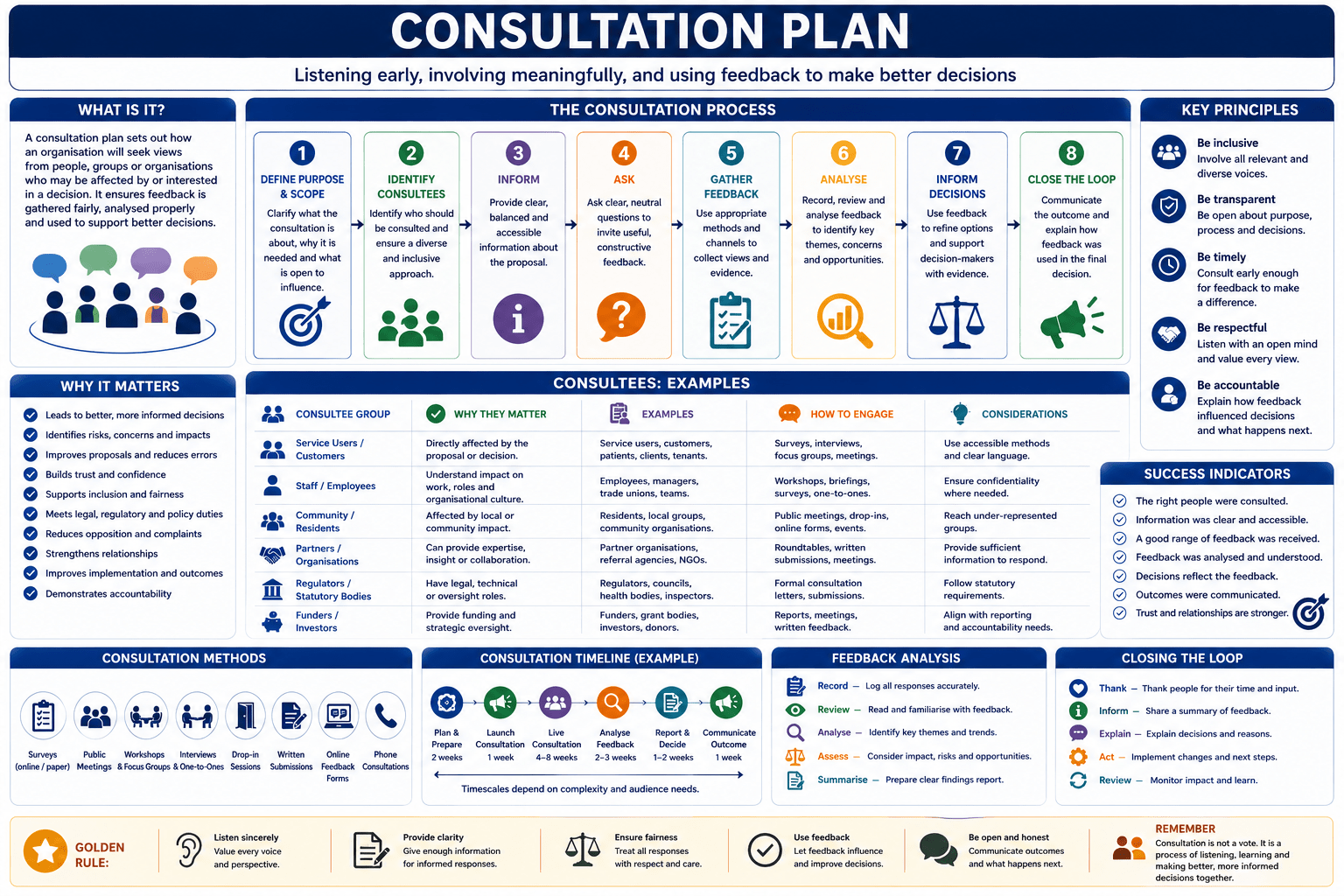
A consultation plan is a practical management and governance tool used to set out how an organisation will seek, collect, analyse and respond to views before making or finalising a decision.
At its simplest, a consultation plan asks:
Who needs to be consulted, what are we asking them, how will we gather their views, and how will those views influence the final decision?
That makes it useful for public sector decisions, charity governance, property development, planning applications, organisational change, service redesign, policy development, customer engagement, staff restructuring, community projects, education, healthcare, housing, transport, risk management and board reporting.
Communications Plan: A Practical Guide to Clear Messages, Better Coordination and Stronger Stakeholder Confidence
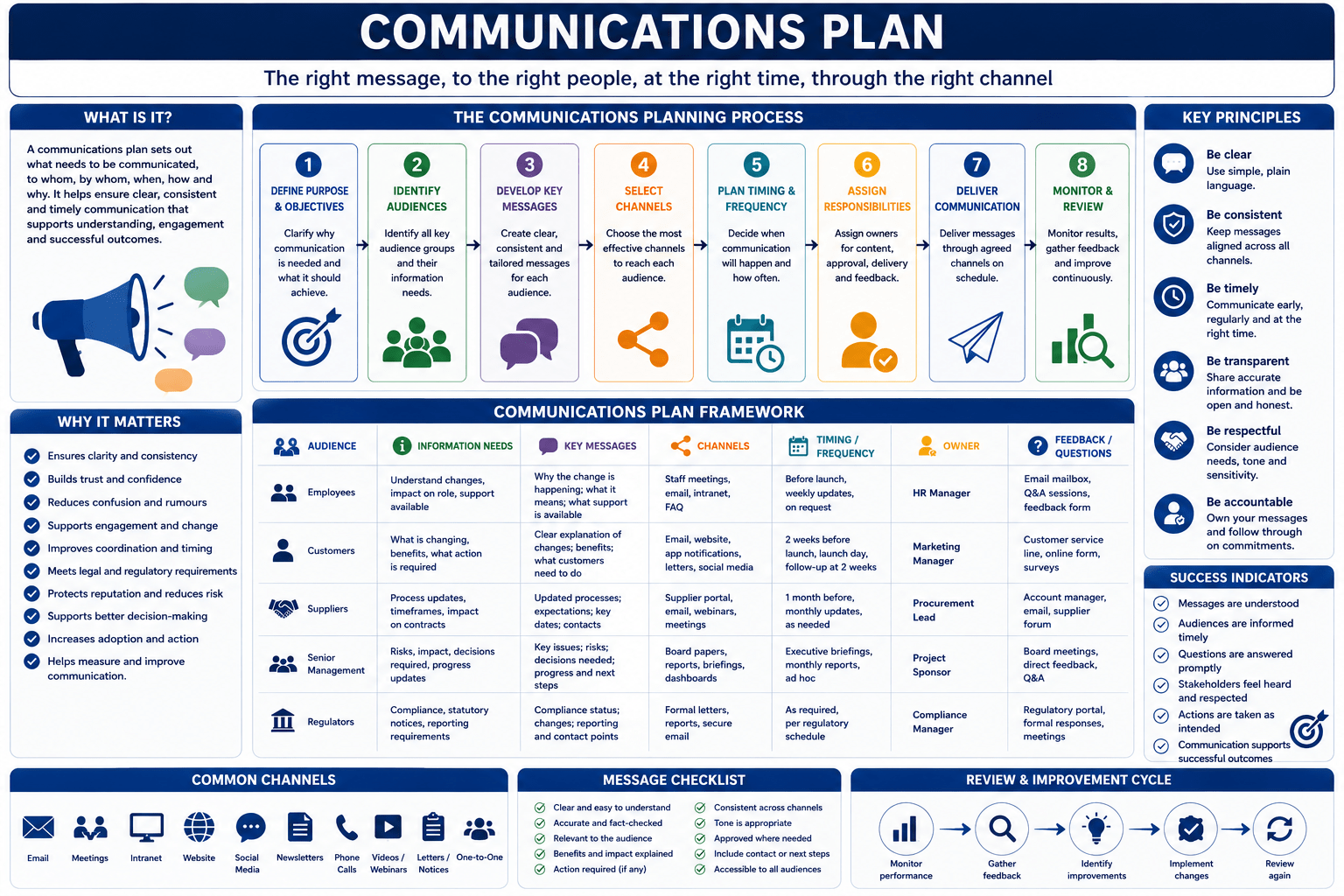
A communications plan is a practical management tool used to decide what needs to be communicated, to whom, by whom, when, how and why.
At its simplest, a communications plan asks:
Who needs to know what, why do they need to know it, how should we tell them, and what should happen as a result?
That makes it useful for strategy, project management, stakeholder engagement, change management, business continuity, internal communication, customer service, marketing, public relations, charity governance, public sector consultation, property development, technology implementation, healthcare, education and board reporting.
Used properly, a communications plan helps organisations communicate clearly, consistently and at the right time.
It is not just a list of emails to send.
It is a practical plan for making sure the right people receive the right information in the right way.
What is a communications plan?
A communications plan sets out how information will be shared during a project, decision, campaign, change programme, service activity or organisational issue.
It normally explains:
What needs to be communicated
Why it needs to be communicated
Who the audience is
What each audience needs to know
What messages should be used
What channels should be used
Who is responsible
When communication should happen
How feedback will be handled
How communication will be reviewed
A communications plan may be used for:
A project launch
A new service
A business change
A staff restructure
A pricing change
A property development
A funding announcement
A public consultation
A system implementation
A crisis or incident
A charity campaign
A customer update
A board decision
A policy change
A marketing campaign
The purpose is to make communication deliberate.
Without a plan, communication can become reactive, inconsistent or too late.
People may hear different versions of the same message. Staff may hear news after customers. Customers may not understand what is changing. Funders or regulators may not receive the information they need. Stakeholders may fill gaps with assumptions.
A communications plan reduces that risk.
Communications plan and stakeholder engagement plan
A communications plan is closely related to a stakeholder engagement plan, but they are not the same.
Communications plan
A communications plan focuses on messages, audiences, channels, timing and responsibility.
It asks:
What information needs to be shared, and how will we share it clearly?
Stakeholder engagement plan
A stakeholder engagement plan is broader.
It focuses on identifying stakeholders, understanding their interests, deciding how to involve them, recording feedback and managing relationships.
It asks:
Who matters, what do they care about, how should we engage with them, and how will their views influence the work?
In simple terms:
A communications plan manages information.
A stakeholder engagement plan manages involvement and relationships.
Both are useful.
A communications plan may sit inside a stakeholder engagement plan, especially where consultation, feedback, co-design or relationship management is needed.
Why communications plans matter
Communications plans matter because poor communication can damage even good decisions.
A decision may be sensible, lawful and well-evidenced, but if communication is unclear, late or inconsistent, people may lose confidence.
Common communication problems include:
People are told too late.
Different audiences hear different messages.
The purpose of the change is unclear.
The language is too technical.
Staff are not briefed before external communication.
Customers do not know what action to take.
Stakeholders feel ignored.
Important details are missed.
Rumours fill the information gap.
The organisation appears defensive or disorganised.
A communications plan helps avoid these problems.
It supports:
Clarity
Consistency
Trust
Transparency
Coordination
Accountability
Better stakeholder confidence
Better customer understanding
Better staff engagement
Better project delivery
Better risk management
Better crisis response
Better reputation management
Better decision implementation
Better feedback handling
Good communication does not guarantee agreement.
But it does improve understanding.
That matters because people are more likely to support, accept or work constructively with a decision when they understand what is happening, why it is happening, and what it means for them.
When to use a communications plan
A communications plan is useful whenever information needs to be shared with several people or groups in a coordinated way.
Good uses include:
Strategic planning
Project delivery
Organisational change
Staff restructuring
New system implementation
Service redesign
Product launches
Pricing changes
Customer updates
Policy changes
Property works
Planning applications
Charity campaigns
Fundraising activity
Public consultations
Board announcements
Crisis communication
Business continuity incidents
Internal communication
Marketing campaigns
Regulatory updates
Supplier changes
Merger or acquisition activity
Training programmes
Community engagement
It is especially useful where:
The issue is sensitive.
The audience is mixed.
Several teams are involved.
Timing matters.
There is risk of misunderstanding.
Stakeholders may be concerned.
There are legal or regulatory implications.
The organisation needs a consistent message.
The change affects customers, staff or the public.
Reputation matters.
It is less useful when it becomes a document that is written once and never used.
A communications plan should guide actual communication.
Communications planning in different industries
SMEs and owner-managed businesses
For SMEs, communications planning is often informal, but it still matters.
Small businesses rely heavily on trust, personal relationships and reputation. Poor communication can quickly affect customers, staff, suppliers and cash flow.
Typical SME communication issues include:
Price increases
Service changes
Staff changes
Customer complaints
Supplier delays
Premises moves
New products or services
Payment terms
Business growth
System changes
Opening hours
Delivery disruption
Ownership or management changes
Recruitment
Local reputation
An SME might ask:
Which customers need to hear this directly?
Should the message come from the owner?
What should staff be told before customers ask questions?
What objections are likely?
What should be put in writing?
What can be handled by phone?
What should be posted publicly?
What follow-up is needed?
For SMEs, a communications plan does not need to be complicated.
It should be clear, practical and relationship-focused.
Manufacturing
Manufacturing businesses need communications planning across production, customers, suppliers, quality, health and safety, logistics and contractors.
Typical communication issues include:
Production delays
Quality issues
Product changes
Supplier disruption
Maintenance shutdowns
New equipment installation
Shift changes
Safety procedures
Customer order updates
Stock availability
Regulatory compliance
Environmental matters
Site access
Contractor activity
Product recalls
A manufacturer might ask:
Which customers need early warning of delays?
Which suppliers need updated forecasts?
What do production teams need to know?
What health and safety message is required?
What communication is needed before a shutdown?
Who approves customer-facing messages?
What technical details must be included?
What should be recorded for audit purposes?
For manufacturing, communications planning should link closely to operations, quality, customer service and risk management.
Retail and ecommerce
Retail and ecommerce businesses communicate constantly with customers, staff, suppliers, delivery partners and online audiences.
Typical communication issues include:
Product launches
Promotions
Stock shortages
Delivery delays
Returns policy changes
Price changes
Website changes
Product recalls
Customer service updates
Seasonal campaigns
Customer complaints
Loyalty schemes
Social media responses
Supplier changes
Marketplace updates
A retailer might ask:
What do customers need to know before buying?
What should be shown on the website?
What should be included in order emails?
What should customer service teams say?
What should be posted on social media?
How will complaints be handled?
How will delivery changes be explained?
What message protects trust?
For ecommerce, communication must be timely and consistent across website, email, social media, customer service and fulfilment.
A small wording issue can affect conversion, complaints and customer confidence.
Professional services
Professional services firms depend on trust, clarity and timely communication.
Typical communication issues include:
Fee changes
New service launches
Regulatory updates
Client onboarding
Project updates
Deadline reminders
Scope changes
Staff changes
Advisory service development
Compliance obligations
Client handovers
System changes
Data protection
Professional risk
Referral relationships
For accountants, solicitors, consultants, architects and advisers, a communications plan might ask:
Which clients need a tailored message?
Which updates can be sent to all clients?
What should be explained in plain English?
What is the call to action?
Who should send the message?
What questions are clients likely to ask?
What should the team say if clients call?
What records should be kept?
Professional services communication should be clear, calm, accurate and client-focused.
Technical accuracy matters, but so does plain English.
Charities and voluntary organisations
Charities often communicate with many different audiences, each with different needs.
Typical audiences include:
Beneficiaries
Families
Funders
Donors
Volunteers
Staff
Trustees
Referrers
Partner organisations
Local communities
Commissioners
Regulators
Safeguarding partners
Campaign supporters
Media
Typical communication issues include:
Service changes
Funding updates
Fundraising campaigns
Volunteer recruitment
Impact reporting
Safeguarding updates
Service closures
New projects
Trustee announcements
Community campaigns
Partnership work
Annual reports
Crisis response
Policy changes
Reputational issues
A charity might ask:
What do beneficiaries need to understand?
How can we communicate sensitively?
What do funders need to know?
What should volunteers hear first?
What should trustees approve?
How do we explain difficult decisions honestly?
How do we avoid causing unnecessary anxiety?
How do we show impact clearly?
For charities, communication should balance compassion, transparency, safeguarding, funding reality and mission.
Public sector and local government
Public bodies need communications planning because they are accountable to residents, service users, elected members, staff, partners and regulators.
Typical communication issues include:
Public consultations
Service changes
Budget decisions
Emergency incidents
Roadworks
Planning policy
Transport changes
Public health messages
Community safety
Digital services
Waste collection changes
Housing updates
Procurement decisions
Equality information
Committee decisions
A public body might ask:
Who has a right to know?
What must be published?
What needs elected member briefing?
What must be accessible?
What language needs to be avoided?
Which groups may be harder to reach?
How will misinformation be corrected?
How will the public know how to respond?
For public bodies, communications planning should support transparency, accessibility, fairness, legal compliance and public value.
Property and construction
Property and construction projects often require careful communication because works can affect tenants, neighbours, contractors, local communities, planners and funders.
Typical communication issues include:
Planning applications
Construction works
Site access
Noise
Parking
Road closures
Tenant notices
Service charge updates
Refurbishment works
Health and safety
Contractor activity
Utility disruption
Regeneration proposals
Rent reviews
Completion delays
A property business might ask:
Who needs notice before works begin?
What information do tenants need?
What should neighbours be told?
What should be communicated to the planning authority?
What disruption should be explained?
What contact route should be provided?
What should contractors communicate on site?
What records should be kept?
For property and construction, communication should be practical, timely and specific.
Unclear communication can quickly create complaints, objections and mistrust.
Technology and software
Technology projects need communications planning because users often experience change directly.
Typical communication issues include:
New system rollout
Software updates
Product releases
Service outages
Cyber security updates
Data migration
Training
User onboarding
Feature changes
Platform migration
Support changes
Integration projects
Product roadmap updates
Terms of service changes
AI adoption
A technology team might ask:
Who needs to know before go-live?
What do users need to do?
What training is required?
What support is available?
What should be communicated if something fails?
What should sales and support teams say?
How will technical information be translated into plain English?
What should customers know about data and security?
For technology projects, communication should reduce uncertainty and support adoption.
The best system implementation can fail if users are not properly informed, trained and supported.
Healthcare and social care
Healthcare and social care communication must be sensitive, accurate and person-centred.
Typical communication issues include:
Service changes
Care planning
Family updates
Safeguarding information
Staffing changes
Inspection outcomes
Quality improvements
Complaints
Medication safety
Digital care records
Appointment changes
Emergency incidents
Policy updates
Training
Continuity of care
A care provider might ask:
What do service users need to understand?
What do families need to know?
What should staff communicate consistently?
What language is appropriate?
What needs to be documented?
What confidentiality rules apply?
What should be escalated?
What communication will provide reassurance?
In healthcare and care, communications planning should support safety, dignity, safeguarding, consent, confidentiality and trust.
Education and training
Education providers communicate with learners, parents, employers, staff, funders, regulators and community partners.
Typical communication issues include:
Course changes
Timetable changes
Safeguarding updates
Funding changes
Attendance expectations
Assessment updates
Employer placements
Digital learning
Learner support
New courses
Course closures
Inspection readiness
Progression information
Parent updates
Policy changes
An education provider might ask:
What do learners need to know?
What do parents or carers need to know?
What should employers be told?
What information must be accessible?
What messages support attendance and completion?
What should tutors communicate?
How will questions be handled?
What should be recorded?
For education, communication should support learner outcomes, safeguarding, quality, employer relationships and confidence.
What a communications plan should include
1. Purpose
The plan should begin with a clear purpose.
For example:
The purpose of this communications plan is to ensure that staff, customers and suppliers receive clear, consistent and timely information about the new ordering system before launch.
The purpose should explain:
What the plan covers
Why communication is needed
What the communication should achieve
Who it is intended to support
What outcome is expected
Without a clear purpose, communication can become unfocused.
2. Objectives
Communication objectives should be specific.
Examples include:
Ensure staff understand the change.
Prepare customers for a new process.
Reduce confusion.
Protect trust.
Support adoption.
Encourage action.
Meet consultation requirements.
Explain a decision.
Promote a new service.
Manage reputational risk.
Provide reassurance.
Gather feedback.
Improve consistency.
Prepare for disruption.
Support behaviour change.
Weak objective:
Communicate the project.
Stronger objective:
Ensure all affected customers understand what is changing, when the change will happen, what action they need to take, and who to contact with questions.
3. Audience
The plan should identify each audience clearly.
Possible audiences include:
Staff
Managers
Directors
Trustees
Customers
Suppliers
Funders
Regulators
Contractors
Partners
Tenants
Local residents
Service users
Families
Volunteers
Investors
Media
Elected representatives
Professional advisers
General public
Avoid using broad labels where different groups need different messages.
For example, “staff” may need to be separated into:
Senior managers
Line managers
Frontline staff
Support staff
Staff directly affected
Staff indirectly affected
The more specific the audience, the better the message can be.
4. Key messages
Key messages explain what needs to be said.
They should be:
Clear
Accurate
Honest
Consistent
Relevant
Concise
Plain English
Audience-specific
Actionable
Approved where necessary
Good key messages usually cover:
What is happening
Why it is happening
Who is affected
When it will happen
What action is required
What support is available
What is not changing
What happens next
Who to contact
How feedback will be handled
A communication plan should usually include different messages for different audiences.
Staff may need operational detail.
Customers may need practical instructions.
Funders may need assurance.
Regulators may need compliance information.
The board may need risk and decision context.
5. Channels
Channels are the methods used to communicate.
Examples include:
Email
Letter
Telephone call
Meeting
Staff briefing
Board paper
Website update
Social media
Newsletter
Press release
Video briefing
Webinar
SMS
Customer portal
Intranet
Notice board
Frequently asked questions
Public meeting
Drop-in session
One-to-one conversation
The channel should fit the message.
A sensitive message may need a meeting or phone call.
A routine update may be suitable by email.
A public announcement may require website and social media updates.
A legal notice may need formal written communication.
6. Timing
Timing matters.
The plan should identify:
What will be communicated before the decision
What will be communicated at approval
What will be communicated during implementation
What will be communicated after completion
What should be communicated regularly
What must be communicated immediately
What is dependent on another action
What must be communicated before external audiences are told
What deadlines apply
What review points are needed
Poor timing can damage trust.
For example, staff should not hear important organisational news from customers, social media or the press.
Customers should not discover a service change only when they try to use the service.
Funders should not be surprised by public announcements that affect funded work.
7. Responsibility
The plan should make ownership clear.
Responsibilities may include:
Overall communications owner
Message author
Message approver
Spokesperson
Channel owner
Audience owner
Feedback owner
Project manager
Senior sponsor
Board or trustee lead
Legal or compliance reviewer
HR lead
Customer service lead
Marketing lead
Operational lead
Clear ownership prevents missed messages and inconsistent communication.
8. Approval process
Some communication needs approval before release.
Approval may be needed for:
Legal accuracy
Financial accuracy
HR matters
Customer commitments
Public statements
Media releases
Regulatory information
Safeguarding matters
Sensitive organisational decisions
Board-level announcements
The plan should explain who signs off messages and how quickly approval must happen.
A slow approval process can delay important communication.
A weak approval process can lead to inaccurate or risky messages.
9. Feedback and questions
Communication should not only be one-way.
The plan should explain how questions and feedback will be handled.
This may include:
Dedicated email address
Named contact
Frequently asked questions
Feedback form
Staff meeting questions
Customer service scripts
Issue log
Feedback log
Escalation route
Response times
Questions are useful.
They reveal confusion, concern and missing information.
A communications plan should expect questions and prepare for them.
10. Monitoring and review
Communication should be reviewed.
Ask:
Was the message received?
Did people understand it?
Did they take the required action?
Were there questions?
Were there complaints?
Was misinformation corrected?
Were channels effective?
Was timing right?
Were audiences missed?
What should be improved next time?
A communications plan should not be treated as complete once messages are sent.
The important question is whether communication worked.
Types of communications plan
Internal communications plan
An internal communications plan focuses on staff, managers, directors, trustees or internal teams.
It is useful for:
Organisational change
Staff updates
System changes
Policy changes
Culture work
Training
Internal campaigns
Restructuring
Business continuity
Leadership communication
Internal communication is often where implementation succeeds or fails.
If staff do not understand the message, customers and stakeholders may not either.
External communications plan
An external communications plan focuses on customers, suppliers, partners, funders, regulators, media or the public.
It is useful for:
Customer announcements
Public campaigns
Pricing changes
Service changes
Funding news
Public consultation
Reputational issues
Product launches
Property works
Community engagement
External communication should be clear, accurate and aligned with internal messaging.
Project communications plan
A project communications plan supports delivery of a specific project.
It may include:
Project updates
Steering group reports
Stakeholder briefings
Risk updates
Milestone announcements
Change notices
Implementation instructions
Lessons learned
Go-live communication
Post-project review
It should connect with the project plan and risk register.
Change communications plan
A change communications plan supports organisational change.
It should explain:
Why change is needed
What is changing
What is not changing
How people are affected
What support is available
What the timetable is
What decisions remain open
How feedback will be handled
What training is needed
What success looks like
Change communication must be repeated, not just announced once.
Crisis communications plan
A crisis communications plan prepares for urgent or high-risk communication.
It may cover:
Incident response
Media handling
Customer updates
Staff communication
Regulatory notification
Social media response
Spokesperson responsibilities
Holding statements
Approval routes
Recovery communication
Crisis communication should be calm, accurate, timely and honest.
Marketing communications plan
A marketing communications plan focuses on promoting a product, service, campaign or brand.
It may include:
Target audience
Campaign message
Channels
Content plan
Calls to action
Budget
Timing
Creative assets
Measurement
Follow-up
Marketing communication should still be grounded in customer need and value.
Common communications planning techniques
Audience mapping
Audience mapping identifies the different groups who need communication.
It helps tailor messages and channels.
Message matrix
A message matrix sets out:
Audience
Key message
Channel
Timing
Owner
Call to action
This is one of the most useful practical tools in communications planning.
RACI matrix
A RACI matrix shows who is:
Responsible
Accountable
Consulted
Informed
This helps clarify communication responsibilities.
Frequently asked questions
FAQs provide consistent answers to likely questions.
They are useful for staff briefings, customer updates, websites and change projects.
Communications calendar
A communications calendar shows when messages will be sent.
It helps coordinate timing across channels.
Spokesperson plan
A spokesperson plan identifies who can speak on behalf of the organisation.
This is useful for media, public meetings, crisis communication and sensitive issues.
Feedback log
A feedback log records questions, concerns and responses.
It helps identify themes and prevent repeated confusion.
Common mistakes in communications plans
Mistake 1: Communicating too late
Late communication creates uncertainty and mistrust.
People should be told early enough to understand and prepare.
Mistake 2: Using vague messages
Vague messages create confusion.
Be clear about what is happening, why, when and what action is needed.
Mistake 3: Using too much jargon
Technical language may be accurate but unhelpful.
Plain English should be used wherever possible.
Mistake 4: Treating all audiences the same
Different audiences need different levels of detail.
Staff, customers, funders and regulators may need different messages.
Mistake 5: Forgetting internal communication
Staff should usually be briefed before external communication.
They need to understand the message and how to respond to questions.
Mistake 6: Sending information without checking understanding
Communication is not complete just because a message has been sent.
Understanding matters.
Mistake 7: Not preparing for questions
People will ask questions.
A good plan anticipates them and prepares answers.
Mistake 8: Overpromising
Do not promise what cannot be delivered.
Overpromising damages trust.
Mistake 9: No approval process
Important messages need review and sign-off.
Without this, inaccurate or risky communication may be released.
Mistake 10: Not reviewing effectiveness
If communication is not reviewed, the organisation may repeat the same mistakes.
Limitations and weaknesses of communications plans
Communications plans are useful, but they have limits.
They cannot fix a poor decision
Good communication cannot make a bad decision good.
It can explain a decision, but it cannot remove the consequences of weak judgement.
They cannot guarantee agreement
Clear communication does not mean everyone will agree.
Some people may still object.
They can become too bureaucratic
A communications plan should be practical.
If it becomes too long and complex, people may not use it.
They can create false confidence
A plan may look complete, but communication may still fail if messages are unclear or channels are wrong.
They depend on trust
If trust is low, communication may be met with scepticism.
Trust is built through honesty, consistency and follow-through.
They can miss informal communication
People do not only learn through official channels.
Rumours, conversations, social media and informal networks also matter.
They can overlook accessibility
Communication may fail if it does not consider language, literacy, disability, digital access or cultural context.
They do not replace engagement
Communication shares information.
Engagement listens, involves and responds.
For important decisions, both may be needed.
Communications plan compared with other strategic and management tools
Communications plan and stakeholder engagement plan
A communications plan focuses on messages, channels and timing.
A stakeholder engagement plan focuses on involvement, consultation, feedback and relationships.
Use both where stakeholders need to be informed and heard.
Communications plan and stakeholder analysis
Stakeholder analysis identifies who matters.
The communications plan explains how and when they will be communicated with.
Communications plan and project plan
A project plan manages delivery.
A communications plan manages information around delivery.
They should be linked so communication supports project milestones.
Communications plan and risk register
Poor communication can create risk.
Communication risks should be captured in the risk register where they could affect delivery, reputation, compliance or stakeholder trust.
Communications plan and issue log
If communication problems have already happened, they should be recorded in the issue log.
Examples include misinformation, missed stakeholders, complaints or inconsistent messages.
Communications plan and business continuity plan
A business continuity plan explains how the organisation will continue during disruption.
A communications plan explains who will be told what during that disruption.
Crisis communication is a key part of continuity planning.
Communications plan and roadmapping
A roadmap sets out phases of change.
A communications plan explains what needs to be communicated at each phase.
Communications plan and change management
Change management helps people move from current state to future state.
Communication is one of the most important parts of change management.
Communications plan and customer research
Customer research helps understand what customers need, value and understand.
This insight should improve communication messages and channels.
Communications plan and internal audit
Internal audit may review whether communication processes are effective for governance, compliance, risk and change control.
Alternatives and complementary frameworks
Stakeholder engagement plan
Use a stakeholder engagement plan where communication needs to include consultation, involvement or relationship management.
Stakeholder analysis
Use stakeholder analysis to identify audiences, interests, influence and likely concerns.
Change management plan
Use a change management plan for adoption, training, behaviour change and organisational transition.
Project plan
Use a project plan to manage detailed delivery tasks.
Risk register
Use a risk register to manage risks caused by poor communication, misunderstanding or stakeholder resistance.
Issue log
Use an issue log to manage active communication problems.
Customer journey mapping
Use customer journey mapping where communication affects customer experience.
Content plan
Use a content plan for regular marketing, website, social media or campaign communication.
Crisis management plan
Use a crisis management plan for serious incidents requiring urgent communication and response.
A practical communications plan template
A useful communications plan should include:
Plan title
Purpose
Communication objectives
Background
Audience groups
Audience needs
Key messages
Channels
Timing
Frequency
Responsible owner
Approval process
Spokesperson
Feedback route
Questions and answers
Risks
Actions required
Measurement
Review date
Link to project plan, stakeholder engagement plan or risk register
Example:
Plan title: Communications plan for new customer payment process
Purpose: Ensure customers, staff and finance team members understand the new payment process before it goes live.
Communication objectives:
Explain why the process is changing.
Tell customers what action they need to take.
Ensure staff can answer questions consistently.
Reduce payment delays during transition.
Monitor feedback and resolve issues quickly.
Audience groups:
Existing customers
New customers
Customer service team
Finance team
Senior management
Key messages:
The payment process is being updated to make payments clearer and easier to track.
Customers will receive updated payment instructions before the change date.
Existing payment terms remain unchanged.
Support is available for customers with questions.
Staff should use the approved FAQ when responding.
Channels:
Customer email
Website update
Invoice note
Staff briefing
FAQ document
Finance team checklist
Timing: Two weeks before go-live, one week before go-live, go-live day and two weeks after go-live.
Owner: Finance Manager.
Review date: One month after go-live.
Questions to ask when creating a communications plan
Purpose questions
Why is communication needed?
What decision, project or change does it support?
What should communication achieve?
What happens if communication is poor?
Who needs to approve the plan?
What risks need managing?
What outcome do we want?
What behaviour or action is needed?
What should people understand?
How will we know communication has worked?
Audience questions
Who needs to know?
Who is directly affected?
Who is indirectly affected?
Who may ask questions?
Who may be concerned?
Who may influence others?
Who needs information first?
Who needs detailed information?
Who needs a simple summary?
Who might be missed?
Message questions
What is happening?
Why is it happening?
Who is affected?
When will it happen?
What action is required?
What is not changing?
What support is available?
What questions are likely?
What should not be promised?
What must be said consistently?
Channel questions
What channel is most suitable?
Is email enough?
Is a meeting needed?
Should the message be written?
Should the message be public or private?
Are accessible formats needed?
Should social media be used?
Should the website be updated?
Should managers brief their teams?
Should one-to-one conversations happen?
Timing questions
When should communication start?
Who needs to hear first?
What must be communicated before launch?
What must be communicated at approval?
What should be repeated?
What depends on another decision?
What deadlines exist?
What is the best time to send the message?
What follow-up is needed?
When should the plan be reviewed?
Review questions
Did people receive the message?
Did they understand it?
Did they take the required action?
What questions were asked?
What confusion occurred?
What feedback was received?
Were any audiences missed?
Were the channels effective?
Was timing appropriate?
What should change next time?
The best way to think about a communications plan
A communications plan is not just a schedule of messages.
It is a tool for clarity, trust and coordination.
A good communications plan should be:
Purpose-led
Audience-focused
Clear
Timely
Consistent
Honest
Practical
Owned
Reviewed
Linked to action
A weak communications plan says:
“We will send an update.”
A strong communications plan asks:
“Who needs to know what, when, through which channel, and what should they understand or do as a result?”
The key question is not simply:
What do we need to say?
The better question is:
What does each audience need to understand, feel confident about, and do next?
Conclusion: communications plans turn information into clarity and confidence
Communications plans remain useful because organisations often underestimate how easily messages can be misunderstood.
A project may be well planned. A decision may be sensible. A change may be necessary. But if people do not understand it, communication failure can create resistance, confusion, delay and mistrust.
Used badly, a communications plan becomes a list of emails and announcements.
Used properly, it becomes a practical management tool. It helps organisations communicate clearly, coordinate messages, support stakeholders, reduce risk, manage change and build confidence.
The real value is not in sending more messages.
The real value is in sending the right messages, to the right people, at the right time, in the right way.
A strong communications plan helps an organisation move from saying, “We need to tell people,” to asking, “Who needs to understand this, what do they need to know, and how will our communication help them act with confidence?”
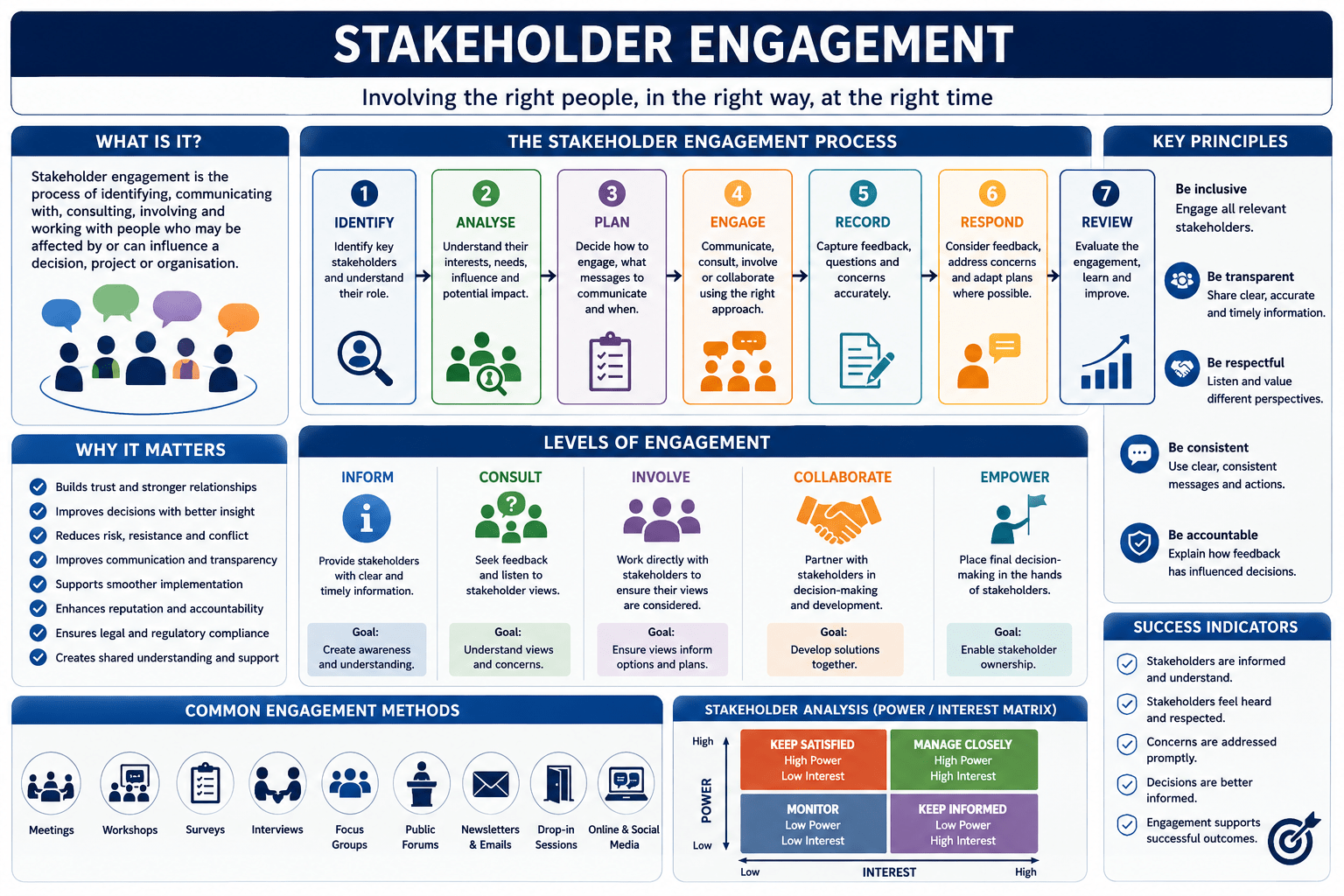
A stakeholder engagement plan is a practical management and communication tool used to identify who needs to be involved, informed, consulted or influenced during a project, strategy, service, decision or organisational change.
At its simplest, a stakeholder engagement plan asks:
Who matters, what do they care about, how could they affect or be affected by the work, and how should we engage with them?
That makes it useful for strategy, project management, change management, property development, charity governance, public sector consultation, business planning, customer service, internal communications, risk management, community engagement, professional services, technology implementation, healthcare, education and board reporting.