Pricing Analysis:
A Practical Guide to Understanding Price, Value, Profit and Customer Behaviour
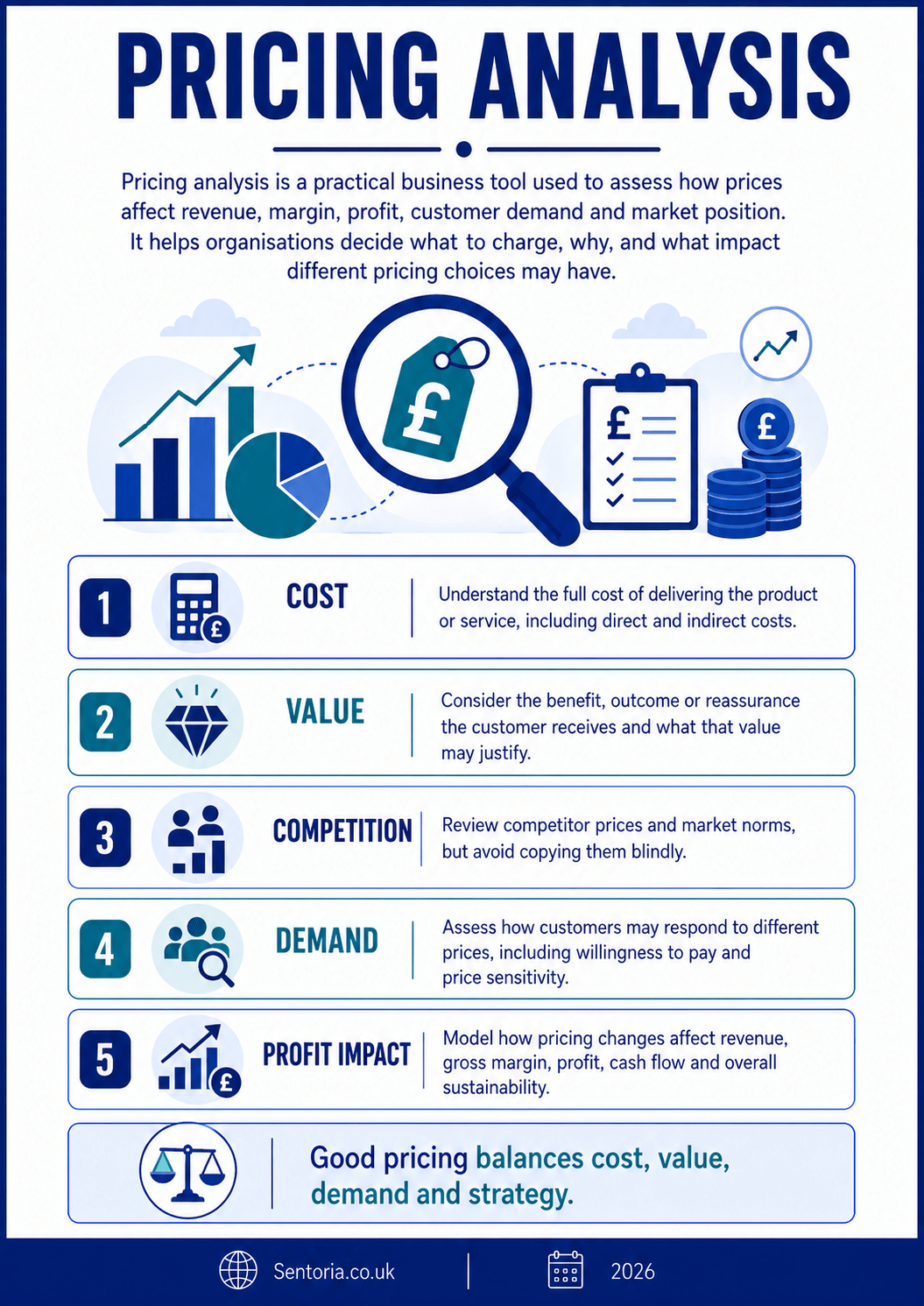
Pricing analysis is a practical business and strategy tool used to examine how prices are set, how customers respond, how competitors price, and how pricing affects revenue, margin, profit, cash flow and market position.
At its simplest, pricing analysis asks:
What should we charge, why should we charge it, how will customers respond, and what will it mean for profit and strategy?
That makes it useful for business planning, sales, marketing, product development, service design, customer research, market research, competitor analysis, forecasting, budgeting, investment appraisal, ecommerce, professional services, manufacturing, property, charities, public sector services, technology, healthcare and education.
Used properly, pricing analysis helps organisations move beyond guesswork, habit or competitor copying. It helps them understand the relationship between price, value, demand, cost, margin, positioning and customer choice.
It is not simply about increasing prices.
It is about setting prices deliberately.
What is pricing analysis?
Pricing analysis is the process of examining the factors that influence price and the effect that different pricing choices may have.
It may consider:
- Cost of delivery
- Gross margin
- Profit margin
- Customer demand
- Customer willingness to pay
- Competitor pricing
- Perceived value
- Market position
- Pricing model
- Discounts
- Payment terms
- Customer segments
- Product or service bundles
- Price sensitivity
- Volume changes
- Capacity
- Quality
- Brand strength
- Risk
- Cash flow
Pricing analysis is important because price is one of the most powerful levers in any organisation.
A small price change can have a large effect on profit.
For example, if a business has fixed costs and spare capacity, a carefully judged price increase may improve profit significantly. But if customers are highly price-sensitive, the same increase may reduce demand and damage revenue.
The point is not to assume that higher prices are always better or lower prices are always safer.
The point is to understand what the price is doing.
Pricing, value and cost
Pricing is often confused with cost.
They are related, but they are not the same.
Cost
Cost is what it takes to provide the product or service.
This may include:
- Materials
- Labour
- Overheads
- Delivery
- Software
- Rent
- Marketing
- Finance costs
- Support
- Administration
Cost matters because the organisation needs to cover its expenses and make a sustainable margin.
Price
Price is what the customer is asked to pay.
It may be:
- A one-off price
- An hourly rate
- A monthly subscription
- A fixed fee
- A usage charge
- A licence fee
- A day rate
- A commission
- A rent
- A service charge
Price affects both customer behaviour and financial performance.
Value
Value is what the customer believes they receive in return.
This may include:
- Convenience
- Quality
- Expertise
- Time saved
- Risk reduced
- Confidence
- Status
- Better outcomes
- Speed
- Reliability
- Trust
- Compliance
- Peace of mind
- Access
- Support
In simple terms:
Cost is what it takes to deliver.
Price is what the customer pays.
Value is what the customer believes it is worth.
Good pricing analysis considers all three.
Why pricing analysis matters
Pricing analysis matters because pricing decisions affect almost everything.
They affect:
- Revenue
- Profit
- Cash flow
- Customer demand
- Market position
- Brand perception
- Sales conversion
- Customer retention
- Competitor response
- Capacity
- Staff workload
- Product mix
- Customer quality
- Investment decisions
- Long-term sustainability
Poor pricing can create serious problems.
A business may sell plenty of products but make too little margin.
A professional services firm may be busy but underpaid.
A charity may price commissioned services below full cost.
A manufacturer may accept volume that fills the factory but weakens profitability.
A software company may underprice early and struggle to fund development.
A property business may misjudge rent and create void periods.
A public body may set charges without understanding subsidy, demand or access.
Pricing analysis helps organisations avoid these issues.
It helps answer:
- Are we charging enough?
- Are we charging too much?
- Are some customers unprofitable?
- Are some products subsidising others?
- Are discounts damaging margin?
- Are prices aligned with value?
- Are competitors changing the market?
- Are customers price-sensitive?
- Are we positioned correctly?
- What happens if prices change?
When to use pricing analysis
Pricing analysis is useful whenever price affects a decision.
Good uses include:
- Launching a new product
- Launching a new service
- Reviewing existing prices
- Increasing prices
- Responding to cost inflation
- Changing pricing model
- Reviewing discounts
- Improving margins
- Preparing a business plan
- Entering a new market
- Reviewing competitor position
- Improving sales conversion
- Reducing unprofitable work
- Creating pricing tiers
- Testing subscription models
- Reviewing tender pricing
- Setting rents or service charges
- Reviewing charity commissioned services
- Testing customer willingness to pay
- Supporting forecasting and budgeting
It is especially useful where:
- Costs are rising.
- Margins are falling.
- Sales volume is high but profit is weak.
- Customers are pushing back on price.
- Competitors are changing prices.
- A new offer is being launched.
- Discounts are common.
- Pricing feels inconsistent.
- Capacity is limited.
- The organisation is unsure how customers perceive value.
It is less useful if it focuses only on spreadsheet margins and ignores customer behaviour.
The main approaches to pricing
1. Cost-plus pricing
Cost-plus pricing starts with cost and adds a margin.
For example:
Cost of delivery: £100
Required margin: 40%
Selling price: £140
This approach is simple and useful where costs are clear.
It is common in manufacturing, construction, professional services, wholesale and project work.
The weakness is that it may ignore customer value and market conditions.
A cost-plus price may be too low if customers value the offer highly.
It may be too high if competitors or substitutes offer similar value at lower prices.
2. Value-based pricing
Value-based pricing starts with the value to the customer.
It asks:
What is this worth to the customer because of the benefit, outcome, time saved, risk reduced or problem solved?
For example:
A consultant may save a client £100,000 through better pricing, cash flow or operational efficiency. Pricing purely by hours may understate the value delivered.
Value-based pricing is useful where:
- The outcome is valuable.
- The customer recognises the benefit.
- The provider can demonstrate credibility.
- The offer is differentiated.
- The customer has a meaningful problem.
- The cost of doing nothing is high.
The weakness is that value can be difficult to prove.
If the customer does not understand the value, they may resist the price.
3. Competitor-based pricing
Competitor-based pricing uses competitor prices as a reference point.
It asks:
What are others charging, and where do we want to sit in relation to them?
This can be useful in competitive markets.
It helps avoid being wildly out of line with customer expectations.
The weakness is that competitors may be wrong.
They may be underpricing.
They may have different costs.
They may have different strategies.
They may be targeting different customers.
Copying competitors can lead to weak margins and unclear positioning.
4. Market-based pricing
Market-based pricing considers the broader market, including customer demand, substitutes, competitors, price expectations and willingness to pay.
It asks:
What price makes sense in this market for this customer segment?
This is useful where customers have alternatives and the market has visible price norms.
It should be supported by market research, competitor analysis and customer research.
5. Dynamic pricing
Dynamic pricing changes price based on demand, timing, availability, customer behaviour or market conditions.
Examples include:
- Hotels
- Airlines
- Events
- Ride-hailing
- Energy
- Advertising
- Ecommerce
- Short-term rentals
- Seasonal products
- Auctions
Dynamic pricing can improve revenue where demand changes over time.
The weakness is that customers may see it as unfair if it is not transparent or proportionate.
6. Penetration pricing
Penetration pricing sets a lower initial price to gain market share, customers or adoption.
It may be useful for:
- New products
- New markets
- Software platforms
- Subscription services
- Retail launches
- Membership models
The danger is that customers become anchored to the low price, making later increases difficult.
It can also attract price-sensitive customers who may not be loyal.
7. Premium pricing
Premium pricing sets a higher price to signal quality, expertise, exclusivity, trust or superior value.
It may be useful where:
- The brand is strong.
- The service is differentiated.
- Quality matters.
- Risk reduction matters.
- Customers value reassurance.
- Capacity is limited.
- Expertise is scarce.
Premium pricing must be supported by customer experience.
A premium price with an ordinary service creates dissatisfaction.
8. Freemium pricing
Freemium pricing offers a free basic version and charges for premium features, usage or support.
It is common in software, apps, digital tools and online services.
The key question is:
Does the free version create enough adoption without undermining paid conversion?
Freemium can work well, but it can also create a large base of non-paying users who generate cost without enough revenue.
9. Subscription pricing
Subscription pricing charges regularly, usually monthly or annually.
It may be useful for:
- Software
- Memberships
- Advisory services
- Maintenance contracts
- Media
- Training
- Support services
- Consumables
- Managed services
- Retainers
Subscription pricing can improve recurring income and cash flow.
The weakness is that customers expect continuing value. If they do not see ongoing benefit, churn may increase.
10. Tiered pricing
Tiered pricing offers different levels of service or product.
For example:
- Basic
- Standard
- Premium
Or:
- Starter
- Growth
- Enterprise
Tiered pricing is useful because different customers have different needs and willingness to pay.
It can also help customers self-select.
The danger is making tiers confusing or creating a middle tier that does not clearly offer value.
Pricing analysis in different industries
SMEs and owner-managed businesses
For SMEs, pricing analysis is often one of the quickest ways to improve profitability.
Many SMEs underprice because they fear losing customers, copy competitors, or fail to include all costs.
Typical SME pricing questions include:
- Are we charging enough?
- Are we covering full costs?
- Which customers are profitable?
- Which products or services have weak margins?
- Are discounts being controlled?
- What happens if we increase prices by 5%?
- Which customers would be most sensitive?
- Are we too busy with low-margin work?
- Does pricing reflect quality and service?
- Are payment terms affecting cash flow?
For SMEs, pricing analysis should focus on practical action.
It may reveal that the business does not need more sales. It needs better-priced sales.
Manufacturing
Manufacturers need pricing analysis because costs, volume, quality, capacity and customer contracts are closely connected.
Typical manufacturing pricing topics include:
- Material cost recovery
- Labour cost recovery
- Overhead absorption
- Minimum order quantities
- Volume discounts
- Customer-specific pricing
- Contract pricing
- Price increases
- Commodity cost changes
- Capacity constraints
- Product line profitability
- Scrap and rework
- Delivery costs
- Warranty costs
- Customer concentration
A manufacturer might ask:
- Which products are genuinely profitable?
- Are cost increases being passed on?
- Are volume discounts justified?
- Does a large customer create enough margin?
- Are small orders priced properly?
- Are setup costs being recovered?
- Is capacity being used on the right work?
- Are prices aligned with quality and technical value?
For manufacturing, pricing analysis should connect sales, costing, production, procurement and capacity planning.
Retail and ecommerce
Retail and ecommerce businesses need pricing analysis because price affects conversion, margin, stock turn and brand perception.
Typical topics include:
- Product pricing
- Discount strategy
- Gross margin
- Competitor pricing
- Delivery charges
- Free shipping thresholds
- Promotions
- Bundles
- Stock clearance
- Returns
- Customer lifetime value
- Marketplace pricing
- Price testing
- Seasonal pricing
- Subscription offers
A retailer might ask:
- Are discounts increasing sales but reducing profit?
- What price points convert best?
- Are delivery charges causing basket abandonment?
- Which products are price-sensitive?
- Which products can support premium pricing?
- Are competitors cheaper on key lines?
- Does free delivery increase profitable order value?
- Are returns damaging margin?
For ecommerce, pricing analysis should look beyond revenue. It should consider margin, returns, fulfilment cost, advertising cost and repeat purchase.
Professional services
Professional services firms often have serious pricing challenges.
They may price by time, fixed fee, retainer, value, project scope or success outcome.
Typical topics include:
- Hourly rates
- Fixed fees
- Retainers
- Scope creep
- Recovery rates
- Write-offs
- Work in progress
- Client profitability
- Advisory pricing
- Compliance pricing
- Discounting
- Fee increases
- Staff leverage
- Pricing tiers
- Payment terms
For accountants, solicitors, consultants, architects and advisers, pricing analysis might ask:
- Are fixed fees profitable?
- Are we recovering enough time?
- Are some clients consistently underpriced?
- Are we charging for value or only hours?
- Are advisory services priced too cheaply?
- Are payment terms protecting cash?
- Are we doing work outside scope?
- Are premium services clearly differentiated?
Professional services firms should be especially careful not to confuse being busy with being profitable.
Charities and voluntary organisations
Charities may not always think of pricing in commercial terms, but pricing analysis is still important.
It may apply to:
- Commissioned services
- Training fees
- Room hire
- Social enterprise activity
- Events
- Memberships
- Trading subsidiaries
- Service contracts
- Full cost recovery
- Contribution to overheads
A charity might ask:
- Are commissioned services covering full cost?
- Are restricted grants subsidised by unrestricted funds?
- Are training fees too low?
- Should concessions be offered?
- Are services priced accessibly but sustainably?
- Is pricing aligned with mission?
- Are costs being fully understood?
- What level of subsidy is deliberate and approved?
For charities, pricing analysis should balance sustainability, mission, access and fairness.
A low price may be appropriate, but it should be a conscious decision rather than an accidental deficit.
Public sector and local government
Public bodies use pricing analysis for fees, charges, traded services, concessions, cost recovery and public value.
Typical topics include:
- Service fees
- Licence charges
- Venue hire
- Parking charges
- Trade waste charges
- Adult education fees
- Leisure fees
- Planning fees where locally set
- Cost recovery
- Subsidy levels
- Concessionary pricing
- Demand impact
- Equality impact
- Statutory constraints
- Public value
A public body might ask:
- What is the full cost of the service?
- What level of cost recovery is appropriate?
- What is the impact on access?
- Are concessions needed?
- Is the charge lawful and fair?
- How will demand change?
- What subsidy is being provided?
- Is pricing aligned with policy objectives?
For public services, pricing analysis should consider affordability, equality, statutory duties, public value and political accountability.
Property and construction
Property and construction businesses use pricing analysis for rents, sales values, service charges, build contracts, project pricing and contractor procurement.
Typical topics include:
- Rent per square foot
- Sale price
- Service charge recovery
- Contractor pricing
- Development appraisal
- Build cost pricing
- Tenant incentives
- Rent-free periods
- Lease terms
- Occupancy
- Yield
- Comparable evidence
- Maintenance charges
- Utilities recovery
- Phasing
A property business might ask:
- What rent is realistic?
- What incentives are needed?
- Is a rent-free period justified?
- Does the service charge recover cost?
- Are void periods more damaging than lower rent?
- Is the development viable at current prices?
- What happens if build costs increase?
- Are lease terms aligned with risk?
For property and construction, pricing analysis should link to valuation, cash flow, tenant demand, market comparables and risk.
Technology and software
Technology and software businesses rely heavily on pricing analysis because pricing model and customer behaviour are central to growth.
Typical topics include:
- Subscription pricing
- Freemium conversion
- User-based pricing
- Usage-based pricing
- Enterprise pricing
- Churn
- Customer acquisition cost
- Customer lifetime value
- Pricing tiers
- Feature packaging
- Trial conversion
- Discounting
- Annual versus monthly billing
- Support cost
- Expansion revenue
A software business might ask:
- Should pricing be per user, per company or usage-based?
- Are pricing tiers clear?
- Is the free plan too generous?
- What price reduces churn?
- What price maximises lifetime value?
- Are enterprise customers underpriced?
- Are support costs included?
- Does pricing support product strategy?
For software businesses, pricing analysis should connect product value, customer segment, usage, retention, support cost and growth strategy.
Healthcare and social care
Healthcare and social care organisations use pricing analysis for private fees, commissioned services, care packages, funding rates and sustainability.
Typical topics include:
- Care fees
- Funding rates
- Private pay pricing
- Commissioned contracts
- Staff costs
- Agency costs
- Occupancy
- Care hours
- Specialist support
- Equipment
- Training
- Compliance cost
- Quality standards
- Concessions
- Sustainability
A care provider might ask:
- Do fees cover safe staffing?
- Are funding rates sufficient?
- Are high-need packages priced properly?
- Is agency cost being recovered?
- What occupancy is needed for sustainability?
- Are quality requirements reflected in pricing?
- Are private fees aligned with market expectations?
- What happens if wage costs rise?
In healthcare and care, pricing analysis must never be used to justify unsafe care. Pricing should support quality, dignity, safeguarding and compliance.
Education and training
Education providers use pricing analysis for course fees, funded provision, employer training, commercial courses and learner support.
Typical topics include:
- Course pricing
- Funding rates
- Employer contributions
- Tutor costs
- Class size
- Completion rates
- Digital delivery cost
- Materials
- Assessment cost
- Learner support
- Concessions
- Course viability
- Competitive pricing
- Payment plans
- Employer demand
An education provider might ask:
- How many learners are needed for viability?
- Does the course fee cover delivery cost?
- Are concessions sustainable?
- Is employer training priced correctly?
- Are low-enrolment courses subsidised knowingly?
- Are digital courses cheaper to deliver?
- What price supports access and quality?
- Which courses should grow, change or stop?
For education, pricing analysis should balance financial sustainability, learner access, outcomes, quality and funding conditions.
How to carry out pricing analysis properly
1. Define the purpose
Start by deciding why pricing analysis is being carried out.
Ask:
- What decision are we making?
- Are we setting a new price or reviewing an existing price?
- Are we trying to improve margin?
- Are we testing demand?
- Are we responding to cost increases?
- Are we changing market position?
- Are we reviewing discounts?
- Are we launching a new pricing model?
- Who will use the analysis?
- What action may follow?
Pricing analysis should be decision-led.
2. Understand the product or service
Be clear about what is being priced.
Define:
- Product or service
- Customer segment
- Scope
- Features
- Service level
- Delivery method
- Support included
- Contract length
- Payment terms
- Quality expectation
- Customisation
- Risk
- Capacity required
- Cost drivers
- Value delivered
Many pricing problems arise because the organisation has not defined what is included.
This is especially common in professional services, projects, care packages, consultancy, construction and software support.
3. Calculate the full cost
Pricing analysis should start with a clear understanding of cost.
Include:
- Direct materials
- Direct labour
- Delivery cost
- Packaging
- Freight
- Software
- Support
- Staff time
- Project management
- Overheads
- Marketing
- Finance costs
- Commission
- Warranties
- Returns
- Bad debt
- Administration
- Compliance
- Training
- Management time
Full cost is often higher than expected.
A product may look profitable until returns, delivery, support and advertising are included.
A client may look profitable until scope creep and slow payment are considered.
A grant-funded service may look covered until central overheads are included.
4. Understand the customer
Pricing is partly about customer perception.
Ask:
- Who is the customer?
- What problem are they solving?
- What do they value?
- What alternatives do they have?
- What is the cost of doing nothing?
- How price-sensitive are they?
- What creates trust?
- What would make the price feel fair?
- What objections might they raise?
- What would justify a premium?
Customer research is essential where willingness to pay is uncertain.
5. Understand the competition
Review competitor pricing where possible.
Consider:
- Direct competitors
- Indirect competitors
- Substitutes
- DIY alternatives
- Free alternatives
- Premium alternatives
- Low-cost alternatives
- In-house options
- Digital alternatives
- Public sector or voluntary alternatives
Competitor pricing should inform your thinking, but not control it.
The question is not simply:
What are they charging?
The better question is:
Why might customers choose them, and where should we sit in relation to them?
6. Analyse value
Value-based pricing requires understanding the customer benefit.
Ask:
- Does the offer save money?
- Does it save time?
- Does it reduce risk?
- Does it improve compliance?
- Does it increase revenue?
- Does it improve confidence?
- Does it improve quality?
- Does it improve convenience?
- Does it create status?
- Does it avoid a larger cost?
The stronger the value, the more pricing flexibility may exist.
But value must be visible.
If customers cannot see or believe the value, they will judge mainly on price.
7. Test price sensitivity
Price sensitivity measures how demand may change when price changes.
Ask:
- Would customers still buy at a higher price?
- Would lower prices significantly increase volume?
- Which customers are most price-sensitive?
- Which products are most price-sensitive?
- Which services are less price-sensitive?
- Are customers more sensitive to headline price or total cost?
- Are payment terms more important than price?
- Are discounts affecting expectations?
- Does price signal quality?
- What objections arise during sales?
Price sensitivity can be tested through interviews, surveys, sales data, A/B tests, competitor analysis and pilot pricing.
8. Model the financial impact
Pricing decisions should be modelled.
Test:
- Current price and volume
- Price increase
- Price decrease
- Volume change
- Margin change
- Break-even volume
- Customer loss
- Discount impact
- Cash flow impact
- Capacity impact
For example:
If price increases by 10%, how much volume can be lost before profit falls?
If price decreases by 10%, how much extra volume is needed to maintain profit?
This is often where pricing analysis becomes most useful.
It shows that chasing volume through lower prices can be dangerous if margins are already tight.
9. Consider positioning
Price affects positioning.
Ask:
- Are we budget, mid-market or premium?
- Does the price match the customer experience?
- Does the price support the brand?
- Are we too cheap to be trusted?
- Are we too expensive for the value shown?
- Are we trying to serve incompatible segments?
- Does our pricing match our positioning map?
- Does our service level justify the price?
- Are we undercutting our own value?
- Would a tiered model be clearer?
Pricing is part of strategy.
It should not be treated as a finance-only decision.
10. Review and refine
Pricing should be reviewed regularly.
Review when:
- Costs change
- Competitors change
- Customer demand changes
- Margins fall
- Capacity becomes constrained
- New products launch
- Service scope changes
- Discounts increase
- Customer mix changes
- Strategy changes
- Inflation rises
- Technology changes
- Customer feedback changes
- Market position changes
- Profitability changes
Pricing should be stable enough to build trust, but not so fixed that it ignores reality.
Common pricing analysis techniques
Gross margin analysis
Gross margin analysis examines the difference between sales revenue and direct cost.
It helps identify which products, services or customers contribute most.
Example:
Selling price: £100
Direct cost: £60
Gross margin: £40
Gross margin percentage: 40%
Gross margin is useful, but it does not include all overheads.
Contribution analysis
Contribution analysis examines how much a sale contributes towards fixed costs and profit after variable costs.
This is useful for decisions about volume, discounts and spare capacity.
Break-even analysis
Break-even analysis calculates the sales needed to cover costs.
It asks:
How much must we sell at this price to cover costs?
It is useful for new products, services, courses, events, property schemes and investment decisions.
Price elasticity analysis
Price elasticity examines how demand changes when price changes.
If a small price increase causes a large fall in demand, the product is price-sensitive.
If demand remains stable despite price changes, pricing power may exist.
Customer profitability analysis
Customer profitability analysis examines profit by customer or customer group.
It may reveal that some customers generate high revenue but low profit because of discounts, service demands, slow payment or complexity.
Product profitability analysis
Product profitability analysis examines margin and profit by product or service.
It helps identify products to grow, reprice, improve or discontinue.
Competitor price comparison
This compares competitor pricing, packaging, terms and value claims.
It should be used with caution because competitor offers may not be directly comparable.
Willingness-to-pay research
This uses customer research to understand what customers may be prepared to pay.
It can include interviews, surveys, choice testing and price testing.
Discount analysis
Discount analysis examines how often discounts are used, who approves them, why they are given and what they do to profit.
Many organisations underestimate the impact of discounting.
Tier analysis
Tier analysis tests whether pricing packages are clear, attractive and profitable.
It is useful for subscriptions, services, software and memberships.
Common mistakes in pricing analysis
Mistake 1: Pricing only from cost
Cost matters, but customers do not buy based only on your cost.
They buy based on value, alternatives, trust and need.
Mistake 2: Copying competitors
Competitors may have different costs, strategies, customers and quality.
Copying them can damage your own position.
Mistake 3: Ignoring full cost
Many organisations miss support time, admin, delivery, rework, returns, overheads and management time.
This leads to underpricing.
Mistake 4: Confusing revenue with profit
A price cut may increase revenue but reduce profit.
A high-volume customer may still be unprofitable.
Mistake 5: Overusing discounts
Discounts can train customers to wait, negotiate or undervalue the offer.
They should be controlled and understood.
Mistake 6: Not reviewing prices
Costs, markets and customer expectations change.
Prices should not remain unchanged simply because they were set years ago.
Mistake 7: Underpricing expertise
Professional services, consultancy, technical work and specialist advice are often underpriced because they are priced by time rather than value.
Mistake 8: Ignoring customer segments
Different customers have different willingness to pay.
One price may not suit all segments.
Mistake 9: Making pricing too complicated
Complex pricing can confuse customers and slow sales.
Pricing should be clear enough to understand.
Mistake 10: Not communicating value
A higher price can be accepted if value is clear.
If value is not communicated, customers compare only on price.
Limitations and weaknesses of pricing analysis
Pricing analysis is useful, but it has limits.
It cannot predict customer behaviour perfectly
Customers may say one thing and do another.
Testing and monitoring are important.
Competitor data may be incomplete
Competitors may not publish prices.
Published prices may not reflect discounts, service levels or contract terms.
Cost data may be imperfect
If internal costing is weak, pricing analysis may be unreliable.
Value can be hard to measure
Some value is emotional, relational or risk-based.
It may still be real, but harder to quantify.
Price is not the only decision factor
Customers also consider quality, trust, speed, convenience, risk, reputation, service and fit.
Low price can damage perception
A low price may increase demand, but it may also signal low quality or reduce trust.
High price must be justified
Premium pricing requires a premium experience.
If the customer experience does not match the price, dissatisfaction increases.
Pricing can create fairness concerns
Dynamic pricing, personalised pricing or large discounts may create resentment if customers feel treated unfairly.
It does not replace strategy
Pricing analysis informs pricing decisions.
It does not decide the organisation’s strategy by itself.
Pricing analysis compared with other strategic and management tools
Pricing analysis and market research
Market research examines customers, competitors, demand and trends.
Pricing analysis uses this evidence to decide what prices may be appropriate.
Pricing analysis and customer research
Customer research helps understand value, price sensitivity and willingness to pay.
Pricing analysis turns that understanding into pricing options.
Pricing analysis and competitor analysis
Competitor analysis shows alternatives and price points.
Pricing analysis asks how the organisation should price in response.
Pricing analysis and positioning map
A positioning map shows where the organisation sits in the market.
Pricing analysis tests whether the price supports that position.
Pricing analysis and forecasting
Forecasting estimates future revenue, cost and profit.
Pricing analysis tests how different prices affect those forecasts.
Pricing analysis and sensitivity analysis
Sensitivity analysis tests how changes in price, volume, cost or margin affect outcomes.
It is especially useful in pricing decisions.
Pricing analysis and benchmarking
Benchmarking compares price, margin, cost or performance against peers.
Pricing analysis uses this comparison to understand whether prices are competitive, sustainable or misaligned.
Pricing analysis and Value Proposition Canvas
The Value Proposition Canvas explains customer jobs, pains and gains.
Pricing analysis tests whether the customer value is strong enough to support the price.
Pricing analysis and Business Model Canvas
The Business Model Canvas includes revenue streams and cost structure.
Pricing analysis tests whether those revenue streams are viable.
Pricing analysis and risk appetite statement
Pricing decisions can affect financial risk, customer risk and strategic risk.
A low-price growth strategy may be outside risk appetite if it weakens cash or margin.
Alternatives and complementary frameworks
Market research
Use market research to understand market demand, competitors, substitutes and trends.
Customer research
Use customer research to understand value, objections, willingness to pay and customer behaviour.
Competitor analysis
Use competitor analysis to compare pricing, positioning, service levels and value claims.
Positioning map
Use a positioning map to connect price with perceived quality, service, specialism or convenience.
Break-even analysis
Use break-even analysis to understand the sales level required at different prices.
Sensitivity analysis
Use sensitivity analysis to test how price, volume and cost changes affect profit and cash.
Benchmarking
Use benchmarking to compare margins, rates, fees, prices and performance with relevant comparators.
Value Proposition Canvas
Use the Value Proposition Canvas to understand whether the offer creates enough value to justify the price.
Customer profitability analysis
Use customer profitability analysis to identify which customers generate profit after service costs and discounts.
A practical pricing analysis template
A useful pricing analysis template should include:
- Product or service being priced
- Purpose of analysis
- Customer segment
- Current price
- Proposed price
- Pricing model
- Direct costs
- Overheads
- Gross margin
- Contribution
- Competitor prices
- Customer value
- Price sensitivity
- Discount policy
- Payment terms
- Break-even point
- Sensitivity testing
- Risks
- Recommended action
- Review date
Example:
Pricing analysis title: Monthly advisory service pricing review
Product or service: Monthly management accounts, cash flow review and commercial advisory meeting for SME clients.
Current price: £450 per month.
Full cost: £280 per month, including staff time, software, review and meeting preparation.
Gross contribution: £170 per month.
Customer value: Improved financial visibility, better cash decisions, clearer management information and regular strategic support.
Competitor evidence: Low-cost bookkeeping packages are cheaper but do not include advisory meetings. Outsourced FD support is more expensive and aimed at larger businesses.
Pricing options:
- Basic reporting package: £350 per month.
- Standard advisory package: £650 per month.
- Premium finance partner package: £1,200 per month.
Risks: Existing clients may compare the new service with compliance fees rather than advisory value.
Recommended action: Pilot tiered pricing with selected clients, improve value messaging, and review profitability after three months.
Owner: Managing Director.
Questions to ask during pricing analysis
Purpose questions
- What pricing decision are we making?
- Why is the price being reviewed?
- What problem are we trying to solve?
- Is this about margin, demand, positioning or sustainability?
- Who will approve the price?
- What evidence is needed?
- What action may follow?
- What happens if the price is wrong?
- How will results be monitored?
- When should pricing be reviewed again?
Cost questions
- What is the direct cost?
- What overheads should be included?
- What staff time is required?
- What support is included?
- What delivery cost exists?
- What rework or returns occur?
- What payment costs apply?
- What bad debt risk exists?
- What is the true cost to serve?
- What margin is required?
Customer questions
- Who is the customer?
- What do they value?
- What problem are they solving?
- What alternatives do they have?
- How price-sensitive are they?
- What would make the price feel fair?
- What would make them pay more?
- What objections might they raise?
- What creates trust?
- What is the cost of doing nothing?
Competitor questions
- Who are the competitors?
- What do they charge?
- What is included in their price?
- What is excluded?
- How do they position themselves?
- Are they cheaper or better value?
- Are they premium or budget?
- What discounts do they appear to offer?
- What do customers say about them?
- Should we match, undercut or differentiate?
Financial questions
- What happens if price increases?
- What happens if price decreases?
- How much volume could be lost before profit falls?
- How much extra volume is needed after a discount?
- What is the break-even point?
- What is the cash flow impact?
- What happens to gross margin?
- What happens to contribution?
- Which customers become unprofitable?
- Which products or services should be repriced?
Action questions
- Should the price change?
- Should the pricing model change?
- Should discounts be restricted?
- Should payment terms change?
- Should tiers be introduced?
- Should low-margin work be stopped?
- Should value messaging improve?
- Should customer research be carried out?
- Who owns implementation?
- When will the impact be reviewed?
The best way to think about pricing analysis
Pricing analysis is not just a calculation.
It is a strategic judgement informed by evidence.
A good pricing analysis process should be:
- Customer-aware
- Cost-aware
- Competitor-aware
- Value-led
- Margin-focused
- Evidence-based
- Linked to positioning
- Linked to cash flow
- Easy to explain
- Reviewed regularly
A weak pricing analysis says:
“This is what our competitors charge.”
A strong pricing analysis asks:
“What value do we create, what does it cost to deliver, what will customers pay, and what price supports our strategy?”
The key question is not simply:
What price can we get away with?
The better question is:
What price fairly reflects value, supports demand, protects margin and strengthens the organisation’s long-term position?
Conclusion: pricing analysis turns price into a strategic decision
Pricing analysis remains useful because price is too important to be left to habit, fear or guesswork.
Every price sends a signal.
It tells customers something about value, quality, confidence, market position and trust. It also determines whether the organisation can cover costs, invest, improve, grow and remain sustainable.
Used badly, pricing analysis becomes a narrow spreadsheet exercise or a race to match competitors.
Used properly, it becomes a practical management tool. It helps organisations understand value, cost, demand, margin, customer behaviour and strategic position.
The real value is not in finding the lowest price or the highest price.
The real value is in finding the right price.
A strong pricing analysis process helps an organisation move from saying, “What should we charge?” to asking, “What value are we creating, who values it, what does it cost to deliver, and what price supports a sustainable future?”