Backforecasting:
A Practical Guide to Working Backwards from a Desired Future
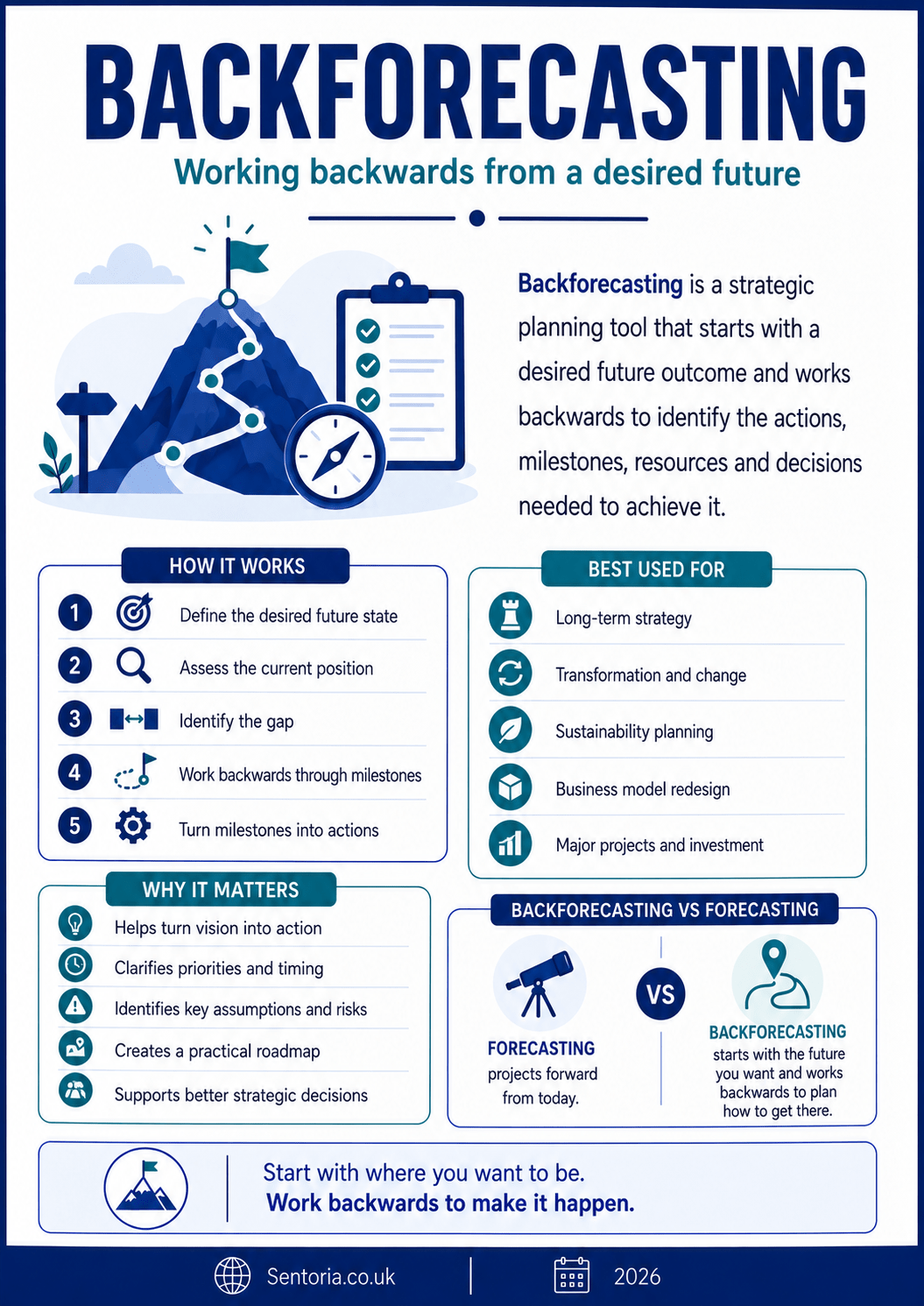
Backforecasting, more commonly known as backcasting, is a strategic planning and decision-making tool used to work backwards from a desired future outcome to identify the actions, decisions and milestones needed to get there.
At its simplest, backforecasting asks:
What future do we want, what would need to be true for that future to happen, and what must we do now to make it possible?
That makes it useful for strategy, transformation, sustainability planning, business model redesign, public policy, charity planning, property development, technology adoption, workforce planning, innovation, long-term investment and major change programmes.
Backcasting is generally described as the opposite of traditional forecasting. Forecasting starts from today and projects forward. Backcasting starts with a desired future state and works backwards to identify the steps required to reach it.
Used properly, backforecasting helps organisations move beyond asking what is likely to happen and start asking what needs to happen.
What is backforecasting?
Backforecasting is a planning approach that begins with a future goal, vision or desired outcome.
The organisation first defines what success should look like at a future point. It then works backwards to identify the decisions, capabilities, resources, policies, projects, partnerships and milestones needed between that future point and today.
For example, an organisation might define a future state such as:
- Become carbon neutral by 2035.
- Double recurring income within five years.
- Build a fully digital customer service model.
- Reduce reliance on one major funder.
- Create a sustainable mixed-use property portfolio.
- Become the leading local provider in a specialist market.
- Deliver a major service transformation.
- Build a financially resilient charity.
- Move from reactive maintenance to planned asset management.
- Develop a scalable advisory service.
Backforecasting then asks:
- What would need to be true by the end date?
- What would need to be true halfway there?
- What would need to change in the next 12 months?
- What decisions are required now?
- What assumptions must be tested?
- What risks must be managed?
- What capabilities are missing?
- What investment is needed?
- What milestones will show progress?
- What must stop, start or change?
The purpose is not to predict the future.
The purpose is to design a route towards a preferred future.
Forecasting and backforecasting
Forecasting and backforecasting are related, but they think in different directions.
Forecasting
Forecasting starts with the current position and uses data, trends, assumptions and judgement to estimate what may happen.
It asks:
Where are we likely to end up if current trends continue?
Example:
A business looks at current sales trends, customer numbers and conversion rates to forecast revenue for the next 12 months.
Backforecasting
Backforecasting starts with a desired future and works backwards to identify what must happen to reach it.
It asks:
What must we do to reach the future we want?
Example:
A business decides that it wants £2 million of recurring revenue in five years, then works backwards to identify the products, pricing, customer acquisition, retention, staffing and systems needed to get there.
In simple terms:
Forecasting projects forward from today.
Backforecasting works backwards from tomorrow.
Forecasting is useful when the future is likely to be shaped by current trends.
Backforecasting is useful when current trends are not enough, or when the organisation wants to create a different future.
History and development of backforecasting
Backforecasting is most widely known as backcasting.
The term backcasting is closely associated with John B. Robinson, who used it in the context of futures, energy and sustainability planning. Backcasting is commonly described as beginning with a desired future situation and then working backwards to identify the steps needed to achieve it.
The method became particularly important in sustainability and long-term policy work because traditional forecasting can be limited where current trends are part of the problem. For example, if current energy use, emissions, congestion, public service demand or funding pressures are unsustainable, simply projecting those trends forward may not help create a better future.
Research on backcasting describes it as especially helpful where problems are complex and where present trends are part of the problem.
This is why backcasting has been used in areas such as:
- Sustainability
- Energy planning
- Climate strategy
- Urban planning
- Public policy
- Technology transition
- Water resource planning
- Long-term infrastructure
- Organisational transformation
- Strategic innovation
Over time, the method has moved into wider business and management use. It is now relevant for any organisation that wants to define a future position and work back to the practical steps required.
Why backforecasting matters
Backforecasting matters because many organisations are limited by current thinking.
They ask:
- What happened last year?
- What is likely next year?
- What does the current forecast say?
- What can we afford now?
- What are competitors doing?
- What does the current structure allow?
- What have we always done?
- What is the safest next step?
Those are useful questions, but they may not be enough.
If an organisation only projects from today, it may simply extend existing weaknesses into the future.
Backforecasting helps leaders ask a different set of questions:
- What future do we actually want?
- What would success look like?
- What would need to change?
- What capabilities would we need?
- What must be true by each stage?
- What barriers must be removed?
- What investments are required?
- What decisions are being avoided?
- What must start now?
- What current activities do not fit the desired future?
That makes backforecasting useful for ambitious change.
It supports:
- Long-term strategic thinking
- Transformation planning
- Better alignment between vision and action
- Stronger milestone planning
- More disciplined investment decisions
- Clearer organisational priorities
- Better risk identification
- Better assumptions testing
- More useful board discussion
- Stronger innovation planning
- Better sustainability planning
- More realistic change programmes
- Better communication of strategic intent
- Greater focus on outcomes
- Less dependence on current trends
Backforecasting is not about wishful thinking.
It is about translating a future vision into practical action.
When to use backforecasting
Backforecasting is useful when the organisation needs to work towards a future that is meaningfully different from the present.
Good uses include:
- Long-term strategy
- Sustainability planning
- Net zero planning
- Business model redesign
- Digital transformation
- Major property redevelopment
- Charity sustainability planning
- Public sector transformation
- New market positioning
- Workforce planning
- Technology adoption
- Innovation roadmaps
- Strategic growth
- Service redesign
- Community regeneration
- Policy development
- Infrastructure planning
- Product portfolio change
- Funding diversification
- Organisational turnaround
It is especially useful where:
- Current trends are not acceptable.
- The organisation wants a step change.
- The future goal is clear but the route is uncertain.
- Several stages of change are needed.
- Long-term investment is required.
- Stakeholders need to understand the journey.
- The organisation needs to challenge existing assumptions.
- The strategy must be more than incremental improvement.
It is less useful where the decision is short-term, routine or mainly operational. In those cases, forecasting, budgeting, risk registers or action logs may be more appropriate.
Backforecasting in different industries
SMEs and owner-managed businesses
For SMEs, backforecasting can help move planning beyond next year’s budget.
An owner-managed business might use it to define a future such as:
- A business less dependent on the owner.
- A stronger management team.
- A scalable service model.
- A more profitable customer base.
- A sale-ready business.
- A recurring revenue model.
- A stronger cash position.
- A specialist market position.
- A digital-first operating model.
- A reduced reliance on one major customer.
For example:
Desired future: In five years, the business can operate without the owner being involved in every decision.
Backforecasting would ask:
- What roles must be in place by year five?
- What decisions should managers be able to make?
- What systems are needed?
- What reporting is required?
- What skills must be developed?
- What must be delegated in year three?
- What must be documented in year two?
- What must the owner stop doing this year?
- What recruitment or training is required?
- What would show genuine progress?
For SMEs, backforecasting is particularly useful where the current business model works but is not sustainable long term.
Manufacturing
Manufacturers can use backforecasting for automation, capacity, sustainability, supply chain resilience and product strategy.
A manufacturer might define a future such as:
- Fully integrated production planning.
- Lower energy intensity.
- Reduced reliance on manual processes.
- A more resilient supplier base.
- Higher-margin specialist products.
- Improved quality and lower rework.
- Greater automation.
- Reduced carbon footprint.
- Shorter lead times.
- More predictable production.
Example:
Desired future: Within five years, the factory has reduced energy use per unit by 30% while maintaining output.
Backforecasting would ask:
- What equipment changes are required?
- What process improvements are needed?
- What data must be collected?
- What investment is needed and when?
- What supplier changes are required?
- What production practices must change?
- What milestones show progress each year?
- What funding or grants may be available?
- What risks could delay the transition?
- What must happen in the first 12 months?
For manufacturing, backforecasting should connect to capital expenditure, maintenance, quality, supply chains and workforce skills.
Retail and ecommerce
Retail and ecommerce businesses can use backforecasting to plan customer experience, product range, fulfilment, brand position and digital capability.
A retailer might define a future such as:
- A stronger online channel.
- A more profitable product mix.
- Faster fulfilment.
- Lower return rates.
- Higher customer retention.
- A subscription model.
- A more distinctive brand.
- Better use of customer data.
- Improved stock turn.
- Reduced dependence on paid advertising.
Example:
Desired future: In three years, 40% of revenue comes from repeat customers rather than one-off sales.
Backforecasting would ask:
- What retention rate is needed?
- What product categories drive repeat purchase?
- What customer data must be captured?
- What email or loyalty system is needed?
- What customer experience changes are required?
- What service standards must be achieved?
- What must happen in the next six months?
- What metrics should be tracked monthly?
- What current marketing spend is not supporting repeat purchase?
- What changes to pricing or fulfilment are needed?
For ecommerce, backforecasting should link to customer lifetime value, acquisition cost, product range, fulfilment and retention.
Professional services
Professional services firms can use backforecasting to redesign services, strengthen advisory income, improve quality and reduce dependency on individuals.
A firm might define a future such as:
- A stronger advisory service.
- Less deadline pressure.
- More recurring income.
- A clearer sector specialism.
- Better client onboarding.
- Higher-quality management information.
- Stronger file review.
- Improved staff progression.
- More efficient delivery.
- Better use of technology.
Example:
Desired future: In four years, advisory income represents 40% of recurring fee income.
Backforecasting would ask:
- What advisory services must be offered?
- Which clients are suitable?
- What skills must staff develop?
- What pricing model is needed?
- What technology supports delivery?
- What marketing content is required?
- What must be piloted this year?
- What client conversations must happen next quarter?
- What current low-value work should be reduced?
- What key results will show progress?
For accountants, solicitors, consultants, architects and advisers, backforecasting can help shift from reactive work to higher-value planned services.
Charities and voluntary organisations
Charities can use backforecasting for sustainability, service impact, funding diversification, volunteer strategy and governance.
A charity might define a future such as:
- A sustainable funding mix.
- Reduced reliance on one funder.
- Stronger reserves.
- Greater volunteer capacity.
- Clearer impact reporting.
- More stable service delivery.
- Better trustee succession.
- Stronger partnerships.
- More predictable referrals.
- Improved digital support.
Example:
Desired future: In five years, no single funder provides more than 25% of annual income.
Backforecasting would ask:
- What income mix is needed by year five?
- What new funding streams must be developed?
- What fundraising capacity is required?
- What partnerships should be built?
- What evidence of impact will funders need?
- What unrestricted income is required?
- What must be achieved by year three?
- What must be started this year?
- What risks must trustees monitor?
- What services may need redesigning?
For charities, backforecasting should link to mission, impact, reserves, risk appetite and trustee governance.
Public sector and local government
Public bodies can use backforecasting for service transformation, infrastructure, financial sustainability, climate planning and policy outcomes.
A public body might define a future such as:
- Reduced demand pressure through prevention.
- More accessible digital services.
- Lower carbon operations.
- Better resident experience.
- More integrated local services.
- Improved value for money.
- Stronger asset management.
- Better workforce resilience.
- Reduced inequality.
- Improved community outcomes.
Example:
Desired future: In ten years, a service has shifted from crisis response to earlier intervention.
Backforecasting would ask:
- What outcomes should be visible by year ten?
- What prevention model is needed?
- What partnerships must exist?
- What data must be shared?
- What funding model is required?
- What workforce skills are needed?
- What policy changes are required?
- What pilots should happen in the next two years?
- What statutory duties must be protected?
- What governance is needed?
For public bodies, backforecasting should be linked to evidence, consultation, equality, statutory duties and public value.
Property and construction
Property and construction organisations can use backforecasting for regeneration, asset repositioning, sustainability upgrades, major developments and estate strategy.
A property business might define a future such as:
- A fully let commercial estate.
- A redeveloped mixed-use site.
- Improved energy performance.
- A more diversified tenant base.
- Reduced maintenance backlog.
- Stronger rental income.
- Improved site access and infrastructure.
- Better community integration.
- Reduced voids.
- A clearer long-term asset plan.
Example:
Desired future: In seven years, a former industrial site has become a viable mixed-use neighbourhood with employment space, housing, services and improved public realm.
Backforecasting would ask:
- What planning position is needed?
- What infrastructure must be delivered?
- What funding is required?
- What stakeholder support is needed?
- What phases should happen first?
- What legal or title issues must be resolved?
- What tenants or occupiers are needed?
- What viability assumptions must be tested?
- What must happen before planning submission?
- What decisions are required this year?
For property and construction, backforecasting should link to planning, funding, phasing, viability, stakeholder engagement and risk management.
Technology and software
Technology businesses can use backforecasting for product strategy, platform development, cyber resilience, scaling and user adoption.
A software business might define a future such as:
- A scalable platform.
- Strong recurring revenue.
- Low churn.
- High user adoption.
- Reliable cyber controls.
- More automated onboarding.
- International market entry.
- Stronger data governance.
- Reduced technical debt.
- A clear product roadmap.
Example:
Desired future: In three years, the product supports ten times the current user volume without service quality reducing.
Backforecasting would ask:
- What architecture is required?
- What infrastructure must change?
- What skills are needed?
- What technical debt must be addressed?
- What monitoring is needed?
- What support model is required?
- What security controls must be in place?
- What user onboarding improvements are needed?
- What must be built in year two?
- What must be fixed now?
For technology businesses, backforecasting helps prevent the current product from limiting future scale.
Healthcare and social care
Healthcare and social care organisations can use backforecasting for service redesign, workforce planning, digital care, prevention and quality improvement.
A care provider might define a future such as:
- Safer staffing.
- Better continuity of care.
- Stronger digital records.
- Improved family communication.
- Reduced agency dependency.
- Better training compliance.
- Stronger safeguarding culture.
- More preventative support.
- Improved inspection outcomes.
- More sustainable funding.
Example:
Desired future: In five years, agency staff use is materially reduced while quality and continuity of care improve.
Backforecasting would ask:
- What workforce model is needed?
- What recruitment and retention strategy is required?
- What training must be improved?
- What rostering systems are needed?
- What pay and progression changes are required?
- What culture changes are needed?
- What must happen in year three?
- What must be started this year?
- What risks must be managed?
- What quality indicators must be tracked?
In healthcare and social care, backforecasting should always protect safety, dignity, safeguarding and regulatory compliance.
Education and training
Education providers can use backforecasting for curriculum planning, skills provision, digital learning, learner outcomes and employer engagement.
An education provider might define a future such as:
- Stronger learner progression.
- Better employer partnerships.
- Higher course completion.
- More flexible delivery.
- Better digital learning.
- Improved safeguarding.
- Stronger funding compliance.
- Better alignment with labour market needs.
- Improved learner support.
- Higher satisfaction.
Example:
Desired future: In five years, courses are aligned with local employer skills needs and achieve stronger progression outcomes.
Backforecasting would ask:
- What skills will employers need?
- What curriculum changes are required?
- What tutors and facilities are needed?
- What employer partnerships must be built?
- What funding rules must be considered?
- What learner support is needed?
- What outcomes should improve by year three?
- What pilots should start next year?
- What data must be collected?
- What must stop because it no longer fits?
For education, backforecasting should link to learner outcomes, funding, quality, safeguarding and employer demand.
How to carry out backforecasting properly
1. Define the future state
Start by describing the future clearly.
A vague future is not useful.
Weak future state:
We want to be more successful.
Stronger future state:
Within five years, 60% of revenue will come from recurring services, customer retention will exceed 85%, and no single customer will represent more than 15% of income.
A good future state should be:
- Clear
- Specific
- Time-bound
- Ambitious but credible
- Linked to strategy
- Measurable where possible
- Easy to explain
- Relevant to stakeholders
- Aligned with values
- Distinct from today
The future state is the anchor for the whole exercise.
2. Explain why that future matters
Backforecasting should not start with an arbitrary vision.
Ask:
- Why is this future desirable?
- What problem does it solve?
- What opportunity does it create?
- What risk does it reduce?
- Who benefits?
- What happens if we do not move towards it?
- How does it support the organisation’s purpose?
- Does it align with risk appetite?
- Does it fit the organisation’s values?
- Is there board or stakeholder support?
This helps avoid unrealistic or fashionable goals.
3. Understand the current position
Before working backwards, be honest about today.
Assess:
- Financial position
- Capabilities
- People
- Systems
- Customers
- Services
- Assets
- Processes
- Risks
- Culture
- Technology
- Governance
- Market position
- Stakeholders
- Funding
The gap between today and the desired future is where the strategy sits.
4. Identify the gap
Compare the current position with the desired future.
Ask:
- What is missing?
- What is too weak?
- What must grow?
- What must reduce?
- What must change?
- What must stop?
- What must be protected?
- What must be learned?
- What must be funded?
- What must be decided?
The gap should be specific.
For example:
- Current income is too concentrated.
- Systems cannot scale.
- Staff skills need development.
- Customer retention is too low.
- Data is not reliable.
- Cash reserves are insufficient.
- Governance is too informal.
- The service model is not sustainable.
- Current technology is outdated.
- Stakeholder support is not secure.
5. Work backwards in stages
Break the future into stages.
For example:
- Year five: desired future achieved.
- Year four: final capabilities in place.
- Year three: major transition completed.
- Year two: pilots and investments scaled.
- Year one: foundations created.
- Next quarter: first decisions made.
For each stage, ask:
- What must be true by this point?
- What must have been completed?
- What evidence would show progress?
- What decisions must already have been made?
- What resources must be in place?
- What risks must have been reduced?
- What assumptions must have been tested?
This turns the future into a roadmap.
6. Identify milestones
Milestones show whether progress is being made.
Examples include:
- Funding secured
- System selected
- Pilot completed
- Staff trained
- Planning submission made
- Customer retention improved
- New service launched
- Debt reduced
- Reserves rebuilt
- Key partnership agreed
- New product tested
- Governance approved
- Data quality improved
- First phase completed
- Benefits realised
Milestones should be meaningful.
They should show progress towards the future, not just activity.
7. Identify assumptions
Backforecasting depends on assumptions.
Examples include:
- Customers will want the future service.
- Funding will be available.
- Staff can develop the required skills.
- Technology will work as expected.
- Planning permission can be obtained.
- Demand will justify investment.
- Stakeholders will support the change.
- Costs will remain affordable.
- The organisation can manage transition.
- The future goal remains relevant.
Important assumptions should be recorded in an assumptions log.
The most uncertain or important assumptions should be tested early.
8. Identify risks and barriers
Backforecasting should identify what could stop the future being achieved.
Barriers may include:
- Lack of funding
- Skills gaps
- Weak systems
- Cultural resistance
- Customer resistance
- Planning risk
- Legal barriers
- Supplier dependency
- Poor data
- Cash constraints
- Weak governance
- Competing priorities
- Technology limitations
- Market changes
- Reputational concerns
These should feed into the risk register.
A desired future is only useful if the organisation understands what could prevent it.
9. Define actions and owners
A backforecasting exercise should produce action.
Actions may include:
- Build a business case.
- Test customer demand.
- Secure funding.
- Recruit capability.
- Develop staff skills.
- Replace systems.
- Improve data.
- Start a pilot.
- Review pricing.
- Reduce dependency.
- Engage stakeholders.
- Update governance.
- Stop low-value activity.
- Build partnerships.
- Create a phased roadmap.
Each action should have:
- Owner
- Deadline
- Dependencies
- Resources
- Success measure
- Review point
Without ownership, backforecasting becomes a workshop output rather than a plan.
10. Review and adapt
The future may change.
Backforecasting should not create a rigid plan that cannot respond to new evidence.
Review when:
- Assumptions change.
- Risks increase.
- Milestones are missed.
- Costs change.
- Stakeholder views change.
- Technology changes.
- Funding changes.
- Regulation changes.
- Forecasts change.
- The strategic environment changes.
The desired future may remain the same, but the route may need to change.
Common backforecasting techniques
Vision-back planning
This starts with a clear vision and works backwards to identify milestones, actions and decisions.
It is useful for strategic planning and transformation.
Milestone mapping
Milestone mapping identifies the key points that must be reached between today and the future.
It is useful for long-term projects and board reporting.
Future state design
Future state design describes the operating model, customer experience, service model or business model required in the future.
It is useful for business model redesign and service transformation.
Transition roadmap
A transition roadmap sets out how the organisation moves from current state to future state.
It is useful where several stages of change are needed.
Backcasting from principles
Backcasting from principles starts with principles or success conditions rather than a detailed future scenario.
This is often used in sustainability planning, where the future must meet certain environmental, social or system conditions.
Strategic milestone review
This reviews whether each stage of the backward plan remains realistic.
It is useful where the external environment is changing.
Common mistakes in backforecasting
Mistake 1: Defining the future too vaguely
A vague future creates vague action.
The future state should be clear enough to work backwards from.
Mistake 2: Confusing aspiration with strategy
A bold future statement is not a strategy.
The strategy is the route, milestones, actions and decisions needed to reach it.
Mistake 3: Ignoring the current position
Backforecasting needs an honest understanding of today.
If the current position is misunderstood, the gap will be wrong.
Mistake 4: Making the future unrealistic
The future should be ambitious, but not fantasy.
If the desired state is impossible, the plan will lack credibility.
Mistake 5: Not testing assumptions
Backforecasting often contains major assumptions.
If those assumptions are not tested, the plan may fail later.
Mistake 6: Ignoring resources
The future may require people, systems, cash, skills, assets or partnerships that are not currently available.
Resources must be planned.
Mistake 7: No milestones
Without milestones, it is difficult to know whether progress is being made.
Mistake 8: No ownership
A future roadmap without owners will drift.
Mistake 9: Ignoring risk
Every strategic route contains risk.
The risks should be identified, scored and managed.
Mistake 10: Treating the plan as fixed
Backforecasting should provide direction, not rigidity.
The plan should adapt as new evidence appears.
Limitations and weaknesses of backforecasting
Backforecasting is useful, but it has limits.
It can become too idealistic
Starting with a desired future can encourage ambition, but it can also encourage unrealistic thinking.
The future state must be tested against evidence, resources and constraints.
It depends on the quality of the future vision
If the desired future is wrong, the backward plan may also be wrong.
The future vision should be challenged.
It can underplay uncertainty
Working backwards can make the route look clearer than it really is.
External change, regulation, markets, funding and technology may disrupt the plan.
It can ignore current constraints
A future-back plan may overlook cash, capacity, governance or legal limits.
The current position must be understood properly.
It can be dominated by leadership assumptions
Senior leaders may define a future that staff, customers, service users or stakeholders do not support.
Engagement matters.
It may not suit short-term decisions
Backforecasting is strongest for long-term change.
It may be unnecessary for routine operational decisions.
It does not replace forecasting
Forecasting remains useful.
Backforecasting defines the desired route. Forecasting helps test whether current performance is on track.
Backforecasting compared with other strategic and management tools
Backforecasting and forecasting
Forecasting projects current evidence forward.
Backforecasting starts with a desired future and works backwards.
Use forecasting to understand where current trends may lead. Use backforecasting to design the route to a preferred future.
Backforecasting and horizon scanning
Horizon scanning identifies emerging signals of change.
Backforecasting uses a desired future to plan backwards.
Use horizon scanning to understand external change. Use backforecasting to decide how to respond strategically.
Backforecasting and scenario planning
Scenario planning explores different possible futures.
Backforecasting focuses on a preferred future.
Use scenario planning to test uncertainty. Use backforecasting to plan towards the future the organisation wants.
Backforecasting and SWOT
SWOT identifies strengths, weaknesses, opportunities and threats.
Backforecasting can use SWOT findings to understand what may help or hinder the route to the desired future.
Backforecasting and TOWS
TOWS turns SWOT into strategic options.
Backforecasting can then map how a selected strategic option could be achieved over time.
Backforecasting and OKRs
OKRs define objectives and measurable key results.
Backforecasting can identify long-term milestones, while OKRs can turn the next stage into quarterly action.
Backforecasting and risk register
Backforecasting identifies future barriers and risks.
Those risks should be added to the risk register and managed.
Backforecasting and assumptions log
Backforecasting relies heavily on assumptions.
The assumptions log records those assumptions, owners, review dates and validation actions.
Backforecasting and Business Model Canvas
The Business Model Canvas describes how an organisation creates, delivers and captures value.
Backforecasting can define a future business model and work backwards to identify how to build it.
Backforecasting and Balanced Scorecard
The Balanced Scorecard tracks strategic performance.
Backforecasting can identify the future strategic outcomes, while the Balanced Scorecard can monitor progress across financial, customer, internal process, and learning and growth perspectives.
Alternatives and complementary frameworks
Forecasting
Use forecasting to estimate likely outcomes based on current data and trends.
Best used alongside backforecasting to compare the likely future with the desired future.
Scenario planning
Use scenario planning where several possible futures should be explored.
Best used before or alongside backforecasting where uncertainty is high.
Horizon scanning
Use horizon scanning to identify emerging trends, risks and opportunities.
Best used to inform the desired future and challenge assumptions.
Theory of change
Use theory of change to map how actions are expected to create outcomes and impact.
Best used in charities, public services, social impact and policy work.
Roadmapping
Use roadmapping to map milestones, dependencies and phases over time.
Best used after backforecasting has identified the desired future and key stages.
OKRs
Use OKRs to turn the next stage of the backforecast into measurable near-term objectives.
Assumptions log
Use an assumptions log to record the assumptions behind the future plan.
Risk register
Use a risk register to manage barriers and risks identified through backforecasting.
Business case
Use a business case to test whether the route to the desired future is affordable, viable and justified.
A practical backforecasting template
A useful backforecasting template should include:
- Desired future state
- Time horizon
- Reason for the future state
- Current position
- Gap analysis
- Future success measures
- Year-by-year milestones
- Required capabilities
- Required resources
- Key assumptions
- Risks and barriers
- Dependencies
- Strategic options
- Immediate actions
- Owners
- Deadlines
- Evidence required
- Review dates
- Linked OKRs
- Linked risk register entries
Example:
Desired future state: Within five years, the organisation has reduced reliance on its largest customer so that no customer represents more than 15% of annual revenue.
Current position: Largest customer represents 42% of revenue.
Gap: Revenue is too concentrated and exposes the organisation to cash flow, staffing and profitability risk.
Year five milestone: No customer above 15% of revenue.
Year three milestone: Largest customer below 25% of revenue, with three new recurring customer groups developed.
Year one milestone: New business pipeline created, target sectors defined, pricing reviewed, and first new recurring service pilot launched.
Key assumptions: Target sectors have sufficient demand, the organisation can deliver without reducing quality, and marketing investment will generate qualified leads.
Risks: Sales pipeline underperforms, delivery capacity is insufficient, existing customer declines faster than replacement income grows.
Immediate actions: Define target sectors, complete competitor analysis, build sales forecast, test new service with five customers, review pricing.
Owner: Managing Director.
Review date: Quarterly.
Questions to ask during backforecasting
Future state questions
- What future do we want?
- Why do we want it?
- When should it be achieved?
- What would success look like?
- How would we measure it?
- Who benefits?
- What problem does it solve?
- What opportunity does it create?
- Does it align with our purpose?
- Is it ambitious but credible?
Current position questions
- Where are we now?
- What are our strengths?
- What are our weaknesses?
- What resources do we have?
- What capabilities are missing?
- What systems are limiting us?
- What financial position are we starting from?
- What risks already exist?
- What assumptions are we making?
- What current activities do not fit the future?
Gap questions
- What must change?
- What must grow?
- What must reduce?
- What must stop?
- What must be created?
- What must be funded?
- What must be learned?
- What must be protected?
- What must be decided?
- What barriers stand in the way?
Milestone questions
- What must be true one year before the future state?
- What must be true halfway there?
- What must be true after the first year?
- What must happen in the next quarter?
- What would show progress?
- What decisions are time-critical?
- What dependencies must be managed?
- What evidence is needed?
- What happens if milestones are missed?
- Who owns each milestone?
Assumption questions
- What are we assuming?
- Why are we assuming it?
- What evidence supports it?
- What evidence is missing?
- What assumption is most uncertain?
- What assumption matters most?
- What happens if it is wrong?
- How can it be tested?
- Who owns it?
- When should it be reviewed?
Risk questions
- What could stop us reaching the future state?
- What risks increase along the way?
- What risks reduce if we succeed?
- Which risks are outside appetite?
- What controls are needed?
- What contingency is required?
- What early warning indicators should be tracked?
- What should go into the risk register?
- What needs board or trustee oversight?
- What would cause the plan to be reconsidered?
Action questions
- What must we do now?
- What can wait?
- What must be stopped?
- What must be funded?
- What must be piloted?
- What must be communicated?
- Who owns the next step?
- What deadline applies?
- What support is needed?
- What decision is required?
The best way to think about backforecasting
Backforecasting is not predicting the future.
It is designing the route to a preferred future.
A good backforecasting process should be:
- Clear
- Ambitious
- Practical
- Evidence-informed
- Honest about the current position
- Structured around milestones
- Linked to assumptions
- Linked to risks
- Linked to owners and actions
- Reviewed regularly
A weak backforecast says:
“This is where we would like to be.”
A strong backforecast asks:
“If this is where we need to be, what must be true at each stage, and what must we do now?”
The key question is not simply:
What future do we want?
The better question is:
What future are we prepared to build, and what actions, decisions and trade-offs are required to get there?
Conclusion: backforecasting turns future ambition into present action
Backforecasting remains useful because many organisations need more than a forecast.
Forecasting tells an organisation where current trends may lead.
Backforecasting helps an organisation decide where it wants to go and work backwards to identify how to get there.
Used badly, backforecasting becomes a vision exercise with no practical route.
Used properly, it becomes a powerful strategic planning tool. It helps leaders, managers, trustees and teams define a desired future, identify the gap from today, map milestones, test assumptions, manage risks and take action.
The real value is not in describing the future.
The real value is in working out what must happen now.
A strong backforecasting process helps an organisation move from saying, “This is what we hope the future looks like,” to asking, “What must be true, what must change, and what will we do first?”