Objectives and Key Results:
A Practical Guide to Setting Goals, Measuring Progress and Improving Focus
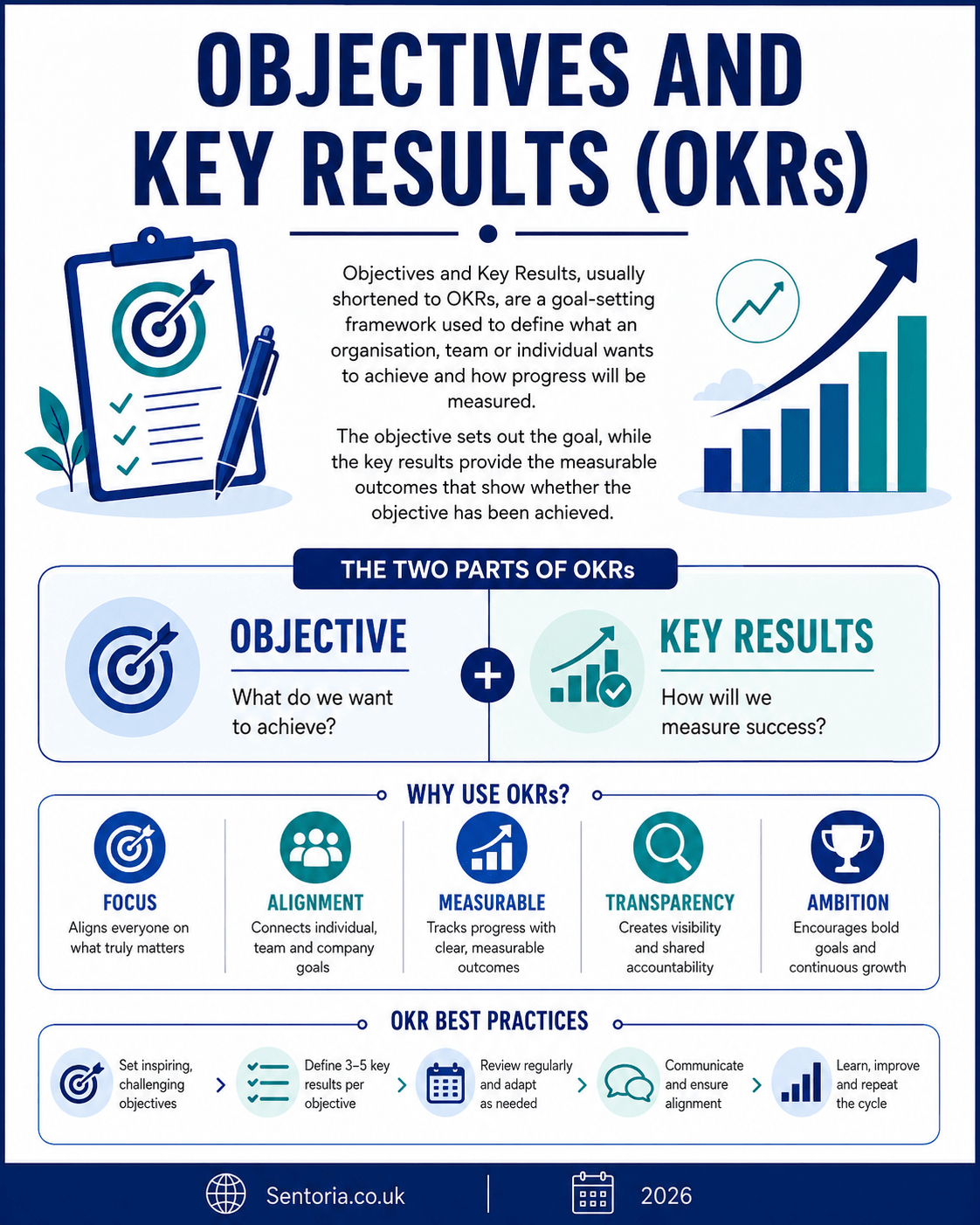
Objectives and Key Results, usually shortened to OKRs, are a goal-setting framework used to define what an organisation, team or individual wants to achieve and how progress will be measured.
At their simplest, OKRs ask:
What are we trying to achieve, and what measurable results will show whether we have achieved it?
That makes OKRs useful for strategy delivery, team alignment, performance management, project planning, growth planning, transformation, product development and organisational focus.
Google describes OKRs as a method for setting ambitious goals and tracking progress, with objectives that are ambitious, key results that are measurable, and transparency so people can see what others are working on.
Used properly, OKRs help organisations move from vague intentions to focused, measurable priorities.
What are OKRs?
An OKR has two parts:
Objective
The objective explains what you want to achieve.
Key Results
The key results explain how you will know whether the objective has been achieved.
A good objective should be clear, meaningful and directional.
A good key result should be specific, measurable and time-bound.
For example:
Objective: Improve customer experience for small business clients.
Key Results:
- Increase client satisfaction score from 82% to 90%.
- Reduce average response time from two working days to one working day.
- Complete quarterly review meetings with 80% of retained clients.
- Reduce client onboarding errors by 50%.
The objective gives direction. The key results make progress measurable.
Harvard Business Review describes objectives as high-level, qualitative and inspirational goals, while key results are quantifiable outcomes used to measure success against those objectives.
History and development of OKRs
OKRs are closely associated with Andy Grove, the former chief executive of Intel, and later with John Doerr, who helped popularise the framework in Silicon Valley.
What Matters, the organisation linked to John Doerr’s OKR work, describes Andy Grove as the father of OKRs and explains that Grove developed the management method at Intel before it influenced many other organisations.
John Doerr later introduced OKRs to Google in 1999. In an excerpt from Measure What Matters, published by Wired, Doerr describes bringing OKRs to Google’s founders in the company’s early days, having first learned the approach at Intel.
The framework became well known because it helped fast-growing organisations focus on priorities, align teams and track measurable progress. Google’s own OKR playbook says OKRs help communicate, measure and achieve ambitious goals, and that well-managed OKRs clarify what matters, what to optimise, and what trade-offs to make.
Over time, OKRs moved beyond technology companies. They are now used by businesses, charities, public bodies, professional services firms, product teams, leadership teams, startups and project teams.
The two parts of an OKR
1. Objectives
An objective is the goal.
It describes what the organisation, team or person wants to achieve.
A good objective should be:
- Clear
- Important
- Understandable
- Action-oriented
- Time-bound
- Connected to strategy
- Inspiring enough to create focus
Examples of objectives include:
- Improve customer retention.
- Launch a new advisory service.
- Strengthen cash flow control.
- Improve staff engagement.
- Reduce project delivery delays.
- Increase local brand awareness.
- Improve service quality.
- Build a stronger fundraising pipeline.
- Improve product reliability.
- Make reporting simpler and more useful.
An objective should not be too narrow. It should describe an outcome or direction, not a task.
Weak objective:
Send more newsletters.
Stronger objective:
Increase engagement with prospective clients through useful, practical content.
The stronger version explains why the work matters.
2. Key Results
Key results are the measurable outcomes that show whether the objective has been achieved.
A good key result should be:
- Specific
- Measurable
- Time-bound
- Outcome-focused
- Verifiable
- Challenging but realistic
- Linked directly to the objective
Examples of key results include:
- Increase recurring monthly revenue from £40,000 to £50,000.
- Reduce average debtor days from 48 to 35.
- Improve customer satisfaction score from 78% to 88%.
- Reduce staff turnover from 18% to 10%.
- Complete 30 customer interviews by quarter end.
- Increase website enquiries from 40 to 70 per month.
- Reduce product returns from 6% to 3%.
- Increase grant applications submitted from 8 to 14.
- Reduce average project delay from 21 days to 7 days.
- Increase training completion from 60% to 95%.
The key point is measurement.
A key result should make it clear whether progress has been made.
Outputs, outcomes and activities
One of the most important parts of using OKRs well is understanding the difference between activities, outputs and outcomes.
Activities
Activities are things you do.
Examples include:
- Run a meeting.
- Publish a blog post.
- Send emails.
- Build a dashboard.
- Hold a workshop.
- Update a policy.
Activities matter, but they do not always prove success.
Outputs
Outputs are things produced.
Examples include:
- A report.
- A new webpage.
- A training session.
- A marketing campaign.
- A process document.
- A completed spreadsheet.
Outputs are useful, but they still may not prove that the objective has been achieved.
Outcomes
Outcomes are the change created.
Examples include:
- Customers respond faster.
- Cash collection improves.
- Staff understand priorities.
- Projects finish earlier.
- Clients retain longer.
- Service users receive support sooner.
OKRs work best when key results measure outcomes rather than activities.
For example:
Weak key result:
Hold five sales meetings.
Stronger key result:
Convert 10 new qualified opportunities into signed proposals.
The first measures activity. The second measures progress towards a commercial outcome.
Why OKRs matter
OKRs matter because organisations often suffer from too many priorities.
Teams may be busy, but not focused. People may work hard, but not towards the same outcomes. Strategy may exist, but not translate into weekly decisions. Reports may track activity, but not meaningful progress.
OKRs help by creating:
- Focus
- Alignment
- Transparency
- Accountability
- Measurable progress
- Better prioritisation
- Stronger communication
- More regular review
- Clearer trade-offs
- Improved learning
This is why OKRs are often used in fast-moving organisations. They help teams decide what matters now, how success will be measured, and what should receive attention.
However, OKRs are not magic. They do not replace leadership, judgement, culture, resources or execution. John Doerr’s Measure What Matters excerpt makes the same point: OKRs are not a substitute for sound judgement, strong leadership or a creative workplace culture.
Committed and aspirational OKRs
Some organisations distinguish between committed and aspirational OKRs.
Committed OKRs
Committed OKRs are goals the organisation expects to achieve.
They usually relate to important operational, financial, compliance or delivery priorities.
Examples include:
- Complete statutory accounts by deadline.
- Reduce overdue debt by 25%.
- Implement a new payroll system by quarter end.
- Deliver a funding report to trustees.
- Complete mandatory training for all staff.
Committed OKRs should usually be achieved. If they are not achieved, there should be a clear explanation.
Aspirational OKRs
Aspirational OKRs are stretching goals.
They are designed to push ambition and encourage teams to think bigger.
Examples include:
- Double qualified inbound enquiries.
- Reduce onboarding time by 70%.
- Launch a new product into an untested segment.
- Achieve a major improvement in customer satisfaction.
- Build a national audience for specialist content.
Aspirational OKRs may not be fully achieved. That is acceptable if the organisation learns and makes meaningful progress.
Google’s OKR guidance explains that objectives are often ambitious, key results are measurable, and that low grades should be treated as data to help refine the next OKRs.
OKRs in different industries
SMEs and owner-managed businesses
For SMEs, OKRs are useful because they bring focus to limited time and resources.
An owner-managed business may have many priorities: sales, cash flow, staffing, customer service, systems, tax, operations, marketing and delivery. OKRs help narrow attention to the most important outcomes for the next quarter.
Example SME OKR:
Objective: Improve cash flow resilience.
Key Results:
- Reduce debtor days from 52 to 38.
- Increase monthly cash forecast accuracy to within 10%.
- Agree payment plans with 90% of overdue customers above £1,000.
- Increase average cash balance by £50,000 by quarter end.
For SMEs, OKRs should be practical. They should connect directly to cash, customers, people, delivery and profitability.
Manufacturing
Manufacturing businesses can use OKRs to improve production, quality, delivery, cost and safety.
Example manufacturing OKR:
Objective: Improve production reliability.
Key Results:
- Increase on-time production completion from 82% to 94%.
- Reduce machine downtime by 25%.
- Reduce rework rate from 7% to 3%.
- Complete preventative maintenance on 100% of critical equipment.
For manufacturing, OKRs should connect to operational data, quality measures, lead times, supplier reliability, health and safety, stock control and customer delivery.
Retail and ecommerce
Retail and ecommerce businesses can use OKRs to improve customer experience, conversion, stock efficiency, repeat purchase and margin.
Example ecommerce OKR:
Objective: Improve online sales performance without reducing margin.
Key Results:
- Increase website conversion rate from 2.1% to 3.0%.
- Increase average order value from £42 to £50.
- Reduce return rate from 8% to 5%.
- Maintain gross margin above 45%.
For ecommerce, OKRs should avoid focusing only on revenue. Revenue growth without margin, repeat purchase and stock control can be misleading.
Professional services
For accountants, solicitors, consultants, architects and advisers, OKRs can help improve client service, advisory income, workflow, quality and team development.
Example professional services OKR:
Objective: Build a stronger monthly advisory service for SME clients.
Key Results:
- Convert 15 existing clients to monthly advisory packages.
- Deliver monthly management reports within 10 working days for 90% of advisory clients.
- Achieve client satisfaction above 90% for advisory meetings.
- Generate £8,000 of additional monthly recurring revenue.
For professional firms, OKRs should connect service quality, client outcomes, margin and staff capacity.
Charities and voluntary organisations
Charities can use OKRs to focus on impact, funding, service delivery, volunteer engagement and governance.
Example charity OKR:
Objective: Strengthen service sustainability while protecting frontline impact.
Key Results:
- Secure £120,000 of confirmed funding for next financial year.
- Maintain service user satisfaction above 90%.
- Reduce average referral waiting time from 21 days to 14 days.
- Recruit and onboard 20 new volunteers.
For charities, OKRs should be linked to mission and impact, not only income. Trustee oversight, safeguarding and funding risk should also be considered.
Public sector and local government
Public bodies can use OKRs for service improvement, transformation, resident engagement and project delivery.
Example public sector OKR:
Objective: Improve resident access to housing support.
Key Results:
- Reduce average response time from 15 working days to 8.
- Increase first-contact resolution from 45% to 65%.
- Reduce avoidable repeat enquiries by 20%.
- Improve resident satisfaction score from 70% to 82%.
For public bodies, OKRs should sit alongside statutory duties, equality considerations, consultation, public value and governance.
Property and construction
Property and construction organisations can use OKRs for development projects, leasing, asset management, planning, maintenance and delivery control.
Example property OKR:
Objective: Improve commercial asset occupancy and tenant experience.
Key Results:
- Increase occupancy from 82% to 90%.
- Reduce average maintenance response time from 10 days to 5 days.
- Complete lease renewals for 80% of tenants due within the quarter.
- Increase tenant satisfaction from 75% to 85%.
For construction, OKRs may focus on programme delivery, defects, safety, subcontractor performance and cost control.
Technology and software
Technology businesses often use OKRs for product development, growth, customer success, reliability and innovation.
Example software OKR:
Objective: Improve new user activation.
Key Results:
- Increase activation rate from 38% to 55%.
- Reduce average onboarding time from 14 days to 7 days.
- Increase users completing the core workflow from 40% to 65%.
- Reduce onboarding support tickets by 30%.
For software, OKRs should focus on user behaviour and value, not just feature delivery.
Healthcare and social care
Healthcare and social care organisations can use OKRs carefully for quality improvement, access, safety, staffing and service experience.
Example care OKR:
Objective: Improve continuity and quality of care.
Key Results:
- Increase care visit continuity from 70% to 85%.
- Complete 100% of mandatory safeguarding refresher training.
- Reduce medication recording errors by 40%.
- Improve family communication satisfaction from 78% to 88%.
In this sector, OKRs must support safety, quality, dignity and regulatory compliance. They should not encourage unsafe shortcuts.
Education and training
Education and training providers can use OKRs to improve learner outcomes, enrolment, completion, employer engagement and course quality.
Example education OKR:
Objective: Improve learner completion and progression.
Key Results:
- Increase course completion from 76% to 88%.
- Improve learner satisfaction from 80% to 90%.
- Secure progression outcomes for 70% of learners within three months.
- Complete employer feedback reviews for all major courses.
For education, OKRs should link to learner outcomes, teaching quality, funding requirements and employer need.
How to create OKRs properly
1. Start with strategy
OKRs should not be created in isolation.
They should flow from strategy, priorities and current challenges.
Before setting OKRs, ask:
- What matters most this quarter?
- What does the strategy require?
- What would make the biggest difference?
- What must improve?
- What should we stop doing?
- What risks need attention?
- What outcomes would show progress?
If OKRs do not connect to strategy, they become another layer of management paperwork.
2. Choose a small number of objectives
Too many OKRs destroy focus.
Most teams should have a small number of objectives at any one time.
A practical starting point is:
- Three to five objectives for an organisation or leadership team.
- One to three objectives for a team.
- Two to four key results per objective.
The exact number depends on the organisation, but the principle is clear: OKRs should force prioritisation.
3. Make objectives clear and meaningful
Objectives should be easy to understand.
Avoid vague wording such as:
- Improve performance.
- Be more efficient.
- Grow the business.
- Enhance customer service.
- Drive excellence.
These may sound positive, but they are too broad.
Stronger objectives include:
- Improve cash collection and reduce financial pressure.
- Build a stronger advisory service for SME clients.
- Reduce delays in project delivery.
- Improve customer onboarding experience.
- Increase volunteer capacity for frontline support.
A good objective should make people understand the direction of travel.
4. Make key results measurable
Key results should answer:
How will we know whether we succeeded?
Avoid key results that are really tasks.
Weak key result:
Launch a new website.
Stronger key result:
Increase website enquiries from 20 to 40 per month after launch.
Weak key result:
Improve communication.
Stronger key result:
Increase staff survey score for internal communication from 62% to 80%.
A key result should usually include a number, percentage, deadline, threshold or clear evidence point.
5. Balance ambition and realism
OKRs should stretch performance, but not become fantasy.
If they are too easy, they do not change behaviour.
If they are impossible, they create cynicism.
The right level depends on whether the OKR is committed or aspirational.
Committed OKRs should be realistic and expected.
Aspirational OKRs should stretch the team, but still have a credible path.
6. Assign ownership
Every OKR needs an owner.
Ownership does not mean one person must do all the work. It means someone is responsible for tracking, coordinating and reporting progress.
For each OKR, define:
- Objective owner
- Key result owner
- Supporting teams
- Review frequency
- Reporting method
- Escalation route
Without ownership, OKRs drift.
7. Review regularly
OKRs should be reviewed during the cycle, not only at the end.
A practical rhythm might include:
- Weekly team check-in
- Monthly leadership review
- Quarterly scoring and learning review
- Annual strategy refresh
The review should ask:
- Are we on track?
- What has changed?
- What is blocked?
- What needs support?
- Are the key results still the right measures?
- What have we learned?
- What decisions are needed?
OKRs should be live management tools, not static documents.
8. Score and learn
At the end of the cycle, review progress.
Scoring can be simple.
For example:
- 0% to 30%: limited progress
- 40% to 60%: partial progress
- 70% to 90%: strong progress
- 100%: fully achieved
Google’s guidance notes that it uses a 0.0 to 1.0 scoring scale, with key results graded individually and then used to support a rough objective grade.
The main purpose of scoring is learning.
Ask:
- What worked?
- What did not work?
- Were the OKRs well designed?
- Were they too easy or too ambitious?
- Did we measure the right things?
- What should change next quarter?
Common mistakes in using OKRs
Mistake 1: Setting too many OKRs
OKRs should create focus.
If everything is an OKR, nothing is an OKR.
Too many objectives create confusion and dilute attention.
Mistake 2: Writing vague objectives
Objectives should be clear enough that people understand what success means.
Vague objectives create vague action.
Mistake 3: Using tasks as key results
A key result should measure an outcome, not simply completion of an activity.
Tasks belong in an action plan. Key results belong in the OKR.
Mistake 4: Linking OKRs too tightly to bonuses
If OKRs are used directly for pay, people may set safe targets.
This can undermine ambition and honesty.
Performance management and OKRs can be connected, but they should not be treated as exactly the same thing.
Mistake 5: Not reviewing progress
OKRs fail when they are written at the start of the quarter and ignored until the end.
Regular review is essential.
Mistake 6: Confusing OKRs with KPIs
KPIs monitor performance.
OKRs drive change.
Both are useful, but they serve different purposes.
Mistake 7: Making every OKR top-down
Leadership direction matters, but teams should usually be involved in shaping their own OKRs.
That improves ownership and practicality.
Mistake 8: Measuring what is easy rather than what matters
Some things are easy to count but not strategically important.
Good OKRs measure meaningful outcomes.
Mistake 9: Ignoring capacity
A team cannot deliver ambitious OKRs if it is already overloaded.
OKRs should force trade-offs, including deciding what not to do.
Mistake 10: Treating OKRs as a software problem
OKR software can help tracking, but it does not solve poor goal-setting.
The discipline matters more than the tool.
Limitations and weaknesses of OKRs
OKRs are useful, but they have limits.
They can create measurement distortion
When people are judged heavily on metrics, they may optimise the metric rather than the underlying outcome.
For example, a team might increase website enquiries but reduce quality. Another might reduce response times but provide weaker answers.
Measures need judgement.
They can encourage short-term thinking
Quarterly OKRs are useful, but not everything important happens in a quarter.
Longer-term strategy, culture, trust, brand, relationships and capability also matter.
They can become bureaucratic
If OKRs become too formal, too many, too detailed or too heavily reported, they lose their value.
The process should support action, not consume time.
They can be hard to apply to complex work
Some work is difficult to measure.
Policy, culture, relationships, research, care, strategy and early innovation can all involve outcomes that are not immediately measurable.
That does not mean OKRs cannot be used, but the key results need careful design.
They can demotivate if poorly handled
Unrealistic OKRs can create frustration.
Low scores can be useful learning, but only if the organisation has a culture that treats them honestly.
They do not replace leadership
OKRs support leadership. They do not replace it.
Leaders still need judgement, communication, prioritisation, coaching and decision-making.
They do not replace strategy
OKRs help deliver strategy, but they do not create the strategy by themselves.
An organisation needs a clear direction before OKRs can be meaningful.
OKRs compared with other strategic tools
OKRs and KPIs
KPIs measure ongoing performance.
OKRs set focused improvement goals.
For example:
KPI: Debtor days are 45.
OKR: Reduce debtor days from 45 to 30 by quarter end.
KPIs are the dashboard. OKRs are the change agenda.
OKRs and Balanced Scorecard
The Balanced Scorecard translates strategy into objectives and measures across areas such as financial performance, customers, internal processes, and learning and growth.
OKRs can sit underneath the Balanced Scorecard as quarterly priorities.
Use the Balanced Scorecard for strategic performance structure. Use OKRs for short-term focus and execution.
OKRs and SWOT
SWOT identifies strengths, weaknesses, opportunities and threats.
OKRs can turn SWOT findings into action.
For example, if SWOT identifies poor customer retention as a weakness, an OKR could focus on improving retention.
OKRs and TOWS
TOWS turns SWOT into strategic options.
OKRs help deliver selected TOWS actions by defining measurable outcomes.
OKRs and Business Model Canvas
The Business Model Canvas describes how an organisation creates, delivers and captures value.
OKRs can focus improvement on specific blocks of the Canvas, such as channels, revenue streams, customer relationships or key activities.
OKRs and Value Proposition Canvas
The Value Proposition Canvas focuses on customer jobs, pains, gains and value fit.
OKRs can be used to test whether a new value proposition is working.
For example, a key result might measure customer conversion, retention or satisfaction.
OKRs and Risk Register
A risk register records and manages risks.
OKRs can be used to reduce important risks.
For example, if the risk register identifies key person dependency, an OKR could focus on documenting processes and training team members.
OKRs and BCG Matrix
The BCG Matrix helps prioritise products, services or business units.
OKRs can then be used to implement decisions, such as growing Stars, protecting Cash Cows, testing Question Marks or reducing Dogs.
Alternatives and complementary frameworks
KPIs
Use KPIs for ongoing performance monitoring.
Best used alongside OKRs to separate steady-state management from improvement priorities.
Balanced Scorecard
Use the Balanced Scorecard for a broader strategic performance framework.
Best used when the organisation needs balance across financial, customer, process and capability measures.
SMART goals
SMART goals are specific, measurable, achievable, relevant and time-bound.
They are useful for individual goals and action planning. OKRs can include SMART-style key results, but OKRs place more emphasis on alignment and strategic focus.
Rocks
Some businesses use quarterly “rocks” to identify the few most important priorities for the quarter.
Rocks are useful for focus. OKRs add measurable key results.
KPI dashboard
A dashboard shows performance data.
OKRs can use dashboard measures to set improvement targets.
Project plan
A project plan sets out tasks, owners, deadlines and dependencies.
OKRs define the intended outcome. A project plan explains how the work will be done.
Strategy map
A strategy map shows how strategic objectives connect.
OKRs can provide quarterly measurable goals that support the map.
A practical OKR template
A useful OKR template should include:
- Objective
- Strategic theme
- Owner
- Time period
- Key result 1
- Key result 2
- Key result 3
- Baseline
- Target
- Current progress
- Confidence level
- Supporting actions
- Risks or blockers
- Dependencies
- Review date
- Final score
- Lessons learned
Example:
Objective: Improve client onboarding experience.
Strategic theme: Customer service and operational efficiency.
Owner: Operations Manager.
Time period: Quarter 2.
Key Results:
- Reduce average onboarding time from 12 working days to 6.
- Increase complete-information submissions from 55% to 85%.
- Reduce onboarding-related client queries by 30%.
- Achieve onboarding satisfaction score above 90%.
Supporting actions:
- Create a standard onboarding checklist.
- Introduce a digital information request form.
- Update client welcome email.
- Review first 20 onboarding cases.
Review frequency: Weekly.
Questions to ask when setting OKRs
Objective questions
- What are we trying to achieve?
- Why does this matter?
- Does it support the strategy?
- Is it clear enough?
- Is it too broad?
- Is it too narrow?
- Would people understand it without explanation?
- Is it important enough to be an OKR?
- What should we stop doing to make room for it?
- Who owns it?
Key Result questions
- How will we know whether the objective has been achieved?
- Can this be measured?
- What is the baseline?
- What is the target?
- Is the target realistic but stretching?
- Does it measure an outcome?
- Is it time-bound?
- Could it be gamed?
- Does it create the right behaviour?
- Are there too many key results?
Alignment questions
- Does this OKR support the organisation’s priorities?
- Does it conflict with another team’s OKR?
- Who needs to contribute?
- Who needs to know?
- Are dependencies clear?
- Are resources available?
- Is leadership aligned?
- Are teams using the same definitions?
- Are measures consistent?
- What trade-offs are required?
Review questions
- Are we on track?
- What evidence shows progress?
- What is blocked?
- What has changed?
- What support is needed?
- Is the OKR still relevant?
- Are the measures still right?
- What decisions are required?
- What have we learned?
- What should change next cycle?
The best way to think about OKRs
OKRs are not a performance form.
They are a focus and execution tool.
A good OKR system should be:
- Strategic
- Simple
- Measurable
- Transparent
- Regularly reviewed
- Outcome-focused
- Owned
- Challenging
- Honest
- Linked to learning
A weak OKR says:
“Do more marketing.”
A strong OKR says:
“Increase qualified inbound enquiries from 40 to 70 per month while maintaining conversion rate above 25%.”
The key question is not simply:
What work are we doing?
The better question is:
What outcome are we trying to achieve, and what evidence will show whether we are getting there?
Conclusion: OKRs turn strategy into focused measurable progress
OKRs remain useful because many organisations do not fail through lack of effort. They fail through lack of focus.
People are busy. Teams are active. Meetings happen. Reports are produced. Projects move forward. But without clear priorities and measurable outcomes, activity can drift away from strategy.
Used badly, OKRs become another management ritual.
Used properly, they become a practical tool for focus, alignment and learning. They help organisations decide what matters most, define measurable progress, review performance regularly and make better trade-offs.
The real value is not in writing the OKRs.
The real value is in the conversation, discipline and action that follow.
A strong OKR process helps an organisation move from saying, “We have lots to do,” to asking, “What matters most, how will we measure success, and what are we learning as we go?”