Value Proposition Canvas:
A Practical Guide to Understanding Customers and Designing Offers They Actually Want
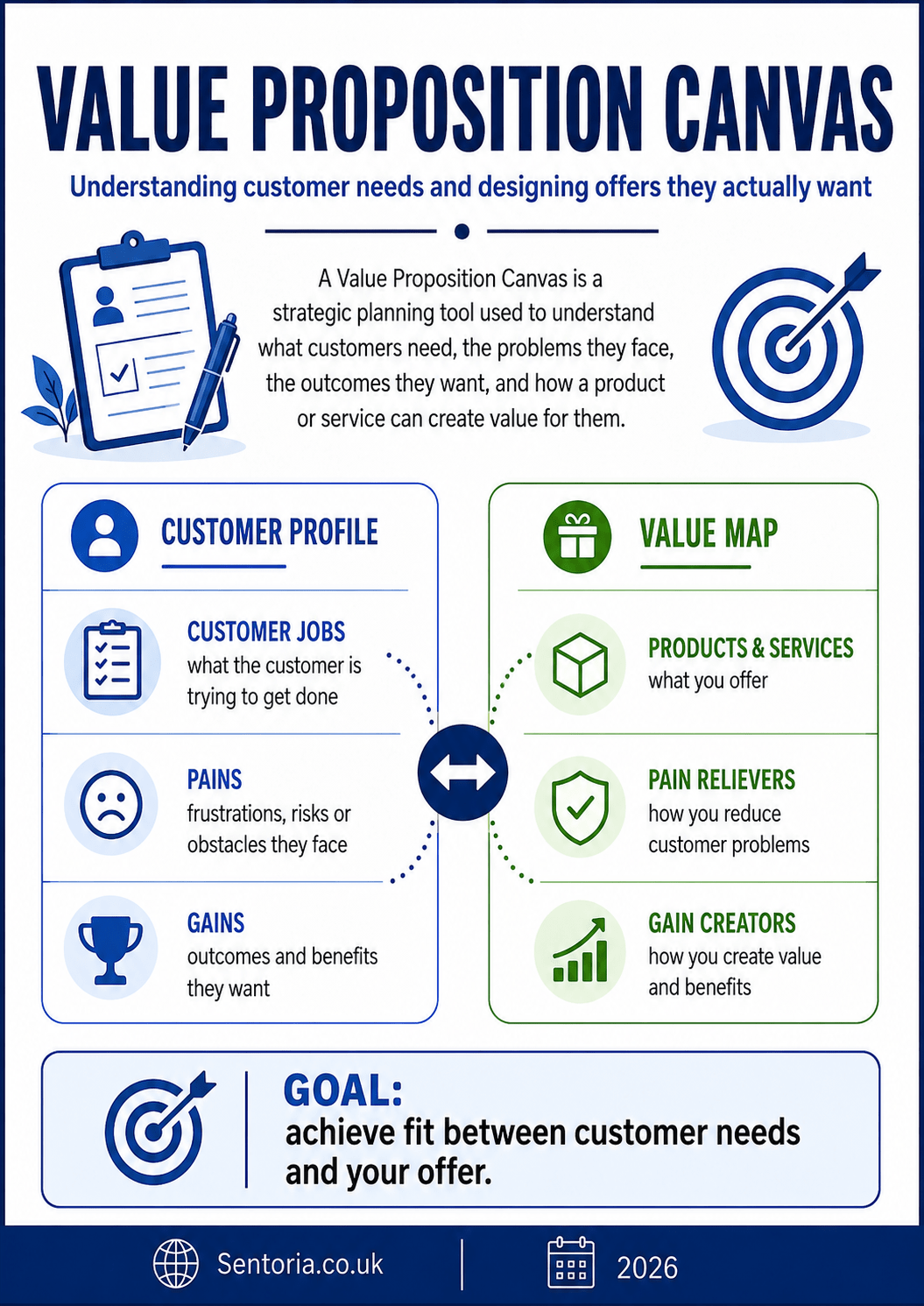
The Value Proposition Canvas is a strategic planning tool used to understand what customers need, what problems they face, what outcomes they want, and how a product, service or organisation can create value for them.
At its simplest, the Value Proposition Canvas asks:
What does the customer need to get done, what makes that difficult, what would make it better, and how does our offer help?
That makes it especially useful for product design, service development, marketing, business model design, customer research, innovation, pricing, sales messaging and strategic planning.
Strategyzer describes the Value Proposition Canvas as a simple way to clarify customers’ jobs to be done, pains and gains, and then design products and services that customers need and want.
Used properly, the Value Proposition Canvas helps organisations move away from internal assumptions and towards customer evidence.
What is the Value Proposition Canvas?
The Value Proposition Canvas is a visual framework that connects two sides of strategy:
- The Customer Profile
- The Value Map
The Customer Profile examines the customer’s world. It looks at what customers are trying to do, what problems or frustrations they experience, and what outcomes or benefits they want.
The Value Map examines the organisation’s offer. It looks at the products and services being provided, how they reduce customer pain, and how they create customer gains.
The aim is to achieve fit.
Fit means the organisation’s offer matches what customers actually care about. It means the product or service helps with important customer jobs, reduces meaningful pains, and creates gains that customers genuinely value.
Strategyzer describes the Value Proposition Canvas as a tool that helps users define customer profiles and visualise the value created through products, services, pain relievers and gain creators.
History and development of the Value Proposition Canvas
The Value Proposition Canvas is closely associated with Alexander Osterwalder, Yves Pigneur, Greg Bernarda, Alan Smith and Strategyzer.
It developed as a more detailed companion to the Business Model Canvas. The Business Model Canvas looks at the whole business model, while the Value Proposition Canvas focuses in more detail on two of the most important parts of that model:
- Customer Segments
- Value Propositions
Strategyzer describes the Business Model Canvas as a strategic management and entrepreneurial tool used to describe, design, challenge, invent and pivot business models. The Value Proposition Canvas can be understood as a deeper tool for testing whether the offer and the customer segment genuinely fit together.
The framework was popularised through the book Value Proposition Design: How to Create Products and Services Customers Want. Strategyzer describes the book as a practical guide to creating compelling products and services that customers want to buy.
The tool became popular because many organisations face the same problem. They develop products, services, campaigns or strategies based on internal opinion rather than customer reality. The Value Proposition Canvas helps reduce that risk by making assumptions visible and testable.
The two sides of the Value Proposition Canvas
1. The Customer Profile
The Customer Profile looks at the customer’s situation.
It has three parts:
- Customer Jobs
- Pains
- Gains
Customer Jobs
Customer Jobs are the things customers are trying to get done.
These may be practical, social or emotional.
Practical jobs might include:
- Submit a tax return
- Reduce energy costs
- Buy a reliable product
- Find a local supplier
- Book an appointment
- Improve cash flow
- Train staff
- Manage a project
- Secure funding
- Comply with regulation
Social jobs might include:
- Look professional
- Be trusted by others
- Feel confident in a decision
- Protect reputation
- Show competence
- Gain approval
- Be seen as responsible
Emotional jobs might include:
- Feel reassured
- Reduce anxiety
- Avoid embarrassment
- Feel in control
- Trust the provider
- Reduce uncertainty
- Feel supported
This is important because customers do not always buy the product itself. They buy progress, reassurance, convenience, status, risk reduction or a better outcome.
For example, a small business owner may not really want “management accounts”. They may want to understand whether the business is making money, whether cash is safe, whether tax is under control, and whether they can make a decision with confidence.
Pains
Pains are the negative experiences, risks, frustrations, obstacles or costs customers face when trying to complete their jobs.
Pains may include:
- Wasted time
- Confusion
- High cost
- Poor service
- Delays
- Jargon
- Risk
- Uncertainty
- Stress
- Complexity
- Lack of trust
- Poor communication
- Hidden fees
- Weak support
- Fear of making the wrong decision
Pains are not always dramatic. Sometimes they are small points of friction that build up over time.
For example, customers may tolerate unclear pricing, slow replies, confusing forms, poor handovers or technical language because they assume that is normal in the sector. Those pains may create an opportunity for a better value proposition.
Gains
Gains are the outcomes, benefits or improvements customers want.
Gains may include:
- Saving time
- Saving money
- Reducing risk
- Increasing confidence
- Improving quality
- Making life easier
- Getting better advice
- Feeling reassured
- Improving reputation
- Accessing expertise
- Increasing speed
- Reducing hassle
- Getting a better result
- Improving control
- Achieving peace of mind
Some gains are expected. Some are desired. Some are unexpected.
For example, a customer may expect accurate work, but may be delighted by proactive communication, plain-English advice, a simple dashboard or a quick answer before they even ask.
2. The Value Map
The Value Map looks at the organisation’s offer.
It has three parts:
- Products and Services
- Pain Relievers
- Gain Creators
Products and Services
Products and Services are the things the organisation offers to the customer.
These may include:
- Physical products
- Professional services
- Software
- Subscriptions
- Advice
- Training
- Support
- Reports
- Tools
- Programmes
- Memberships
- Consultancy
- Delivery services
- Community services
- Public services
This section should be specific. It should not just list everything the organisation does. It should identify which products or services are relevant to the particular customer segment being analysed.
A Value Proposition Canvas should normally be completed for one customer segment at a time. Different customer groups often have different jobs, pains and gains.
Pain Relievers
Pain Relievers explain how the offer reduces customer pains.
They might reduce:
- Time
- Cost
- Risk
- Stress
- Complexity
- Uncertainty
- Errors
- Administration
- Poor communication
- Compliance burden
- Waiting time
- Confusion
For example, a professional services firm might relieve pain by using fixed fees, clear timescales, plain-English advice, digital document requests and proactive reminders.
A software company might relieve pain by automating manual tasks, reducing errors, improving visibility and integrating with existing systems.
A charity might relieve pain by simplifying access, reducing stigma, offering trusted support and helping people navigate complex services.
Gain Creators
Gain Creators explain how the offer creates positive outcomes.
They might create:
- Better results
- Greater confidence
- More convenience
- Improved performance
- Stronger relationships
- More insight
- Better decisions
- Time savings
- Financial benefit
- Emotional reassurance
- Social value
- Improved quality
- Easier access
- Stronger control
- Increased opportunity
For example, an advisory service may create gains by helping a business owner understand cash flow, plan tax, improve margins and make decisions earlier.
A training provider may create gains by helping learners gain confidence, develop employable skills and progress into work.
A retailer may create gains by helping customers choose the right product quickly and avoid buyer’s remorse.
The idea of fit
Fit is the central point of the Value Proposition Canvas.
A strong fit exists when the Value Map clearly responds to the most important elements of the Customer Profile.
In other words:
- The products and services help customers with important jobs.
- The pain relievers reduce meaningful pains.
- The gain creators produce outcomes customers actually want.
- The customer recognises the value.
- The organisation can deliver the value sustainably.
Strategyzer’s materials describe fit as the point where pain relievers and gain creators address important customer pains and gains.
This matters because organisations often make the mistake of designing offers around what they can provide, rather than what customers need.
The Value Proposition Canvas helps expose that gap.
Why the Value Proposition Canvas matters
The Value Proposition Canvas matters because many products, services and strategies fail for the same reason:
They are built on assumptions about what customers want.
An organisation may assume customers want more features, lower prices, longer reports, faster delivery, more choice or a more premium experience. Sometimes that is true. Sometimes it is not.
The Canvas helps test those assumptions.
It supports:
- Better customer understanding
- Clearer value propositions
- Stronger product design
- Better service development
- More focused marketing
- Improved sales conversations
- Better pricing decisions
- Reduced risk of wasted investment
- Stronger innovation
- Better fit between offer and market
Harvard Business School Online describes a value proposition as a statement that conveys what a brand does and how it differs from competitors. The Value Proposition Canvas helps build the thinking behind that statement, so it is grounded in customer need rather than internal claims.
When to use the Value Proposition Canvas
The Value Proposition Canvas is useful whenever an organisation needs to understand or improve the fit between a customer group and an offer.
Good uses include:
- Launching a new product
- Designing a new service
- Improving an existing offer
- Reviewing customer segments
- Preparing a marketing strategy
- Writing website copy
- Testing a business idea
- Developing a charity programme
- Designing public services
- Improving sales proposals
- Creating service packages
- Developing customer personas
- Preparing a funding or investment pitch
- Reviewing product-market fit
- Improving customer retention
It is particularly useful when the organisation is asking:
- Do customers actually want this?
- What problem are we solving?
- Why would customers choose us?
- Are we addressing the most important pains?
- Are we creating gains customers value?
- Are we communicating the offer clearly?
- What should we test before investing?
Value Proposition Canvas in different industries
SMEs and owner-managed businesses
For SMEs, the Value Proposition Canvas is especially useful because smaller businesses often rely on instinct, relationships and experience.
That can be a strength, but it can also lead to assumptions.
An SME might use the Canvas to ask:
- Which customers do we serve best?
- What are those customers really trying to achieve?
- What frustrates them about existing providers?
- What pains do we reduce better than competitors?
- What gains do we create that customers recognise?
- Are we explaining our value clearly?
- Are we offering too many things to too many people?
For a small business, the Canvas can help sharpen positioning. Instead of saying “we provide a great service”, the business can explain the specific value it creates for a specific customer group.
Manufacturing
In manufacturing, the Value Proposition Canvas helps connect product features to customer value.
A manufacturer might discover that customers are not only buying a component, material or product. They may also be buying reliability, consistency, technical support, speed, reduced downtime or lower total cost of ownership.
Customer jobs may include:
- Keep production running
- Reduce defects
- Meet specification
- Lower operating cost
- Improve reliability
- Reduce supplier risk
- Meet regulatory standards
- Launch new products
Pains may include late delivery, quality failures, unclear technical support, supply chain disruption or poor communication.
Gains may include faster turnaround, better documentation, easier ordering, technical confidence and fewer production delays.
For manufacturing, the Canvas should be linked to quality data, delivery performance, customer complaints, technical support and value chain analysis.
Retail and ecommerce
For retail and ecommerce, the Canvas helps understand why customers choose one retailer over another.
Customer jobs may include:
- Find the right product quickly
- Compare options
- Avoid wasting money
- Buy with confidence
- Receive delivery on time
- Return easily if needed
- Feel reassured by reviews
- Get good aftercare
Pains may include confusing websites, poor product information, hidden delivery costs, weak returns policies, slow delivery, poor customer service or lack of trust.
Gains may include easy comparison, helpful guidance, strong reviews, fast delivery, clear pricing and confidence that the product is right.
For ecommerce, the Canvas should connect to conversion rates, customer reviews, returns, fulfilment, customer acquisition cost and repeat purchase.
Professional services
For accountants, solicitors, consultants, architects and advisers, the Value Proposition Canvas can be very powerful because clients often buy trust, clarity and reduced risk.
Customer jobs may include:
- Stay compliant
- Make better decisions
- Reduce risk
- Save time
- Understand complex matters
- Plan ahead
- Protect the business
- Secure funding
- Resolve problems
- Gain confidence
Pains may include jargon, uncertainty, slow response, unclear fees, lack of proactive advice, missed deadlines, poor communication and feeling unsupported.
Gains may include clarity, confidence, better decisions, predictable fees, trusted advice, proactive support and reduced stress.
For professional services, the Canvas can help turn technical expertise into clearer client value.
Charities and voluntary organisations
For charities, the Value Proposition Canvas needs adapting because the customer, funder, beneficiary and service user may be different people.
A charity may need separate canvases for:
- Beneficiaries
- Funders
- Donors
- Volunteers
- Commissioners
- Community partners
- Trustees
For beneficiaries, jobs may include accessing support, feeling safe, solving a problem, reducing isolation or navigating services.
For funders, jobs may include achieving social impact, allocating funds responsibly, supporting policy goals and demonstrating outcomes.
For volunteers, jobs may include making a difference, using skills, feeling connected and contributing to the community.
For charities, the Canvas should be linked to safeguarding, accessibility, impact measurement, funding strategy and stakeholder analysis.
Public sector and local government
In the public sector, the Value Proposition Canvas can support better service design.
Residents, service users and stakeholders may have different jobs, pains and gains.
A resident may want to:
- Access a service quickly
- Understand eligibility
- Get a decision
- Report a problem
- Receive updates
- Avoid repeating information
- Trust that the issue is being handled
Pains may include complex forms, long waits, unclear communication, digital exclusion, lack of ownership and poor handovers.
Gains may include simple access, clear updates, fair treatment, faster resolution and confidence in the service.
For public bodies, the Canvas should be combined with statutory duties, equality considerations, consultation, risk management and public value assessment.
Property and construction
In property and construction, the Canvas can help clarify value for tenants, buyers, occupiers, funders, planning authorities and communities.
For a commercial property scheme, occupier jobs might include:
- Find suitable space
- Control costs
- Access transport links
- Attract staff
- Reduce operational disruption
- Secure flexible lease terms
- Support brand and customer experience
Pains may include poor access, uncertain costs, unsuitable layout, lack of parking, weak infrastructure, planning uncertainty or poor landlord communication.
Gains may include flexibility, reliability, good location, energy efficiency, clear terms, better staff experience and long-term suitability.
For property projects, the Canvas should sit alongside viability appraisal, planning analysis, stakeholder engagement, legal review and market testing.
Technology and software
For technology businesses, the Value Proposition Canvas is essential because many products fail by focusing on features rather than customer outcomes.
Customer jobs may include:
- Automate a task
- Reduce errors
- Save time
- Improve visibility
- Support decision-making
- Integrate systems
- Improve collaboration
- Reduce risk
- Scale operations
Pains may include manual work, poor data, confusing interfaces, lack of integration, unreliable systems, weak support and high switching cost.
Gains may include speed, automation, insight, ease of use, better reporting, confidence, reduced cost and improved performance.
For software, the Canvas should be linked to user research, product analytics, onboarding, churn, customer success and product-market fit.
Healthcare and social care
In healthcare and social care, the Value Proposition Canvas should be used carefully and ethically.
Service users, patients, families, commissioners, regulators and staff may all have different jobs, pains and gains.
Service user jobs may include:
- Access safe care
- Be treated with dignity
- Understand options
- Maintain independence
- Feel reassured
- Reduce anxiety
- Receive consistent support
Pains may include uncertainty, poor communication, lack of continuity, waiting times, fear, complexity and loss of control.
Gains may include safety, trust, dignity, confidence, continuity, better outcomes and reassurance for families.
In this sector, the Canvas must sit alongside safeguarding, clinical governance, regulation, workforce planning and quality assurance.
Education and training
Education providers can use the Canvas to design courses and learning experiences around learner and employer needs.
Learner jobs may include:
- Gain skills
- Improve employment prospects
- Pass assessments
- Build confidence
- Learn flexibly
- Access support
- Progress to further study or work
Employer jobs may include:
- Fill skills gaps
- Improve productivity
- Train staff
- Meet compliance needs
- Improve retention
- Develop future talent
Pains may include unclear course value, poor support, inconvenient delivery, weak relevance, assessment anxiety and lack of progression.
Gains may include employability, confidence, recognised qualifications, flexible delivery, practical learning and better outcomes.
For education, the Canvas should be linked to learner outcomes, employer engagement, quality assurance and funding requirements.
How to carry out a Value Proposition Canvas properly
1. Define the customer segment
Start with one customer segment.
Do not try to complete one Canvas for everyone.
For example, a professional services firm may have different canvases for:
- Startups
- Established SMEs
- Landlords
- Contractors
- Charities
- High-growth businesses
- Retiring business owners
Each segment may have different jobs, pains and gains.
2. Start with the customer, not the product
The most common mistake is starting with the organisation’s offer.
Start instead by understanding the customer.
Ask:
- What are they trying to do?
- What problems do they face?
- What outcomes do they want?
- What alternatives do they use?
- What frustrates them?
- What do they value enough to pay for?
- What would make their life easier?
The product should come later.
3. Identify customer jobs
List the customer’s jobs in practical, social and emotional terms.
Avoid being too narrow.
For example, a business owner hiring an accountant may have practical jobs such as filing accounts and tax returns. But they may also have emotional jobs such as feeling reassured, avoiding penalties and trusting that someone is watching the detail.
4. Identify pains
List the frustrations, risks, obstacles and negative outcomes.
Then rank them.
Not all pains matter equally.
A small inconvenience may not justify a new product or service. A major pain may create strong demand.
Ask:
- Which pains are most intense?
- Which happen most often?
- Which create the greatest cost or risk?
- Which are poorly addressed by competitors?
- Which pains are customers willing to pay to remove?
5. Identify gains
List the outcomes customers want.
Then rank them.
Ask:
- Which gains are essential?
- Which gains would delight customers?
- Which gains would make the offer stand out?
- Which gains would influence buying decisions?
- Which gains would support loyalty or repeat use?
Gains should be specific. “Better service” is too broad. “A named contact who responds within one working day” is clearer.
6. Map products and services
Now list the relevant products and services.
Keep the list focused.
The question is not “what do we sell?” The question is “what parts of our offer help this customer segment with its jobs, pains and gains?”
7. Define pain relievers
For each important pain, ask how the offer reduces it.
For example:
- Fixed fees reduce fear of unexpected costs.
- Simple onboarding reduces administrative effort.
- Clear reporting reduces confusion.
- Fast response reduces uncertainty.
- Proactive reminders reduce missed deadlines.
- Training reduces user errors.
- Automation reduces manual work.
Pain relievers should be direct and credible.
8. Define gain creators
For each important gain, ask how the offer creates it.
For example:
- A dashboard creates visibility.
- Regular reviews create confidence.
- Specialist advice creates better decisions.
- Flexible delivery creates convenience.
- Strong aftercare creates reassurance.
- Community support creates connection.
- Clear benchmarking creates insight.
Gain creators should be linked to outcomes customers actually want.
9. Check for fit
Compare both sides of the Canvas.
Ask:
- Are we addressing the most important jobs?
- Are we reducing the most important pains?
- Are we creating the most important gains?
- Are there pains we do not address?
- Are there gains customers want but we do not create?
- Are we offering features that customers do not value?
- Is the offer focused or trying to do too much?
Strategyzer warns that trying to link every customer job, pain and gain to every part of the offer can lead to unfocused efforts to do everything, which can leave customers unsatisfied.
10. Test with evidence
The Canvas should be treated as a set of assumptions until tested.
Testing may include:
- Customer interviews
- Surveys
- Sales conversations
- Prototype offers
- Landing pages
- Pilot projects
- Pricing tests
- Customer support analysis
- Review analysis
- Competitor comparison
- Usage data
- Churn analysis
The aim is to learn whether customers recognise and value the proposed fit.
Common mistakes in using the Value Proposition Canvas
Mistake 1: Starting with the product
This turns the Canvas into a sales exercise.
The proper starting point is the customer.
Mistake 2: Using vague customer segments
A Canvas for “small businesses” or “local residents” may be too broad.
Different customer groups may have very different jobs, pains and gains.
Mistake 3: Listing features rather than value
A feature is what the offer includes.
Value is why the customer cares.
For example, “monthly report” is a feature. “Better visibility of cash flow before decisions are made” is value.
Mistake 4: Treating all pains and gains equally
Some pains are minor. Some gains are nice to have.
The best value propositions focus on the pains and gains that matter most.
Mistake 5: Ignoring emotional and social jobs
Customers are not purely rational.
Trust, confidence, reputation, fear, status and reassurance often influence buying decisions.
Mistake 6: Assuming fit without testing
A completed Canvas does not prove demand.
It only organises assumptions.
Those assumptions still need evidence.
Mistake 7: Trying to solve everything
A focused value proposition is usually stronger than an offer that tries to meet every possible need.
Trying to do everything often creates complexity, cost and confusion.
Mistake 8: Ignoring competitors and alternatives
Customers compare.
They may compare direct competitors, substitutes, doing it themselves, delaying the decision or doing nothing.
The Canvas should be used alongside competitor analysis.
Mistake 9: Not translating the Canvas into messaging
A good Canvas should improve communication.
It should help with website copy, sales conversations, proposals, social media posts and service descriptions.
Mistake 10: Not updating the Canvas
Customer jobs, pains and gains change.
Technology, regulation, economic conditions, competition and expectations all move over time.
The Canvas should be reviewed regularly.
Limitations and weaknesses of the Value Proposition Canvas
The Value Proposition Canvas is useful, but it has limits.
It can oversimplify customers
Customers are complex.
A Canvas is a simplified model. It cannot capture every motivation, context or behaviour.
It depends on evidence
If the Canvas is completed only by an internal team, it may reflect assumptions rather than reality.
Customer research is essential.
It does not prove commercial viability
A strong value proposition does not automatically mean a strong business model.
The offer still needs pricing, channels, resources, activities, partners, revenue streams and a sustainable cost structure.
That is why the Value Proposition Canvas should often be used alongside the Business Model Canvas.
It may focus too much on current customers
Existing customers are important, but they may not reveal future opportunities.
Noncustomers, lost customers and underserved groups may provide valuable insight.
It can encourage feature matching
If used badly, teams may try to add more pain relievers and gain creators without removing anything.
This can increase cost and complexity.
It does not replace strategy
The Canvas helps design and test value propositions.
It does not decide the whole strategy by itself.
It does not replace financial analysis
An offer may solve a real customer pain but still be uneconomic to deliver.
Pricing, margin, cost to serve, customer acquisition cost and cash flow still matter.
It can become static
A Canvas should be updated as new evidence emerges.
It should not be treated as a final answer.
Value Proposition Canvas compared with other strategic tools
Value Proposition Canvas and Business Model Canvas
The Business Model Canvas looks at the whole business model.
The Value Proposition Canvas looks in more detail at the relationship between a customer segment and a value proposition.
Use the Value Proposition Canvas to test customer fit. Use the Business Model Canvas to test business model fit.
Value Proposition Canvas and SWOT
SWOT identifies strengths, weaknesses, opportunities and threats.
The Value Proposition Canvas helps understand whether an offer addresses customer needs.
Use SWOT to assess strategic position. Use the Value Proposition Canvas to sharpen customer value.
Value Proposition Canvas and PESTLE
PESTLE examines external political, economic, social, technological, legal and environmental factors.
PESTLE may reveal changes in customer jobs, pains and gains.
For example, regulation may create compliance pains. Technology may create new expectations. Economic pressure may make cost savings more valuable.
Value Proposition Canvas and Porter’s Five Forces
Porter’s Five Forces examines competitive pressure.
The Value Proposition Canvas examines customer fit.
Use Five Forces to understand market pressure. Use the Value Proposition Canvas to decide how to create value customers care about.
Value Proposition Canvas and Competitor Analysis
Competitor analysis shows what others offer and how they position themselves.
The Value Proposition Canvas helps identify whether your offer solves customer needs better, differently or more clearly.
Use both to avoid copying competitors and to create meaningful differentiation.
Value Proposition Canvas and Blue Ocean Strategy
Blue Ocean Strategy asks how an organisation can create new market space and make competition less relevant.
The Value Proposition Canvas can help identify noncustomer pains, unmet gains and new forms of value that may support a blue ocean opportunity.
Value Proposition Canvas and Jobs to be Done
Jobs to be Done thinking focuses on the progress customers are trying to make.
The Value Proposition Canvas includes customer jobs as one of its core components.
Use Jobs to be Done thinking to deepen the customer side of the Canvas.
Value Proposition Canvas and Lean Startup
Lean Startup focuses on testing assumptions quickly.
The Value Proposition Canvas helps define which customer and value assumptions need testing.
Use the Canvas to identify assumptions. Use Lean Startup methods to test them.
Alternatives and complementary frameworks
Business Model Canvas
Useful for understanding the whole business model.
Best used after or alongside the Value Proposition Canvas.
Customer journey mapping
Useful for understanding the customer’s experience across stages.
Best used when the issue is friction, service experience or process design.
Empathy mapping
Useful for understanding what customers think, feel, say and do.
Best used when emotional and behavioural insight matters.
Jobs to be Done
Useful for understanding the underlying progress customers are seeking.
Best used when the product category or customer need is not obvious.
Competitor analysis
Useful for understanding market alternatives.
Best used when positioning and differentiation need strengthening.
Blue Ocean Strategy
Useful for creating new market space.
Best used when customers are underserved or the market is crowded.
Customer interviews
Useful for testing assumptions directly.
Best used before finalising a product, service or marketing message.
Surveys
Useful for gathering wider feedback.
Best used after qualitative insight has clarified the right questions.
Prototyping
Useful for testing the offer quickly.
Best used when the organisation needs evidence before investing heavily.
Pricing research
Useful for testing whether customers will pay.
Best used when value is clear but commercial viability is uncertain.
A practical Value Proposition Canvas template
A useful Value Proposition Canvas template should include:
- Customer segment
- Customer jobs
- Customer pains
- Customer gains
- Products and services
- Pain relievers
- Gain creators
- Evidence supporting each assumption
- Importance ranking
- Current alternatives
- Fit assessment
- Gaps
- Test required
- Owner
- Deadline
- Measure of success
- Review date
Example:
Customer segment: Owner-managed businesses with limited finance support.
Customer jobs: Understand financial performance, manage cash flow, meet tax deadlines and make better decisions.
Pains: Jargon, late information, unclear fees, poor visibility of cash, fear of tax surprises and lack of proactive advice.
Gains: Clear reports, practical advice, tax confidence, better cash control, regular support and trusted guidance.
Products and services: Monthly management accounts, cash flow review, tax planning meeting and advisory support.
Pain relievers: Fixed fees, plain-English reporting, reminders, proactive review and simple dashboard.
Gain creators: Better decisions, greater confidence, improved cash visibility and stronger planning.
Test required: Offer pilot to ten existing clients and measure take-up, feedback and profitability.
Questions to ask during Value Proposition Canvas work
Customer job questions
- What is the customer trying to get done?
- What practical tasks matter?
- What emotional outcomes matter?
- What social outcomes matter?
- What alternatives do they use?
- What does success look like for them?
- What happens if the job is not done well?
- How often does this job arise?
- How important is it?
- Who else is involved in the decision?
Pain questions
- What frustrates the customer?
- What wastes their time?
- What costs them money?
- What creates risk?
- What causes stress?
- What makes the decision difficult?
- What do competitors fail to solve?
- What do customers complain about?
- Which pains are most intense?
- Which pains would customers pay to remove?
Gain questions
- What outcomes do customers want?
- What would delight them?
- What would make the offer easier to choose?
- What would make them stay?
- What would make them recommend the service?
- What would improve confidence?
- What would save time?
- What would reduce uncertainty?
- Which gains are essential?
- Which gains are unexpected but valuable?
Pain reliever questions
- How does our offer reduce customer pain?
- Which pains do we address directly?
- Which pains do we ignore?
- Are our pain relievers credible?
- Are they better than alternatives?
- Are they easy to explain?
- Are they costly to deliver?
- Do customers recognise them?
- Which pain relievers matter most?
- Which should be improved?
Gain creator questions
- How does our offer create customer gains?
- Which gains do we create best?
- Which gains are most valued?
- Are we creating gains customers do not care about?
- Could we create stronger gains?
- Are our gain creators distinctive?
- Are they difficult to copy?
- Do they support pricing?
- Do they improve loyalty?
- Can we prove the gain?
Fit questions
- Is there a clear match between customer needs and our offer?
- Are we addressing the most important jobs?
- Are we reducing the most important pains?
- Are we creating the most important gains?
- What evidence supports the fit?
- What assumptions remain untested?
- What should be removed?
- What should be improved?
- What should be created?
- What should we test next?
The best way to think about the Value Proposition Canvas
The Value Proposition Canvas is not just a marketing tool.
It is a disciplined way of understanding customer value.
A good Value Proposition Canvas should be:
- Customer-focused
- Specific
- Evidence-based
- Prioritised
- Honest about assumptions
- Clear about fit
- Linked to testing
- Connected to the business model
- Useful for communication
- Reviewed regularly
A weak Value Proposition Canvas says:
“Here is what we sell.”
A strong Value Proposition Canvas asks:
“What does the customer need, what matters most to them, and how does our offer create value they recognise?”
Conclusion: the Value Proposition Canvas turns customer understanding into better offers
The Value Proposition Canvas remains useful because it focuses strategy on one of the most important questions in business and organisational planning:
Why should the customer care?
It helps organisations understand customer jobs, pains and gains, then design products and services that relieve meaningful pain and create valued outcomes.
Used badly, it becomes another template filled with assumptions.
Used properly, it becomes a practical tool for customer insight, better service design, clearer messaging, stronger differentiation and reduced risk.
The real value is not in completing the Canvas.
The real value is in the learning, testing and action that follow.
A strong Value Proposition Canvas helps an organisation move from saying, “This is what we offer,” to proving, “This is the value our customers need and recognise.”