Value Chain Analysis:
A Practical Guide to Understanding How an Organisation Creates Value
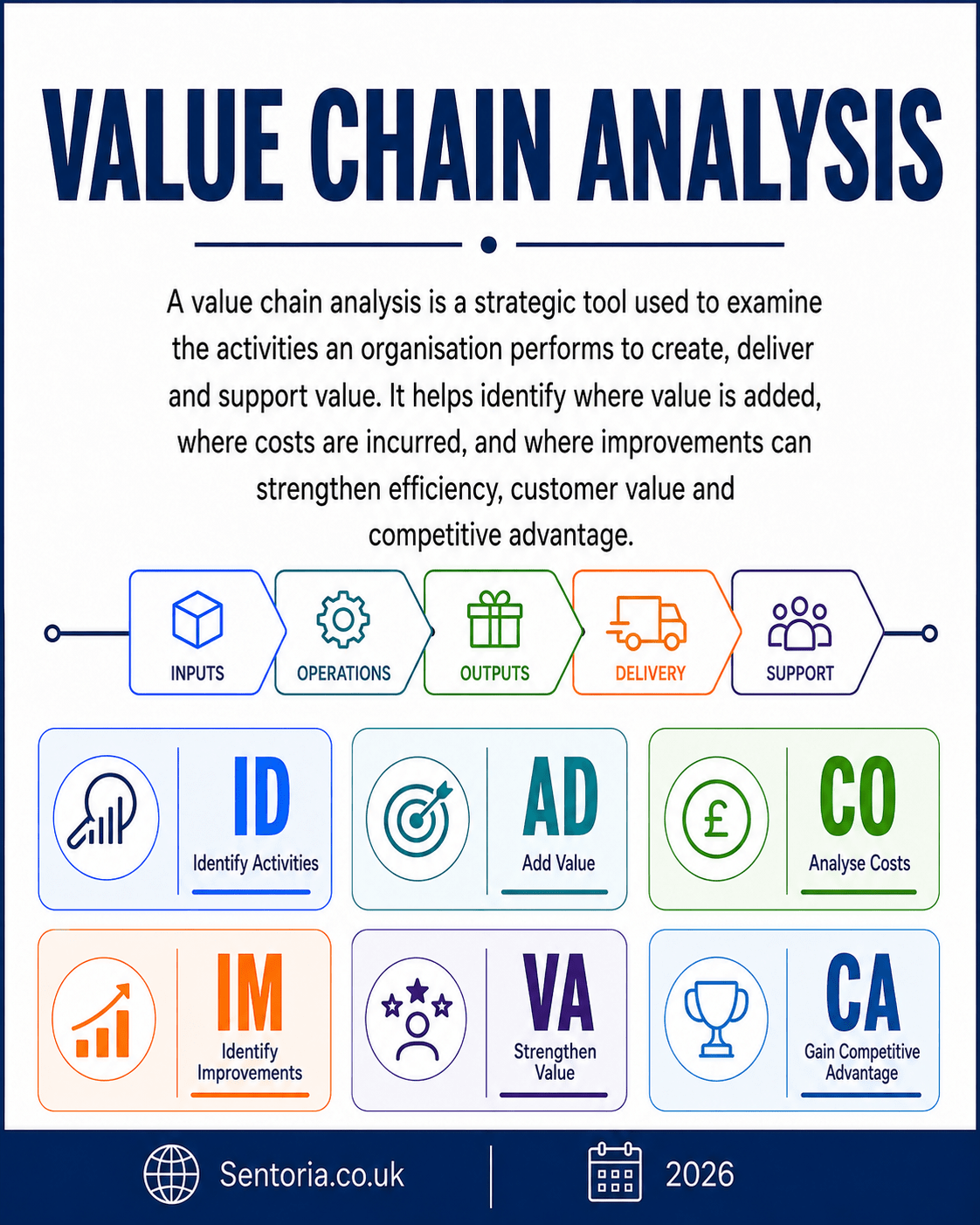
Value chain analysis is a strategic planning tool used to understand the activities through which an organisation creates, delivers and supports value for its customers, clients, service users or stakeholders.
At its simplest, value chain analysis asks:
What activities do we perform, which of them create value, what do they cost, and how can they be improved to strengthen competitive advantage?
That makes it useful for business strategy, operational improvement, cost control, pricing, customer experience, process redesign, manufacturing, service delivery, digital transformation and management accounting.
Michael Porter’s value chain framework was developed to break a company down into its strategically important activities, so managers can understand where competitive advantage comes from. Harvard Business School’s Institute for Strategy and Competitiveness describes the value chain as a tool for disaggregating a company into strategically relevant activities, focusing on sources of competitive advantage such as higher prices or lower costs.
Used properly, value chain analysis helps organisations move beyond broad statements such as “we need to be more efficient” or “we need to add more value”. It shows where value is actually created, where cost is incurred, where processes are weak, and where strategic improvement is possible.
What is value chain analysis?
Value chain analysis is the structured review of the activities involved in producing, delivering and supporting a product or service.
The Chartered Institute of Management Accountants’ official terminology describes the value chain as a sequence of business activities through which, from the end user’s perspective, value is added or costs are incurred in relation to the products or services produced by an entity.
In simple terms, every organisation performs activities to create something of value.
For a manufacturer, this may include buying raw materials, production, storage, distribution, marketing, sales and after-sales service.
For a professional services firm, it may include client acquisition, onboarding, technical work, review, advice, billing and relationship management.
For a charity, it may include fundraising, referral, assessment, service delivery, safeguarding, impact reporting and funder engagement.
For a public body, it may include policy design, resident engagement, commissioning, service delivery, compliance, monitoring and review.
The point of value chain analysis is to look at these activities deliberately. It asks which activities matter most, which activities create differentiation, which activities create unnecessary cost, and which activities need to be improved, outsourced, automated, protected or redesigned.
History and development of value chain analysis
Value chain analysis is most closely associated with Michael E. Porter, who introduced the value chain in his 1985 book Competitive Advantage: Creating and Sustaining Superior Performance. Harvard Business School’s Institute for Strategy and Competitiveness identifies the value chain as a framework developed by Porter and used globally to analyse strategically relevant activities and sources of competitive advantage.
Porter’s work built on the broader field of competitive strategy. His earlier Five Forces framework examined industry structure and the external forces affecting profitability. The value chain complemented that by looking inside the organisation. It helped explain how a firm’s activities create cost advantage or differentiation.
The important shift was from seeing a business as a single unit to seeing it as a system of linked activities. Porter’s framework encouraged managers to ask not only whether the organisation was profitable, but where in the chain value was created or lost.
Over time, value chain analysis expanded beyond manufacturing and traditional business strategy. It became widely used in management accounting, supply chain management, operational improvement, procurement, service design, digital transformation, sustainability, outsourcing and strategic cost management.
The concept also developed into broader thinking about value systems and extended value chains. Harvard Business School notes that a company’s value chain is typically part of a larger value system involving suppliers upstream and distribution channels downstream.
That is important because organisations rarely create value entirely on their own. Suppliers, distributors, partners, technology providers, funders, contractors and customers may all affect value creation. Modern value chain analysis therefore often looks beyond internal activities to understand the wider ecosystem.
The primary and support activities in Porter’s value chain
Porter’s traditional value chain divides activities into two broad groups:
- Primary activities
- Support activities
Primary activities are directly involved in creating, selling, delivering and supporting the product or service.
Support activities enable the primary activities to work effectively.
Primary activities
1. Inbound logistics
Inbound logistics covers the receipt, storage and movement of inputs into the organisation.
In a manufacturing business, this may include raw materials, components, warehousing, stock control and supplier deliveries.
In a service business, it may include information, client data, referrals, documents, enquiries, case files or digital inputs.
Questions to ask:
- Are inputs reliable and timely?
- Are supplier arrangements efficient?
- Is stock or information being handled properly?
- Are delays created before work even begins?
- Are costs being increased by poor ordering, storage or scheduling?
- Are quality problems entering the process at this stage?
Inbound logistics matters because poor inputs create problems downstream.
2. Operations
Operations are the activities that turn inputs into products, services or outputs.
This is often the most visible part of the value chain.
In manufacturing, operations include production, assembly, testing and quality control.
In professional services, operations include technical work, advice, drafting, review and delivery.
In charities, operations may include assessment, support, casework, safeguarding and intervention.
Questions to ask:
- Which activities actually create value?
- Where are the bottlenecks?
- Are processes consistent?
- Are errors, duplication or rework occurring?
- Are systems supporting or slowing delivery?
- Is quality being built in or checked too late?
Operations are often where cost, quality and customer experience are most directly affected.
3. Outbound logistics
Outbound logistics covers the delivery of the finished product or service to the customer or user.
For manufacturers and retailers, this includes storage, order fulfilment, delivery, transport and distribution.
For service organisations, this may include issuing reports, delivering advice, providing access, completing projects or transferring outputs to the customer.
Questions to ask:
- Is delivery reliable?
- Are customers receiving the output in the right format?
- Are delays damaging customer experience?
- Are distribution costs too high?
- Is handover clear?
- Is there unnecessary friction at the final delivery stage?
This part of the chain is important because a strong product or service can still be undermined by poor delivery.
4. Marketing and sales
Marketing and sales cover how the organisation communicates value, attracts customers, converts interest and secures income.
This includes brand positioning, content, advertising, proposals, tenders, sales conversations, pricing, customer segmentation and relationship development.
Questions to ask:
- Is the value proposition clear?
- Are we reaching the right customers?
- Are sales and marketing aligned?
- Are we competing on price when we should be competing on value?
- Are proposals and sales processes effective?
- Are customer acquisition costs sustainable?
Marketing and sales are not just promotional activities. They are part of how value is communicated and captured.
5. Service
Service includes the support provided after the sale or delivery.
This may include maintenance, customer support, training, repairs, account management, aftercare, feedback, complaint handling and ongoing advice.
Questions to ask:
- Are customers supported properly after purchase or delivery?
- Does service strengthen retention?
- Are complaints being used as learning?
- Are aftercare costs understood?
- Could better service create differentiation?
- Could poor service damage reputation?
Service is often a major source of competitive advantage, especially where trust, reliability or long-term relationships matter.
Support activities
1. Firm infrastructure
Infrastructure includes management, finance, legal, governance, compliance, administration, planning and reporting.
These functions may not always be visible to customers, but they shape the organisation’s ability to perform.
Questions to ask:
- Is management information reliable?
- Are decisions supported by good data?
- Are financial controls strong?
- Are governance and compliance effective?
- Are reporting systems useful or bureaucratic?
- Does the organisation have the structure needed to deliver its strategy?
Weak infrastructure can undermine the whole value chain.
2. Human resource management
Human resource management includes recruitment, training, development, reward, performance management, culture and workforce planning.
People are often central to value creation, especially in service organisations.
Questions to ask:
- Do we have the right skills?
- Are staff engaged and supported?
- Is training aligned with strategy?
- Are key roles dependent on too few people?
- Is staff turnover damaging delivery?
- Does the culture support quality, improvement and customer value?
In many organisations, the people dimension is not just a support activity. It is one of the main sources of value.
3. Technology development
Technology development includes systems, software, automation, research, product development, data, digital tools and process improvement.
Questions to ask:
- Are systems helping or hindering work?
- Could automation reduce cost or error?
- Is data being used properly?
- Are technology investments linked to value creation?
- Is cyber risk being managed?
- Is the organisation keeping pace with customer expectations?
Technology can strengthen every part of the value chain, but only if it supports the right processes.
4. Procurement
Procurement includes acquiring goods, services, equipment, software, professional advice, premises, contractors and other resources.
Questions to ask:
- Are we buying well?
- Are supplier relationships strategic or purely transactional?
- Are procurement decisions based only on price?
- Are suppliers creating value or risk?
- Are contracts and service levels clear?
- Are we overly dependent on a small number of suppliers?
Procurement affects cost, quality, resilience and flexibility.
Why value chain analysis matters
Value chain analysis matters because competitive advantage is usually created through activities, not slogans.
An organisation may say it wants to be lower cost, more responsive, higher quality, more innovative or more customer-focused. Value chain analysis asks whether its activities actually support that position.
Harvard Business School’s Institute for Strategy and Competitiveness makes the point that activities and the value chain in which they are embedded are the basic units of competitive advantage. It also notes that strategy is reflected in choices about how activities are configured and linked together.
That is the key insight.
Strategy is not only what an organisation says. It is how it chooses to operate.
A value chain analysis can help identify:
- Where value is created
- Where cost is incurred
- Where customers experience friction
- Where quality problems arise
- Where processes are duplicated
- Where technology could help
- Where outsourcing may make sense
- Where activities should remain protected internally
- Where margins are being eroded
- Where the organisation can differentiate
This makes it useful for both growth and improvement. It can help an organisation become more efficient, but it can also help it become more distinctive.
When to use value chain analysis
Value chain analysis is useful when an organisation wants to understand how work is done and how value is created.
Good uses include:
- Strategic planning
- Cost reduction
- Margin improvement
- Process redesign
- Customer experience improvement
- Digital transformation
- Outsourcing decisions
- Pricing strategy
- Product or service development
- Supply chain review
- Operational improvement
- Business model review
- Competitor comparison
- Merger or acquisition review
- Sustainability and ESG review
It is especially useful where an organisation has grown organically and processes have become unclear, duplicated or inefficient.
It is less useful if treated only as a theoretical diagram. The real value comes from using it to identify practical changes.
Value chain analysis in different industries
SMEs and owner-managed businesses
For SMEs, value chain analysis can help reveal where time, cost and effort are being absorbed.
Small businesses often grow around people rather than processes. The owner, key staff and informal routines may hold the business together. That can work for a while, but it creates risk as the business grows.
An SME value chain analysis might examine:
- How enquiries are generated
- How quotes are prepared
- How work is scheduled
- How products or services are delivered
- How customers are supported
- How invoices are raised
- How cash is collected
- How suppliers are managed
- How quality is reviewed
- How repeat business is encouraged
For SMEs, the aim is usually practical: reduce waste, improve margins, make the business less owner-dependent and strengthen customer value.
Manufacturing
Value chain analysis is particularly natural in manufacturing because activities are often visible, measurable and process-based.
A manufacturer might review:
- Supplier selection
- Inbound materials
- Stock control
- Production planning
- Machine utilisation
- Quality control
- Waste and rework
- Packaging
- Warehousing
- Distribution
- After-sales support
- Maintenance
- Procurement
- Workforce skills
Manufacturing value chain analysis should be linked to cost per unit, downtime, scrap, rework, lead times, supplier reliability, energy usage and customer quality expectations.
It can support either cost advantage or differentiation. A manufacturer may compete by being cheaper, faster, more flexible, more reliable or technically superior.
Retail and ecommerce
In retail and ecommerce, value chain analysis helps connect product sourcing, marketing, fulfilment, customer experience and margin.
A retailer might review:
- Product selection
- Buying and supplier terms
- Stock management
- Merchandising
- Website user experience
- Marketing and paid advertising
- Conversion rate
- Checkout process
- Fulfilment
- Delivery
- Returns
- Customer service
- Loyalty and repeat purchase
In ecommerce, the value chain should be linked closely to customer acquisition cost, gross margin, fulfilment cost, return rates and lifetime value.
A retailer may discover that the problem is not sales volume, but poor stock turn, high returns, weak margin or costly acquisition.
Professional services
For accountants, solicitors, consultants, architects and advisers, value chain analysis can reveal how expertise is turned into client value.
A professional services value chain might include:
- Lead generation
- Enquiry handling
- Client onboarding
- Scoping and engagement letters
- Information gathering
- Technical work
- Review and quality control
- Advice delivery
- Billing
- Client follow-up
- Relationship management
- Cross-selling or advisory development
This analysis often exposes avoidable friction. For example, poor onboarding may delay work. Weak information requests may create rework. Inconsistent review may reduce quality. Late billing may damage cash flow.
For professional firms, value chain analysis can help shift the business from reactive service delivery to a more structured, profitable and client-focused model.
Charities and voluntary organisations
Charities can use value chain analysis to understand how resources are turned into impact.
A charity value chain might include:
- Fundraising
- Volunteer recruitment
- Referral pathways
- Beneficiary assessment
- Service delivery
- Safeguarding
- Case management
- Partnership working
- Outcome measurement
- Impact reporting
- Funder communication
- Governance and compliance
For charities, value is not only financial. It may be social value, community benefit, improved wellbeing, prevention, family support, reduced isolation or better access to services.
Value chain analysis can help trustees and managers ask whether limited resources are being used in the activities that create the greatest impact.
Public sector and local government
In the public sector, value chain analysis can support service redesign and value-for-money reviews.
A council or public body might review:
- Resident contact
- Eligibility assessment
- Case processing
- Commissioning
- Service delivery
- Contractor management
- Complaint handling
- Performance monitoring
- Data reporting
- Compliance
- Safeguarding
- Partnership working
Public sector value is not simply profit. It may include access, fairness, statutory compliance, prevention, resident satisfaction, public trust and long-term cost reduction.
For public bodies, value chain analysis should be used carefully alongside statutory duties, equality considerations, consultation and risk management.
Property and construction
Property and construction value chains can be complex because value is created across long project timelines.
A property value chain might include:
- Site acquisition
- Legal due diligence
- Planning strategy
- Design
- Funding
- Procurement
- Construction
- Utilities
- Letting or sale
- Asset management
- Maintenance
- Tenant relationships
- Exit or long-term holding strategy
For construction firms, the value chain may include tendering, estimating, procurement, project management, subcontractor control, health and safety, quality, client handover and defects management.
Value chain analysis can help identify where project margin is lost: poor estimating, weak procurement, delay, rework, contractor failure, planning risk, specification changes or poor handover.
Technology and software
Technology businesses can use value chain analysis to understand how ideas become products, customers and recurring value.
A software value chain might include:
- Customer discovery
- Product design
- Development
- Testing
- Deployment
- Sales and onboarding
- Customer success
- Support
- Data and analytics
- Security
- Product improvement
- Renewals and expansion
For software businesses, value chain analysis should be linked to churn, onboarding time, support tickets, uptime, feature adoption, customer acquisition cost and lifetime value.
It can also reveal where technical debt or poor onboarding damages future growth.
Healthcare and social care
Healthcare and social care value chains must be analysed with care because quality, safety and dignity are central.
A care service value chain might include:
- Referral
- Assessment
- Care planning
- Staffing
- Service delivery
- Medication management
- Safeguarding
- Family communication
- Quality review
- Incident reporting
- Regulatory compliance
- Outcome monitoring
The purpose is not simply efficiency. It is safe, effective, person-centred care delivered sustainably.
Value chain analysis can help identify where delays, handovers, poor information, workforce shortages or weak systems affect quality.
Education and training
Education providers can use value chain analysis to understand how learner value is created.
An education value chain might include:
- Market need assessment
- Curriculum design
- Student recruitment
- Enrolment
- Teaching delivery
- Learner support
- Assessment
- Feedback
- Progression
- Employer engagement
- Quality assurance
- Alumni relationships
For training providers, the value chain should connect learner outcomes, employer demand, delivery cost, funding, retention and progression.
How to carry out value chain analysis properly
1. Define the purpose
Start with a clear question.
For example:
- Where are we losing margin?
- How do we create value for customers?
- Which activities should we improve?
- Which activities should we outsource or automate?
- Where are customers experiencing friction?
- How can we differentiate from competitors?
- Which activities are strategically important?
- How can we reduce cost without damaging value?
Without a clear purpose, the analysis becomes too broad.
2. Define the scope
Decide whether the analysis covers:
- The whole organisation
- One product
- One service
- One department
- One customer journey
- One project
- One market segment
- One process
A whole organisation value chain may be useful for strategy. A narrower value chain may be better for operational improvement.
3. Map the activities
List the activities involved in creating, delivering and supporting value.
Start with the customer outcome and work backwards if needed.
Ask:
- What happens first?
- What happens next?
- Who performs each activity?
- What inputs are required?
- What systems are used?
- What outputs are produced?
- What handovers occur?
- Where does the customer experience the process?
The activity map should reflect reality, not the process manual.
4. Separate primary and support activities
Classify activities into primary and support categories.
This helps distinguish between activities directly involved in delivery and activities that enable delivery.
However, do not become too rigid. In service organisations, support activities such as people, systems and data may be central to the value proposition.
5. Assess cost
For each activity, identify the cost.
This may include:
- Staff time
- Materials
- Software
- Premises
- Equipment
- Supplier cost
- Finance cost
- Management time
- Rework
- Waste
- Delay
- Compliance cost
The aim is not perfect accounting precision at first. The aim is to understand where significant cost sits.
6. Assess value
For each activity, ask how it contributes to customer value.
Does it improve:
- Quality?
- Speed?
- Reliability?
- Convenience?
- Trust?
- Safety?
- Compliance?
- Experience?
- Customisation?
- Outcome?
- Reputation?
- Differentiation?
Some activities may be necessary but not visible to customers. Others may be highly valued and strategically important.
7. Identify cost drivers and value drivers
Cost drivers are the factors that increase or reduce cost.
Examples include:
- Volume
- Complexity
- Rework
- Labour intensity
- Technology
- Supplier terms
- Errors
- Stock levels
- Compliance burden
- Customer variation
Value drivers are the factors that increase customer benefit or willingness to pay.
Examples include:
- Speed
- Quality
- Expertise
- Convenience
- Design
- Relationship
- Reliability
- Availability
- Brand
- Risk reduction
The strongest strategies often improve value drivers while controlling cost drivers.
8. Compare with competitors or alternatives
Value chain analysis becomes more powerful when compared with competitors.
Ask:
- Do competitors perform this activity differently?
- Are they faster, cheaper or more reliable?
- Do they outsource activities we keep in-house?
- Do they use technology better?
- Do they offer better service after delivery?
- Are they stronger in procurement, marketing or distribution?
- Where are we genuinely different?
This helps link value chain analysis to competitor analysis.
9. Identify improvement options
Possible actions include:
- Remove unnecessary steps
- Automate repetitive tasks
- Improve handovers
- Standardise processes
- Train staff
- Change supplier arrangements
- Outsource non-core activities
- Bring strategic activities in-house
- Improve customer communication
- Redesign the service
- Invest in technology
- Improve quality control
- Change pricing
- Reallocate resources
The aim is not only to reduce cost. The aim is to strengthen the organisation’s ability to create and capture value.
10. Prioritise and implement
Rank improvement options by:
- Strategic importance
- Customer impact
- Cost saving
- Revenue potential
- Risk reduction
- Ease of implementation
- Required investment
- Timescale
- Capacity
- Dependencies
Then assign owners, deadlines and measures of success.
Without implementation, value chain analysis remains only a diagram.
Common mistakes in value chain analysis
Mistake 1: Treating every activity as equally important
Some activities are strategically critical. Others are routine.
A good analysis identifies which activities create differentiation, affect cost or drive customer experience.
Mistake 2: Focusing only on cost reduction
Value chain analysis can reduce cost, but it is not only a cost-cutting tool.
Cutting an activity that customers value may damage the business.
Mistake 3: Ignoring support activities
Support activities such as people, technology, procurement and infrastructure can be major sources of advantage.
Poor systems, weak training or bad management information can undermine the whole chain.
Mistake 4: Mapping the official process rather than reality
Process documents often show how work is supposed to happen.
Value chain analysis must show what actually happens.
Mistake 5: Ignoring the customer’s perspective
A process may look efficient internally but still frustrate customers.
The analysis should consider customer experience, not only internal workflow.
Mistake 6: Overlooking handovers
Value is often lost at handover points.
Examples include sales to operations, operations to finance, supplier to production, project team to customer, or adviser to client.
Mistake 7: Analysing activities without financial data
Value chain analysis should connect to cost, margin, pricing and performance.
A purely qualitative review may miss where the real economic issues sit.
Mistake 8: Assuming technology is always the answer
Technology can improve the value chain, but automating a poor process may simply make poor performance happen faster.
Process clarity should come first.
Mistake 9: Ignoring the wider value system
Suppliers, distributors, partners and customers may all affect value creation.
A narrow internal review may miss important external dependencies.
Mistake 10: No action plan
A value chain map without action is only a picture.
The value comes from changing activities, resources, systems, responsibilities and measures.
Limitations and weaknesses of value chain analysis
Value chain analysis is useful, but it has limits.
It can be too linear
Traditional value chain diagrams can imply that value moves neatly from input to output.
Many modern organisations operate through networks, platforms, ecosystems and feedback loops.
It can be harder to apply to services
In services, value is often created through people, knowledge, trust, relationships and customer participation.
These can be harder to map than physical goods.
It can underplay external disruption
Value chain analysis looks closely at activities. It may not fully capture political, economic, technological or regulatory change unless combined with external analysis.
It can become too operational
The tool can drift into process mapping and lose sight of strategy.
The key question should always be how activities support competitive advantage or organisational value.
It may miss intangible value
Brand, trust, culture, data, relationships and reputation can be difficult to allocate to specific activities.
However, they may be central to value creation.
It depends on good information
Poor cost data, weak management information or unclear processes can limit the analysis.
It can create internal defensiveness
People may feel their work is being judged or threatened.
Good facilitation is important. The purpose should be improvement, not blame.
It does not choose the strategy by itself
Value chain analysis provides insight. Leaders still need to make choices about positioning, investment, pricing, service design and risk.
Value chain analysis compared with other strategic tools
Value chain analysis and SWOT
SWOT summarises strengths, weaknesses, opportunities and threats.
Value chain analysis provides evidence for strengths and weaknesses by examining activities.
Use value chain analysis to make SWOT more specific and operationally grounded.
Value chain analysis and PESTLE
PESTLE examines external factors.
Value chain analysis examines internal activities and the wider value system.
Use PESTLE to understand external change, then use value chain analysis to assess how those changes affect activities, costs and value.
Value chain analysis and Porter’s Five Forces
Five Forces analyses industry structure and competitive pressure.
Value chain analysis examines the internal activities through which a firm competes.
Use Five Forces to understand the market. Use value chain analysis to understand how the organisation can compete within that market.
Value chain analysis and TOWS
TOWS turns SWOT findings into strategic options.
Value chain analysis can identify activity-based strengths and weaknesses that feed into TOWS.
Value chain analysis and Business Model Canvas
The Business Model Canvas shows how an organisation creates, delivers and captures value.
Value chain analysis goes deeper into the activities that make the model work.
Use the Canvas for business model logic. Use value chain analysis for operational and strategic activity detail.
Value chain analysis and Balanced Scorecard
The Balanced Scorecard turns strategy into objectives, measures and actions.
Value chain analysis can help identify which activities need measures and improvement targets.
Value chain analysis and risk register
Weaknesses in the value chain can create risks.
For example, supplier dependency, poor quality control, weak cyber security, staff dependency or poor handovers may need to be recorded in the risk register.
Value chain analysis and scenario planning
Scenario planning tests strategy against different futures.
Value chain analysis can show which activities are most exposed under each scenario.
For example, high energy prices may affect operations. Labour shortages may affect service delivery. Regulation may affect compliance activities.
Alternatives and complementary frameworks
Process mapping
Process mapping shows the steps in a workflow.
Use it when the main aim is to improve a specific process.
Customer journey mapping
Customer journey mapping focuses on the customer’s experience.
Use it when customer friction, satisfaction or service quality is the issue.
Lean management
Lean focuses on reducing waste and improving flow.
Use it when efficiency, rework, delay or overprocessing are major problems.
Activity-based costing
Activity-based costing assigns costs to activities more accurately.
Use it when the organisation needs a clearer understanding of cost drivers and profitability.
Business Model Canvas
Use it to understand the overall business model before looking deeper into the value chain.
Porter’s Five Forces
Use it to understand competitive pressure before deciding which value chain activities need strengthening.
Benchmarking
Benchmarking compares performance against other organisations.
Use it to assess whether value chain activities are competitive.
Supply chain analysis
Supply chain analysis focuses on suppliers, logistics and external flows.
Use it when external dependencies, procurement, stock or distribution are central.
Service blueprinting
Service blueprinting maps customer actions, front-stage activities, back-stage activities and support processes.
Use it for service design and customer experience improvement.
Digital transformation review
Use it when technology may change how value is created, delivered or captured.
A practical value chain analysis template
A useful value chain analysis template should include:
- Activity category
- Specific activity
- Purpose of the activity
- Owner
- Inputs
- Outputs
- Systems used
- Cost
- Time required
- Customer value created
- Quality issues
- Risks
- Dependencies
- Performance measure
- Improvement opportunity
- Priority
- Action owner
- Deadline
- Expected benefit
- Review date
Example:
Activity: Client onboarding
Category: Primary activity
Purpose: Gather information, set expectations and start work efficiently
Current issue: Incomplete information causes delays and rework
Customer value: Faster start, clearer communication and better experience
Cost impact: Staff time lost chasing missing information
Improvement action: Create standard onboarding checklist and digital information request
Owner: Operations Manager
Measure: Percentage of complete onboarding packs received before work starts
Review date: Monthly
Questions to ask during value chain analysis
Activity questions
- What activities do we perform?
- Which activities are primary?
- Which activities are support activities?
- Who performs each activity?
- What inputs are required?
- What outputs are produced?
- What systems are used?
- Where are the handovers?
- Which activities are duplicated?
- Which activities are unnecessary?
Cost questions
- What does each activity cost?
- Which activities consume the most staff time?
- Where is rework occurring?
- Where are delays creating cost?
- Which activities have hidden costs?
- Which suppliers affect cost most?
- Which activities drive overhead?
- Are costs aligned with customer value?
- Could cost be reduced without damaging quality?
- Which costs are strategic and which are waste?
Value questions
- Which activities matter most to customers?
- Which activities improve quality?
- Which activities improve speed?
- Which activities reduce risk?
- Which activities create differentiation?
- Which activities support trust?
- Which activities increase willingness to pay?
- Which activities are invisible but essential?
- Which activities create social or public value?
- Which activities should be protected?
Improvement questions
- What should be simplified?
- What should be automated?
- What should be standardised?
- What should be outsourced?
- What should be brought in-house?
- What should be invested in?
- What should be stopped?
- What should be measured?
- What needs better ownership?
- What would improve customer value most?
Strategic questions
- Does our value chain support our strategy?
- Are we configured for cost advantage, differentiation or focus?
- Are our activities aligned or contradictory?
- Are we trying to be premium while operating like a low-cost provider?
- Are we trying to be low-cost while carrying unnecessary complexity?
- Which activities make us distinctive?
- Which activities are easy for competitors to copy?
- Which activities should we not outsource?
- What does the value chain say about our real strategy?
- What choices do we need to make?
The best way to think about value chain analysis
Value chain analysis is not just process mapping.
It is a strategic tool for understanding how activities create value and competitive advantage.
A good value chain analysis should be:
- Customer-focused
- Evidence-based
- Activity-based
- Linked to cost and value
- Honest about weaknesses
- Clear about strategic priorities
- Connected to action
- Reviewed as the organisation changes
A weak value chain analysis is a diagram with boxes.
A strong value chain analysis explains how the organisation works, where value is created, where cost is incurred, and what needs to change.
The key question is not simply:
What activities do we perform?
The better question is:
Which activities create value, which activities absorb cost, and how should we configure them to strengthen performance and advantage?
Conclusion: value chain analysis turns activity into strategic insight
Value chain analysis remains useful because every organisation creates value through activities.
Those activities may involve materials, people, systems, suppliers, technology, relationships, knowledge, data, service delivery or customer support. Some activities create clear value. Some are necessary but costly. Some are weak, duplicated or outdated. Some may be the real source of advantage.
Used badly, value chain analysis becomes a process diagram that sits in a strategy document.
Used properly, it becomes a practical management tool. It helps leaders understand how the organisation actually creates value, where costs arise, where customers experience quality or friction, and where improvement will have the greatest effect.
The real value is not in drawing the chain. The real value is in changing what happens inside it.
A strong value chain analysis helps an organisation make better choices about cost, quality, differentiation, technology, outsourcing, investment and customer experience.
In short, it helps answer one of the most important questions in strategy:
How do we turn what we do into value that customers recognise, and performance that the organisation can sustain?