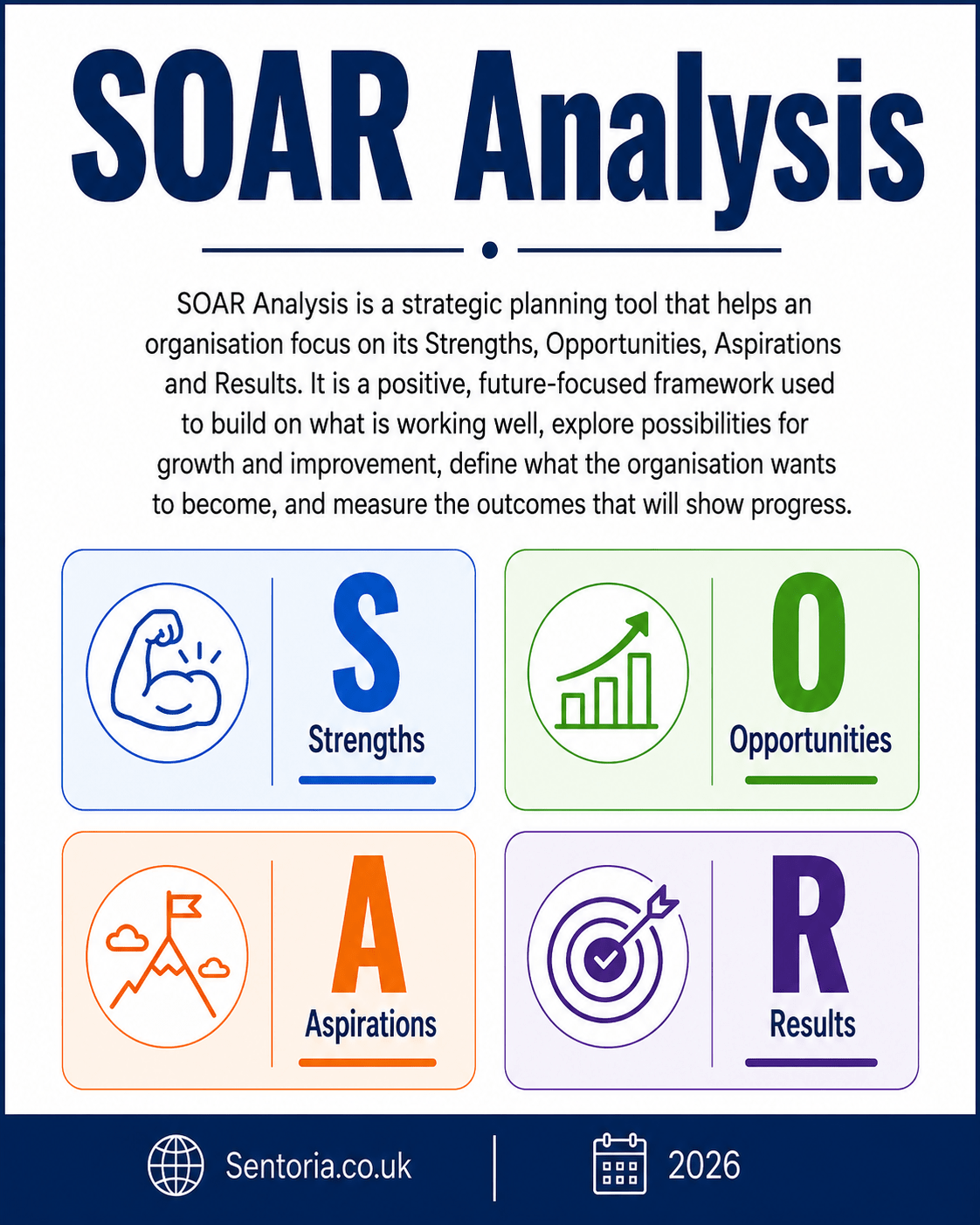
SOAR Analysis:
A Practical Guide to Strengths, Opportunities, Aspirations and Results
A SOAR analysis is a strategic planning tool used to help an organisation focus on what it does well, identify future opportunities, define what it wants to become, and agree the results that will show progress.
SOAR stands for:
Strengths
Opportunities
Aspirations
Results
It is often seen as a more positive and future-focused alternative to SWOT analysis. Where SWOT considers strengths, weaknesses, opportunities and threats, SOAR keeps the focus on strengths and opportunities, then adds aspirations and measurable results.
In simple terms:
SWOT asks: what is our current position?
SOAR asks: what is possible, what do we want to become, and how will we know we are getting there?
SOAR is closely linked to Appreciative Inquiry, a positive approach to organisational change that focuses on what is working, what gives energy, and what can be built upon. NASTAD’s SOAR worksheet describes SOAR as a strategic planning instrument that helps an organisation focus on current strengths, project its vision for the future, and complement SWOT by enhancing what is already done well.
Used properly, SOAR can be a powerful tool for strategic planning, team development, organisational change, stakeholder engagement and culture-building.
What is a SOAR analysis?
A SOAR analysis is a structured framework for strategic thinking and planning.
It examines four areas:
Strengths
What are we already good at? What assets, capabilities, achievements, relationships, resources or qualities can we build upon?
Opportunities
What external possibilities, trends, partnerships, needs or developments could help us move forward?
Aspirations
What do we want to become? What future do we want to create? What would success feel like and look like?
Results
What measurable outcomes will show that we are making progress? What indicators, targets or evidence will demonstrate success?
The SOAR framework is designed to be collaborative. It works best when it includes the voices of people who understand the organisation from different perspectives. A programme review handbook from Thompson Rivers University describes SOAR as a strategic approach that focuses on strengths and seeks to understand an organisation and its environment by including relevant stakeholders.
The key difference from many traditional planning tools is tone and orientation. SOAR is not primarily about finding faults. It is about identifying what is working and using that as the basis for positive action.
History and development of SOAR analysis
SOAR developed from the wider field of Appreciative Inquiry, often shortened to AI.
Appreciative Inquiry is a positive approach to change that looks for the best of what already exists and uses that as the foundation for improvement. The Center for Appreciative Inquiry describes AI as an inclusive process that builds creativity, shared vision and purpose by building on an organisation’s core values and strengths. It commonly uses a 5D process: Define, Discover, Dream, Design and Destiny.
SOAR took that appreciative mindset and applied it to strategic planning.
The framework is closely associated with Jacqueline M. Stavros and Gina Hinrichs, whose 2009 book The Thin Book of SOAR: Building Strengths-Based Strategy helped popularise the model. Google Books describes SOAR in that book as a strategic planning process based on discovering and multiplying what an organisation does well, applying Appreciative Inquiry to provide a strategic thinking and dialogue process.
SOAR can therefore be understood as part of a broader shift in management thinking. Instead of viewing strategy only through gaps, weaknesses, problems and competitive threats, SOAR asks leaders and teams to explore strengths, potential, shared ambition and measurable outcomes.
That does not mean SOAR ignores risk or weakness. A good SOAR process should still be honest. The difference is that weaknesses and threats are often reframed as opportunities for improvement, development or strategic action.
The four elements of SOAR analysis
1. Strengths
Strengths are the qualities, assets and capabilities that the organisation can build upon.
These may include:
- Reputation
- Customer loyalty
- Skilled staff
- Strong values
- Community trust
- Financial resilience
- Specialist knowledge
- Technology
- Partnerships
- Good systems
- Brand recognition
- Track record
- Local presence
- Strong leadership
The strengths section should not become a list of generic positives. It should identify the strengths that are most relevant to future strategy.
For example, “good staff” is too vague.
A stronger point would be:
“Our team has strong technical knowledge, low turnover and trusted relationships with long-standing customers.”
That is specific. It explains why the strength matters.
2. Opportunities
Opportunities are external possibilities that the organisation could use to improve, grow, innovate or increase impact.
These may include:
- Market growth
- New technology
- Customer demand
- Funding availability
- Partnership opportunities
- Regulatory change
- Competitor weakness
- Demographic change
- Local regeneration
- New delivery channels
- Workforce trends
- Policy priorities
- Community need
- New product or service ideas
In SOAR, opportunities are usually explored positively. Rather than simply asking what external factors might help or harm the organisation, SOAR asks what possibilities could be created by combining external opportunities with existing strengths.
For example:
“What new services could we develop because of our existing expertise?”
“What partnerships could we build because of our local reputation?”
“What technology could help us do more of what we already do well?”
3. Aspirations
Aspirations describe the future the organisation wants to create.
This is one of the most distinctive parts of SOAR.
Aspirations are not just targets. They are statements of ambition, identity and direction. They ask what the organisation wants to become, how it wants to be known, and what difference it wants to make.
Examples include:
- To become the most trusted local provider in our sector.
- To be recognised for practical, jargon-free advice.
- To become financially sustainable while increasing community impact.
- To build a workplace where people feel valued, skilled and motivated.
- To create a service model that is accessible, responsive and high quality.
- To become a leading specialist in a defined niche.
- To use technology to improve service without losing personal relationships.
Aspirations should be ambitious, but credible. They should stretch the organisation without becoming empty slogans.
4. Results
Results define how progress will be measured.
This is the part of SOAR that prevents it from becoming vague or overly inspirational.
Results may include:
- Revenue growth
- Profitability
- Cash flow
- Customer retention
- Customer satisfaction
- Beneficiary outcomes
- Service quality
- Staff engagement
- Volunteer retention
- Fundraising success
- Market share
- Website enquiries
- Delivery speed
- Impact measures
- Cost reduction
- Project milestones
A good SOAR analysis should always ask:
How will we know whether our aspirations are becoming reality?
The Results section should include clear measures, not just hopes.
Why SOAR analysis matters
SOAR matters because many planning exercises can become negative, defensive or problem-heavy.
Traditional analysis is valuable, but it can sometimes drain energy. Teams can spend most of their time discussing what is wrong, what is missing, what is difficult and what might go badly. That may identify real risks, but it does not always create commitment, confidence or action.
SOAR takes a different starting point.
It asks:
- What is working well?
- What gives us energy?
- What strengths can we build upon?
- What future do we want to create?
- What opportunities fit who we are?
- What results would prove progress?
This makes SOAR particularly useful where engagement matters. It can help involve staff, trustees, volunteers, partners, customers, service users and other stakeholders in a more constructive strategic conversation.
The Center for Appreciative Inquiry describes SOAR as a positive approach to strategic thinking, planning, leading and conversations, allowing people at different levels of an organisation to contribute to strategy and strategic plans.
When to use SOAR analysis
SOAR is useful when the organisation wants to develop strategy in a positive, participative and future-focused way.
Good uses include:
- Strategic planning
- Team development
- Culture change
- Charity strategy
- Stakeholder engagement
- Service improvement
- Departmental planning
- Leadership development
- Organisational development
- Brand positioning
- Community planning
- Programme review
- Business model development
- Change management
- Personal development planning
SOAR is especially useful when morale, engagement or confidence matters. It can help teams move away from blame or problem lists and towards shared ambition.
It is less suitable when the organisation needs a hard risk assessment, crisis response, compliance review or forensic analysis of failure. In those cases, SOAR may still help later, but it should not replace direct problem-solving.
SOAR analysis in different industries
SMEs and owner-managed businesses
For SMEs, SOAR can help owners and managers focus on what makes the business distinctive.
Strengths may include customer relationships, technical knowledge, local reputation, flexibility, speed of decision-making or specialist service. Opportunities may include local growth, digital marketing, new services, partnerships, competitor weakness or technology. Aspirations may include becoming more profitable, less owner-dependent, more advisory, more specialised or more resilient. Results may include higher margins, recurring revenue, better cash flow, improved customer retention or reduced reliance on one customer.
For an SME, SOAR is useful because it can shift the discussion from survival to direction.
It asks:
“What are we already good at, and how can we build a better business around that?”
Manufacturing
In manufacturing, SOAR can help identify strengths in production, quality, technical capability and customer relationships.
Strengths might include skilled labour, specialist machinery, process knowledge, quality control or long-standing supplier relationships. Opportunities may include automation, reshoring, new materials, sustainability, export markets or higher-value niches. Aspirations may include becoming a preferred specialist supplier, reducing waste, improving productivity or moving into more profitable products. Results may include improved margin, lower scrap, fewer defects, faster delivery, increased capacity or stronger customer retention.
For manufacturing, SOAR should be linked to operational data, production capacity, cost analysis and quality performance.
Retail and ecommerce
Retail businesses can use SOAR to focus on customer experience, brand, product strengths and growth channels.
Strengths may include loyal customers, product knowledge, local identity, online reach, strong merchandising or service quality. Opportunities may include ecommerce, subscriptions, local delivery, social media, marketplace selling or customer data. Aspirations may include becoming the go-to local specialist, building a stronger online community or improving customer loyalty. Results may include repeat purchase, average order value, margin, conversion rate, customer reviews and stock turnover.
For ecommerce, SOAR should be grounded in data. Positive thinking is useful, but customer acquisition cost, return rates and gross margin still matter.
Professional services
For accountants, solicitors, consultants, architects and advisers, SOAR can help clarify positioning and future direction.
Strengths may include expertise, trust, recurring clients, sector knowledge, responsiveness, professional reputation or advisory capability. Opportunities may include automation, advisory services, niche specialism, content marketing, regulatory change or client demand for better insight. Aspirations may include becoming a trusted specialist, moving from compliance to advisory, improving client experience or building a stronger team culture. Results may include recurring income, client retention, referral rates, advisory revenue, turnaround time and staff development.
For professional firms, SOAR is useful because it helps move beyond simply being busy. It asks what kind of firm the organisation wants to become.
Charities and voluntary organisations
SOAR is particularly well suited to charities because it fits well with mission, values, community, beneficiaries and stakeholder engagement.
Strengths may include community trust, committed volunteers, skilled staff, lived experience, strong partnerships or local knowledge. Opportunities may include new funding, collaboration, digital delivery, increased community awareness or local policy priorities. Aspirations may include deeper impact, sustainable funding, wider reach, stronger volunteer support or improved beneficiary outcomes. Results may include impact measures, funding diversity, reserves, volunteer retention, beneficiary satisfaction and service access.
For charities, SOAR can be more energising than a purely risk-focused review. However, it should still be combined with proper financial planning and risk management.
Public sector and local government
In public sector settings, SOAR can support service improvement, community engagement and organisational development.
Strengths may include statutory powers, local knowledge, professional staff, public accountability, data, partnerships or existing infrastructure. Opportunities may include digital transformation, preventative services, community partnerships, devolution, regeneration or better use of assets. Aspirations may include better resident experience, more efficient services, stronger community trust or earlier intervention. Results may include response times, service outcomes, satisfaction, budget performance, demand reduction and equality of access.
For public bodies, SOAR should be used alongside evidence, statutory duties, risk review and financial constraints.
Property and construction
In property and construction, SOAR can help frame opportunity around assets, sites, relationships and development potential.
Strengths may include land ownership, local reputation, planning knowledge, funding access, heritage assets, occupier relationships or professional team capability. Opportunities may include regeneration funding, planning policy support, housing need, sustainability upgrades or changing occupier demand. Aspirations may include creating a viable mixed-use scheme, improving asset quality, supporting local employment or unlocking long-term value. Results may include planning progress, rental income, capital value, occupancy, project milestones and community benefit.
For property projects, SOAR should not replace feasibility work. It should sit alongside financial appraisal, planning review, legal advice and risk assessment.
Technology and software
Technology businesses can use SOAR to focus on product strengths, innovation and future growth.
Strengths may include technical capability, intellectual property, user experience, data, development speed or customer insight. Opportunities may include AI, integrations, new platforms, automation, international markets or recurring revenue models. Aspirations may include becoming a category leader, improving user outcomes, scaling sustainably or building a strong product culture. Results may include monthly recurring revenue, churn, usage, retention, uptime, customer satisfaction and product delivery milestones.
For technology businesses, SOAR should be refreshed often because markets and technologies move quickly.
Healthcare and social care
In healthcare and care settings, SOAR can be used carefully to support quality improvement and team engagement.
Strengths may include compassionate staff, clinical expertise, trusted relationships, good outcomes, safeguarding culture or community partnerships. Opportunities may include digital records, preventative care, workforce development, partnerships or improved pathways. Aspirations may include safer care, better access, improved staff wellbeing or more person-centred services. Results may include patient or service user outcomes, inspection ratings, incident reduction, staff retention, training completion and satisfaction.
In this sector, SOAR should never replace direct risk management. Positive planning must sit alongside safeguarding, quality assurance and regulatory compliance.
Education and training
SOAR is well suited to education because it can involve staff, students, employers and partners in shaping future direction.
Strengths may include teaching quality, learner support, employer relationships, curriculum expertise, student outcomes or community role. Opportunities may include online learning, employer demand, skills funding, new qualifications or partnership working. Aspirations may include becoming a centre of excellence, improving learner progression or widening access. Results may include retention, achievement, progression, satisfaction, enrolment and employer feedback.
The Thompson Rivers University handbook uses SOAR in programme review, with strengths, opportunities, aspirations and results used to support collaborative reflection and measurable improvement.
How to carry out a SOAR analysis properly
1. Define the purpose
Start with a clear question.
For example:
- What should our strategy be for the next three years?
- How can we improve this service?
- How do we build on our strengths?
- What future do we want for this team?
- How can we increase impact?
- How should we develop our offer?
- How can we improve culture and engagement?
Without a clear purpose, SOAR can become too broad.
2. Decide who should be involved
SOAR works best when it includes multiple perspectives.
Depending on the context, this may include:
- Directors
- Managers
- Staff
- Trustees
- Volunteers
- Customers
- Service users
- Beneficiaries
- Funders
- Suppliers
- Community partners
- External advisers
The aim is to create a richer view of strengths, opportunities, aspirations and results.
3. Gather evidence
SOAR is positive, but it should not be fluffy.
Evidence may include:
- Financial performance
- Customer feedback
- Staff surveys
- Service outcomes
- Case studies
- Performance data
- Market research
- Competitor insight
- Stakeholder interviews
- Impact reports
- Project results
- Complaints and compliments
- Website analytics
- Benchmarking
Strengths should be evidenced. Opportunities should be tested. Aspirations should be grounded. Results should be measurable.
4. Identify strengths
Ask:
- What are we best at?
- What do customers or stakeholders value most?
- What achievements are we proud of?
- What capabilities make us distinctive?
- What resources do we already have?
- What gives us energy?
- What do we want to preserve as we grow or change?
This stage should be specific and evidence-based.
5. Identify opportunities
Ask:
- What external trends could help us?
- What customer or community needs are emerging?
- What partnerships could create value?
- What technology could help us improve?
- What market gaps exist?
- What funding or policy opportunities are available?
- What changes could we turn to advantage?
Opportunities should be prioritised according to fit, impact and feasibility.
6. Define aspirations
Ask:
- What do we want to become?
- What future would excite and motivate people?
- What difference do we want to make?
- How do we want to be known?
- What kind of organisation do we want to build?
- What would success feel like?
- What would be worth committing to?
Aspirations should connect emotion, purpose and strategy.
They should be ambitious enough to inspire action, but clear enough to guide decisions.
7. Define results
Ask:
- How will we know we are succeeding?
- What indicators will show progress?
- What outcomes matter most?
- What targets should we set?
- What will we measure monthly, quarterly or annually?
- What evidence will stakeholders trust?
- What does success look like in practical terms?
The Results section should turn aspiration into accountability.
8. Prioritise
SOAR can generate many ideas.
The next step is to prioritise.
For each proposed opportunity or aspiration, ask:
- Does it build on our strengths?
- Does it fit our purpose?
- Is it realistic?
- Is it affordable?
- What evidence supports it?
- What impact could it have?
- What risks need managing?
- Who would need to act?
The aim is not to do everything. It is to choose the most important strategic priorities.
9. Create an action plan
Every serious SOAR output should lead to action.
For each priority, record:
- Action
- Owner
- Deadline
- Resources required
- Success measure
- Risks
- Dependencies
- Review date
Without this step, SOAR becomes a positive conversation rather than a management tool.
10. Review progress
SOAR should not be a one-off workshop.
Review the results regularly.
Ask:
- Are we making progress?
- Are the results improving?
- Do the aspirations still fit?
- Are the opportunities still relevant?
- Are we building on strengths?
- What have we learned?
- What needs changing?
The best SOAR processes create ongoing strategic conversation.
Common mistakes in SOAR analysis
Mistake 1: Treating SOAR as positive thinking only
SOAR is positive, but it should not be superficial.
It should be evidence-based, structured and linked to action.
Mistake 2: Ignoring real problems
SOAR does not mean pretending weaknesses and threats do not exist.
It means reframing them constructively where possible. However, serious risks, compliance failures, financial weaknesses and safeguarding concerns must still be addressed directly.
Mistake 3: Being too vague about strengths
“Good people”, “good reputation” and “good service” are not enough.
Strengths should be specific, evidenced and strategically relevant.
Mistake 4: Confusing aspirations with slogans
Aspirations should not be empty statements.
They should help guide decisions and inspire action.
For example, “to be the best” is weak unless it explains what “best” means, for whom, and how it will be measured.
Mistake 5: Weak results
The Results section is often the weakest part.
If results are not measurable, the organisation cannot track progress.
A good result should be specific enough to answer:
“Has anything actually changed?”
Mistake 6: No prioritisation
SOAR can generate enthusiasm and many ideas.
That is useful, but only if ideas are prioritised and converted into action.
Mistake 7: No ownership
A SOAR output without owners, deadlines and measures is unlikely to lead to meaningful change.
Mistake 8: Using SOAR when another tool is needed
SOAR is not always the right tool.
If the task is risk assessment, financial recovery, legal compliance, audit response or crisis management, other tools may be more suitable.
Limitations and weaknesses of SOAR analysis
SOAR is useful, but it has limits.
It can underplay risk
Because SOAR focuses on strengths and opportunities, it can underplay weaknesses and threats if used carelessly.
This is why SOAR should often be used alongside SWOT, risk registers or PESTLE analysis.
It can become overly optimistic
Positive energy is useful, but strategy still needs realism.
Aspirations need to be tested against resources, capacity, cash, evidence and risk.
It may not suit urgent crisis situations
In a crisis, management may need direct action, risk containment and problem-solving.
SOAR can help rebuild after the crisis, but it may not be the best first tool when urgent control is needed.
It depends on good facilitation
SOAR relies on good questions, inclusive participation and honest discussion.
Poor facilitation can lead to vague aspirations, groupthink or avoidance of difficult issues.
It may not provide enough external analysis
SOAR includes opportunities, but it does not provide a full external analysis by itself.
PESTLE, Porter’s Five Forces and scenario planning may be needed to understand the wider environment properly.
It does not replace financial analysis
SOAR can identify ambition and results, but it does not replace budgets, cash flow forecasts, investment appraisal or sensitivity testing.
It can be misunderstood as avoiding weakness
The best SOAR processes do not deny weaknesses. They reframe problems into possibilities where appropriate, while still recognising that some risks need direct management.
SOAR compared with SWOT
SOAR and SWOT are closely related, but they are different in tone and purpose.
SWOT considers strengths, weaknesses, opportunities and threats.
SOAR considers strengths, opportunities, aspirations and results.
SWOT is often useful for diagnosis. It helps identify what is helping, what is holding the organisation back, what external opportunities exist and what threats need managing.
SOAR is more future-focused. It asks what the organisation can build upon, what possibilities exist, what future it wants to create, and how success will be measured.
The Center for Appreciative Inquiry describes SOAR as a framework that builds on SWOT and uses strengths and opportunities to support aspirations and results.
A practical way to use both is:
- Use SWOT to understand the full position.
- Use SOAR to create positive strategic direction.
- Use a risk register to manage threats.
- Use a Balanced Scorecard to track results.
SOAR should not be treated as a replacement for every other tool. It is strongest when used as part of a wider strategy process.
Alternatives and complementary frameworks
SWOT analysis
SWOT is useful when the organisation needs a balanced view of strengths, weaknesses, opportunities and threats.
Use SWOT when risks and weaknesses need to be surfaced clearly.
TOWS analysis
TOWS turns SWOT findings into strategic options.
Use TOWS when the organisation has already completed a SWOT and needs to decide what to do next.
PESTLE analysis
PESTLE examines political, economic, social, technological, legal and environmental factors.
Use PESTLE to identify external opportunities and risks before or alongside SOAR.
Porter’s Five Forces
Porter’s Five Forces analyses competitive pressure and industry structure.
Use it when market attractiveness, buyer power, supplier power, new entrants, substitutes or rivalry matter.
Business Model Canvas
The Business Model Canvas explains how an organisation creates, delivers and captures value.
Use it when SOAR identifies aspirations that may require a change to the business model.
Balanced Scorecard
The Balanced Scorecard translates strategy into objectives, measures, targets and actions.
Use it after SOAR to track whether aspirations are becoming measurable results.
Risk register
A risk register records, assesses and monitors risks.
Use it alongside SOAR to make sure optimism does not hide material risks.
Appreciative Inquiry
Appreciative Inquiry is the wider change approach that informs SOAR.
Use it when the focus is culture, engagement, organisational development or positive change.
Scenario planning
Scenario planning explores different possible futures.
Use it when aspirations and opportunities depend on uncertain external conditions.
A practical SOAR template
A useful SOAR template should include more than four boxes.
For each section, record:
- SOAR category
- Key point
- Evidence
- Strategic importance
- Possible action
- Owner
- Measure of success
- Timescale
- Risks or dependencies
- Review date
Example:
Strength: Strong relationships with local owner-managed businesses.
Opportunity: Increased demand for practical finance and tax advice.
Aspiration: Become the trusted local adviser for growing SMEs.
Result: Increase advisory revenue by 25% within 12 months, with client satisfaction above 90%.
Action: Create a structured monthly advisory package and promote it to existing clients.
Owner: Managing Director.
Review date: Quarterly.
Questions to ask in each SOAR section
Strengths
- What do we do especially well?
- What are we proud of?
- What do customers, clients, beneficiaries or stakeholders value most?
- What assets or capabilities do we already have?
- What achievements show us at our best?
- What gives people energy?
- What is difficult for others to copy?
- Which strengths are most relevant to the future?
- What should we protect as we grow or change?
- What evidence supports these strengths?
Opportunities
- What external possibilities could help us?
- What customer or community needs are emerging?
- What trends could we use positively?
- What partnerships could create value?
- What technology could help us improve?
- What funding, policy or market changes are relevant?
- What opportunities fit our strengths?
- What could we do more of?
- What could we do differently?
- What opportunities are worth prioritising?
Aspirations
- What future do we want to create?
- What do we want to be known for?
- What difference do we want to make?
- What would success look and feel like?
- What would inspire people to commit?
- What kind of organisation do we want to become?
- What would customers or stakeholders say if we achieved this?
- What ambition is realistic but stretching?
- What should stay true to our values?
- What future would make the effort worthwhile?
Results
- How will we know we are succeeding?
- What outcomes matter most?
- What should we measure?
- What targets should we set?
- What evidence will be credible?
- What will change for customers, staff or stakeholders?
- What financial results are needed?
- What non-financial results matter?
- How often should results be reviewed?
- Who owns each result?
The best way to think about SOAR
SOAR is not about ignoring reality. It is about choosing a constructive starting point.
A good SOAR analysis should be:
- Positive
- Evidence-based
- Inclusive
- Future-focused
- Specific
- Measurable
- Prioritised
- Linked to action
- Reviewed regularly
- Balanced with risk awareness
A weak SOAR analysis is vague, overly optimistic and disconnected from implementation.
The key question is not simply:
What are our strengths and opportunities?
The better question is:
How can we build on what works, create a future people believe in, and measure whether we are making real progress?
Conclusion: SOAR turns strengths into shared direction
SOAR analysis is useful because it helps organisations create strategy from a position of energy, confidence and possibility.
It does not start by asking what is broken. It starts by asking what is working, what can be built upon, what future people want to create, and what results will show progress.
That makes it especially valuable for teams, charities, community organisations, professional firms, public bodies and businesses that want strategy to be more than a document. SOAR can create engagement, shared ownership and practical momentum.
However, SOAR should not be used naively. It does not replace risk management, financial analysis, external scanning or honest discussion of serious weaknesses. Its value is strongest when it is combined with other tools and followed by clear action.
Used badly, SOAR becomes motivational language without substance.
Used properly, it becomes a practical method for turning strengths into aspirations, and aspirations into measurable results.
The real value is not in completing the four boxes. It is in the strategic conversation that follows: what we will build, why it matters, who will act, and how we will know that progress is real.