PESTLE Analysis: A Practical Guide to Understanding the External Forces That Shape Strategy
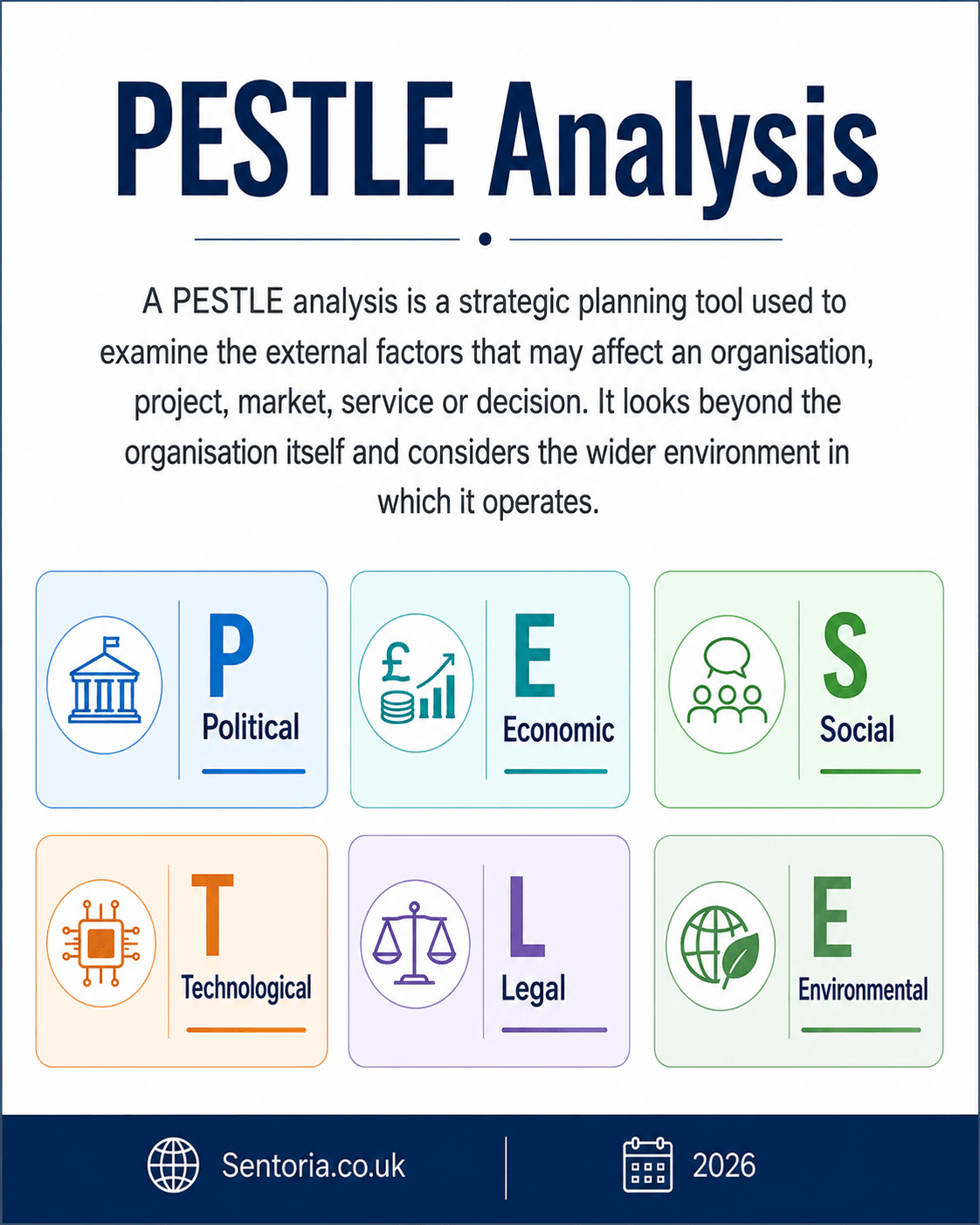
A PESTLE analysis is a strategic planning tool used to examine the external factors that may affect an organisation, project, market, service or decision. It looks beyond the organisation itself and considers the wider environment in which it operates.
PESTLE stands for:
Political
Economic
Social or Sociological
Technological
Legal
Environmental
The purpose of PESTLE is not simply to describe the world outside the organisation. Its real value is in helping leaders, managers, trustees, advisers and project teams understand how external change could create opportunities, increase risk, affect costs, reshape demand, influence regulation or alter the assumptions behind a plan.
Used properly, PESTLE helps an organisation ask a simple but important question:
What is happening outside our organisation that could affect what we are trying to achieve?
CIPD describes PESTLE as a framework for studying the key external factors that influence an organisation and support strategic decision-making. It also emphasises that PESTLE is particularly useful for understanding opportunities, threats and the wider business environment.
What is a PESTLE analysis?
A PESTLE analysis is a structured review of six external influences.
Political factors
Political factors relate to government policy, political stability, public spending, taxation, trade rules, procurement policy, industrial strategy, planning policy and the wider political climate.
Examples include:
- Changes in tax rates
- Government funding decisions
- Public sector spending priorities
- Trade restrictions or tariffs
- Political instability
- Changes in planning policy
- Devolution or local government reform
- Public procurement rules
- International relations
- War, sanctions or geopolitical tension
Political factors matter because government decisions can directly affect cost, demand, regulation, funding and confidence.
Economic factors
Economic factors relate to the financial and commercial conditions in which an organisation operates.
Examples include:
- Inflation
- Interest rates
- Exchange rates
- Wage pressure
- Consumer confidence
- Unemployment
- Economic growth or recession
- Credit availability
- Property values
- Energy prices
- Supply chain costs
- Cost of living pressures
Economic factors are often among the most visible external forces because they affect cash flow, pricing, margins, borrowing costs, investment decisions and customer behaviour.
Social factors
Social factors relate to people, culture, demographics, attitudes and behaviour.
Examples include:
- Population growth or decline
- Ageing population
- Migration patterns
- Lifestyle changes
- Consumer expectations
- Attitudes to work
- Health awareness
- Family structures
- Education levels
- Community expectations
- Social media behaviour
- Demand for flexibility, convenience or ethical behaviour
Social factors are especially important where an organisation depends on public trust, consumer behaviour, workforce availability or community support.
Technological factors
Technological factors relate to innovation, digital change, automation, data, systems and new methods of delivery.
Examples include:
- Artificial intelligence
- Automation
- Cloud computing
- Cyber security
- Data analytics
- Robotics
- Online platforms
- Digital payments
- New production methods
- Software integration
- Remote working technology
- Changes in customer communication channels
Technology can create opportunity, but it can also disrupt existing business models. CIPD specifically highlights robotics, artificial intelligence and the increasing pace of technological change as important considerations within PESTLE analysis.
Legal factors
Legal factors relate to the laws and regulations that affect the organisation.
Examples include:
- Employment law
- Health and safety law
- Data protection
- Consumer protection
- Tax law
- Environmental regulation
- Planning law
- Company law
- Charity law
- Equality law
- Contract law
- Sector-specific regulation
Legal factors are not the same as political factors. Political factors often concern policy direction and government priorities. Legal factors concern the rules that must be followed and the consequences of non-compliance.
Environmental factors
Environmental factors relate to sustainability, climate, natural resources, environmental regulation and public expectations around responsible behaviour.
Examples include:
- Climate change
- Carbon reduction
- Energy efficiency
- Waste management
- Recycling
- Flood risk
- Biodiversity
- Ethical sourcing
- Environmental reporting
- Supply chain sustainability
- Resource scarcity
- Public expectations around environmental responsibility
Environmental factors have become increasingly important because customers, funders, investors, regulators and communities now expect organisations to consider their wider environmental impact.
History and development of PESTLE analysis
PESTLE analysis developed from earlier thinking about environmental scanning in strategic management. The roots of the framework are commonly traced back to Francis J. Aguilar’s 1967 book Scanning the Business Environment, which considered Economic, Technical, Political and Social factors as part of the business environment. WorldCat records Aguilar’s book as being published by Macmillan in New York in 1967, and several business strategy summaries identify this as an important early source for the framework that later became known as PEST analysis.
The original order was not always the familiar PEST order used today. The early approach is often referred to as ETPS, based on Economic, Technical, Political and Social factors. Later writers and practitioners reordered and adapted the model, producing versions such as STEP, PEST, PESTEL, PESTLE and STEEPLE.
Over time, the basic four-factor PEST model expanded. PEST looked mainly at Political, Economic, Social and Technological factors. PESTLE or PESTEL added Legal and Environmental factors. Other variants include STEEPLE, which adds an Ethical dimension, and STEEPLED, which also includes Demographic factors. The Wiley Encyclopedia of Management notes that PESTLE adds Environmental and Legal components, while STEEPLE and STEEPLED add further dimensions.
This development reflects changes in the business environment itself. Earlier strategic planning often focused heavily on markets, economics and technology. Modern organisations must also consider regulation, sustainability, social responsibility, demographics, ethical expectations, environmental impact, data protection and workforce change.
In practical terms, PESTLE has become a broader and more modern version of PEST. It recognises that an organisation’s external environment is not only shaped by politics, economics, society and technology, but also by law, regulation, climate, sustainability and environmental expectations.
Why PESTLE analysis matters
PESTLE matters because organisations do not operate in isolation. A business, charity, public body or project can have strong leadership, good people, good systems and a sound plan, but still be affected by external events beyond its control.
A rise in interest rates can undermine an otherwise viable property project. A change in employment law can affect workforce costs. A new technology can disrupt a service model. A shift in public attitudes can damage a brand. A change in government funding can alter the future of a charity. A planning policy change can affect land values. A new environmental rule can increase compliance costs or create new opportunities.
PESTLE helps decision-makers think about these issues before they become problems.
It is particularly useful because it encourages external thinking. Many organisations are naturally inward-looking. They focus on staffing, systems, products, customers, finances and operations. Those issues matter, but they are only part of the picture. PESTLE forces the organisation to look outward and ask what is changing in the wider world.
When to use PESTLE analysis
PESTLE is useful whenever external conditions matter to a decision.
It is particularly valuable for:
- Strategic business planning
- Entering a new market
- Launching a new product or service
- Reviewing a business model
- Preparing a charity strategy
- Assessing a property development
- Reviewing public sector service delivery
- Considering investment decisions
- Planning workforce requirements
- Preparing a risk review
- Entering a new country or region
- Considering merger, acquisition or partnership opportunities
- Reviewing marketing strategy
- Testing whether an existing plan remains realistic
CIPD identifies several practical uses for PESTLE, including strategic business planning, workforce planning, marketing planning, product or service development, organisational change and people strategies.
PESTLE analysis in different industries
SMEs and owner-managed businesses
For SMEs, PESTLE is useful because smaller businesses are often highly exposed to external change. They may have limited cash reserves, fewer management resources and less ability to absorb shocks.
Political issues may include tax changes, business rates, local authority decisions or government support schemes. Economic issues may include inflation, wage pressure, customer confidence and borrowing costs. Social issues may include changing customer expectations or local demographic shifts. Technological issues may include automation, online selling, cyber security or digital accounting systems. Legal issues may include employment law, health and safety, GDPR and trading regulations. Environmental issues may include energy efficiency, waste, packaging and customer expectations around sustainability.
For SMEs, the most useful PESTLE analysis is usually short, practical and directly linked to cash flow, customer demand, cost control and risk.
Manufacturing
Manufacturing businesses are strongly affected by economic, technological, environmental and supply chain factors.
A manufacturing PESTLE should consider energy costs, input prices, exchange rates, skills shortages, automation, robotics, environmental regulation, supply chain resilience, export conditions, trade policy and health and safety requirements.
Political and legal factors may affect tariffs, product standards, employment rules and environmental compliance. Technological factors may affect productivity, quality control and competitiveness. Environmental factors may affect energy consumption, waste, emissions and customer requirements.
For manufacturing, PESTLE should be linked to cost modelling, capacity planning, capital investment decisions and supply chain risk.
Retail and ecommerce
Retailers are particularly exposed to economic and social change.
Inflation, interest rates, consumer confidence, rent, wage costs and stock availability can all affect performance. Social trends may influence what customers buy, how they shop and what they expect from service. Technology affects payment methods, ecommerce platforms, delivery expectations, data analytics and online marketing. Legal factors include consumer rights, employment law, data protection and product safety. Environmental issues include packaging, ethical sourcing, returns, waste and sustainability claims.
A retail PESTLE should be grounded in customer behaviour, margin data, stock movement, competitor activity and channel performance.
Professional services
Accountants, solicitors, consultants, architects and other professional firms are affected by regulation, technology, labour market change and client expectations.
Political and economic factors may influence client confidence, investment decisions and demand for advisory services. Social factors may affect recruitment, flexible working and client communication preferences. Technology may reshape service delivery through automation, artificial intelligence, cloud systems and data analytics. Legal and regulatory factors may affect professional standards, compliance obligations and risk. Environmental factors may influence client reporting, ESG-related advice and procurement expectations.
For professional firms, PESTLE should be linked to service development, pricing, recruitment, technology investment and client sector focus.
Charities and voluntary organisations
For charities, PESTLE can be extremely useful because external change often affects both income and demand.
Political factors may include public funding priorities, commissioning decisions and local authority budgets. Economic factors may include inflation, wage costs, donor capacity and pressure on reserves. Social factors may include community need, inequality, family pressures, volunteering trends and beneficiary expectations. Technology may affect fundraising, service delivery and safeguarding systems. Legal factors include charity law, employment law, safeguarding, data protection and reporting duties. Environmental factors may affect premises, transport, procurement and funding expectations.
A charity PESTLE should feed into strategy, reserves policy, funding plans, trustee risk registers and impact reporting.
Public sector and local government
In the public sector, PESTLE is useful for service planning, policy design and transformation projects.
Political factors may include national policy, local political priorities, devolution, public spending settlements and statutory duties. Economic factors may include budget pressure, local deprivation, employment trends and demand for services. Social factors may include population ageing, housing need, health inequalities and community expectations. Technological factors may include digital inclusion, data systems, cyber security and online service delivery. Legal factors may include statutory responsibilities, procurement law, equality duties and judicial review risk. Environmental factors may include climate adaptation, carbon reduction, flood risk and transport policy.
For public bodies, PESTLE should be evidence-based and should connect to service data, financial modelling, statutory obligations and public consultation.
Property and construction
Property and construction projects are especially sensitive to political, economic, legal and environmental factors.
Political factors may include planning policy, regeneration priorities, infrastructure funding and local authority strategy. Economic factors may include interest rates, build costs, property values, rental demand and finance availability. Social factors may include housing need, community attitudes, local employment and demographic change. Technological factors may include construction methods, energy systems, building management technology and design tools. Legal factors include planning law, leases, building regulations, health and safety, title matters and contract risk. Environmental factors include flood risk, contamination, biodiversity net gain, energy performance and carbon requirements.
A property PESTLE should sit alongside financial appraisal, planning analysis, legal review, sensitivity testing and stakeholder engagement.
Technology and software
Technology businesses operate in fast-moving external environments.
Political factors may include digital policy, cyber security strategy and international trade restrictions. Economic factors may include funding availability, customer budgets and valuation cycles. Social factors may include adoption behaviour, privacy expectations and trust. Technological factors include artificial intelligence, cloud infrastructure, integrations, platform dependency and cyber threats. Legal factors include data protection, intellectual property, consumer law and software licensing. Environmental factors may include energy use, hardware supply chains and data centre sustainability.
For technology businesses, PESTLE should be refreshed regularly because the assumptions behind the analysis can change quickly.
Healthcare and social care
Healthcare and social care organisations are shaped by public policy, workforce availability, regulation, technology and demographic change.
Political factors may include NHS policy, local commissioning, social care funding and public health priorities. Economic factors may include wage pressure, inflation, funding gaps and cost of care. Social factors may include ageing populations, long-term conditions, health inequalities and patient expectations. Technological factors include digital records, telehealth, AI diagnostics and remote monitoring. Legal factors include safeguarding, employment law, clinical regulation, data protection and duty of care. Environmental factors may include estate efficiency, waste, transport and climate resilience.
In healthcare and care settings, PESTLE should be combined with risk management, safeguarding review, workforce planning and quality improvement.
Education and training
Schools, colleges, universities and training providers are affected by government policy, funding, demographics, skills needs and technology.
Political factors may include curriculum reform, funding decisions, inspection regimes and skills policy. Economic factors may include household income, employer training budgets and public funding. Social factors may include student expectations, demographic change, wellbeing and inclusion. Technological factors include online learning, AI tools, digital platforms and cyber security. Legal factors include safeguarding, equality law, employment law and data protection. Environmental factors include estate management, travel, energy costs and sustainability education.
A PESTLE analysis in education should connect to curriculum planning, funding strategy, student recruitment, estate planning and digital delivery.
How to carry out a PESTLE analysis properly
1.Define the purpose
Start with a clear question. For example:
“Should we launch this new service?”
“What external factors could affect our three-year strategy?”
“Is this market still attractive?”
“What risks could affect this development project?”
“How might external change affect our workforce plan?”
Without a clear purpose, PESTLE becomes too broad. The result is usually a long list of interesting points rather than a useful strategic analysis.
2. Define the scope
Be clear about the geography, sector, timescale and decision being reviewed.
A PESTLE for a local retail business in Huddersfield will look different from a PESTLE for an export manufacturer, a national charity or a technology start-up. A one-year operational review will also look different from a ten-year strategic plan.
CIPD recommends identifying the research scope so that the analysis covers current and possible future scenarios, and applies to the relevant industry and regions.
3. Gather evidence
A PESTLE analysis should not rely only on opinion. Useful sources may include:
- Government publications
- Economic data
- Industry reports
- Local authority strategies
- Regulatory updates
- Customer research
- Competitor activity
- Demographic data
- Technology trend reports
- Legal briefings
- Environmental and climate data
- Supplier and workforce intelligence
The quality of a PESTLE analysis depends heavily on the quality of evidence behind it.
4. Use more than one perspective
PESTLE is stronger when more than one person contributes. Senior leaders, finance teams, operational managers, frontline staff, advisers, customers, trustees and external specialists may all see different risks and opportunities.
CIPD recommends collaboration and using multiple perspectives, partly because this can identify more risk and reduce blind spots.
5. Separate facts, assumptions and opinions
Not every point in a PESTLE analysis has the same reliability.
Some points are facts. For example, a tax rate has changed.
Some are reasonable forecasts. For example, inflation may remain above a certain level.
Some are assumptions. For example, customers may become more price sensitive.
Some are opinions. For example, a team may believe a new competitor will struggle.
A good PESTLE makes this distinction clear.
6. Assess impact and likelihood
Do not treat every factor as equally important.
For each item, ask:
- How likely is this to happen?
- How soon could it affect us?
- What would the impact be?
- Would it affect income, costs, risk, reputation or capacity?
- Would it create an opportunity, a threat or both?
- Do we need to act, monitor or investigate?
CIPD recommends marking items by importance in relation to potential risk, identifying business options and deciding which actions should be taken and which trends should be monitored.
7. Convert the analysis into action
The final output should not just be a completed PESTLE table. It should lead to decisions.
Possible actions include:
- Change the strategy
- Adjust pricing
- Review costs
- Invest in technology
- Strengthen compliance
- Build reserves
- Revisit the business model
- Change marketing focus
- Develop new partnerships
- Monitor an emerging risk
- Commission further researchStop or delay a project
The value of PESTLE lies in the link between external insight and practical action.
8. Review it regularly
A PESTLE analysis is a snapshot. It can become outdated quickly.
CIPD notes that PESTLE should be done regularly to help organisations spot trends early and maintain an advantage. It also warns that the pace of change makes it difficult to anticipate future developments.
Common mistakes in PESTLE analysis
Mistake 1: Creating a list but not an analysis
The most common mistake is producing a long list of external factors without explaining why they matter.
For example, “inflation” is not an analysis. A useful PESTLE point would explain how inflation affects wages, materials, customer spending, pricing, margins and cash flow.
Mistake 2: Including internal issues
PESTLE is about the external environment.
Poor management information is not a PESTLE factor. It is an internal weakness. A new reporting requirement from a regulator may be a legal factor. Rising wage costs may be an economic factor. Staff turnover may be internal, but a sector-wide skills shortage may be social, economic or political.
Internal issues are better captured in SWOT, internal audit, capability review or operational planning.
Mistake 3: Treating the categories too rigidly
Some factors fit into more than one category.
For example, net zero policy may be political, legal and environmental. Artificial intelligence may be technological, legal, economic and social. Housing policy may be political, economic, legal and social.
The category is less important than the implication. Do not waste time debating which box something belongs in if the practical point is clear.
Mistake 4: Ignoring local context
National trends matter, but local context can be just as important.
A national economic forecast may not explain what is happening in a specific town, sector, supply chain or community. A business in West Yorkshire, a charity in Kirklees, a property project in Marsden or a retailer in a local high street will each face specific external factors.
A good PESTLE balances national, regional, local and sector-specific evidence.
Mistake 5: Using outdated assumptions
External assumptions need regular review. Interest rates change. Regulation changes. Technology changes. Public expectations change. Competitors change. Funding priorities change.
A PESTLE prepared two years ago may still contain useful thinking, but it should not be relied upon without being refreshed.
Mistake 6: Overloading the analysis with data
Too little evidence is dangerous, but too much unfiltered information can be equally unhelpful.
CIPD warns that PESTLE users can either oversimplify by using insufficient data or collect too much data and suffer from “paralysis by analysis”.
Mistake 7: Failing to prioritise
Not every external factor needs action. Some need monitoring. Some are background noise. Some are strategically critical.
The best PESTLE analysis highlights the few external factors that really matter.
Limitations and weaknesses of PESTLE analysis
PESTLE is useful, but it has limits.
It looks outward, not inward
PESTLE focuses on external factors. It does not assess internal capability, financial strength, leadership quality, systems, culture or operational performance.
A business may identify a major opportunity through PESTLE, but still lack the skills, cash, systems or capacity to pursue it.
It does not make decisions for you
PESTLE organises thinking. It does not tell you what to do.
A factor may be important, but the right response still requires judgement, financial analysis, risk assessment and implementation planning.
It can become speculative
Because PESTLE looks at future trends, some of the analysis will involve uncertainty. Forecasts may be wrong. Political decisions may change. Technology may develop differently from expectations.
The answer is not to avoid forecasting. The answer is to be clear about assumptions and review them regularly.
It can oversimplify complex issues
A six-category framework is useful, but the real world is more complicated. External factors interact with each other.
For example, climate policy can affect regulation, consumer behaviour, investment, technology, insurance costs and supply chains.
It can become too broad
Because PESTLE covers the whole external environment, it can become unfocused. The solution is to define the purpose clearly and focus on the factors most relevant to the decision.
It needs evidence and judgement
A PESTLE analysis is only as good as the people and evidence behind it. If the team misses a major trend or relies on weak assumptions, the output may be misleading.
PESTLE compared with SWOT
PESTLE and SWOT are closely connected, but they are not the same.
PESTLE examines the external environment. SWOT looks at both internal and external issues.
In SWOT, external opportunities and threats can often be identified through PESTLE. The Wiley Encyclopedia of Management describes external environmental analysis as forming the “OT” part of SWOT, meaning opportunities and threats.
A practical sequence is:
- Use PESTLE to understand the external environment.
- Use SWOT to combine that external insight with internal strengths and weaknesses.
- Use strategic options appraisal to decide what to do.
- Use an action plan or Balanced Scorecard to implement and monitor progress.
Alternatives and complementary frameworks
PESTLE should rarely be used on its own. It is most useful when combined with other tools.
SWOT analysis
SWOT considers Strengths, Weaknesses, Opportunities and Threats. It is useful for combining internal capability with external context.
Use SWOT after PESTLE when you want to understand how external opportunities and threats relate to internal strengths and weaknesses.
Porter’s Five Forces
Porter’s Five Forces examines the competitive structure of an industry. It considers rivalry, supplier power, buyer power, threat of new entrants and threat of substitutes. Harvard Business School’s Institute for Strategy and Competitiveness describes Five Forces as a framework for understanding the competitive forces within an industry and how economic value is divided among industry participants.
Use Five Forces when the key question is market attractiveness, profitability or competitive pressure.
Scenario planning
Scenario planning explores different possible futures. It is especially useful when uncertainty is high.
Use scenario planning when external factors are uncertain but potentially significant, such as interest rates, regulation, technology, public funding or climate risk.
Risk register
A risk register turns risks into managed actions. It usually records likelihood, impact, controls, owners and mitigation.
Use a risk register after PESTLE when external threats need to be actively managed.
Business Model Canvas
The Business Model Canvas helps describe, design, challenge and adapt a business model. Strategyzer describes it as a strategic management and entrepreneurial tool for designing, challenging, inventing and pivoting a business model.
Use it when PESTLE suggests that the external environment may require a change to how the organisation creates and captures value.
Balanced Scorecard
The Balanced Scorecard helps translate strategy into performance measures. Kaplan and Norton’s original Harvard Business Review article introduced it as a way to provide a broader view of performance beyond purely financial measures.
Use it when the challenge is turning strategic insight into measurable objectives.
Competitor analysis
Competitor analysis looks at rival organisations, their positioning, pricing, strengths, weaknesses and likely behaviour.
Use it alongside PESTLE when market competition is a major issue.
Stakeholder analysis
Stakeholder analysis identifies the people and organisations that can affect or be affected by a decision.
Use it when political, social or community factors are important.
A practical PESTLE template
A useful PESTLE template should include more than a heading and a list. It should connect external factors to practical consequences.
For each item, record:
- Category
- External factor
- Evidence or source
- Why it matters
- Opportunity, threat or both
- Likelihood
- Impact
- Timescale
- Possible response
- Owner
- Review date
For example:
Category: Economic
External factor: Interest rates remain high.
Why it matters: Borrowing costs may affect investment, customer spending and project viability.
Opportunity or threat: Threat, but potentially an opportunity if competitors are more highly leveraged.
Impact: High.
Response: Review debt exposure, stress-test cash flow and reassess investment timing.
Owner: Finance Director.
Review date: Quarterly.
Questions to ask in each PESTLE section
Political
- What government policies could affect us?
- Are public spending priorities changing?
- Could tax policy affect costs or demand?
- Are there local authority decisions that matter?
- Could political instability affect confidence?
- Are there trade, procurement or funding changes to monitor?
- How could policy change affect our customers, suppliers or workforce?
Economic
- How could inflation affect costs and pricing?
- What happens if interest rates rise or remain high?
- How sensitive are customers to economic pressure?
- Are wages rising faster than income?
- Could exchange rates affect imports or exports?
- Is credit becoming easier or harder to access?
- How resilient is cash flow under different economic scenarios?
Social
- How are customer expectations changing?
- Are demographics shifting?
- What social trends affect demand?
- Are attitudes to work changing?
- What does the community expect from us?
- Are lifestyle or health trends relevant?
- Could public trust or reputation become an issue?
Technological
- What technology could improve efficiency?
- What technology could disrupt us?
- Are competitors using technology better than we are?
- Are our systems fit for purpose?
- Are there cyber risks to address?
- Could AI change our service model?
- What data could help us make better decisions?
Legal
- What legal changes could affect us?
- Are we meeting current compliance obligations?
- Could employment law changes affect workforce planning?
- Are contracts, leases or terms up to date?
- Are there data protection risks?
- Are sector-specific regulations changing?
- What would happen if compliance standards tightened?
Environmental
- How exposed are we to energy costs?
- Are customers or funders asking more about sustainability?
- Could environmental regulation affect costs?
- Are there climate risks to property, supply chains or operations?
- Can we reduce waste or improve efficiency?
- Are environmental claims accurate and supportable?
- Could sustainability become a competitive advantage?
The best way to think about PESTLE
PESTLE is not about predicting the future perfectly. It is about improving the quality of decision-making by making external assumptions visible.
A good PESTLE analysis should be:
- Clear in purpose
- Evidence-based
- Focused on external factors
- Practical rather than theoretical
- Prioritised
- Linked to action
- Reviewed regularly
The best PESTLE analysis does not simply say, “Here are some trends.” It says, “Here are the external factors most likely to affect our plan, here is why they matter, and here is what we should do about them.”
Conclusion: PESTLE turns external change into strategic insight
PESTLE analysis remains useful because every organisation is affected by forces outside its control.
Politics, economics, society, technology, law and the environment can all change the assumptions behind a plan. Sometimes those changes create risk. Sometimes they create opportunity. Often, they create both.
The strength of PESTLE is that it gives structure to external thinking. It helps organisations avoid tunnel vision, challenge assumptions, identify emerging issues and prepare for change.
But PESTLE is only valuable if it leads to action. A completed matrix is not the end point. The real value comes when the analysis informs strategy, investment, risk management, workforce planning, service design, marketing, governance and decision-making.
Used properly, PESTLE is not just a planning exercise. It is a way of making better decisions in a changing world.