Greek bank lending is expected to continue growing rapidly over the next three years as businesses invest in tourism, renewable energy, shipping, infrastructure and digital transformation.
Net credit expansion by Greek banks could reach between €10 billion and €12 billion during 2026, which would represent one of the strongest annual performances recorded by the country’s banking sector in the past 15 years.
An analysis by Axia-Alpha Finance forecasts that outstanding loans will grow by an average of approximately 8% a year between 2026 and 2028. This would place Greece among the eurozone countries experiencing the fastest rates of credit expansion. The forecast is an analyst assessment rather than an official target, but recent Bank of Greece data support the broader picture of accelerating business lending.
The resurgence in lending represents a substantial change from the years following Greece’s sovereign debt crisis, when banks were burdened by large volumes of bad loans and businesses reduced borrowing and investment.
However, the recovery remains uneven. Large and medium-sized companies are receiving most of the additional finance, while many smaller businesses, sole traders and households remain constrained by limited collateral, legacy debts or continuing exclusion from the banking system.
Private-sector lending accelerates
Bank of Greece figures show that credit to the domestic private sector increased by 7.4% in the year to May 2026, up from 6.8% in April.
The monthly net flow of private-sector credit was positive at €1.32 billion during May, reversing the €1.22 billion decline recorded in April.
Lending to corporations increased at an annual rate of 9.8%, compared with 8.8% a month earlier. Credit to non-financial companies also grew by 9.8%, with a positive monthly flow of €427 million.
This performance is considerably stronger than the eurozone average. Across the single-currency area, lending to non-financial companies increased by 4% in the year to May, its fastest rate for three years but still substantially below the growth recorded in Greece.
The comparison demonstrates the unusual position of the Greek economy. Much of the eurozone is experiencing cautious lending growth after a period of elevated interest rates, while Greece is still rebuilding its credit market after more than a decade of crisis-related deleveraging.
Credit expansion is therefore being driven partly by current economic growth and partly by the restoration of lending that disappeared during the financial crisis.
A reversal of the post-crisis contraction
Greece’s banking crisis resulted in a prolonged reduction in the amount of credit available to businesses and households.
Banks suffered substantial losses on Greek government bonds, deposits fell sharply and non-performing loans eventually accounted for almost half of their total lending portfolios. Companies responded by reducing investment, repaying debt where possible and relying more heavily on internal funds.
The banking system has since undergone extensive restructuring. Capital positions have been strengthened, deposits have returned and billions of euros of problem loans have been removed from bank balance sheets.
The Hellenic Asset Protection Scheme helped banks securitise and transfer approximately €57 billion of non-performing loans by the end of 2025. This allowed banks to concentrate more heavily on new lending rather than managing distressed assets accumulated during the crisis.
The European Central Bank has described the transformation as one of the most substantial banking recoveries in modern Europe. Greek banks are again able to provide meaningful finance to companies and households, while lending standards for small and medium-sized businesses have eased more sharply than those applied to larger companies.
This does not mean that the earlier crisis has been fully resolved. It does, however, mean that the formal banking system has regained the liquidity, profitability and capital needed to support new investment.
EU recovery funding drives investment
A major part of the current credit expansion has been supported by the European Union’s Recovery and Resilience Facility.
Greece’s national recovery plan, known as Greece 2.0, has a total value of €35.95 billion following several revisions. It includes 100 investments and 76 reforms covering the green transition, digital transformation, employment, skills, social cohesion and private investment.
The programme is expected to mobilise more than €60 billion of total investment by August 2026, combining EU grants and loans with commercial bank lending and private capital.
The loan component enables qualifying businesses to finance investments at below-market interest rates, provided projects meet criteria relating to areas such as digitalisation, energy efficiency, exports, innovation and business expansion.
Greece 2.0 states that €16.67 billion will be channelled into the private economy through four business-financing programmes.
Banks have played a central role in assessing projects, providing complementary finance and distributing recovery-fund resources.
This structure means that each euro of public or EU-backed lending can support a larger total investment once private bank loans and companies’ own contributions are included.
For banks, the programme has also reduced some of the risks attached to financing long-term investment. Projects undergo eligibility and viability assessments, while the favourable funding component can lower the borrower’s overall financing cost.
Investment pipeline expected to continue beyond the fund
An important question is whether credit growth can continue after the formal end of the Recovery and Resilience Facility.
Axia-Alpha Finance believes the current lending expansion is not solely a temporary consequence of EU funding. Discussions with Greek bank management teams reportedly indicate that the pipeline of potential investments remains strong, particularly in tourism, energy and shipping.
Approximately 390 projects with a combined budget of around €9 billion did not receive funding through the existing recovery programme. Banking sources expect many of these projects to proceed using conventional commercial loans or alternative financing arrangements.
A proposed transfer of approximately €2 billion in unused recovery resources to the Hellenic Development Bank could provide additional support, particularly for mature projects led by small and medium-sized businesses that were unable to secure a place within the original programme.
This could help create a bridge between the EU-backed lending phase and a more conventional credit market.
The success of that transition will be important. If lending growth depends too heavily on temporary public programmes, investment could slow abruptly as the recovery fund is phased out. A sustainable banking recovery requires companies to continue identifying viable projects that can support ordinary commercial borrowing.
Tourism remains an important source of demand
Tourism is likely to remain one of the largest users of new investment finance.
Greek hotel groups and other tourism businesses have invested heavily in renovations, new accommodation, luxury resorts, energy efficiency and the extension of the visitor season.
International visitor numbers have remained strong, while Greece has attempted to attract more higher-spending travellers and reduce its dependence on the traditional July and August peak.
Financing demand is likely to include the redevelopment of existing hotels, the construction of new resorts, transport connections and investments in food, leisure and visitor services.
However, tourism lending also creates risks. The sector is exposed to economic conditions in overseas markets, extreme weather, geopolitical disruption and changing travel patterns.
A concentration of bank lending in hotels and tourism-related property could become problematic if visitor demand weakens or if too many similar projects are developed in the same locations.
Banks will therefore need to distinguish between projects based on sustainable demand and those relying primarily on continued rapid growth in property values and international travel.
Energy projects support lending growth
Renewable energy and electricity infrastructure represent another major part of Greece’s investment pipeline.
The country has substantial potential for solar and wind generation, while its geography creates demand for electricity storage, network improvements and connections between its islands and the mainland.
Recovery-fund programmes have supported renewable generation, energy-efficient buildings, industrial decarbonisation and transport electrification.
These projects are frequently capital-intensive, making bank finance essential. Their long-term revenues may be supported by electricity contracts or regulated infrastructure arrangements, which can make them attractive to lenders.
However, energy projects face planning delays, grid-capacity constraints and uncertainty surrounding future electricity prices.
The OECD has recommended that Greece continue simplifying permitting and licensing for renewable-energy investments. It has also warned that the country remains highly dependent on imported fossil fuels, leaving its economy vulnerable to international oil and gas disruption.
Effective investment in domestic energy capacity could therefore support credit growth while reducing an important structural weakness in the Greek economy.
Shipping provides further opportunities
Greek shipowners control approximately one-fifth of global shipping tonnage, making the sector economically important both domestically and internationally.
Shipping businesses require substantial amounts of capital to purchase vessels, modernise fleets and comply with increasingly demanding environmental regulations.
The transition towards lower-carbon shipping will require investment in more efficient ships, cleaner fuels and new technology. This may create considerable lending opportunities for Greek and international banks.
Shipping finance can generate attractive returns, but it is also highly cyclical. Vessel values, freight rates and demand can change rapidly in response to world trade, energy markets and geopolitical events.
Greek banks have therefore become more cautious about shipping exposure than they were before the financial crisis, often lending alongside international banks or requiring significant borrower equity.
Strong demand from established shipping groups may support the 8% credit-growth forecast, but it will also require disciplined risk assessment.
Household lending begins to recover
Corporate borrowing remains the principal source of credit growth, but household lending has also begun to improve.
Bank credit to individuals and private non-profit institutions increased by 2.7% in the year to May 2026. The monthly net flow was positive at €39 million, compared with a €13 million decline in April.
Housing lending has shown particularly important signs of recovery. The annual rate of change in Greek mortgage lending became positive in November 2025 for the first time since the middle of 2010.
By March 2026, outstanding housing loans were growing at an annual rate of approximately 1.1%. The average interest rate on new mortgages had declined to 3.39%, while the rate on new corporate loans fell to 4.02%.
This represents a major reversal after more than 15 years during which households reduced mortgage debt and banks exercised extreme caution over new housing finance.
The improvement remains modest compared with corporate lending. Housing affordability, property-price increases and unresolved historic debts continue to restrict access for many potential borrowers.
A gradual mortgage recovery may support housing construction and transactions, but banks and regulators will want to avoid recreating the excessive borrowing and weak underwriting that contributed to previous financial problems.
Smaller businesses are not sharing equally in the recovery
The headline credit-growth figures conceal a significant difference between incorporated companies and the smallest enterprises.
While total corporate lending increased strongly in May, bank credit to sole proprietors and unincorporated partnerships contracted by 2% compared with the previous year. The monthly net flow to this group was negative by €9 million.
This is particularly important in Greece, where small family businesses and self-employed people represent a large share of economic activity.
Smaller borrowers often have less collateral, shorter financial histories and accounts that may not provide banks with the same level of information available from larger companies.
They may also require relatively small loans, which can be expensive for banks to assess and administer compared with the potential interest income.
The ECB has found that access to finance for Greek microbusinesses improved significantly between 2019 and 2024. However, small companies continue to face higher borrowing costs and tighter constraints because lenders perceive them as riskier and they have fewer assets available as security.
The proposed Hellenic Development Bank programmes could therefore determine whether the lending recovery becomes more broadly distributed or remains concentrated among larger companies.
Deposit growth strengthens banks’ funding position
Greek banks are supporting the lending expansion from a stronger deposit base.
Private-sector deposits increased by €5.31 billion during May 2026. Corporate deposits rose by almost €4.97 billion, while household and private non-profit deposits increased by €340 million.
The annual growth rate of corporate deposits reached 18.7%, while household deposits grew by 4.1%.
Growing deposits provide banks with a relatively stable source of funding and reduce their dependence on more expensive wholesale financial markets.
They can also indicate improving business cash generation and greater confidence in the banking system.
During the debt crisis, Greek banks experienced a severe withdrawal of deposits as households and businesses moved money overseas or held cash outside the banking system.
The return of deposits is therefore both a practical funding advantage and a sign that confidence has been rebuilt.
However, a large increase in corporate deposits may also mean that some businesses are retaining cash rather than investing it. Banks must identify creditworthy borrowers capable of turning available funding into productive economic activity.
Banks are stronger and more profitable
The expansion in credit follows a substantial improvement in the financial position of Greece’s major banks.
National Bank of Greece, Eurobank, Piraeus Bank and Alpha Bank generated combined net profits of almost €5 billion during 2025, supported by stronger lending, fee income and improved asset quality.
Their non-performing exposure ratios fell below 4%, approaching the average recorded by other European banks. The banking sector also resumed paying dividends after a lengthy period in which distributions were restricted.
The International Monetary Fund reported that Greek bank profitability remained above the European Union average, despite some reduction as interest rates declined. Capital levels were strong and liquidity remained comfortably above regulatory requirements.
A healthier banking system can support the economy in several ways.
Banks can approve more loans, offer more competitive interest rates and finance longer-term investment. They can also absorb a greater level of ordinary credit losses without requiring government support.
For shareholders, rising loan volumes may help offset the effect of declining European Central Bank interest rates on banks’ profit margins.
During the recent period of higher rates, banks benefited because the interest received on loans increased more quickly than the rates paid to many depositors. As interest rates normalise, growing the amount of lending becomes increasingly important to maintaining revenue.
Legacy bad loans remain a major obstacle
The improvement in bank balance sheets does not mean that Greece’s historic private-debt problem has disappeared.
Much of the problem has moved outside the formal banking sector after distressed loans were sold or securitised and transferred to specialist servicing companies.
The ECB estimates that these assets are equivalent to approximately one-third of Greek GDP. Court delays, incomplete information and problems with the auction and insolvency systems have slowed efforts to restructure or recover the debts.
Reuters reported that approximately 1.5 million Greek citizens remain effectively excluded from the banking system because of unresolved historic debts. Nearly half are small-business owners.
Around €75 billion is tied up in legal disputes or delayed settlements, restricting the ability of affected borrowers to obtain new business loans, mortgages or even credit cards.
This creates two different versions of the Greek credit recovery.
Larger, financially healthy businesses can obtain funding for substantial investments, often supported by European programmes. At the same time, many households and smaller entrepreneurs remain unable to participate because of debts accumulated during the crisis.
Resolving this divide is important not only for social reasons but also for economic growth. A business owner cannot invest, replace equipment or expand employment if an unresolved historic loan prevents access to ordinary banking services.
The government says reforms to the civil justice system and the recruitment of additional judges have reduced average case-processing times. However, lawyers, borrowers and international institutions warn that some disputes could remain unresolved for years.
Rapid growth requires careful risk management
An 8% annual increase in lending would support investment, but rapid credit expansion also requires effective supervision.
Banks may experience pressure to compete for attractive projects, reduce margins or accept weaker lending conditions in order to meet growth targets.
The Bank of Greece monitors indicators including private-sector credit growth, household borrowing and corporate lending when assessing whether financial risks are building.
Its financial stability review identifies credit risk as a continuing priority, despite the improvement in the quality of bank balance sheets.
The composition of lending is as important as its overall rate of growth.
Loans used to modernise productive businesses, improve energy efficiency or develop export capacity can increase the economy’s long-term productive potential.
Credit used mainly to inflate land and property prices may provide a temporary boost but create vulnerabilities if valuations fall.
Greek banks must also avoid excessive concentration in a limited number of sectors or large corporate groups.
The country’s reliance on tourism, shipping and energy creates valuable opportunities but also exposes borrowers and lenders to international developments that Greece cannot control.
Recovery funding creates an approaching transition
The recovery programme is scheduled to reach its implementation deadline in August 2026.
OECD forecasts suggest that Recovery and Resilience Facility spending will increase from approximately 2.6% of Greek GDP in 2025 to 4.4% in 2026 before being phased out.
This concentration of spending creates both an opportunity and a risk.
The large flow of investment during 2026 can improve infrastructure, technology and business productivity. If projects are completed successfully, they may generate economic activity and further commercial investment for many years.
However, the economy could experience a slowdown if public and EU-backed investment is not replaced by conventional private finance.
The forecast of sustained 8% credit growth assumes that banks and companies will make this transition successfully.
Projects currently excluded from recovery funding, together with new investment in tourism, energy and shipping, could provide the necessary pipeline. But their commercial viability will need to be assessed without relying on unusually favourable public finance.
Economic growth remains comparatively strong
The wider Greek economy is expected to continue outperforming much of the eurozone.
The OECD forecasts GDP growth of 1.9% in 2026 and 2% in 2027. Investment supported by recovery funds, employment growth and tax changes are expected to support activity, although higher energy prices and weaker confidence create risks.
The eurozone economy as a whole is forecast to grow by only 0.8% during 2026 before expanding by 1.2% in 2027.
Greece’s stronger expected performance helps explain the demand for new business loans.
Companies generally borrow when they believe future revenues will justify the cost and risk of an investment. Strong tourism, improving employment and the availability of EU-supported finance have created a more favourable environment for expansion.
However, Greece remains vulnerable to energy prices, geopolitical disruption and the international economy.
The OECD expects Greek inflation to average 4.2% during 2026, driven principally by higher energy costs, before easing to 2.6% in 2027. It has also warned that delays in absorbing European funds or prolonged disruption to international energy markets could weaken growth.
What credit expansion means for Greek businesses
For established companies, the recovery in bank lending creates opportunities to undertake projects that may have been impossible during the crisis years.
Businesses can finance new machinery, technology, energy improvements, acquisitions, exports and additional premises without depending entirely on retained profits.
Greater competition between banks may also reduce lending margins and improve contractual terms for financially strong borrowers.
However, additional credit should not be mistaken for free capital. Businesses must still generate sufficient cash to service interest and repay principal after any subsidised or interest-free periods have ended.
Projects dependent on continued high tourism growth, low energy prices or rapidly appreciating property values need to be stress-tested against less favourable scenarios.
Small businesses should examine whether Hellenic Development Bank guarantees, recovery-fund successor schemes or other supported lending arrangements can address the collateral and risk requirements that prevent them obtaining ordinary bank loans.
Good financial records, credible forecasts and clear evidence of how an investment will increase revenue or reduce costs will remain essential.
A more complete banking recovery still lies ahead
Greece’s return to strong credit growth represents an important milestone in its recovery from the sovereign debt crisis.
Banks that once struggled with collapsing deposits, large losses and extraordinarily high levels of non-performing loans are now financing investment at one of the fastest rates in the eurozone.
A projected €10 billion to €12 billion of net lending during 2026 could support new hotels, renewable-energy facilities, shipping investments, infrastructure and the digital transformation of thousands of businesses.
The forecast of 8% annual credit growth through 2028 suggests that the momentum may continue after the immediate recovery-fund programme ends.
However, the recovery will remain incomplete while so many households and small businesses are excluded from normal banking services.
Strong lending to large and medium-sized companies can improve national investment, but sustainable economic development also requires viable smaller enterprises and individuals to regain access to finance.
The next stage of Greece’s banking recovery will therefore be measured not only by the total value of loans issued, but by the quality of the projects financed and the extent to which credit reaches businesses throughout the economy.
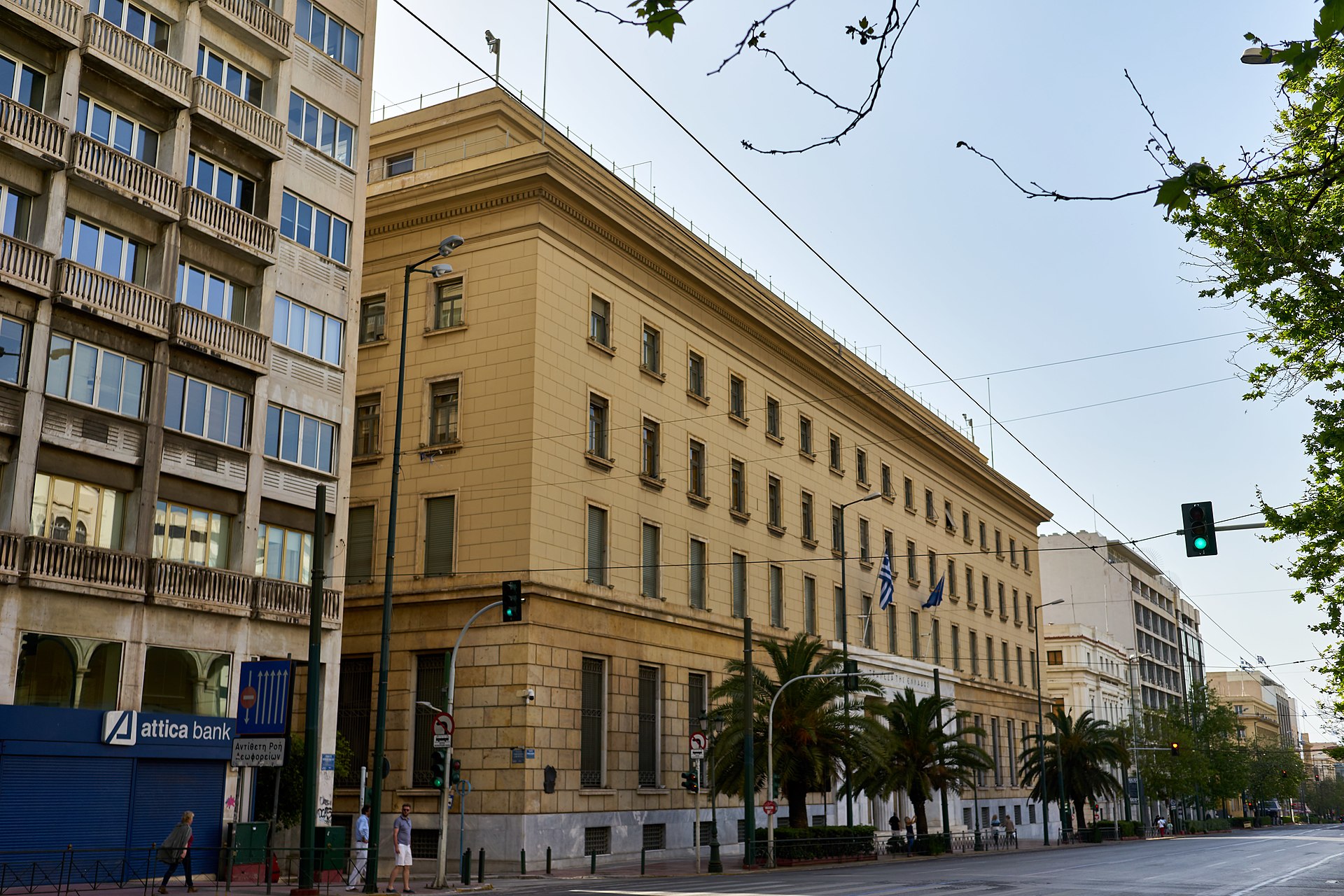
Photo by George E. Koronaios, licensed under CC BY-SA 4.0 via Wikimedia Commons.