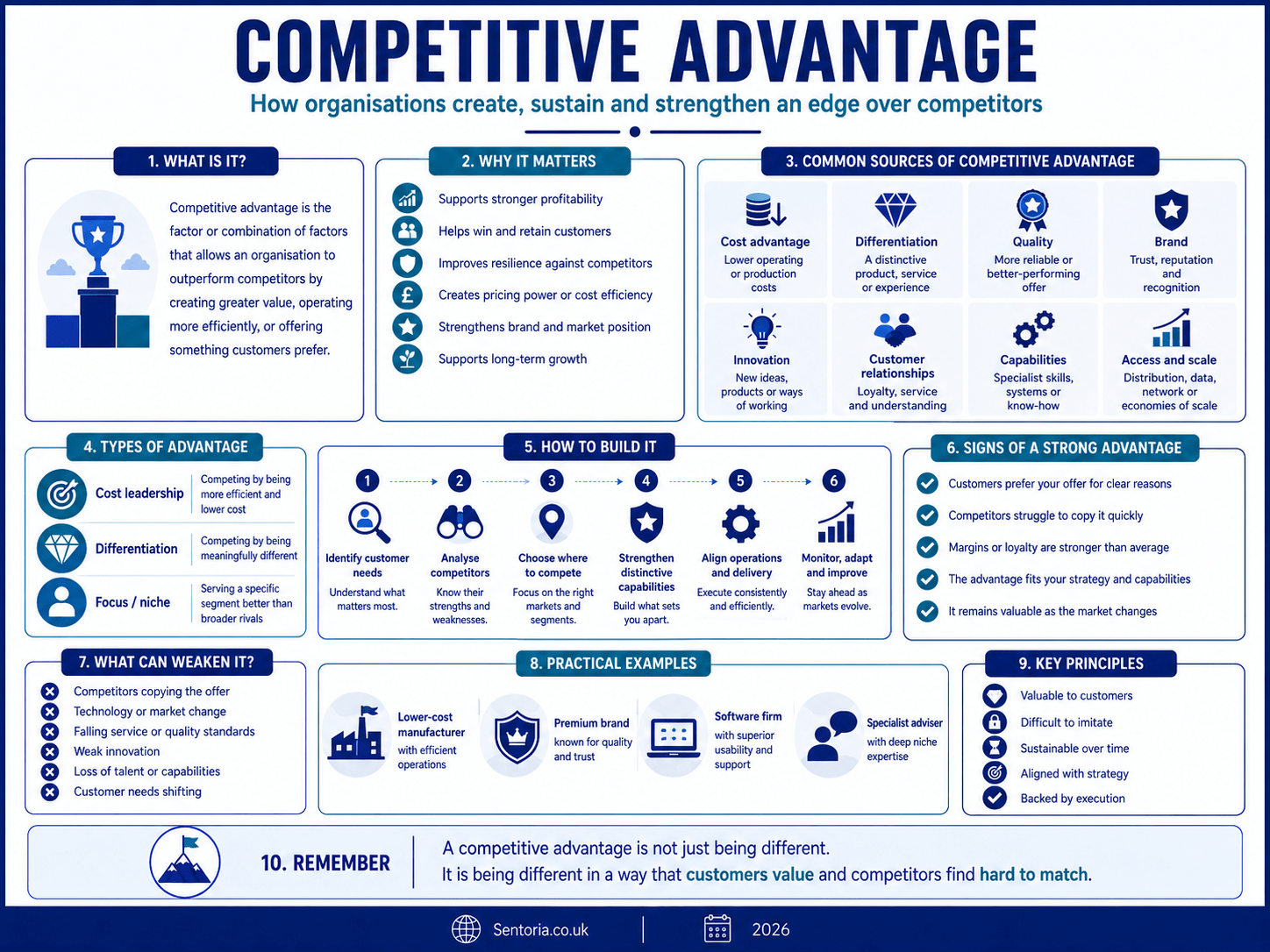
Competitive Advantage: A Practical Guide to Building, Protecting and Strengthening What Makes an Organisation Win
Competitive advantage is the factor, or combination of factors, that allows an organisation to perform better than its rivals, attract and retain customers, generate stronger margins, or deliver greater value in a way that competitors find difficult to match.
At its simplest, competitive advantage asks:
Why should customers choose us, why can we perform better than alternatives, and what makes that advantage difficult for others to copy?
That makes it useful for strategy, business planning, pricing, market research, customer research, competitor analysis, product development, service design, brand positioning, operations, innovation, investment appraisal, charity strategy, public sector service design, professional services, manufacturing, technology, property, education and healthcare.
Used properly, competitive advantage helps organisations move beyond vague statements such as “we are better” or “we offer great service” and focus instead on what genuinely creates value, difference and resilience.
It is not just about being different.
It is about being different in a way that customers value, that the organisation can deliver, and that competitors cannot easily neutralise.
What is competitive advantage?
Competitive advantage is the reason an organisation can outperform competitors or alternatives.
That advantage may come from many sources, including:
- Lower costs
- Better quality
- Stronger brand
- Better customer relationships
- Superior technology
- Better data
- Greater scale
- Specialist expertise
- Faster delivery
- Better location
- Better customer experience
- Stronger distribution
- Better design
- Better processes
- Stronger culture
- Unique intellectual property
- Stronger partnerships
- Regulatory approvals
- Better pricing power
- A clearer market position
Competitive advantage can exist in any type of organisation.
A manufacturer may have a cost advantage because its production process is more efficient.
A professional services firm may have an advantage because clients trust its advice and value its specialist expertise.
A retailer may have an advantage because customers recognise its brand and find it convenient.
A software company may have an advantage because its product is easier to use and deeply embedded in customer workflows.
A charity may have an advantage because it has trusted community relationships, strong volunteer networks and deep understanding of beneficiary needs.
A public body may have an advantage in service delivery because it has better local data, stronger partnerships and more integrated systems.
The key point is that competitive advantage is not only about what the organisation does.
It is about what the organisation does better, differently or more efficiently than alternatives.
Competitive advantage and value
Competitive advantage should always be connected to value.
An organisation may be different, but that difference only matters if it creates value for customers, service users, funders, commissioners, residents, investors or other stakeholders.
For example:
- A business may have complex technology, but customers may not care unless it improves speed, quality, cost or experience.
- A professional firm may have deep technical knowledge, but clients may value it only if it is explained clearly and applied practically.
- A charity may have a long history, but funders may value evidence of impact more than age.
- A retailer may offer a huge product range, but customers may prefer a smaller curated range that saves time.
- A public service may have detailed procedures, but residents may value access, clarity and response time.
A competitive advantage must therefore answer two questions:
- What do we do better than alternatives?
- Why does that matter to the people we serve?
If customers do not value the difference, it is not a competitive advantage.
It is only an internal feature.
Competitive advantage, differentiation and cost leadership
Competitive advantage is often discussed through two broad routes:
- Cost leadership
- Differentiation
These routes were made especially prominent by Michael Porter’s work on competitive strategy.
Cost leadership
Cost leadership means competing by being able to operate at lower cost than competitors.
This does not always mean charging the lowest price.
It means the organisation has a cost structure that allows it to compete more efficiently.
A cost advantage may come from:
- Economies of scale
- Process efficiency
- Automation
- Lower input costs
- Better procurement
- Standardisation
- Lean operations
- Lower waste
- Better stock control
- More efficient distribution
- Lower overheads
- Better use of technology
A cost advantage can allow an organisation to:
- Charge lower prices while maintaining margin
- Maintain prices and earn higher profit
- Invest more in marketing, product development or service
- Withstand price pressure from competitors
- Survive downturns better
However, cost leadership can be dangerous if it becomes a race to the bottom.
A low-cost position still needs quality, reliability and customer trust.
Differentiation
Differentiation means competing by offering something customers value that is meaningfully different from alternatives.
Differentiation may come from:
- Better quality
- Better design
- Better service
- Stronger brand
- Specialist expertise
- Better customer experience
- More convenience
- Greater reliability
- Faster delivery
- Better advice
- Stronger relationships
- Better outcomes
- Unique product features
- Better accessibility
- Greater trust
Differentiation can allow an organisation to:
- Charge premium prices
- Improve customer loyalty
- Reduce direct price comparison
- Strengthen brand reputation
- Attract better customers
- Defend against low-cost rivals
- Improve margins
- Build stronger long-term relationships
However, differentiation must be real.
A business that claims to be premium but delivers ordinary service will damage trust.
A charity that claims to be community-led must genuinely listen to the community.
A professional firm that claims to be proactive must actually contact clients before problems arise.
Focus and niche advantage
A third route is focus.
A focus strategy means serving a specific segment, niche, geography, customer type or need better than broader competitors.
Focus may involve:
- A specialist industry
- A local community
- A defined customer group
- A particular technical problem
- A premium niche
- A low-cost niche
- A specific service need
- A specialised product range
- A particular user group
- A specific regulatory environment
A focused organisation may win because it understands its chosen market more deeply than generalist competitors.
For example:
- An accountancy firm specialising in owner-managed manufacturing businesses.
- A software company serving a specific professional workflow.
- A charity supporting a particular community need.
- A manufacturer producing specialist components.
- A training provider focused on a specific skills shortage.
- A property business specialising in flexible workspace for local SMEs.
Focus can be powerful because it creates clarity.
The organisation knows who it serves, what they value, and how to design its offer around them.
The risk is that the niche may be too small, too vulnerable or too dependent on one customer group.
History and development of competitive advantage
The idea of competitive advantage developed from economics, strategic management, marketing, industrial organisation and business planning.
Organisations have always sought ways to outperform rivals. Traders looked for better locations. Manufacturers sought lower costs and better production methods. Retailers built brands and customer loyalty. Professional firms developed reputations for expertise and trust.
Over time, competitive advantage became a central idea in strategic management.
The development of strategy thinking helped move the discussion from simple competition to deeper questions:
- Why do some organisations consistently outperform others?
- Why are some businesses more profitable?
- Why do customers prefer some brands?
- Why are some advantages sustained over time?
- Why do some competitors struggle to copy successful organisations?
- What role do resources, capabilities and market position play?
Two broad schools of thought became especially important.
The first is the market positioning view, associated strongly with Porter. This looks at industry structure, competitive forces, cost leadership, differentiation and focus.
The second is the resource-based view, which looks inside the organisation at valuable, rare, difficult-to-copy and well-organised resources and capabilities.
Together, these perspectives show that competitive advantage can come from both outside and inside the organisation.
The external view asks:
Where should we compete, and how attractive is that market?
The internal view asks:
What can we do better than others, and what capabilities can we build?
Good strategy needs both.
Why competitive advantage matters
Competitive advantage matters because most organisations face alternatives, rivals or substitutes.
Customers can choose another supplier.
Clients can choose another adviser.
Tenants can choose another property.
Donors can support another charity.
Funders can award grants elsewhere.
Residents can compare public services.
Learners can choose another training provider.
Users can switch software.
If an organisation cannot explain why people should choose it, support it, fund it or continue using it, it is vulnerable.
Competitive advantage helps organisations:
- Attract customers
- Retain customers
- Improve profitability
- Strengthen margins
- Improve pricing power
- Reduce reliance on discounts
- Build customer loyalty
- Improve brand reputation
- Focus strategy
- Prioritise investment
- Defend against competitors
- Improve resilience
- Support growth
- Improve marketing
- Improve product and service design
- Strengthen stakeholder confidence
- Make better recruitment decisions
- Improve operational decisions
- Support funding applications
- Build long-term sustainability
Competitive advantage also helps organisations say no.
A business with a clear advantage does not need to chase every customer.
A charity with a clear advantage does not need to pursue every funding opportunity.
A professional firm with a clear advantage does not need to compete on price with low-value work.
Strategy becomes clearer when the organisation understands where it can genuinely win.
When to use competitive advantage analysis
Competitive advantage analysis is useful whenever an organisation needs to understand why it is, or could be, better placed than alternatives.
Good uses include:
- Strategic planning
- Business planning
- Market entry
- Product development
- Service redesign
- Pricing analysis
- Competitor analysis
- Customer research
- Brand positioning
- Investment appraisal
- Growth planning
- Turnaround planning
- Charity funding strategy
- Public sector service improvement
- Professional services positioning
- Technology product strategy
- Manufacturing improvement
- Property development
- Mergers and acquisitions
- Board strategy sessions
It is especially useful where:
- Growth has slowed.
- Margins are under pressure.
- Competitors are becoming stronger.
- Customers are more price-sensitive.
- The organisation is unclear how it is different.
- The market is crowded.
- A new service is being launched.
- A strategic repositioning is being considered.
- The organisation is too dependent on one source of income.
- The board needs clarity on future direction.
It is less useful when it becomes a vague branding exercise.
Competitive advantage should be tested against evidence.
Sources of competitive advantage
1. Cost advantage
A cost advantage exists when an organisation can produce, deliver or operate at lower cost than competitors.
This may come from:
- Scale
- Process efficiency
- Procurement strength
- Technology
- Automation
- Lower waste
- Standardisation
- Strong supplier relationships
- Better asset utilisation
- Lower overheads
A cost advantage is strongest when competitors cannot easily copy the cost structure.
For example, a manufacturer with specialised equipment, efficient production flows and strong procurement may be able to produce at lower cost than smaller rivals.
However, cost advantage must be managed carefully.
If low cost becomes low quality, the advantage may disappear.
2. Differentiation advantage
A differentiation advantage exists when customers value what makes the organisation different.
This may come from:
- Quality
- Design
- Brand
- Expertise
- Service
- Convenience
- Trust
- Speed
- Innovation
- Customer experience
A differentiation advantage is strongest when customers can clearly see and value the difference.
For example, a professional firm may charge more because clients value its commercial insight, plain English advice and proactive support.
Differentiation is weak if it is only claimed internally.
It must be visible in the customer experience.
3. Brand advantage
A brand advantage exists when reputation, recognition and trust influence customer choice.
Strong brands can:
- Reduce perceived risk
- Increase customer confidence
- Support premium pricing
- Improve loyalty
- Improve recruitment
- Make marketing more efficient
- Support expansion into new offers
- Create emotional connection
Brand advantage takes time to build and can be quickly damaged.
It must be supported by consistent delivery.
4. Customer relationship advantage
A customer relationship advantage exists when the organisation has stronger, deeper or more trusted relationships than competitors.
This is common in:
- Professional services
- Charities
- B2B manufacturing
- Property management
- Healthcare
- Social care
- Education
- Specialist suppliers
- Local businesses
- Community organisations
Relationship advantage may come from:
- Trust
- Responsiveness
- Personal knowledge
- Reliability
- Long-term support
- Understanding customer context
- Strong communication
- Consistent service
- Problem-solving
- Shared values
The risk is that relationship advantage may depend too heavily on one individual.
The organisation should build systems and culture that protect the relationship, not leave it entirely personal.
5. Innovation advantage
An innovation advantage exists when the organisation can create, test and deliver new ideas faster or better than competitors.
Innovation may involve:
- New products
- New services
- New business models
- Better processes
- Better technology
- New customer experiences
- Better data use
- New partnerships
- New pricing models
- New routes to market
Innovation advantage is not only about invention.
It is also about implementation.
Many organisations have ideas. Fewer can turn those ideas into useful, profitable and scalable outcomes.
6. Capability advantage
A capability advantage exists when the organisation has skills, systems, knowledge, processes or culture that competitors struggle to match.
Capabilities may include:
- Specialist technical knowledge
- Strong management information
- Excellent project delivery
- High-quality customer service
- Strong governance
- Effective sales process
- Strong operational discipline
- Excellent training
- Strong data capability
- Good decision-making culture
This is closely linked to the resource-based view.
A capability is especially valuable when it is difficult for competitors to copy because it has been built over time through people, systems, experience and culture.
7. Data advantage
A data advantage exists when the organisation has better, more useful or more actionable information than competitors.
This may include:
- Customer behaviour data
- Market data
- Operational data
- Product usage data
- Financial data
- Pricing data
- Demand data
- Local knowledge
- Risk data
- Service outcome data
Data alone is not an advantage.
The advantage comes from using data well.
An organisation with good data but poor decision-making may still underperform.
8. Network and scale advantage
A scale advantage exists when size creates benefits that smaller competitors cannot easily match.
This may include:
- Lower unit costs
- Wider distribution
- Better procurement terms
- Brand recognition
- More data
- More locations
- Greater investment capacity
- Network effects
- Wider partnerships
- Greater resilience
A network advantage exists when the value of the product, service or organisation increases as more people use it.
This is common in digital platforms, marketplaces, payment systems, social platforms and some membership models.
Scale can be powerful, but it can also make organisations slower, less personal and less flexible.
Smaller organisations may compete by being more specialist, responsive or trusted.
9. Location advantage
A location advantage exists when geography creates value.
This may include:
- Footfall
- Local demand
- Transport access
- Proximity to customers
- Proximity to suppliers
- Local reputation
- Local knowledge
- Planning position
- Scarcity of suitable sites
- Community connection
Location advantage is especially relevant in retail, hospitality, property, logistics, healthcare, education and local services.
A good location can be hard to copy.
However, digital alternatives and changing customer behaviour can weaken location-based advantages over time.
10. Regulatory or licence advantage
Some organisations benefit from licences, approvals, contracts, accreditations or regulatory barriers that make competition harder.
Examples include:
- Professional licences
- Planning permissions
- Public sector contracts
- Regulatory approvals
- Patents
- Accreditation
- Exclusive supplier agreements
- Concession agreements
- Data access rights
- Specialist compliance capability
These advantages can be strong, but they may be vulnerable to regulatory change, contract expiry or public scrutiny.
Competitive advantage in different industries
SMEs and owner-managed businesses
For SMEs, competitive advantage is often practical rather than theoretical.
It may come from:
- Personal service
- Local reputation
- Specialist knowledge
- Speed of response
- Customer trust
- Flexibility
- Lower overheads
- Niche focus
- Strong relationships
- Better communication
An SME might ask:
- Why do customers choose us?
- Why do customers stay with us?
- What do we do better than larger competitors?
- What do we do better than cheaper competitors?
- What are customers willing to pay for?
- Which customers value us most?
- What could competitors easily copy?
- What should we strengthen before it weakens?
For SMEs, the danger is trying to compete everywhere.
A small business often wins by being clearer, more focused and closer to customers than larger rivals.
Manufacturing
Manufacturing competitive advantage often comes from cost, quality, technical capability, reliability and delivery.
Sources may include:
- Efficient production
- Specialist machinery
- Skilled workforce
- Quality systems
- Low defect rates
- Reliable supply
- Strong procurement
- Engineering expertise
- Shorter lead times
- Customer-specific knowledge
- Product consistency
- Technical support
- Certification
- Production flexibility
- Lower waste
A manufacturer might ask:
- Are we lower cost or higher value?
- Are we better at quality, speed, reliability or technical complexity?
- Which customers value our capability most?
- Which products create the strongest margins?
- Can competitors copy our process?
- Are we using capacity on the right work?
- What capabilities should we invest in?
- What could weaken our advantage?
For manufacturing, competitive advantage should connect to operations, costing, pricing, customer requirements and capital investment.
Retail and ecommerce
Retail and ecommerce competitive advantage may come from brand, product range, pricing, convenience, customer experience, fulfilment or trust.
Sources may include:
- Strong brand
- Exclusive products
- Better pricing
- Faster delivery
- Better website experience
- Stronger reviews
- Easier returns
- Better customer support
- More convenient purchasing
- Better product curation
- Stronger loyalty
- Better content
- Better stock availability
- Stronger social proof
- Better customer data
A retailer might ask:
- Why would customers buy from us rather than a marketplace?
- Are we competing on price, convenience, trust or specialism?
- What products create loyalty?
- What does customer research show?
- What do reviews praise or criticise?
- Can competitors copy our offer quickly?
- Does our fulfilment support our brand promise?
- Are discounts weakening our position?
For ecommerce, competitive advantage must usually be visible quickly.
Customers can compare alternatives in seconds.
Professional services
Professional services competitive advantage often comes from trust, expertise, reputation, relationships, sector knowledge and communication.
For accountants, solicitors, consultants, architects and advisers, sources may include:
- Specialist knowledge
- Client trust
- Plain English communication
- Responsiveness
- Commercial judgement
- Sector expertise
- Advisory capability
- Reputation
- Quality of people
- Strong client relationships
- Reliable delivery
- Professional credibility
- Strong referral network
- Better systems
- Proactive service
A professional firm might ask:
- Why do clients choose us?
- What do clients value most?
- Are we genuinely proactive?
- Are we trusted for advice or only compliance?
- What expertise do we have that others lack?
- Which services are hardest for competitors to copy?
- Does our pricing reflect our value?
- Does our website communicate our advantage clearly?
Professional services firms often sound similar.
Competitive advantage must therefore be specific, credible and visible in the client experience.
Charities and voluntary organisations
Charities may not think in terms of competition, but they still need advantage.
They compete for attention, funding, volunteers, partnerships, public trust and sometimes commissioned services.
Sources of advantage may include:
- Trust within a community
- Deep understanding of beneficiary needs
- Strong volunteer base
- Evidence of impact
- Specialist service knowledge
- Local presence
- Strong partnerships
- Fundraising capability
- Good governance
- Safeguarding credibility
- Strong outcomes data
- Long-standing relationships
- Clear mission
- Reputation for delivery
- Ability to reach underserved groups
A charity might ask:
- Why do funders support us?
- What impact can we demonstrate?
- Which needs do we understand better than others?
- Which relationships are hard to replicate?
- What do beneficiaries value most?
- What makes our service credible?
- Are we too dependent on one advantage?
- What capabilities must we protect?
For charities, competitive advantage should always be linked to mission and impact, not only funding.
Public sector and local government
Public bodies do not usually compete in the same way as private businesses, but competitive advantage thinking can still be useful.
It can help identify distinctive strengths in service delivery, partnership working and public value.
Sources may include:
- Local knowledge
- Statutory authority
- Trusted relationships
- Data access
- Community reach
- Partnership networks
- Service integration
- Public accountability
- Procurement capability
- Long-term presence
- Policy expertise
- Local assets
- Convening power
- Democratic legitimacy
- Ability to coordinate services
A public body might ask:
- What are we uniquely placed to do?
- Where do we have better local knowledge than others?
- Which services are better delivered through partners?
- Where can we create public value?
- What capabilities support prevention rather than reaction?
- How can we use data responsibly?
- What strengths support better outcomes?
- What weaknesses undermine delivery?
In public services, the aim is not private profit.
The aim is better value, better outcomes and better use of public resources.
Property and construction
Property and construction competitive advantage may come from location, land ownership, planning knowledge, tenant relationships, delivery capability, funding access or design.
Sources may include:
- Strong sites
- Local knowledge
- Planning expertise
- Tenant relationships
- Development capability
- Access to capital
- Contractor relationships
- Heritage expertise
- Lower build cost
- Strong design
- Flexible space
- Better asset management
- Regeneration credibility
- Community trust
- Long-term ownership
A property business might ask:
- What makes this asset attractive?
- Is the advantage location, flexibility, price, quality or relationship?
- What do tenants value?
- What is hard for competitors to replicate?
- Does the site have planning or infrastructure advantages?
- Are we using the asset to its full potential?
- What investment would strengthen the advantage?
- What market changes could weaken it?
For property and construction, competitive advantage should be linked to viability, tenant demand, planning, funding and long-term asset strategy.
Technology and software
Technology competitive advantage may come from product, data, user experience, integrations, speed, intellectual property, network effects or customer success.
Sources may include:
- Better product usability
- Stronger data
- Better integrations
- Faster development
- Stronger technical architecture
- Network effects
- Intellectual property
- Better customer onboarding
- Lower churn
- Stronger product-market fit
- Better support
- Specialist workflow knowledge
- Stronger security
- Better analytics
- Scalable infrastructure
A software business might ask:
- What problem do we solve better than alternatives?
- Why do customers stay?
- What creates switching costs?
- Are users adopting the product deeply?
- Can competitors copy our features?
- Do we have data or workflow advantages?
- Does pricing reflect value?
- What product roadmap strengthens advantage?
In technology, features alone may not create lasting advantage.
Competitors can copy features. Stronger advantages often come from adoption, data, workflows, integrations, brand, ecosystem and customer success.
Healthcare and social care
Healthcare and social care competitive advantage should be handled carefully because quality, safety, dignity and compliance come first.
Sources may include:
- Quality of care
- Trust with families
- Specialist expertise
- Continuity of staff
- Strong safeguarding culture
- Good inspection outcomes
- Better communication
- Strong care planning
- Local reputation
- Staff training
- Compassionate leadership
- Reliable systems
- Specialist facilities
- Good partnerships
- Person-centred service
A care provider might ask:
- Why do families trust us?
- What do service users value?
- What outcomes are stronger than peers?
- What quality indicators support our position?
- Are staff stable and well trained?
- What specialist capability do we have?
- What would damage our reputation?
- How do we sustain quality as costs rise?
In healthcare and care, competitive advantage must never come from cutting corners.
It should come from better outcomes, safer care, trust, dignity and quality.
Education and training
Education providers may gain advantage through learner outcomes, employer links, specialist curriculum, teaching quality, support and progression.
Sources may include:
- Strong learner outcomes
- Employer partnerships
- Specialist courses
- High-quality teaching
- Good learner support
- Strong safeguarding culture
- Good progression rates
- Flexible delivery
- Digital learning capability
- Local reputation
- Industry relevance
- Funding expertise
- Strong placement network
- Accessible learning
- Trusted qualifications
An education provider might ask:
- Why do learners choose us?
- Why do employers work with us?
- What outcomes are better than alternatives?
- Which courses are distinctive?
- What support improves retention?
- What skills gaps are we well placed to meet?
- What evidence supports our reputation?
- What capabilities should we build?
For education, competitive advantage should connect to learner outcomes, employer needs, safeguarding, quality and financial sustainability.
How to identify competitive advantage properly
1. Define the market
Start by defining where the organisation is competing.
A broad market definition can hide the real issue.
For example:
Weak definition:
We compete in accountancy.
Stronger definition:
We support owner-managed SMEs in West Yorkshire that need tax compliance, management information and practical commercial finance advice.
Weak definition:
We provide training.
Stronger definition:
We provide vocational training for adults seeking employment in digital, business administration and customer service roles.
A clear market definition helps identify the real alternatives.
2. Identify the customer or stakeholder
Competitive advantage depends on who is choosing.
This may include:
- Customers
- Clients
- Service users
- Beneficiaries
- Donors
- Funders
- Commissioners
- Tenants
- Investors
- Learners
- Families
- Employers
- Residents
- Partners
- Regulators
Different stakeholders value different things.
A funder may value evidence of impact.
A beneficiary may value trust and accessibility.
A customer may value speed and price.
A client may value expertise and reassurance.
An employer may value learner readiness.
A tenant may value location and responsiveness.
Competitive advantage should be assessed from the stakeholder’s perspective.
3. Understand what they value
Ask what matters most to the people choosing.
This may include:
- Price
- Quality
- Convenience
- Speed
- Trust
- Reliability
- Expertise
- Relationship
- Accessibility
- Risk reduction
- Outcomes
- Reputation
- Support
- Flexibility
- Simplicity
Customer research, market research and stakeholder engagement can help.
Do not assume value.
Ask, observe and test.
4. Identify competitors and alternatives
Competitors are not always obvious.
Include:
- Direct competitors
- Indirect competitors
- Substitutes
- Low-cost alternatives
- Premium alternatives
- DIY options
- In-house solutions
- Digital alternatives
- Public sector alternatives
- Doing nothing
For example, a professional services firm may compete with other firms, software, in-house finance teams, online templates or clients delaying the decision.
A charity may compete with other charities, public services, social enterprises or informal community support.
Understanding alternatives helps clarify what the organisation is really up against.
5. Compare performance
Use evidence to compare.
This may include:
- Pricing
- Customer satisfaction
- Reviews
- Delivery time
- Quality
- Product features
- Service level
- Outcomes
- Financial performance
- Market share
- Retention
- Churn
- Conversion
- Brand awareness
- Staff capability
Benchmarking, competitor analysis and market research are useful here.
The question is not simply:
What do we believe we are good at?
The question is:
What evidence shows we perform better, differently or more efficiently?
6. Identify distinctive capabilities
Look inside the organisation.
Ask:
- What can we do especially well?
- What knowledge do we have?
- What systems support us?
- What relationships matter?
- What data do we have?
- What assets are valuable?
- What processes work well?
- What culture supports performance?
- What experience have we built?
- What would be difficult for competitors to copy?
This is where the resource-based view is useful.
A strong advantage often comes from capabilities built over time.
7. Test whether the advantage is valuable
An advantage must matter to the customer or stakeholder.
Ask:
- Does it solve a real problem?
- Does it improve an outcome?
- Does it reduce risk?
- Does it save time?
- Does it save money?
- Does it increase confidence?
- Does it improve experience?
- Does it influence choice?
- Does it support loyalty?
- Does it justify pricing?
If the answer is no, the advantage may not be commercially or strategically meaningful.
8. Test whether it is difficult to copy
A strong competitive advantage should be hard to imitate.
Ask:
- Can competitors copy it quickly?
- Can competitors buy the same technology?
- Can competitors hire the same skills?
- Can competitors match the price?
- Can competitors replicate the relationship?
- Can competitors build the same reputation?
- Can competitors access the same data?
- Can competitors achieve the same scale?
- Can competitors copy the process?
- Can competitors neutralise the difference?
If the advantage is easy to copy, it may be temporary.
Temporary advantage can still be useful, but it needs constant renewal.
9. Test whether the organisation can deliver it consistently
Competitive advantage must be operationally real.
Ask:
- Can we deliver this every day?
- Do our systems support it?
- Do staff understand it?
- Do processes reinforce it?
- Does pricing support it?
- Does culture support it?
- Does leadership support it?
- Can we scale it?
- Can we maintain quality?
- Can we prove it?
Many organisations have an intended advantage but fail in delivery.
For example, a business may claim excellent service, but response times may be slow.
A professional firm may claim proactive advice, but contact clients only at deadlines.
A charity may claim accessibility, but its referral process may be confusing.
Delivery must match the promise.
10. Decide how to strengthen it
Competitive advantage should be actively managed.
Actions may include:
- Invest in capability
- Improve quality
- Improve customer experience
- Strengthen brand
- Improve data
- Improve systems
- Train staff
- Protect intellectual property
- Build partnerships
- Improve pricing
- Focus on a niche
- Improve marketing
- Reduce costs
- Improve operational efficiency
- Build switching costs
- Strengthen relationships
- Improve measurement
- Improve innovation
- Improve governance
- Stop low-value activity
A competitive advantage that is not maintained may weaken over time.
Common competitive advantage techniques
Competitor analysis
Competitor analysis examines who else serves the market, what they offer, how they price, how they position themselves and where they may be strong or weak.
It is one of the most direct tools for identifying advantage.
Customer research
Customer research helps identify what customers value, why they choose, why they leave, and what would make them prefer one organisation over another.
Competitive advantage should be built around customer value, not internal preference.
Market research
Market research helps understand demand, trends, pricing, competitors, segments and opportunities.
It helps test whether an advantage is relevant in the market.
Positioning map
A positioning map shows where the organisation sits compared with competitors.
It can reveal whether the organisation is differentiated or stuck in a crowded middle.
Value Proposition Canvas
The Value Proposition Canvas connects customer jobs, pains and gains with the organisation’s offer.
It helps test whether the advantage solves something important.
VRIO analysis
VRIO tests whether a resource or capability is:
- Valuable
- Rare
- Difficult to imitate
- Organised to capture value
It is especially useful for assessing whether an advantage can be sustained.
Value chain analysis
Value chain analysis examines how activities create value from input to delivery.
It can identify where advantage is created through operations, logistics, marketing, service or support activities.
Benchmarking
Benchmarking compares performance with peers, competitors, standards or best practice.
It helps test whether a claimed advantage is supported by evidence.
Porter’s Five Forces
Porter’s Five Forces examines industry structure, rivalry, supplier power, buyer power, substitutes and new entrants.
It helps understand whether the market allows advantage to be profitable.
Resource-Based View
The Resource-Based View focuses on internal resources and capabilities.
It helps identify advantages that come from what the organisation owns, knows or can do.
Common mistakes in competitive advantage
Mistake 1: Confusing difference with advantage
Being different is not enough.
The difference must matter to customers or stakeholders.
Mistake 2: Making vague claims
Statements such as “we offer great service” or “we are high quality” are weak unless supported by evidence.
Be specific.
Mistake 3: Ignoring competitors
An organisation cannot understand advantage without understanding alternatives.
Competitors shape customer choice.
Mistake 4: Ignoring customers
Competitive advantage should be judged from the customer’s perspective.
Internal opinion is not enough.
Mistake 5: Competing only on price
Price competition can be effective where a real cost advantage exists.
Without that, it can destroy margin.
Mistake 6: Trying to serve everyone
Trying to appeal to everyone often weakens advantage.
Focus can create stronger differentiation.
Mistake 7: Failing to protect the advantage
Advantages weaken if they are not maintained.
Competitors copy, customers change and markets move.
Mistake 8: Claiming an advantage the organisation cannot deliver
Marketing must match reality.
A promise that is not delivered damages trust.
Mistake 9: Relying too much on one person
Many SMEs and professional firms rely on individual relationships or founder expertise.
That can be powerful, but also risky.
The advantage should be embedded into systems, culture and team capability.
Mistake 10: Not adapting
An advantage that worked in the past may not work in the future.
Customer needs, technology, regulation and competitors change.
Limitations and weaknesses of competitive advantage analysis
Competitive advantage analysis is useful, but it has limits.
It can become too theoretical
Competitive advantage must be translated into action.
A strategy statement alone does not create advantage.
It can be based on internal bias
Organisations often overestimate their strengths.
Customer and market evidence are needed.
It can ignore execution
A good strategic position fails if delivery is weak.
Operations, people, systems and culture matter.
It can underplay market change
An advantage may weaken as technology, regulation, customer behaviour or competitors change.
Horizon scanning and scenario planning can help.
It can over-focus on competitors
Competitors matter, but customer need matters more.
Do not build strategy only by reacting to rivals.
It can encourage complacency
A current advantage does not guarantee future success.
Strong organisations keep improving.
It can be hard to measure
Some advantages, such as trust, culture and reputation, are difficult to measure precisely.
That does not make them unimportant.
It does not replace profitability analysis
An advantage may attract customers but still fail financially if pricing, cost and margins are weak.
Competitive advantage should be linked to financial performance.
Competitive advantage compared with other strategic and management tools
Competitive advantage and SWOT
SWOT identifies strengths, weaknesses, opportunities and threats.
Competitive advantage analysis goes further by asking which strengths actually create customer value and outperform competitors.
Use SWOT for broad diagnosis. Use competitive advantage analysis to understand what can genuinely help the organisation win.
Competitive advantage and TOWS
TOWS turns SWOT into strategic options.
Competitive advantage helps assess which options are likely to create a stronger position.
Competitive advantage and Porter’s Five Forces
Porter’s Five Forces examines industry attractiveness and competitive pressure.
Competitive advantage asks how the organisation can win within that environment.
Use Five Forces to understand the market. Use competitive advantage to decide how to compete.
Competitive advantage and Resource-Based View
The Resource-Based View examines internal resources and capabilities.
Competitive advantage can come from those resources when they are valuable, rare, difficult to imitate and well organised.
Competitive advantage and VRIO
VRIO is a practical way to test whether a resource or capability can create sustained advantage.
Use VRIO to assess whether a claimed advantage is genuinely strong.
Competitive advantage and Value Chain Analysis
Value Chain Analysis examines where value is created across activities.
Competitive advantage may be found in specific activities such as procurement, operations, logistics, marketing, sales or service.
Competitive advantage and positioning map
A positioning map shows how the organisation is perceived compared with alternatives.
Competitive advantage explains why that position matters and whether it can be defended.
Competitive advantage and pricing analysis
Pricing analysis tests whether the organisation’s advantage supports pricing power, margin or a specific market position.
An advantage that customers value may support premium pricing.
A cost advantage may support lower prices or stronger margins.
Competitive advantage and customer research
Customer research helps test whether customers recognise and value the organisation’s advantage.
Without customer evidence, competitive advantage may be assumed rather than proven.
Competitive advantage and market research
Market research helps test whether the advantage fits market demand, trends, segments and opportunities.
Competitive advantage and benchmarking
Benchmarking helps test whether performance is better than peers, competitors or standards.
It can provide evidence of advantage.
Alternatives and complementary frameworks
Competitor analysis
Use competitor analysis to understand rivals, alternatives, strengths, weaknesses, pricing and positioning.
Customer research
Use customer research to understand what customers value and why they choose.
Market research
Use market research to understand market demand, trends, segments and opportunities.
SWOT analysis
Use SWOT to identify internal strengths and weaknesses and external opportunities and threats.
VRIO analysis
Use VRIO to test whether resources and capabilities can support sustained advantage.
Resource-Based View
Use Resource-Based View to understand internal capabilities, assets and knowledge.
Value Chain Analysis
Use Value Chain Analysis to identify where value is created or cost is reduced.
Porter’s Five Forces
Use Porter’s Five Forces to understand industry structure and competitive pressure.
Positioning Map
Use a positioning map to understand market perception and competitive space.
Blue Ocean Strategy
Use Blue Ocean Strategy to explore new market space and challenge existing industry assumptions.
A practical competitive advantage template
A useful competitive advantage template should include:
- Market definition
- Target customer or stakeholder
- Customer needs
- Key competitors and alternatives
- Current position
- Claimed advantage
- Evidence supporting the advantage
- Source of advantage
- Customer value created
- Cost or differentiation impact
- Difficulty of imitation
- Internal capabilities required
- Risks to the advantage
- Competitor response
- Actions to strengthen the advantage
- Measures of success
- Owner
- Review date
- Link to strategy
- Link to risk register or roadmap
Example:
Market definition: Monthly financial advice and management information support for owner-managed SMEs in West Yorkshire.
Target customer: Business owners with turnover between £500,000 and £10 million who need better financial visibility and practical decision support.
Customer need: Clearer cash flow information, better management reporting, plain English advice and confidence in financial decisions.
Competitors and alternatives: Local accountancy firms, outsourced finance directors, bookkeepers, cloud accounting software and doing nothing.
Claimed advantage: Practical finance director level experience combined with accountancy expertise, plain English communication and local SME understanding.
Customer value: Business owners receive clearer information, more confidence, better cash planning and more practical support than from compliance-only services.
Evidence needed: Client interviews, testimonials, case studies, pricing comparison, conversion rates and retention.
Risks: Larger firms may introduce similar advisory packages. Clients may not understand the value unless communication is improved.
Actions: Create a clear advisory proposition, pilot with selected clients, build case studies, introduce tiered pricing and review feedback after three months.
Owner: Managing Director.
Questions to ask during competitive advantage analysis
Market questions
- What market are we competing in?
- Who are the customers or stakeholders?
- What alternatives do they consider?
- Is the market growing or declining?
- What trends are changing the market?
- What segments are most attractive?
- What barriers to entry exist?
- What substitutes exist?
- What does the customer value most?
- What does the market reward?
Customer questions
- Why do customers choose us?
- Why do customers stay?
- Why do customers leave?
- What do customers value most?
- What problem are they solving?
- What creates trust?
- What creates loyalty?
- What would make them pay more?
- What would make them switch?
- What do customers say we do best?
Competitor questions
- Who are the real competitors?
- What are they good at?
- What are they weak at?
- How do they price?
- How are they positioned?
- What do customers praise about them?
- What do customers criticise?
- What could they copy?
- What could they do better than us?
- How might they respond to our strategy?
Capability questions
- What do we do especially well?
- What resources do we have?
- What knowledge do we hold?
- What systems support us?
- What relationships matter?
- What data do we have?
- What assets are valuable?
- What culture supports performance?
- What is hard for others to copy?
- What capability should we build next?
Value questions
- Does our advantage solve a real problem?
- Does it save money?
- Does it save time?
- Does it reduce risk?
- Does it improve quality?
- Does it increase confidence?
- Does it improve experience?
- Does it support premium pricing?
- Does it improve loyalty?
- Does it matter enough to influence choice?
Sustainability questions
- Can competitors copy it?
- Can technology replace it?
- Can customers stop valuing it?
- Can regulation weaken it?
- Can staff turnover damage it?
- Can cost inflation reduce it?
- Can larger competitors overpower it?
- Can smaller competitors move faster?
- Can the organisation keep investing in it?
- What must be done to protect it?
Action questions
- What should we strengthen?
- What should we stop doing?
- What should we invest in?
- What should we communicate more clearly?
- What should we price differently?
- What customer segment should we focus on?
- What capability should we build?
- What risk should be added to the risk register?
- What should be added to the roadmap?
- Who owns the next action?
The best way to think about competitive advantage
Competitive advantage is not a slogan.
It is a test of value, difference and resilience.
A good competitive advantage should be:
- Valuable to customers or stakeholders
- Clear
- Evidence-based
- Difficult to copy
- Aligned with strategy
- Supported by capabilities
- Visible in delivery
- Financially sustainable
- Monitored regularly
- Strengthened over time
A weak competitive advantage says:
“We are different.”
A strong competitive advantage asks:
“Are we different in a way that customers value, competitors struggle to copy, and our organisation can deliver consistently?”
The key question is not simply:
What makes us different?
The better question is:
What makes us more valuable, more efficient, more trusted or more difficult to replace than the alternatives?
Conclusion: competitive advantage turns difference into strategic strength
Competitive advantage remains useful because no organisation operates in isolation.
Customers, clients, funders, service users, tenants, donors, learners and communities all have choices, alternatives and expectations.
An organisation that cannot explain why it should be chosen, trusted, funded or retained is vulnerable.
Used badly, competitive advantage becomes a vague claim about quality, service or being better than competitors.
Used properly, it becomes a practical strategy tool. It helps organisations understand what customers value, where competitors are strong, what capabilities matter, what should be protected, and where investment should be focused.
The real value is not in saying the organisation has an advantage.
The real value is in proving it, strengthening it and turning it into better decisions.
A strong competitive advantage process helps an organisation move from saying, “We are better,” to asking, “Why are we better, who values that difference, how do we prove it, and how do we make it harder for competitors to match?”