Wimpy: Britain’s Original Burger Chain and the Long Road from High Street Giant to Nostalgia Brand
A full business analysis and strategic review
Wimpy is one of the strangest stories in British fast food. For a generation, it was the burger restaurant. Before McDonald’s became part of everyday Britain, before Burger King had scale, before Five Guys, Shake Shack, Wendy’s revival, premium chicken chains, delivery apps and drive thru lanes, there was Wimpy.
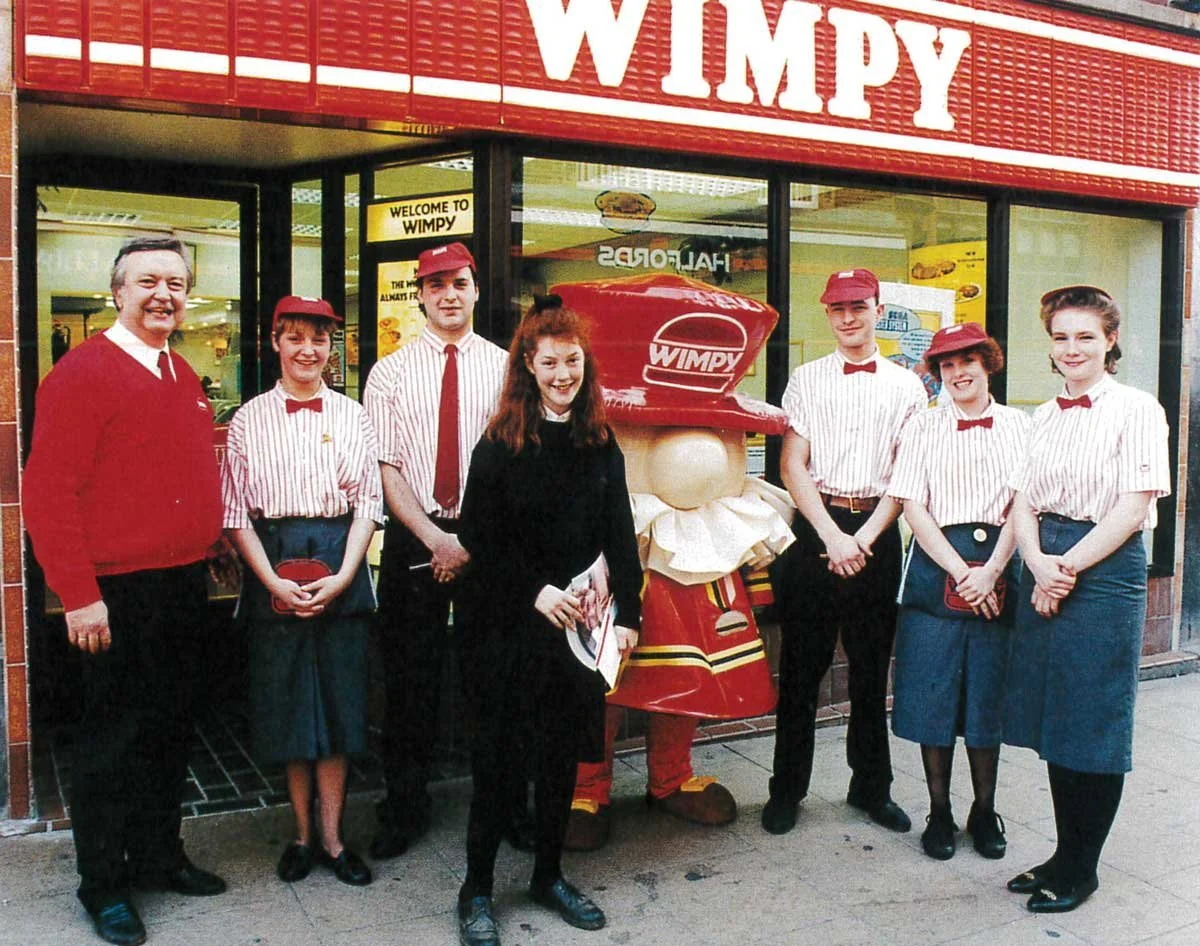
It was familiar, friendly and slightly British in a way that later American fast food chains were not. It had table service, plates, knives and forks, ketchup in tomato-shaped bottles, Bender in a Bun, Brown Derby desserts, thick milkshakes, Mr Wimpy, family booths, seaside locations and town centre branches. It was a place where children went with parents, teenagers met friends, shoppers stopped for lunch, and older customers could sit down properly rather than rush through a plastic counter-service experience.
Today, however, Wimpy has almost vanished from the national high street. It has not disappeared completely. There are still around 60 UK restaurants, mostly franchised, with a loyal customer base and some signs of selective reinvestment. But it is no longer a mainstream national fast food force. It is a survivor, a nostalgia brand and a niche operator in a market it once helped create. Recent reports put the UK estate at around 61 to 64 locations, compared with hundreds at its peak.
The question is: what happened?
The simple answer is McDonald’s. But that is too shallow. Wimpy declined because of a combination of ownership decisions, site conversions, strategic hesitation, brand confusion, underinvestment, changing eating habits, the rise of drive thru fast food, stronger international competitors, high street weakness and an operating model that became increasingly out of step with the market.
The more interesting question is whether Wimpy has a future. The answer is yes, but probably not as a mass market national chain. Wimpy’s best future is as a smaller, focused, franchise-led heritage diner brand built around nostalgia, freshly cooked food, sit-down service, family occasions, seaside towns, transport-adjacent locations and selected local high streets. It cannot realistically become McDonald’s. It should not try. Its opportunity is to become the best version of Wimpy.
1. Origins: an American name that became a British institution
Wimpy’s story begins in the United States. The brand was founded in Bloomington, Indiana, in 1934 by Edward Gold and was named after J. Wellington Wimpy, the hamburger-loving character from Popeye. The UK story began later, when J. Lyons & Co obtained the UK licence and opened the first British Wimpy inside a Lyons Corner House in London in 1954. Wimpy UK describes itself as the first hamburger chain to be set up in the UK and says it became known as the “home of the hamburger”.
That origin is important. In Britain, Wimpy was not a copy of McDonald’s. It came first. McDonald’s opened its first UK restaurant in Woolwich in October 1974, two decades after Wimpy arrived.
Wimpy therefore introduced many British consumers to the idea of the hamburger restaurant. It was modern, American-influenced and accessible, but it was filtered through a British hospitality context. It was not only about speed. It was about the novelty of hamburgers, milkshakes, fries and casual family dining.
This explains why Wimpy still carries a stronger emotional memory than its current footprint would suggest. For many people, it was the place they first had a burger in a restaurant setting. It was part of post-war British consumer culture, when American-style food, youth culture, town centre shopping and casual dining were all developing.
Recap
Wimpy was not a late entrant. It was the original UK hamburger chain. That gave it early cultural power, but it also meant it was built around an older model of casual dining before the later fast food giants changed customer expectations.
2. The Lyons era: why Wimpy felt different
J. Lyons & Co was not a small restaurant operator. It was a major British food and hospitality business, famous for Lyons Corner Houses, tea shops, catering and food manufacturing. This mattered because Wimpy’s early UK development was connected to a broader culture of accessible eating out.
Wimpy was not originally the same kind of fast food proposition that McDonald’s later brought to Britain. It was closer to a casual dining burger bar. Customers sat down. Meals were often served on plates. The atmosphere was more restaurant than pure counter service. That gave Wimpy warmth and familiarity, but it also created a long term strategic tension.
The Wimpy model combined three things:
A burger and fast food product.
A sit-down restaurant experience.
A local high street presence.
That combination worked brilliantly when there were few competitors and customers valued novelty, comfort and table service. But it became less efficient when the market moved towards speed, standardisation, low-cost operations, drive thrus and aggressive national advertising.
Wimpy’s early success also led to international growth. Wimpy UK’s own history says the brand became global by 1970, with more than 1,000 restaurants in 23 countries.
The problem was that scale alone did not guarantee future dominance. Wimpy had reach, but McDonald’s would later bring a more disciplined operating system.
3. The product range: burgers, Benders and British adaptation
Wimpy’s menu became distinctive because it was never purely American. It included burgers, chips, milkshakes and sundaes, but also items that felt more British: mixed grills, fish and chips, breakfasts, bendy sausages, tea and sit-down meal combinations.
The brand built memory through products. The Bender in a Bun, Special Sauce, Brown Derby and thick shakes were not just menu items. They were brand assets. Wimpy’s official history records the launch of Special Sauce in 1981, the debut of Mr Wimpy in Brighton in 1978, the introduction of meat-free burgers in 1986, Quorn products in 1997, delivery in 2018 and a vegan burger option in 2020.
That history shows two things.
First, Wimpy was not always slow to innovate. It claims to have been the first burger chain to offer meat-free burgers in 1986 and the first major fast food chain to introduce Quorn products in 1997.
Second, the innovations did not translate into renewed market leadership. This is a recurring theme in business history. A company can do individual things early, but still lose strategically if the broader model is weaker.
Wimpy adapted the product range, but it did not redefine the category in the way McDonald’s did with speed, consistency, children’s marketing, property strategy and drive thru growth.
Recap
Wimpy’s menu created affection. But affection around individual products could not compensate for a weaker operating model and shrinking estate.
4. The competitive shock: McDonald’s and the new rules of fast food
McDonald’s entered the UK in 1974, opening in Woolwich. Burger King followed in the UK in the late 1970s, with its first UK outlet commonly traced to Coventry Street in central London.
The arrival of McDonald’s changed the rules. The key difference was not simply that McDonald’s sold burgers. Wimpy already did that. The difference was operating discipline.
McDonald’s brought:
Tighter standardisation.
Faster counter service.
Strong children’s marketing.
Heavy national advertising.
A consistent global brand.
Highly engineered kitchens.
Clear site strategy.
Drive thru development.
A powerful franchise system.
Strong supply chain control.
Wimpy had a brand, but McDonald’s had a machine.
This distinction is central. In food service, a strong brand matters, but the operating model often matters more. McDonald’s could replicate itself quickly, deliver consistent service, control costs, serve families rapidly, and make the visit feel predictable. Wimpy’s table service and local franchise character gave it personality, but also made it harder to scale efficiently.
Wimpy’s more leisurely style became a disadvantage as customers increasingly wanted speed, convenience and certainty. What had once felt friendly began to feel old fashioned.
5. The ownership turning point: Wimpy sacrificed for Burger King
The most important strategic moment in Wimpy’s decline came in the late 1980s and early 1990s.
Wimpy had been sold by Lyons to United Biscuits in 1977. In 1989, United Biscuits sold Wimpy to Grand Metropolitan, which had acquired Burger King the previous year. The Drum summarised the consequence clearly: Burger King took the prime sites for conversion to Burger King restaurants, while a management buyout took over the remaining sites and continued trading them as Wimpy table-service restaurants.
That was a defining moment. Wimpy did not simply lose a few shops. It lost much of the estate that might have allowed it to compete nationally. The stronger sites were effectively repurposed to build Burger King’s UK presence.
This was rational from Grand Metropolitan’s perspective. Burger King had stronger global recognition and was a better platform to compete with McDonald’s. But it was devastating for Wimpy. It left the brand with a smaller, less attractive, more fragmented estate.
The result was a strategic hollowing out. Wimpy kept the name, the nostalgia and the loyal customers, but lost much of the national visibility required to remain a serious fast food player.
This is why the story is not simply “Wimpy failed because McDonald’s arrived.” Wimpy also became a casualty of corporate brand portfolio management. Its owner made a choice: build Burger King, not Wimpy.
Recap
Wimpy was not beaten only in the customer market. It was also weakened in the ownership market. Its best sites were used to strengthen a rival brand within the same corporate owner’s portfolio.
6. The management buyout era: survival rather than dominance
After the Burger King conversion process, the remaining Wimpy restaurants continued largely through franchise and management buyout structures. That preserved the brand, but changed its future.
The remaining restaurants were often table-service branches, many in less attractive locations than the sites converted to Burger King. Over time, this created a self-reinforcing pattern:
Fewer sites meant less national visibility.
Less visibility meant weaker marketing power.
Weaker marketing made franchise recruitment harder.
A smaller estate reduced supply chain scale.
Lower scale made modernisation harder.
The brand became more nostalgic than contemporary.
This does not mean the operators were poor. Many Wimpy franchisees appear to have been deeply committed, local and long-serving. Wimpy’s own FAQ notes that all UK restaurants are owned and operated by franchisees, some of whom have been part of the Wimpy family for decades and some of whom are multi-generational.
That local commitment is a strength. It helps explain why Wimpy still exists. But it also shows the limitation. A collection of loyal local franchisees is not the same as a growth-focused national fast food system.
The management buyout era kept Wimpy alive, but it did not restore it to scale.
7. Famous Brands ownership: stability, but not transformation
Wimpy UK is now owned by Famous Brands Limited, a South African food service group. Wimpy UK’s FAQ states that Famous Brands owns the Wimpy brand and describes Famous Brands as Africa’s largest branded food services franchisor, with a portfolio of 25 restaurant brands and 2,853 restaurants across South Africa, the rest of Africa, the Middle East and the UK.
Famous Brands brought professional franchise ownership, brand support and supply chain capability. It also had long-standing experience with Wimpy in South Africa, where the brand remains much more prominent than it is in the UK.
However, UK revival has been cautious rather than dramatic. City AM reported in 2024 that Wimpy Restaurants had around 63 UK sites, compared with about 380 branches at its height. It also reported UK revenue of £6.9 million for the year ended 29 February 2024, down slightly from £7 million, with pre-tax profit falling to £799,000 from £918,000.
Famous Brands’ 2025 annual report shows the UK operating environment remained difficult, with Wimpy UK reporting an operating profit margin of 5.4%, down from 11.4% the prior year.
These figures matter. They show that Wimpy is not dead, but it is small, exposed and sensitive to UK consumer pressure. The business can be profitable, but it is not currently a high-growth national challenger.
8. Current footprint: still alive, but no longer mainstream
Wimpy’s current UK footprint is small relative to the scale it once had. ScrapeHero reported 61 UK restaurants as of 25 April 2025, while Insider Media referred to 64 UK locations in February 2025. The exact figure can move as franchise branches open, close, relocate or refurbish, but the broad point is clear: Wimpy is now a small estate brand.
Its restaurants are concentrated in England, with a handful in Scotland. Many are in towns, seaside locations or older high street sites rather than the prime urban and roadside locations dominated by McDonald’s, Burger King, KFC, Greggs, Costa and newer quick service players.
The current menu still leans into burgers, breakfast, coffee, mixed grills, fish and chips, thick shakes and traditional Wimpy favourites. The website describes food as freshly cooked to order and highlights burgers, breakfast muffins and other familiar menu items.
That “freshly cooked to order” positioning is important. It differentiates Wimpy from faster assembly-line models. But it also limits speed. In modern quick service restaurants, speed is not a minor feature. It is often the product.
9. Market positioning: what does Wimpy stand for now?
Wimpy’s market position is unusual. It is not really competing on the same basis as McDonald’s, Burger King or Five Guys.
It is too small to compete on national scale.
It is too nostalgic to feel fully modern.
It is too service-led to be pure fast food.
It is too value-conscious to be premium casual dining.
It is too local to be a major national campaign brand.
Yet it still has a position.
Wimpy today is best understood as a heritage British burger diner, with freshly cooked food, local franchise ownership, sit-down comfort and nostalgic appeal.
A positioning map might look like this:
| Brand | Core position | Strength | Weakness |
|---|---|---|---|
| McDonald’s | Mass market fast food | Scale, speed, drive thru, app, value | Less personal, highly standardised |
| Burger King | Flame-grilled burger chain | Whopper, global recognition, delivery | Weaker UK footprint than McDonald’s |
| Five Guys | Premium fast casual burgers | Quality, customisation, fresh preparation | High price |
| Wendy’s | US fast food challenger | Brand novelty, fresh beef positioning | Still rebuilding UK scale |
| Greggs | Affordable food to go | Value, breakfast, convenience | Not a burger specialist |
| Wimpy | Heritage sit-down burger diner | Nostalgia, local loyalty, cooked to order | Small estate, limited relevance among younger customers |
| Independent burger restaurants | Local premium or casual dining | Quality, local identity | Limited scale |
The problem is that Wimpy’s position is emotionally strong but commercially narrow. Nostalgia brings people back occasionally. A growth business needs habit, frequency and convenience.
Recap
Wimpy still has meaning. The challenge is converting memory into repeat modern demand.
10. Benchmarking Wimpy against competitors
Wimpy versus McDonald’s
McDonald’s is the benchmark for operational excellence in fast food. It has scale, property strength, drive thrus, app ordering, delivery, breakfast, children’s marketing, national advertising and a highly efficient franchise system. Wimpy cannot match that. It should not try to be a smaller McDonald’s.
Wimpy versus Burger King
Burger King is particularly relevant because of the shared history. Burger King benefited from site conversions that weakened Wimpy. It has stronger global recognition, a clearer hero product in the Whopper and more mainstream fast food positioning. Wimpy has more warmth and nostalgia, but less scale and less operational modernity.
Wimpy versus Five Guys
Five Guys shows that a made-to-order burger model can work, but only if customers perceive quality strongly enough to pay a premium. Wimpy’s made-to-order claim could be valuable, but the brand is not currently positioned as premium enough to charge Five Guys prices.
Wimpy versus Greggs
Greggs is not a burger chain, but it is a major threat because it owns affordable everyday food to go. Greggs has done what Wimpy failed to do: move from a traditional food format into a modern national convenience food platform.
Wimpy versus independents
Independent burger restaurants can often beat Wimpy on food quality, local identity or craft. Wimpy’s advantage is brand memory and recognisability. But that advantage weakens with younger customers who may not have childhood Wimpy memories.
Benchmarking conclusion
Wimpy’s future depends on choosing the right competitive frame. It cannot win as a speed-led national fast food giant. It can win as a smaller, warmer, freshly cooked, nostalgic diner brand.
11. The fast food market today: why revival is difficult
The UK quick service restaurant market is large and still growing. Mordor Intelligence valued the UK QSR market at USD 35.77 billion in 2025 and estimated growth to USD 48.56 billion by 2031, with delivery forecast to keep expanding. It also reported burger concepts as the largest cuisine segment in 2025.
At first glance, that sounds positive for Wimpy. Burgers remain popular. Quick service restaurants are growing. Delivery is now normal. Value-led eating out remains important.
But the same market conditions also make Wimpy’s challenge harder. The modern quick service market rewards:
Digital ordering.
Delivery partnerships.
Menu engineering.
Drive thru access.
Strong brand apps.
National marketing.
Procurement scale.
Labour efficiency.
Fast service.
Menu innovation.
Property discipline.
Wimpy has some of these features, but not enough at scale. It has delivery in many restaurants, and its history notes that most restaurants launched home delivery after successful trials in 2018. But delivery alone does not create a modern brand. It simply allows an existing brand to participate in a channel that competitors are also using.
The wider hospitality environment is also tough. Hospitality businesses face rising wages, employer costs, energy, food inflation and business rates. UK hospitality voices have warned of closures driven by business rates, National Insurance, minimum wage increases, energy bills and food inflation.
For a small franchise system, these pressures matter enormously. McDonald’s can absorb, negotiate and automate. A local Wimpy franchisee has less room for error.
12. PESTLE analysis
Political and legal
Wimpy operates in a highly regulated food service environment. Employment law, wage increases, business rates, food safety, allergen labelling, franchising rules and planning rules all matter. The UK hospitality sector is currently under pressure from cost increases including wages, National Insurance, energy and business rates.
For Wimpy, this is particularly important because table service and freshly cooked food can be more labour-intensive than ultra-standardised counter-service fast food.
Economic
Wimpy’s customers are value-conscious, but eating out remains discretionary. City AM reported that Wimpy UK’s revenue dipped in 2024 as consumer spending weakened, with Famous Brands citing political and economic uncertainty in Europe as a factor.
This creates a pricing challenge. Wimpy cannot be too expensive, because it is not a premium burger brand. But it cannot be too cheap, because a small franchise estate does not have McDonald’s purchasing power.
Social
Wimpy has nostalgia and family appeal. That is valuable, but it skews older unless carefully refreshed. Younger consumers may know McDonald’s, Burger King, Five Guys, Nando’s, Greggs, Taco Bell, Wendy’s and delivery-first brands better than Wimpy.
The opportunity is intergenerational: parents and grandparents taking children to “the place we used to go”. The risk is that this remains occasional rather than habitual.
Technological
Technology is now essential in quick service restaurants: app ordering, loyalty, self-order kiosks, delivery integrations, digital menus, labour scheduling, stock management and customer data. Famous Brands’ wider report highlights self-service terminals, delivery systems and back-end improvements across its restaurant network, although this is mainly described in the South African Leading Brands context.
Wimpy UK needs a modern digital layer without losing its sit-down charm.
Environmental
Food service businesses face pressure on packaging, food waste, supply chains, beef sourcing, energy and delivery emissions. Wimpy’s UK FAQ says its burgers are made from British and Irish beef and that its own-label products use free-range eggs, with a commitment to cage-free alternatives for remaining products containing egg ingredients by the end of 2025.
PESTLE conclusion
Wimpy’s external environment is difficult but not impossible. The brand has a place, but it must operate with far more discipline than in its high street heyday.
13. SWOT analysis
Strengths
Wimpy has strong brand nostalgia, heritage as Britain’s original hamburger chain, long-standing franchisees, a differentiated sit-down experience, recognisable menu classics, cooked-to-order positioning and the backing of Famous Brands. Its ownership by a major franchisor gives it more support than a purely independent small chain would have.
Weaknesses
Wimpy’s weaknesses are serious: small footprint, limited national marketing power, ageing brand perception, inconsistent visibility, limited drive thru presence, weak appeal among younger consumers, a franchise estate that may vary by site, and a business model that is less efficient than high-volume counter-service competitors.
Opportunities
Opportunities include selective franchise growth, seaside towns, family locations, nostalgia-led marketing, delivery, breakfast, coffee, local high streets, travel-adjacent sites, compact diner formats, partnerships, refurbished stores and heritage product launches. Recent South East expansion activity, including the Brighton opening and Worthing refurbishment supported by Lloyds funding, shows that targeted reinvestment is possible.
Threats
Threats include McDonald’s, Burger King, Five Guys, Wendy’s, Greggs, KFC, supermarkets, delivery-only brands, rising labour costs, franchisee funding constraints, weaker high street footfall, changing diets and younger customers’ lack of brand memory.
SWOT conclusion
Wimpy’s strongest asset is emotional memory. Its biggest weakness is commercial relevance. The strategy must convert nostalgia into a clear modern proposition.
14. Porter’s Five Forces
Competitive rivalry: very high
The burger and quick service market is crowded. Wimpy competes against global chains, local independents, delivery brands, coffee shops, bakeries, supermarkets and casual dining operators.
Buyer power: high
Customers can switch easily. If they want cheap and quick, McDonald’s or Greggs are nearby. If they want premium, Five Guys or independents are available. If they want convenience, delivery apps offer many alternatives.
Supplier power: moderate
Famous Brands gives Wimpy some procurement support, but the UK estate is small. This limits buying power compared with McDonald’s, Burger King or Greggs.
Threat of substitutes: high
A Wimpy visit can be replaced by a supermarket meal deal, a McDonald’s drive thru, a Greggs breakfast, a pub burger, a Five Guys order, a delivery app meal or a local café.
Threat of new entrants: moderate
Opening one burger restaurant is not hard. Building a national chain is difficult, but the rise of fast casual brands, food halls, dark kitchens and delivery-first concepts keeps pressure high.
Five Forces conclusion
Wimpy operates in a structurally difficult market. Its answer cannot be scale. It must be distinction.
15. BCG-style portfolio review
Core burgers: cash generator
The burger remains the centre of Wimpy. It must be protected and improved. If Wimpy wants to claim freshly cooked food, the burger must taste meaningfully better than mass fast food.
Bender in a Bun and heritage classics: brand assets
These products are not just menu lines. They are memory triggers. Used correctly, they can create social media interest, nostalgia campaigns and intergenerational visits.
Breakfast and coffee: growth opportunity
Breakfast is one of the strongest dayparts in modern food service. Wimpy already offers breakfast and coffee, which could become more central to the proposition. This is especially relevant in town centres, seaside towns and local communities.
Delivery: necessary but not defining
Delivery allows Wimpy to reach customers, but it does not automatically make the brand modern. Delivery should support the core business, not replace restaurant relevance.
Vegan and meat-free options: hygiene factor
Wimpy has a history of early meat-free products and now offers a vegan burger option. This helps avoid exclusion, but vegan products alone will not revive the brand.
Franchise expansion: question mark
New franchise locations can work, but only with careful site selection, modern formats and strong franchisee economics. Poorly chosen expansion would damage the brand further.
BCG conclusion
Wimpy should invest in refreshed core restaurants, heritage classics, breakfast, family dining and selective new franchise sites. It should not chase every fast food trend.
16. Ansoff Matrix: growth options
Market penetration
Wimpy can grow sales in existing restaurants through better local marketing, improved delivery presentation, loyalty schemes, breakfast promotions, family deals, seasonal nostalgia products and community engagement.
Market development
Wimpy can open in selected new locations, especially where the brand has recognition and where sit-down family dining still works: seaside towns, market towns, suburban high streets, leisure parks and transport-adjacent areas. The Brighton opening and Worthing refurbishment show the South East remains a live expansion area.
Product development
Product development should focus on better burgers, breakfast, coffee, milkshakes, desserts, classic menu revivals, vegetarian and vegan items, value bundles and limited-edition heritage products.
Diversification
Diversification should be modest. Wimpy should avoid becoming a chicken brand, coffee chain, dessert parlour or delivery-only operator. It has already survived because of its distinctiveness. Diversification that weakens that identity would be dangerous.
Ansoff conclusion
Wimpy’s best growth route is focused market development and product renewal, not radical reinvention.
17. Pricing analysis: where should Wimpy sit?
Wimpy’s pricing challenge is delicate.
If it prices too close to McDonald’s, it may struggle because it lacks McDonald’s speed and scale.
If it prices too close to Five Guys, customers may question whether the quality and brand experience justify the premium.
If it discounts too heavily, franchisees may suffer and the brand may feel weak.
The right position is affordable sit-down value.
That means Wimpy should not compete purely on the cheapest burger. It should compete on the idea that customers get a proper meal, cooked to order, in a comfortable setting, at a fair price. This is a different proposition from “fastest burger for the lowest price”.
A successful pricing structure would include:
Value lunch offers.
Family meal bundles.
Breakfast deals.
Classic burger meals.
Premium specials.
Dessert and shake bundles.
Local promotions.
Delivery-specific menus with protected margins.
The pricing message should be simple: Wimpy is not the cheapest, not the poshest, but a proper burger restaurant at a fair price.
18. Mistakes and missed opportunities
1. Losing the best sites
The conversion of prime Wimpy sites to Burger King was arguably the most damaging event in the brand’s UK history. It removed scale, visibility and property advantage.
2. Failing to match McDonald’s operating system
Wimpy had a strong product memory, but McDonald’s had a more powerful operating system. Speed, consistency, drive thru, marketing and supply chain discipline won.
3. Remaining too dependent on table service
Table service was part of Wimpy’s charm, but it became a limitation when the market shifted towards speed and convenience. The challenge was not table service itself. The problem was failing to modernise the format around it.
4. Weak national marketing
As the estate shrank, Wimpy became less visible. A brand can fade not because people dislike it, but because younger customers stop seeing it.
5. Nostalgia without enough renewal
Nostalgia is powerful, but dangerous. It attracts older customers and occasional visits, but it does not automatically create modern relevance.
6. Missing drive thru and roadside growth
Drive thru became central to UK fast food. Wimpy did not become a serious drive thru operator, leaving McDonald’s, Burger King, KFC and others to dominate that mission.
7. Underplaying family dining
Wimpy had a natural family-friendly position, but McDonald’s captured family fast food more effectively through Happy Meals, play areas, children’s marketing and constant national visibility.
8. Limited digital transformation
Delivery and online presence have been added, but Wimpy lacks the digital ecosystem of leading chains: app loyalty, deep customer data, personalised offers and frictionless ordering.
Recap
Wimpy’s decline was not caused by one bad decision. It was the cumulative result of strategic drift, ownership choices, property loss and a changing market.
19. Stakeholder analysis
Customers
Older customers value memory, comfort and familiar products. Families want affordability, children-friendly menus and reliability. Younger customers need a reason to care. Wimpy must speak to all three groups without becoming confused.
Franchisees
Franchisees are the heart of the UK business. Wimpy UK says all restaurants are franchise-owned and operated. Franchisee economics must therefore drive strategy. If franchisees cannot make returns, expansion will not happen.
Famous Brands
Famous Brands needs Wimpy UK to remain profitable and strategically credible, but the UK is a small part of a wider international portfolio. That may limit the scale of investment available.
Landlords
Wimpy needs landlords who understand that it is not a pure fast food counter model. Smaller towns, leisure sites and seafront locations may be more suitable than expensive prime city-centre rents.
Employees
Table service and cooked-to-order food require trained, motivated teams. Labour cost pressure makes this increasingly challenging.
Local communities
Many surviving Wimpys are local institutions. That community role is valuable and should be strengthened rather than ignored.
20. Where Wimpy might expand
Seaside towns
Seaside towns fit the brand well. They support nostalgia, family meals, day trips, milkshakes, desserts and sit-down dining. Wimpy’s remaining presence in locations such as Swanage and traditional coastal towns points to this opportunity.
Market towns and suburban high streets
Wimpy is unlikely to win prime central London or major city food-court battles. It may do better in towns where customers value local familiarity and where rents are more realistic.
Leisure parks and cinemas
Family leisure locations could work if the format is modernised. Wimpy can offer an alternative to generic fast food if the price and service model are right.
Travel-adjacent sites
Not necessarily motorway drive thrus, but railway-adjacent, coach stop, ferry port, seaside promenade and local transport hub sites could fit the brand.
Breakfast-led sites
A smaller Wimpy breakfast and burger diner format could work in towns where cafés, coffee shops and Greggs dominate but customers still want a cooked sit-down option.
Delivery-supported local stores
Delivery can strengthen local units, especially in towns where the brand has existing recognition. But delivery should be an addition, not the whole model.
21. Strategic recommendations
1. Stop trying to look like modern fast food
Wimpy should not chase McDonald’s, Burger King or Five Guys directly. It should own its difference: proper sit-down burgers, cooked to order, with classic products and local friendliness.
2. Build a modern nostalgia strategy
Nostalgia should be used actively, not passively. Classic menu items, retro packaging, Mr Wimpy references, family memory campaigns and limited-edition revivals could help. But nostalgia must be paired with clean restaurants, good service and modern food quality.
3. Improve the burger quality story
If Wimpy is cooked to order, customers should taste the difference. Better buns, better patties, better chips, better presentation and clearer sourcing could justify a slightly higher price than mass fast food.
4. Create a smaller modern format
A compact diner model could reduce capital costs for franchisees while preserving the Wimpy experience. Not every restaurant needs to be large.
5. Develop breakfast properly
Breakfast is a natural opportunity. Wimpy can offer something warmer and more substantial than a coffee shop but more comfortable than a pure takeaway.
6. Use local franchisees as a strength
Wimpy should lean into local ownership. Customers often like businesses run by people who are visibly part of the community.
7. Build digital foundations
A national loyalty app may be difficult at current scale, but basic digital ordering, local offers, email marketing, click and collect and delivery presentation should be improved.
8. Choose locations carefully
Expansion should be slow and disciplined. A bad new site damages franchisee confidence and brand credibility.
9. Own the “British burger diner” position
This is the clearest modern identity. Wimpy should not be ashamed of being old-fashioned in the right ways. It should be clean, friendly, familiar and well-run.
22. Future scenarios
Scenario 1: Niche revival
This is the best realistic scenario. Wimpy opens selected new restaurants, refurbishes existing sites, improves local marketing, builds nostalgia-led campaigns, strengthens breakfast and family dining, and becomes a profitable small heritage chain. It does not return to hundreds of branches, but it becomes healthier.
Scenario 2: Stable survival
In this scenario, Wimpy remains roughly where it is: around 50 to 70 restaurants, modestly profitable, sustained by loyal franchisees and older customers. It survives, but remains marginal in the national market.
Scenario 3: Franchise erosion
If franchisees retire, costs rise and new operators are not recruited, the estate could shrink further. This is a real risk because many surviving restaurants depend heavily on local operators.
Scenario 4: Relaunch under a bolder investor
A more ambitious investor or Famous Brands initiative could attempt a stronger relaunch with modern formats, delivery, branding and selective high-profile sites. This is possible, but would require capital and disciplined execution.
Scenario 5: Brand licensing rather than restaurants
If restaurant growth proves too difficult, Wimpy could eventually become more of a licensing or product brand: sauces, frozen burgers, supermarket nostalgia products or limited partnerships. This would preserve the name, but not the restaurant experience.
23. Will Wimpy ever return to the high street?
Wimpy may return to some high streets, but it is unlikely to return as a major national high street chain.
The high street itself has changed too much. Many town centres have weaker footfall, higher costs and stronger competition from coffee shops, bakeries, takeaway outlets, supermarkets and delivery. A large-scale return would require a level of investment and brand momentum that Wimpy does not currently appear to have.
However, a selective return is possible. The Brighton opening and Worthing refurbishment suggest franchise-led growth can happen where local operators, funding and suitable sites align.
The future Wimpy high street will probably not look like the old one. It will need:
Smaller units.
Better design.
Stronger breakfast and coffee.
Better delivery integration.
A clearer family offer.
More disciplined franchise economics.
Stronger local marketing.
Refreshed menu quality.
Wimpy can return to selected high streets if it offers something modern competitors do not: a proper sit-down local burger diner with emotional connection.
Conclusion: Wimpy did not vanish because people stopped liking it
Wimpy’s decline is one of the most instructive stories in British food service.
It began as Britain’s original hamburger chain, arriving in London in 1954 and introducing many customers to the burger restaurant experience. It grew into a major brand with hundreds of UK locations and an international footprint. It had memorable products, family appeal, table service and a distinctive British interpretation of American fast food.
But the market changed. McDonald’s brought speed, scale and operating discipline. Burger King gained strength partly through the conversion of former Wimpy sites. The best locations were lost. The remaining estate became smaller and more fragmented. Table service became less efficient. The brand leaned too heavily on memory. Younger consumers moved on.
Wimpy did not fail because it was hated. It faded because it lost relevance, scale and strategic momentum.
The brand still has a future, but not as a direct rival to McDonald’s or Burger King. Its best opportunity is to embrace what makes it different: heritage, local franchise ownership, cooked-to-order food, sit-down comfort, classic products and family nostalgia.
The likely future is a smaller, steadier Wimpy: fewer than the glory years, but more focused; not a national fast food giant, but a distinctive British burger diner brand with carefully chosen locations and loyal customers.
The danger is slow erosion as franchisees retire and costs rise.
The opportunity is a thoughtful revival based not on pretending to be modern fast food, but on making Wimpy’s old strengths relevant again.
In business terms, Wimpy’s lesson is simple: being first is not enough. Being loved is not enough. A brand must keep adapting its operating model to the way customers actually live, eat and spend.
Wimpy once helped create the British burger market.
Its challenge now is to find a smaller, sharper place within the market it once led.