WHSmith: From Railway Bookstalls to Global Travel Retailer
A strategic business analysis and review
WHSmith is one of those British businesses that looks deceptively ordinary. For generations it was part of the furniture of the high street: newspapers, paperbacks, birthday cards, school stationery, chocolate bars at the till, and Post Office counters in the back of the shop. Yet behind that familiar image is a far more interesting business story. WHSmith is not merely an old newsagent chain that has struggled with the internet. It is a company that has repeatedly reinvented itself around changes in how people move, read, shop and spend their time.
The modern WHSmith is now a very different business from the one most people grew up with. In 2025, it agreed the sale of its UK high street business to Modella Capital, with the stores to be rebranded as TGJones. WHSmith retained the brand for its travel business and became, in effect, a pure-play global travel retailer operating in airports, railway stations, hospitals, motorway service areas and other high-footfall journey locations. The transaction was presented by the company as a strategic reset: 75% of revenue and 85% of trading profit had already come from Travel in the previous financial year, and management wanted to focus on higher-growth travel markets.
That decision makes sense strategically, but it does not make WHSmith’s future simple. The travel retail business is attractive, but it is also competitive, concession-driven, capital-hungry and exposed to passenger flows, landlord relationships, geopolitical shocks and operational execution. WHSmith’s recent North American accounting problems also show that the next stage of the company’s history will not only be about growth. It will be about governance, control, discipline and rebuilding trust.
This review looks at WHSmith’s history, its strategic choices, the mistakes and missed opportunities along the way, its market positioning today, and where the business is most likely to go next.
1. The origins: a business built on movement, information and convenience
WHSmith began in 1792, when Henry Walton Smith and his wife Anna opened a small newsvendor business in Little Grosvenor Street, London. Henry died shortly afterwards, leaving Anna to continue the business, before their son William Henry Smith became central to its development. The company later became WHSmith & Son in 1846, when the younger William Henry Smith joined the business.
The key strategic moment came in 1848, when WHSmith opened its first railway bookstall at Euston Station. That decision was not just a retail move. It was a brilliant act of market positioning. The railway was transforming Britain. People were travelling in greater numbers, journeys were longer, and travellers needed newspapers, books and portable entertainment. WHSmith placed itself where demand was concentrated, urgent and relatively price-insensitive.
In many ways, the company’s modern travel retail strategy is not a departure from its origins. It is a return to them. WHSmith was never only about books and stationery. At its best, it has been about serving people in transit.
A useful way to understand the company is this: WHSmith’s strongest periods have usually come when it has aligned itself with movement. Its weaker periods have often come when it has tried to behave like a general high street retailer.
2. Expansion, product range and the creation of a national retailer
Through the nineteenth and twentieth centuries, WHSmith built a distribution and retail network around newspapers, books and railway stations. By 1854, it had established a substantial newspaper distribution network with warehouses in Dublin, Birmingham, Manchester and Liverpool. It later opened its first overseas store in Paris in 1903 and became a public company in 1949.
Its product range grew naturally from its original base. Newspapers led into magazines. Magazines and books led into stationery, cards, gifts, maps, diaries and later music, videos, DVDs, computer games and impulse products. This was classic adjacent expansion: the customer was already in the shop, the brand was trusted, and the additional products fitted the same broad mission of reading, writing, learning, entertainment and everyday convenience.
The company also had moments of genuine innovation. WHSmith says it created the ISBN book identifier in 1966. It launched WHSmith Online in 1999 and records that it took the UK’s first secure online order in 1995, recognised by IMRG as the start of online shopping in the UK.
That last point is particularly striking. WHSmith was present at the birth of UK ecommerce. Yet it did not become the dominant online bookseller, stationery platform or marketplace. This is one of the great missed opportunities in the company’s history. It saw the future early, but did not own it.
3. Diversification and acquisition: ambition, complexity and mixed results
From the 1970s onwards, WHSmith expanded beyond its historic core. It entered and exited a range of adjacent and semi-adjacent sectors. It acquired Paperchase stationery stores and Our Price Music in 1986. It had interests in music retail, publishing, online retail, travel agency operations, distribution and specialist retail formats. It acquired Funky Pigeon in 2010 and Cult Pens in 2017.
Some of these moves were logical at the time. Music retail, for example, was a natural extension of books and entertainment. Paperchase fitted stationery. Publishing fitted books. Online fitted the future of retail. But the broader pattern suggests a company that often had good instincts without always having the organisational focus or courage to dominate the new category.
The company’s history contains several strategic tensions:
First, WHSmith had a strong brand but not always a strong proposition. Customers knew the name, but the high street offer increasingly became a mixture of books, stationery, cards, confectionery, toys, Post Office services and convenience items. That breadth kept stores useful, but it did not always make them exciting.
Second, it had early exposure to important future markets, including ecommerce and travel retail, but did not always press its advantage quickly enough.
Third, diversification added complexity. A business can only stretch its brand and management attention so far before focus becomes diluted.
Fourth, the company sometimes moved in and out of markets in a way that later looked strategically awkward. For example, it sold its US airport and hotel retailing businesses in 2003, only to make North American travel retail a major growth platform later through acquisitions such as InMotion in 2018 and Marshall Retail Group in 2019.
The lesson is not that every disposal was wrong. Circumstances change. But it does show that WHSmith’s best strategic asset, retailing to people on the move, was not always fully recognised as the centre of the business.
4. The Kate Swann era and the high street paradox
Kate Swann became Group Chief Executive in 2003. That period is widely associated with disciplined cost control, tighter retail execution and a stronger focus on profitability. The company sold Hodder Headline in 2004 and demerged its retail and news distribution businesses in 2006, creating WH Smith PLC and Smiths News PLC as separate listed companies.
This period helped stabilise the business. It also exposed a paradox that would define WHSmith for the next two decades. The high street stores were often criticised by customers for tired-looking shops, limited staffing and a sense of under-investment. Yet the high street business remained profitable and cash generative for a long time. In narrow financial terms, sweating the assets worked. In brand and customer experience terms, it arguably stored up long-term weakness.
This is a classic strategic trade-off. Management can optimise a mature business for cash, or reinvest heavily to try to reposition it. WHSmith largely chose the former. That decision supported shareholder returns, but it also meant that the high street estate became less central to the company’s future.
By the time the high street division was sold in 2025, WHSmith itself described it as profitable and cash generative but increasingly small in the context of the wider group. The company said the Travel business had become strategically distinct, with a greater focus on food and drink, health and beauty, tech accessories and travel essentials.
A fair summary is this: the high street business was not necessarily failing inside WHSmith, but it had stopped being the future of WHSmith.
5. The 2025 sale: a clean strategic break
The sale of the UK high street estate to Modella Capital was a landmark moment. It ended WHSmith’s long-standing presence as a branded high street retailer and left the listed group focused on travel. The WHSmith brand was not included in the sale, and the travel divisions continued to trade as WHSmith across 32 countries.
The transaction made strategic sense for several reasons.
It simplified the group. Investors could now assess WHSmith as a travel retailer rather than a hybrid of mature high street stores and growth travel locations.
It improved strategic focus. Management could concentrate on airports, rail, hospitals, motorway service areas and international travel retail.
It clarified the customer proposition. The core customer is no longer the town-centre shopper browsing stationery and cards. It is the traveller, patient, hospital visitor, commuter or airport passenger who needs convenience, speed and reliability.
It also separated two very different retail models. High street retail depends on local footfall, rent, town centre vitality and competition from online retailers. Travel retail depends on concession access, passenger flows, space productivity, landlord relationships and operational excellence.
However, the post-sale story also raises questions about whether WHSmith had under-invested in the estate before disposal. Recent reporting says the new TGJones business has struggled after the rebrand, with its new chief executive describing the former WHSmith high street chain as “almost completely broken” and seeking a restructuring plan involving possible store closures. That is no longer WHSmith’s direct business, but it remains relevant to the historical assessment of how the high street estate was managed.
6. WHSmith today: a focused travel essentials business
WHSmith now describes itself as a pure-play global travel retailer. Its strategy is built around reliable customer experiences, strategic partnerships, a lean operating platform, space management, customer and commercial propositions, an advantaged operating model and attractive return on capital employed.
The UK remains the largest division. WHSmith operates in airports, hospitals, railway stations and motorway service areas, with the strategy of becoming a one-stop shop for travel essentials across transport hubs. The company reports 593 UK stores and £834 million of UK revenue on its divisional page, with airports as the largest channel. It also partners with brands such as M&S, Costa Coffee and Well Pharmacy.
North America is presented as the biggest growth opportunity. WHSmith describes it as the world’s largest travel retail market and says it has more than 360 stores there, including Travel Essentials and InMotion. InMotion is described as the largest airport-based electronics retailer in travel locations globally.
The Rest of the World division operates in more than 30 countries and more than 120 airports globally. WHSmith says it is focused on core markets where it has brand recognition and proven commercial success, with Australia, Ireland and Spain highlighted in the 2025 annual report commentary.
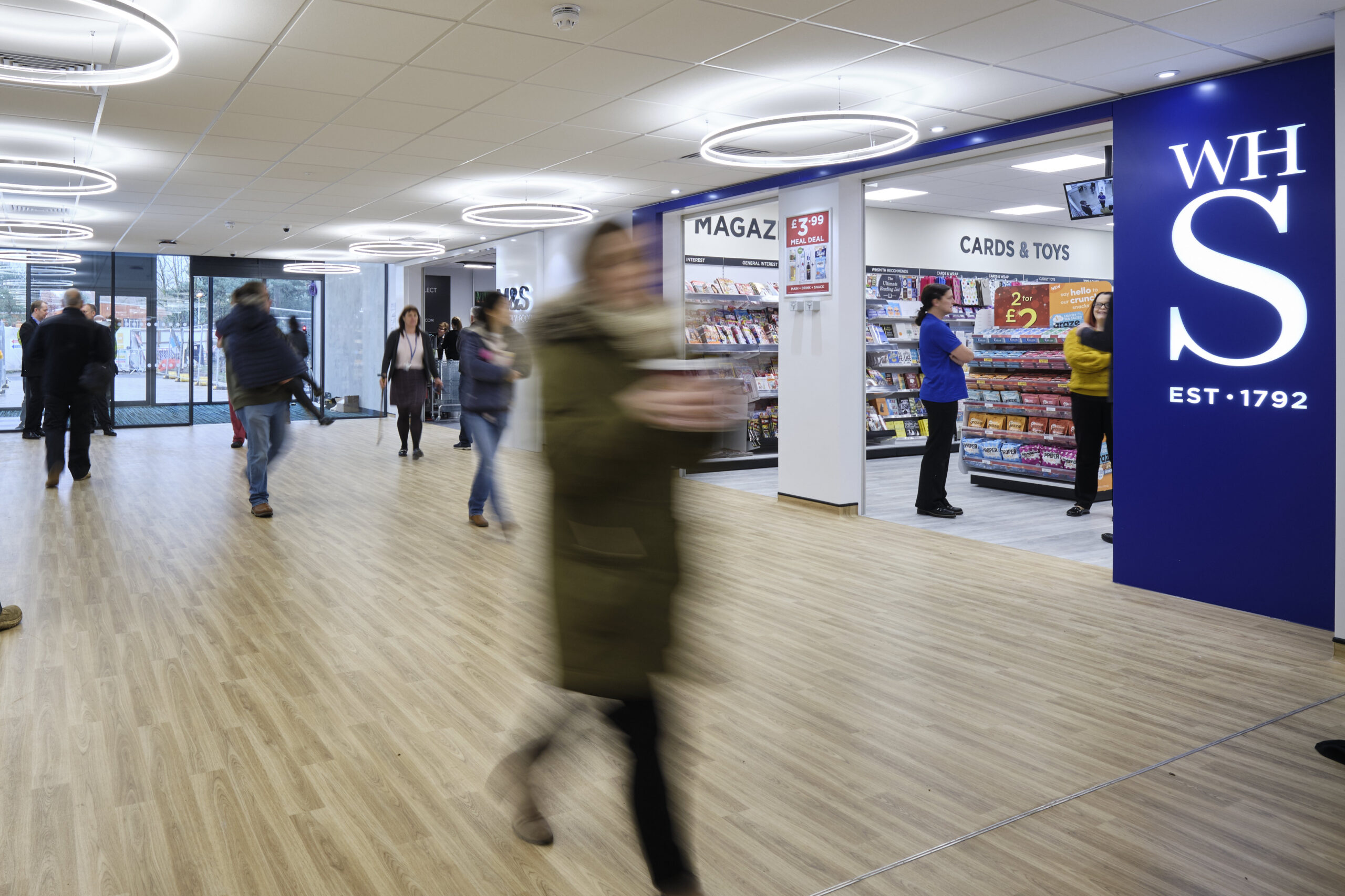
The product strategy has also changed. The modern WHSmith travel store is not just a newsagent. It is a compact, high-footfall convenience retailer selling food and drink, health and beauty, books, magazines, tech accessories, travel products, impulse items and sometimes partner ranges. WHSmith says it has sharpened its focus on food and drinks, health and beauty, tech accessories, books and magazines.
The strategic phrase that matters most is “one-stop shop”. WHSmith wants to capture more of each traveller’s pre-journey spend in a single, efficient retail format.
7. Market positioning: where WHSmith sits
WHSmith’s positioning is unusual. It is not a full duty-free giant like Avolta. It is not primarily a food and beverage operator like SSP. It is not a pure bookseller, pharmacy, coffee chain or electronics retailer. It sits in the middle: travel convenience, travel essentials and high-density, multi-category retail.
That gives it both advantages and vulnerabilities.
Its advantages are clear. The brand is trusted in the UK, familiar to landlords, and proven in travel environments. It can operate small and medium-sized stores effectively. It can flex its range by location. A hospital store, a railway kiosk, a Heathrow flagship and a motorway franchise can all use the same retail logic but different category weightings. The model is operationally repeatable.
Its vulnerability is that it competes with specialists on almost every part of the offer. For food, it competes with Pret, Costa, M&S Food, Boots, supermarket formats and foodservice operators. For health and beauty, it competes with Boots and pharmacies. For tech, it competes with airport electronics retailers and online pre-purchase. For books, it competes with Amazon, Waterstones and digital reading. For travel convenience, it competes with Avolta’s Hudson and other travel retail operators.
Avolta reported 2025 IFRS turnover of CHF 13,983 million and operates at a much larger global scale, while Lagardère Group reported 2025 revenue of €9.4 billion, with Lagardère Travel Retail delivering strong performance as one of its core divisions. WHSmith is smaller, but more focused.
Its market position can therefore be summarised as:
WHSmith is not trying to be the biggest travel retailer in the world. It is trying to be one of the most productive operators of travel essentials space.
That distinction matters. In airports and stations, the critical measure is not brand glamour. It is sales density, reliability, range relevance, landlord confidence, and the ability to make limited space work hard.
8. PESTLE analysis
A PESTLE review shows why WHSmith’s travel pivot is logical, but also why the business carries risk.
Political: Travel retail is influenced by border policies, airport regulation, public transport investment, planning, airport expansion and geopolitical disruption. Conflict, airspace restrictions and security concerns can quickly affect passenger flows. WHSmith’s April 2026 interim announcement referred to a cautious outlook ahead of peak summer trading and suspended the dividend to reduce debt and strengthen the group’s financial position.
Economic: The model benefits from growing passenger numbers, but spending per passenger can be pressured by inflation, lower discretionary income and travel disruption. A customer may still buy water, a sandwich and a charging cable, but may trade down on books, gifts or premium electronics.
Social: Travellers increasingly want convenience, healthier food, beauty and wellness products, phone accessories, and quick service. WHSmith’s launch of its Smith’s Family Kitchen own-brand food range in 2024 fits this trend.
Technological: Technology affects both product demand and operations. Smartphones reduce demand for newspapers and magazines but increase demand for chargers, headphones, power banks and accessories. Digital screens, self-checkout, stock analytics and passenger data can improve store productivity. WHSmith’s InMotion acquisition gave it a stronger position in airport technology accessories.
Legal and regulatory: WHSmith must manage concession contracts, employment law, food safety, consumer law, airport security requirements and financial reporting obligations. The North America accounting issue shows that governance and controls are not administrative details. They are strategic foundations.
Environmental: Travel retail is exposed to climate policy and sustainability expectations. Long-term aviation demand may grow, but aviation will remain under pressure to decarbonise. IATA forecasts global air passenger demand to more than double by 2050 under its mid-range scenario, but also notes the importance of infrastructure, regulation and the clean energy transition.
The PESTLE conclusion is straightforward: the market tailwinds are real, but WHSmith cannot simply ride them. It must manage volatility, regulation, ESG pressure, changing consumer behaviour and operational complexity.
9. SWOT analysis
Strengths
WHSmith has a long-established brand, strong UK travel presence, experience in small-format retail, long-standing landlord relationships and a highly relevant convenience proposition. It also has a portfolio of formats and partnerships, including M&S, Costa, Well Pharmacy and InMotion.
Weaknesses
The brand still carries some baggage from the tired high street estate. North America has exposed weaknesses in financial controls, systems and oversight. The group also has debt pressure and has suspended the dividend to support balance sheet strength.
Opportunities
Passenger growth, airport infrastructure investment, hospital retail, rail travel, motorway service areas, North America, Australia, Ireland, Spain and further international partnerships all offer growth potential. WHSmith specifically identifies passenger growth, airport infrastructure and the one-stop-shop trend as key market drivers.
Threats
The main threats are travel disruption, concession competition, inflation, labour costs, landlord bargaining power, online substitution, changing media habits, and governance risk. Competitors such as Avolta and Lagardère have greater global scale, and foodservice operators such as SSP compete for adjacent passenger spend.
The SWOT conclusion is that WHSmith has a strong strategic niche, but its future depends on disciplined execution rather than brand nostalgia.
10. Porter’s Five Forces
Competitive rivalry: high. Travel locations are crowded with capable operators. The competition is not always direct, but it is intense. A WHSmith airport store competes with Boots, Pret, M&S, Costa, duty-free, vending, convenience stores and airport foodservice.
Buyer power: mixed. Individual customers have limited time and often limited choice once inside a terminal or station. That supports pricing power. But landlords, airports, hospitals and transport operators have significant power because they control the space.
Supplier power: moderate. WHSmith’s scale helps with major suppliers, but branded food, beauty and tech suppliers still matter. The North America supplier income issue also shows that supplier arrangements can become financially and operationally sensitive.
Threat of substitutes: high in some categories, low in others. Newspapers, magazines and books face digital substitution. But drinks, food, medicine, chargers and travel essentials remain physical, immediate-need purchases.
Threat of new entrants: moderate. Travel concessions require relationships, experience, compliance, operational capability and capital. That creates barriers. But airports and landlords can invite strong global competitors to bid.
Porter’s conclusion: WHSmith operates in attractive but demanding markets. The profit pool exists, but it is fought over by sophisticated operators and controlled by powerful landlords.
11. BCG-style portfolio view
WHSmith’s portfolio can be read as follows.
UK Airports: A core cash-generating growth platform. Mature, strong and strategically important. The challenge is continued space optimisation and refurbishments without excessive disruption.
UK Hospitals: A good niche with defensible characteristics. Hospitals provide steady footfall from staff, patients and visitors. WHSmith says it operates over 150 stores in more than 100 UK hospitals and partners with M&S and Costa in healthcare locations.
Rail and motorway service areas: Useful and historically aligned with the brand. Rail is part of the company’s DNA. Motorway sites are convenience-led and often franchise-based.
North America Travel Essentials: Potential star category. WHSmith says North America is the largest travel retail market and that Travel Essentials is the largest and fastest-growing part of its North American Air business.
InMotion: Strategically useful, but exposed to tech product cycles and price comparison. It gives WHSmith a stronger electronics proposition, but the category needs strong buying, service and margin control.
Resorts and sub-scale markets: Question marks. WHSmith’s recent commentary refers to decisive actions in the Resorts business and reducing exposure in sub-scale markets.
Former high street: Now divested. Historically a cash cow, but no longer central to the group.
The portfolio conclusion is that WHSmith should invest behind travel essentials, airports, hospitals and carefully selected international markets, while being ruthless about sub-scale or low-return activities.
12. Pricing analysis: convenience, not cheapness
WHSmith has often been criticised for high prices in stations and airports. Strategically, however, this reflects the economics of travel retail.
The customer is not usually doing a full weekly shop. They are solving an immediate problem: I need water, a sandwich, painkillers, a charging cable, a book for the flight, a last-minute gift, or something to occupy a child. The location is convenient, the time window is short, and alternative options may be limited.
That gives WHSmith pricing power, but only within limits. If prices feel exploitative, customer trust weakens. If the range feels poor, customers switch to Boots, M&S, Pret or airport foodservice. The strategic challenge is to price for convenience without damaging perceived value.
The likely direction is more tiering: good, better and premium ranges. Own-brand food can support margin and perceived value. Partnerships with M&S, Costa and Well Pharmacy can add credibility. Tech accessories can support margin, but customers are increasingly aware of online pricing, so service, convenience and availability matter.
The pricing principle should be: charge for convenience, but justify it through availability, speed, quality and relevance.
13. Stakeholder analysis
WHSmith’s future depends on multiple stakeholder groups.
Customers want speed, availability, clear layouts, relevant products and fair value.
Landlords and transport operators want reliable operators who can generate high sales per square foot, pay concession fees, improve passenger experience and operate compliantly.
Investors want growth, cash generation, disciplined capital allocation, lower debt and restored confidence after the accounting issue.
Employees need clear operating standards, staffing models that work, and a culture that does not become excessively target-driven.
Suppliers want predictable, well-controlled commercial relationships.
Regulators and auditors now matter more visibly because financial reporting failures can damage value quickly.
The important point is that WHSmith is no longer simply a shopkeeper. It is a partner in regulated, high-footfall infrastructure environments. That makes stakeholder management central to strategy.
14. Mistakes, missed opportunities and management lessons
WHSmith’s history is not a story of failure. A company does not survive for more than 230 years by accident. But it has made mistakes, or at least choices that look questionable with hindsight.
The first missed opportunity was ecommerce. WHSmith had early online credentials, including the UK’s first secure online order in 1995 and WHSmith Online in 1999. Yet it did not become a defining online retailer.
The second was brand experience on the high street. The high street business remained profitable, but many customers perceived the stores as tired. The later difficulties of TGJones suggest that the estate may have needed more investment and repositioning than it received.
The third was strategic inconsistency in travel retail. WHSmith sold its US airport and hotel businesses in 2003, then later re-entered and expanded in North America. That does not automatically mean the 2003 sale was wrong, but it does show that travel retail was not always treated as the strategic heart of the business.
The fourth was governance in North America. The Deloitte review found that supplier income accounting in North America was inconsistent with group policy and accounting standards, with issues linked to a target-driven culture, decentralised structure, limited group oversight, finance team weaknesses, and insufficient systems and controls.
That final point is especially important. WHSmith’s future growth case depends heavily on North America. A growth market with weak controls is not a strength. It is a risk. The company’s strategic challenge is therefore not merely to open stores. It must professionalise the operating platform underneath them.
15. Current financial and operational position
WHSmith’s 2025 annual report described a year of significant change and challenge. It reported group revenue of £1.6 billion, headline group profit before tax before non-underlying items of £108 million, statutory group profit before tax of £2 million, and 1,280 stores.
The April 2026 interim results then showed total group revenue up 5% to £748 million for the six months to 28 February 2026, but headline group profit before tax fell to £3 million from £21 million in the restated prior period. The company suspended the dividend to reduce debt and strengthen the financial position.
This creates a mixed picture. The revenue base is growing. The travel proposition remains strategically attractive. But profitability, debt, disruption from refurbishments, North American performance and investor confidence are now key issues.
The next two years are likely to be a test of whether WHSmith can turn a good strategic idea into a consistently well-controlled, high-return operating model.
16. Future direction: where WHSmith is likely to expand
The most likely expansion areas are clear.
North America will remain the largest strategic prize. WHSmith has a relatively small share in a very large travel retail market. The company says it has a strong store pipeline and sees margin opportunities through retaining stronger-margin stores, range optimisation and improved operational performance.
UK airports will remain central. The company has been investing in large airport stores and opened global flagship stores at Heathrow Terminals 3, 4 and 5 in March and April 2026.
Hospitals are likely to keep growing. They fit the one-stop-shop convenience model, and they are less exposed to international travel shocks than airports.
Core international markets such as Australia, Ireland and Spain are likely to receive more focus than scattered sub-scale markets. WHSmith’s 2025 annual report says the Rest of the World division will focus investment on core, strategically important markets, including Australia, Ireland and Spain.
Partnership formats will become more important. M&S, Costa, Well Pharmacy and localised airport formats allow WHSmith to strengthen its offer without having to own every brand capability itself.
Food, drink, health, beauty and tech will continue to take share from traditional newspapers and magazines. Books will remain part of the offer, but the economic engine is increasingly multi-category convenience.
17. Likely scenarios for the future
Scenario 1: Disciplined recovery and focused growth
This is the best realistic scenario. WHSmith strengthens controls, rebuilds trust, reduces debt, improves North American profitability and continues expanding in travel essentials. It becomes a smaller but higher-quality global travel retailer. This scenario is plausible because the market tailwinds are real and passenger growth is expected over the long term.
Scenario 2: Growth continues, but returns disappoint
In this scenario, revenue grows but margins remain under pressure from concession costs, inflation, refurbishment disruption, competitive bidding and operational complexity. WHSmith opens stores but struggles to convert growth into shareholder value.
Scenario 3: North America forces a strategic rethink
If North America remains problematic, WHSmith may have to rationalise more aggressively, exit weaker formats, reduce exposure to resorts or sub-scale operations, and focus more tightly on proven travel essentials stores. This would not necessarily be bad. A smaller, cleaner North American business could be more valuable than a larger, messy one.
Scenario 4: WHSmith becomes a takeover or consolidation target
Once simplified into a pure travel retailer, WHSmith may be easier for investors or competitors to understand. That can support valuation, but it can also make the company more visible as a target. Larger global players with travel retail scale may look at WHSmith’s UK strength, airport relationships and North American platform. This is speculative, but strategically plausible.
18. The likely future of WHSmith
WHSmith is unlikely to disappear. It has already done the painful thing many legacy retailers fail to do: it has let go of its emotional past and focused on where the economics are stronger.
The future WHSmith is likely to be:
A travel essentials retailer, not a traditional newsagent.
A landlord partner, not just a shop operator.
A multi-category convenience business, not a books and stationery chain.
An airport, hospital, rail and motorway brand, not a high street brand.
A business judged on sales density, return on capital, controls and cash, not nostalgia.
The strongest future version of WHSmith will look something like this: fewer distractions, better stores, stronger food and health ranges, sharper tech accessories, localised airport formats, more hospital and transport hub partnerships, disciplined North American growth, and a much stronger finance and governance platform.
The biggest risk is that management mistakes the travel tailwind for a substitute for execution. Passenger growth helps, but it does not automatically create value. Value will come from winning the right space, designing the right format, controlling costs, managing suppliers properly, earning landlord trust and maintaining financial discipline.
Conclusion: a return to the original idea
The great irony of WHSmith’s story is that its future looks remarkably like its past. The company began by selling reading material and useful products to people on the move. It grew with the railway. It became part of Britain’s travel infrastructure. Then, over time, it became associated with the high street. Now, after more than two centuries, it has returned to travel as its core identity.
The strategic review therefore leads to a clear conclusion.
WHSmith’s high street exit was not an abandonment of its heritage. It was a return to the part of its heritage that worked best.
The company’s future is promising, but not guaranteed. Its markets are attractive, its brand still matters, and its one-stop-shop travel essentials model has logic. But the North American accounting issue has shown that WHSmith must now prove it can govern a global business as well as it can run a travel shop.
If it succeeds, WHSmith could become one of the most interesting examples of British retail reinvention: a 230-year-old business that survived not by clinging to the high street, but by rediscovering the traveller.