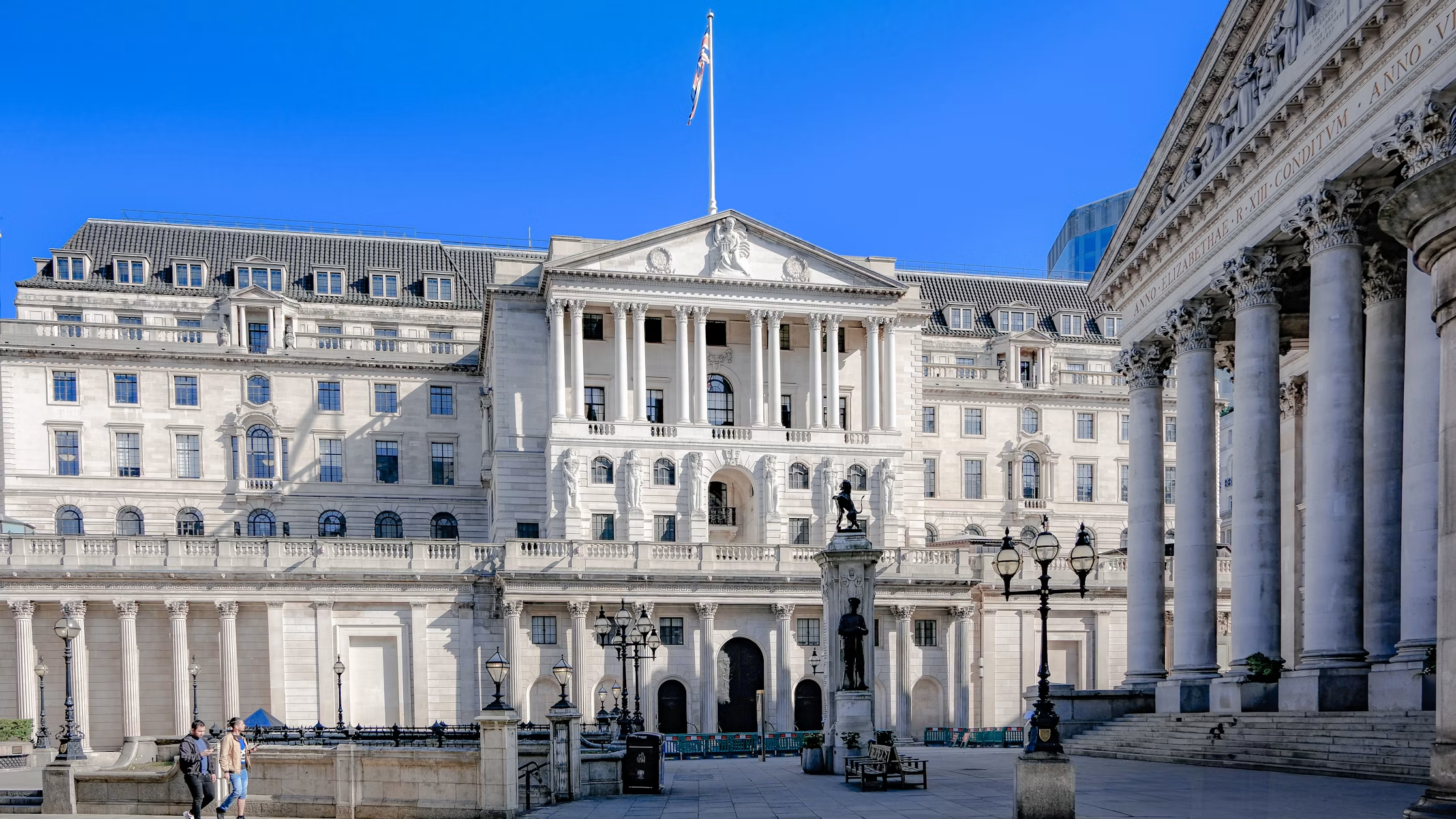
Central banks in the United States and United Kingdom are expected to keep interest rates unchanged this week, as hopes that a US-Iran peace deal will ease pressure on global energy prices give policymakers more time to assess the inflation outlook.
The Federal Reserve is preparing for its first policy decision under new chair Kevin Warsh, while the Bank of England is also expected to hold Bank Rate at 3.75%. Both central banks remain under pressure to control inflation, but a recent fall in oil prices has reduced immediate expectations of further rate rises.
The shift follows a preliminary agreement between the US and Iran, which has raised hopes that energy flows through the Strait of Hormuz could normalise. The strait is one of the world’s most important oil shipping routes, and disruption there has been a major factor behind recent rises in energy prices, fuel costs and inflation expectations.
For businesses, the immediate message is cautious relief rather than a clear turning point. Borrowing costs are unlikely to fall quickly, but the risk of imminent rate increases may have reduced if the peace deal holds and oil prices continue to ease.
Federal Reserve faces first test under Kevin Warsh
The Federal Reserve is widely expected to hold its benchmark interest rate in the 3.50% to 3.75% range at its June policy meeting. The decision will be closely watched because it is the first under Kevin Warsh, who recently succeeded Jerome Powell as Fed chair.
Warsh takes charge at a difficult moment. US inflation rose to 4.2% in May, its highest level for three years, with energy prices accounting for a large part of the increase. Core inflation, which strips out food and energy, was lower at 2.9%, suggesting that the immediate pressure is still heavily linked to energy and fuel rather than broad-based price rises across the economy.
That distinction matters. If inflation is mainly the result of temporary energy disruption, the Fed may choose to wait. If higher energy costs feed into wages, transport, food, manufacturing and services, the central bank may face pressure to raise rates later in the year.
Investors will therefore be watching Warsh’s language as much as the rate decision itself. Analysts expect the Fed to hold rates, but they will look for any change in guidance about whether the next move is more likely to be a cut, a hold, or a rise.
Warsh has previously criticised the Fed’s communication style and has argued for less forward guidance. That could make his first press conference especially important for financial markets. If he signals that inflation risks remain high, bond yields and borrowing costs could rise. If he suggests the Iran peace deal has materially reduced energy risks, markets may assume the Fed has more room to wait.
Bank of England expected to wait
The Bank of England faces a similar but not identical challenge.
UK inflation was 2.8% in April, down from 3.3% in March, but still above the Bank’s 2% target. The Bank Rate currently stands at 3.75%, after the Monetary Policy Committee held rates at its last meeting and warned that the Iran conflict could create significant inflation risks.
In April, the Bank set out scenarios showing that if oil prices remained high for a prolonged period, UK inflation could rise sharply in 2027. In the most damaging scenario, inflation could exceed 6% in early 2027, requiring a much tighter monetary policy response.
The situation now appears less severe than that worst-case scenario, at least for the moment. The US-Iran peace deal has pushed oil prices lower and has encouraged investors to reduce expectations of aggressive rate rises. However, policymakers are unlikely to declare the risk over.
The Bank of England is expected to adopt a wait-and-see approach. It may be reluctant to raise rates while UK growth remains weak, the labour market shows signs of softening, and households are already facing higher mortgage and loan costs. At the same time, it will want to avoid allowing inflation expectations to become embedded.
For business owners, the key issue is that interest rates may remain higher for longer, even if they do not rise further in the short term.
Why energy prices are central to the decision
The Iran conflict has mattered to central banks because energy prices affect almost every part of the economy.
Higher oil prices feed directly into petrol, diesel, heating and transport costs. They also raise costs for manufacturers, logistics firms, food producers, airlines, retailers and construction businesses. If companies pass those costs on to customers, inflation rises. If workers then seek higher wages to offset living costs, inflation can become harder to control.
That is why central banks are focused on what are known as second-round effects. A temporary increase in oil prices is one problem. A broader cycle of higher prices and higher wages is another.
The European Central Bank has already acted more firmly, raising interest rates after eurozone inflation increased. ECB president Christine Lagarde has warned that higher energy costs are starting to feed through into other areas of the economy, including wage bargaining.
The Fed and the Bank of England appear more cautious. Their position is not that inflation risks have disappeared, but that the peace deal may give them enough time to avoid moving rates immediately.
Markets respond positively, but uncertainty remains
Financial markets reacted positively to the US-Iran deal. Reuters reported that stocks rose, oil prices fell and markets reduced expectations of global interest-rate rises after the announcement.
That response reflects the importance of energy security to inflation and monetary policy. If oil prices fall and shipping through the Strait of Hormuz becomes more reliable, central banks may face less pressure to tighten policy.
However, the agreement is still fragile. The details of implementation, the reopening of shipping routes, the durability of the ceasefire and future talks on Iran’s nuclear programme remain important uncertainties.
Markets may therefore be moving faster than central banks. Investors can price in optimism quickly, but policymakers usually wait for evidence. Central banks will want to see whether lower oil prices are sustained, whether fuel costs fall for households and firms, and whether wage and price-setting behaviour remains contained.
That means businesses should not assume that lower oil prices will automatically lead to cheaper borrowing.
What it means for businesses
For businesses, the interest-rate outlook remains finely balanced.
A hold by the Fed and the Bank of England would reduce the immediate risk of higher debt servicing costs. That will be welcome for companies with floating-rate borrowing, overdrafts, asset finance, property loans or refinancing needs.
However, holding rates is not the same as cutting them. Borrowing costs remain materially higher than they were during the low-rate period before the inflation shock. Investment decisions, acquisitions, working capital funding and property transactions may still be affected by expensive finance.
The other pressure is cost volatility. Even if oil prices fall from recent highs, many businesses have already experienced higher transport, utility, input and wage costs. Some may have absorbed these costs through reduced margins. Others may have passed them on to customers. A period of rate stability may help, but it will not immediately reverse those pressures.
Retailers, manufacturers, hospitality firms, logistics operators and construction companies are likely to remain especially sensitive to the path of energy prices and consumer spending.
Consumers may not feel immediate relief
Households may also see limited short-term benefit.
If central banks hold rates, mortgage rates and personal borrowing costs may stabilise, but they are unlikely to fall quickly unless markets become convinced that inflation is moving decisively back towards target. Many mortgage holders who refinance this year may still face higher payments than they were used to several years ago.
Consumer confidence could improve if fuel prices fall and rate rises are avoided, but real household budgets remain under pressure. That matters to businesses because consumer demand is a major driver of sales in retail, leisure, hospitality and discretionary services.
The Bank of England will be watching this closely. If households reduce spending, that weakens growth and reduces inflation pressure. If wages and prices continue rising despite softer demand, the Bank faces a more difficult decision.
A pause, not a pivot
The likely interest-rate hold should be seen as a pause rather than a clear change in direction.
The case for holding rates is that the Iran peace deal may reduce energy costs, inflation pressures may ease, and economies on both sides of the Atlantic do not need additional tightening unless second-round effects become clearer.
The case for raising rates later is that inflation remains above target, energy shocks may not fully unwind, and wage pressures could keep price growth elevated.
The case for cutting rates is weaker in the immediate term, but it could return if oil prices fall further, inflation slows, labour markets weaken and growth disappoints.
For now, the central banks appear to be choosing caution. That may be the most business-friendly option available, because it avoids adding further pressure to firms and households while still keeping policy tight enough to signal that inflation remains a priority.
The coming weeks will show whether the peace deal provides genuine economic relief or only a temporary pause in a volatile inflation cycle.
For businesses, the practical conclusion is clear: interest rates may not rise this week, but the cost of money, energy and wages remains a live strategic risk.