KFC has unveiled a major global brand refresh, placing its famous chicken bucket at the centre of a broader strategy to modernise the chain’s food, restaurants, digital experience and visual identity.
The new brand system, developed with creative agency JKR, covers packaging, typography, restaurant interiors, digital platforms, advertising, app design and tone of voice. It is rolling out first in the UK and Ireland before moving into Australia, the US and other global markets.
The project has been described by JKR and KFC as the “Bucketverse”, a visual and experiential system built around one of the brand’s most recognisable assets. The bucket has been redrawn and standardised so it can work not only as packaging, but as a flexible device across advertising, restaurant environments, digital screens, product photography and campaign messaging.
For a brand that operates more than 34,000 restaurants in more than 150 countries, the refresh is not simply a design exercise. It is part of a wider commercial push by KFC to defend its heritage while responding to changing customer expectations in an increasingly competitive quick-service restaurant market.
More than a logo change
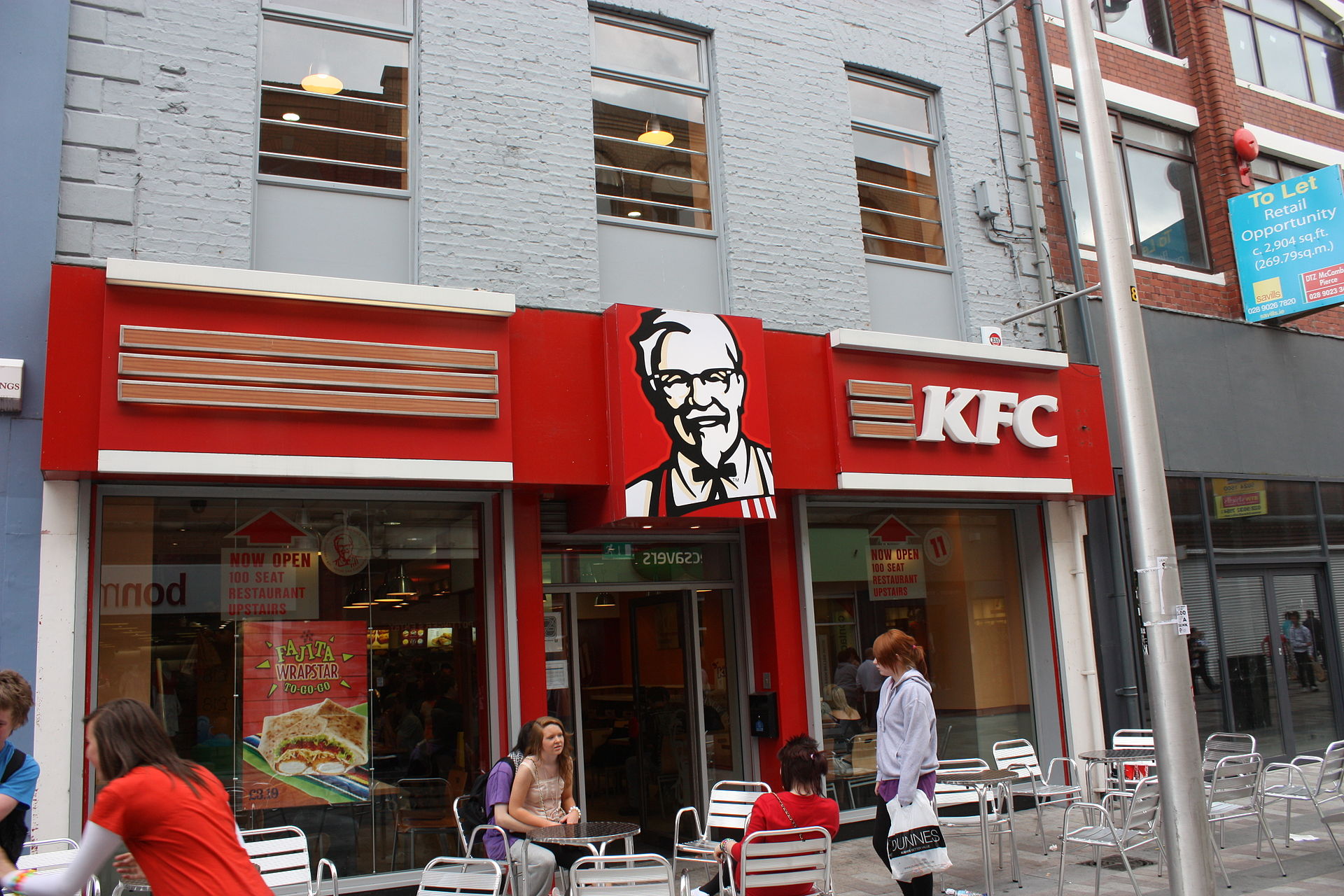
The refresh keeps KFC’s core visual assets intact: the red, white and black colour palette, the Colonel Sanders character, and the brand’s link with buckets of fried chicken. But it updates how those assets are used.
The logo has been made more dimensional, the Colonel has been subtly refreshed, and the lettermark has been simplified for legibility across physical and digital channels. The identity also introduces custom typefaces, Kentucky Fried Serif and Kentucky Fried Sans, created with StudioDrama.
The updated system extends beyond traditional branding. It includes a broader colour palette, new illustration and photography styles, updated social copy and more dynamic digital menu boards. Restaurant screens are being treated less as purely transactional displays and more as branded canvases.
This reflects a wider trend in hospitality branding. Large food chains are no longer just competing through menu, price and location. They are also competing through recognisable visual systems, digital ordering, social media presence, in-store experience and the ability to create moments that customers want to share.
For KFC, the challenge is to look more contemporary without losing the familiar brand codes that make it distinctive.
Why the bucket matters
At the heart of the refresh is the bucket.
That may sound obvious, but it is strategically important. In a crowded market, brands often rely on assets that customers can identify instantly. For McDonald’s it is the golden arches. For Starbucks it is the siren. For KFC it is the Colonel, the red-and-white stripes and the bucket.
The bucket is both functional and symbolic. It represents sharing, groups, family meals and the original fried chicken proposition. By turning it into a flexible design system, KFC is trying to make its most familiar asset work harder across modern channels.
That matters because digital environments can flatten brands. On a delivery app, social feed or mobile ordering screen, a restaurant chain may appear as little more than a logo, thumbnail, offer or menu tile. Distinctive visual assets help a brand stand out in those crowded spaces.
The rebrand therefore appears to be less about replacing KFC’s identity and more about strengthening the parts of it that remain most recognisable.
Menu changes reflect shifting eating habits
The brand refresh is being launched alongside a wider menu and restaurant strategy.
KFC is expanding its focus on boneless chicken, dipping occasions, sauces and drinks. The company is introducing more than 20 sauces globally, including regional variations, while pushing menu items designed for dipping, dunking and snacking. It is also expanding KWENCH by KFC, a drinks platform including boba-style refreshers, sparkling lemonades, iced coffees and shakes.
This is not accidental. Consumer behaviour has changed. Younger customers are more likely to snack, graze, customise meals and seek visually appealing drinks or limited-time products. Chicken tenders, sauces and speciality drinks also lend themselves well to social media and delivery.
Traditional bone-in fried chicken remains central to KFC’s heritage, but it is not the only way people now eat chicken. Boneless products are easier to eat on the move, easier to dip, and often more flexible for delivery and individual meals.
That puts KFC in direct competition not only with traditional burger chains, but also with fast-growing chicken specialists, beverage-led operators and snack-focused brands.
A competitive chicken market
The timing of the refresh is important.
Chicken has become one of the most competitive parts of the fast-food industry. In the US, KFC faces pressure from Chick-fil-A, Popeyes, Raising Cane’s, Wingstop, Dave’s Hot Chicken and other chicken-led brands. Many of these rivals have built growth around a narrower product focus, strong customer loyalty, boneless formats, sauces and digital-friendly menu items.
KFC remains a major global player, but the brand has faced particular pressure in the US market. Business Insider has described the chain as having become a global brand with an American problem, reflecting the gap between its international strength and tougher competition in its original home market.
That context helps explain the global nature of the refresh. KFC is not abandoning its heritage, but it is trying to make that heritage more relevant to today’s fast-food habits.
The company’s recent financial performance gives it a stronger platform. Yum Brands reported that KFC division system sales grew 6% in the first quarter of 2026, with same-store sales up 2% and unit growth of 7%. KFC also opened 648 gross new restaurants across 45 countries during the quarter.
Those figures suggest that KFC’s global expansion remains strong, even if some markets are more challenging than others.
UK and Ireland as launchpad
The UK and Ireland are playing a prominent role in the rollout, with the refresh beginning there before moving to other markets.
That is notable because the region is already a major growth focus for KFC. In 2025, the company announced plans to invest £1.49bn in the UK and Ireland over five years, creating more than 7,000 jobs and supporting its ambition to open a further 500 outlets over the next decade.
KFC already operates more than 1,000 outlets across the UK and Ireland and employs around 30,000 people in the region. The company has said the UK’s appetite for fried chicken is growing, with the market estimated at £3.1bn.
This makes the UK and Ireland a logical testing ground. The market is mature enough to provide scale, but competitive enough to test whether the updated identity and menu strategy can cut through.
It also means the rebrand is linked to real investment. New branding on its own rarely changes a business. Branding becomes more commercially meaningful when it is tied to restaurants, menus, digital infrastructure, staff, customer experience and expansion plans.
Experience-led restaurants
KFC is also updating restaurant design.
The company has highlighted new concept restaurants in locations including McKinney, Texas, and Dubai. The aim is to create more flexible, modern spaces that work across different customer occasions, from takeaway and delivery collection to in-restaurant dining and digital ordering.
This reflects a broader shift in quick-service restaurants. Fast-food sites are no longer designed only around counter service and eating in. They must handle app orders, delivery drivers, drive-through traffic, self-order kiosks, collection shelves and peak-time operational pressure.
At the same time, chains are trying to make restaurants feel less functional and more experience-led. The design challenge is to increase operational efficiency without making the customer experience feel cold or transactional.
That is difficult. Digital ordering can improve speed and accuracy, but it can also reduce human interaction. Delivery channels can increase reach, but they can disrupt restaurant flow. More immersive design can attract attention, but only if the basics of food quality, value and service remain strong.
The risk of changing too much, or too little
The balance for KFC is delicate.
Heritage brands have to modernise, but customers can react badly if familiar assets are changed too aggressively. Recent corporate rebrands in other sectors have shown how quickly audiences can criticise changes that appear to weaken brand recognition.
KFC appears to be avoiding that risk by keeping its core symbols while making them more flexible. The Colonel stays. The bucket stays. The red and white stays. The update is more about system, expression and application than a complete reinvention.
The opposite risk is that the refresh may be seen as cosmetic if the customer experience does not improve. A stronger visual identity will not solve slow service, poor delivery experience, inconsistent food quality or weak value perception. For the rebrand to work commercially, customers must notice more than new packaging.
This is where the menu, restaurant and digital changes become important. KFC is trying to present the refresh as a whole-business shift, not just a graphic design project.
What it means for the brand
The rebrand shows how global restaurant chains are adapting to a more fragmented and competitive market.
Customers now encounter brands across many touchpoints: street signage, delivery apps, social media posts, packaging, restaurant interiors, digital screens, loyalty schemes and advertising. Consistency matters, but so does flexibility. A brand has to be recognisable in a two-second scroll and still strong enough to support a full restaurant experience.
KFC’s answer is to amplify the assets it already owns. Rather than chasing a completely new image, it is leaning into the bucket, the Colonel and the language of fried chicken while updating the system around them.
That may prove commercially sensible. In a market where many newer chicken brands are trying to manufacture heritage, KFC already has it. Its challenge is to make that heritage feel current.
A rebrand tied to growth
KFC’s refresh is arriving at a time when Yum Brands is reshaping its portfolio and focusing on the strongest parts of its restaurant estate. KFC’s global unit growth, the planned UK and Ireland investment, and the move into sauces, drinks and more modern restaurant formats all suggest that the brand is being positioned for a larger role in the group’s future.
For customers, the most visible changes will be packaging, restaurant design, menus and digital experiences. For the business, the aim is broader: more occasions, more personalisation, more digital engagement and stronger differentiation in a crowded chicken market.
The rebrand is unlikely to be judged by designers alone. Its real test will be whether it drives sales, improves customer perception, supports franchisee growth and helps KFC compete with younger, faster-moving rivals.
The bucket has always been one of KFC’s most recognisable symbols. The company is now betting that it can become the organising idea for its next phase of global growth.
Image: Ardfern, Wikimedia Commons, CC BY-SA 3.0