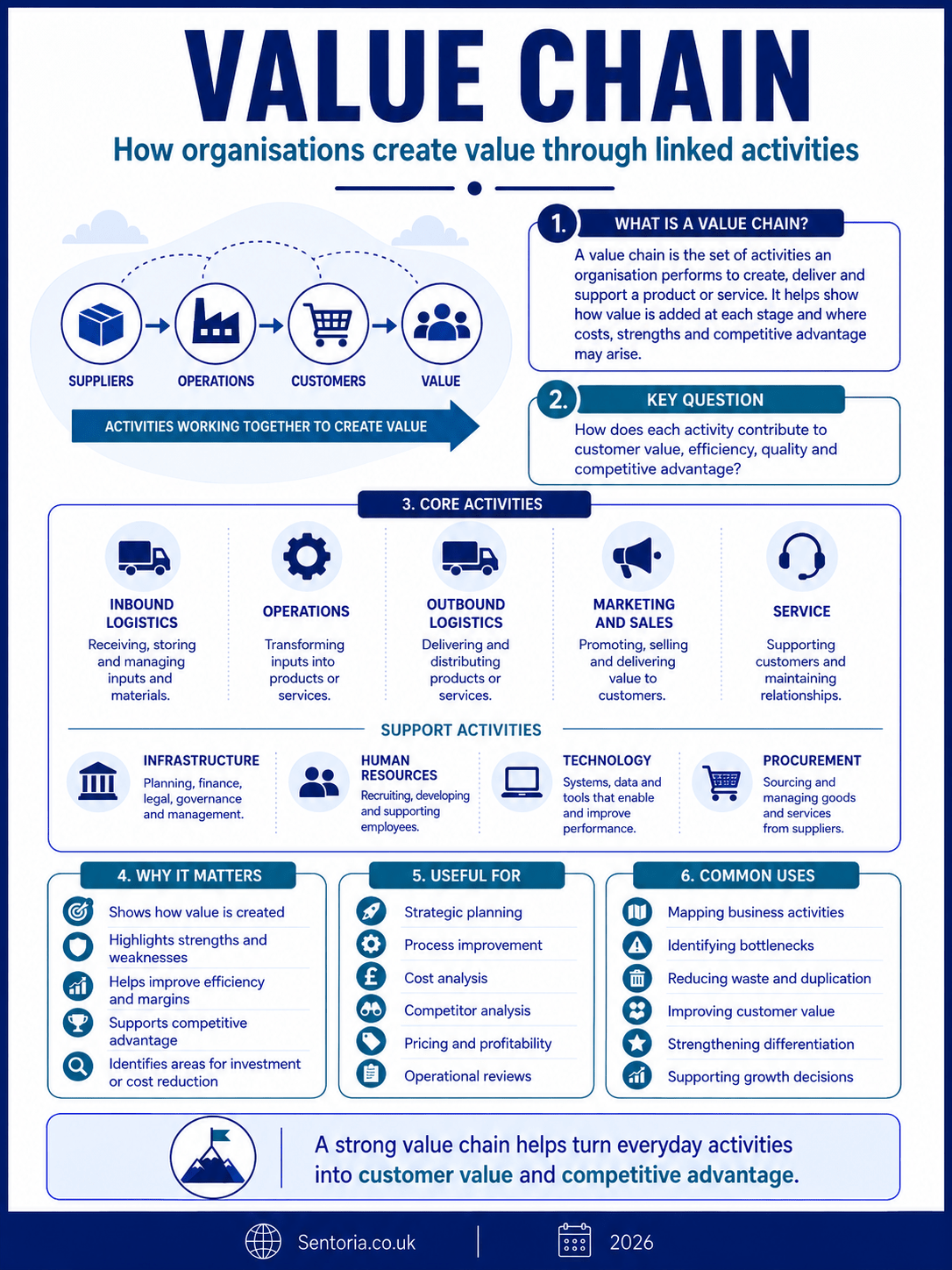
Value Chain: A Practical Guide to Understanding How Organisations Create Value Through Linked Activities
A value chain is the sequence of activities an organisation performs to create, deliver and support a product, service, experience or outcome.
At its simplest, the value chain asks:
How does value move through the organisation, where is value added, where are costs incurred, and which activities create advantage or weakness?
That makes it useful for strategy, business planning, operational improvement, pricing, cost analysis, competitor analysis, customer experience, process improvement, manufacturing, retail, ecommerce, professional services, charities, public services, property, technology, healthcare and education.
Used properly, the value chain helps organisations move beyond seeing departments, processes and costs in isolation. It shows how activities connect.
It is not just about operations.
It is about understanding how everyday activities combine to create value for customers, service users, stakeholders and the organisation itself.
What is a value chain?
A value chain is the set of linked activities that turn inputs into outputs that customers or stakeholders value.
Those inputs may include:
- Raw materials
- Information
- Staff time
- Expertise
- Technology
- Data
- Funding
- Property
- Relationships
- Supplier services
- Customer needs
- Community insight
- Professional knowledge
- Equipment
- Intellectual property
Those outputs may include:
- Products
- Services
- Advice
- Care
- Education
- Digital tools
- Reports
- Customer experiences
- Social impact
- Public value
- Tenant outcomes
- Health outcomes
- Learning outcomes
- Financial returns
- Community benefit
A value chain helps show how the organisation takes resources and turns them into something useful.
For example:
A manufacturer buys materials, turns them into finished products, stores them, sells them, delivers them and supports customers after sale.
A professional services firm attracts clients, understands their needs, gathers information, applies expertise, provides advice, manages quality and maintains relationships.
A charity identifies need, secures funding, recruits staff or volunteers, delivers services, measures impact and reports back to funders and trustees.
A public body assesses demand, designs services, allocates resources, delivers support, monitors outcomes and reports to decision-makers.
The value chain is therefore not just a manufacturing concept.
Every organisation has a value chain, even if it does not call it that.
Value chain and value chain analysis
The terms value chain and value chain analysis are closely linked, but they are not exactly the same.
Value chain
The value chain is the actual set of activities that create, deliver and support value.
It asks:
What activities does the organisation perform to create value?
Value chain analysis
Value chain analysis is the process of examining those activities to understand cost, value, efficiency, quality, differentiation and competitive advantage.
It asks:
Where is value created, where is value lost, and what should we improve?
In simple terms:
The value chain is the system.
Value chain analysis is the review of that system.
The concept is useful because many organisations understand their individual activities, but not always how those activities combine.
A business may look at sales, operations, finance and customer service separately.
A charity may look at fundraising, service delivery and impact reporting separately.
A public body may look at policy, commissioning, operations and performance separately.
The value chain brings those pieces together.
History and development of the value chain concept
The value chain concept is most strongly associated with Michael Porter, who popularised it as part of competitive strategy.
Porter’s value chain separated business activities into primary activities and support activities. The purpose was to understand how each activity contributes to cost, differentiation and competitive advantage.
The idea became influential because it shifted attention from broad statements about strategy to the detailed activities that make strategy real.
An organisation does not create advantage only by choosing a market position.
It creates advantage through what it actually does.
For example:
- How it buys
- How it produces
- How it delivers
- How it sells
- How it supports customers
- How it recruits
- How it uses technology
- How it manages finance
- How it governs decisions
- How it improves quality
The value chain also helped organisations understand that advantage may come from different places.
One business may win through efficient operations.
Another may win through superior service.
Another may win through product design.
Another may win through procurement strength.
Another may win through data, systems and logistics.
Another may win through trusted relationships and specialist expertise.
Over time, value chain thinking has moved beyond traditional manufacturing.
It is now used in services, digital businesses, charities, public services, education, healthcare, property, software, logistics, professional services and social enterprises.
The language may change, but the principle remains the same.
Value is created through connected activities.
Why the value chain matters
The value chain matters because organisations often lose value between departments, processes and handovers.
A strong product can be damaged by poor delivery.
Good marketing can be undermined by weak customer service.
Efficient operations can be undermined by poor procurement.
A charity can deliver excellent services but struggle to demonstrate impact to funders.
A public body can have a strong policy intention but weak implementation.
A professional firm can have strong expertise but poor client communication.
A property business can have valuable assets but poor tenant management.
The value chain helps identify these links.
It supports:
- Better understanding of how value is created
- Better cost control
- Better process improvement
- Better customer experience
- Better service delivery
- Better pricing decisions
- Better operational efficiency
- Better strategic focus
- Better resource allocation
- Better quality management
- Better identification of bottlenecks
- Better competitive advantage
- Better investment decisions
- Better risk management
- Better cross-team working
- Better use of technology
- Better supplier management
- Better margin improvement
- Better differentiation
- Better long-term sustainability
The value chain is especially useful because it connects strategy with delivery.
A strategy may say:
We will compete on service quality.
The value chain asks:
Which activities create that service quality, and are they strong enough?
A strategy may say:
We will become more efficient.
The value chain asks:
Where are costs incurred, where is work duplicated, and which activities could be redesigned?
A strategy may say:
We will improve customer experience.
The value chain asks:
Which activities shape the customer experience from first contact to aftercare?
That practical connection is the real strength of value chain thinking.
When to use the value chain
The value chain is useful whenever an organisation needs to understand how activities create value, cost, quality or advantage.
Good uses include:
- Strategy development
- Operational improvement
- Cost reduction
- Margin improvement
- Process redesign
- Customer experience improvement
- Service redesign
- Competitive advantage analysis
- Business model review
- Pricing analysis
- Procurement review
- Technology investment
- Quality improvement
- Internal audit
- Risk management
- Supplier review
- Outsourcing decisions
- Growth planning
- Turnaround planning
- Board reporting
- Charity sustainability
- Public service redesign
- Property asset management
- Digital transformation
- Manufacturing efficiency
It is especially useful where:
- Costs are rising.
- Margins are falling.
- Customer complaints are increasing.
- Processes feel slow or duplicated.
- Teams are working in silos.
- Service quality is inconsistent.
- The organisation is unclear where value is created.
- Competitors are more efficient.
- Customers are not seeing the value provided.
- The organisation needs to decide where to invest.
It is less useful when used only as a theoretical diagram.
The value chain should be based on real activities, real costs, real customers and real evidence.
The core structure of a value chain
The traditional value chain is often split into:
- Primary activities
- Support activities
Primary activities are directly involved in creating, delivering, selling and supporting the product or service.
Support activities enable the primary activities to work effectively.
Primary activities
Primary activities usually include:
- Inbound logistics
- Operations
- Outbound logistics
- Marketing and sales
- Service
These terms come from manufacturing and product-based businesses, but they can be adapted for services, charities and public bodies.
Support activities
Support activities usually include:
- Infrastructure
- Human resources
- Technology development
- Procurement
Again, these should be adapted to the organisation being reviewed.
The important point is not to force every organisation into rigid labels.
The important point is to understand which activities create value and which activities support them.
Primary activity 1: Inbound logistics
Inbound logistics covers how inputs enter the organisation.
In a product business, this may include:
- Supplier selection
- Purchasing
- Receiving goods
- Stock control
- Warehousing
- Quality checks
- Material handling
- Delivery scheduling
- Supplier communication
- Inventory systems
In a service organisation, inbound logistics may mean gathering the information, documents, referrals or requests needed to begin the work.
For example:
- Client onboarding
- Customer enquiries
- Referral forms
- Needs assessments
- Initial consultations
- Data collection
- Booking processes
- Intake processes
- Document requests
- Case opening
Inbound logistics matters because poor inputs create poor outputs.
If materials are late, production suffers.
If client information is incomplete, advice is delayed.
If referrals are unclear, service delivery is weaker.
If customer requirements are misunderstood, the wrong solution may be delivered.
Key questions include:
- Do we receive the right inputs?
- Are inputs complete and accurate?
- Are suppliers reliable?
- Is information captured properly?
- Are handovers clear?
- Are delays caused at the start?
- Is stock too high or too low?
- Are quality checks effective?
- Are systems supporting the process?
- What could be simplified?
Primary activity 2: Operations
Operations covers the activities that transform inputs into products, services or outcomes.
In manufacturing, operations may include:
- Production
- Assembly
- Machining
- Testing
- Quality control
- Packaging
- Maintenance
- Scheduling
- Labour planning
- Process improvement
In a service organisation, operations may include:
- Advice delivery
- Casework
- Project work
- Care delivery
- Teaching
- Training
- Consultancy
- Report preparation
- Repairs
- Customer support
- Service appointments
- Assessments
- Processing applications
- Delivery of interventions
- Programme management
Operations is often where most value is created, but also where many costs arise.
It is therefore central to value chain analysis.
Key questions include:
- How is value created during delivery?
- Which steps add value?
- Which steps create delay?
- Where is work duplicated?
- Where do errors occur?
- Where is quality strongest?
- Where is quality weakest?
- Are processes standardised where appropriate?
- Is bespoke work priced properly?
- What skills or systems are essential?
Operations should not be viewed only as cost.
Good operations can create differentiation, reliability and trust.
Primary activity 3: Outbound logistics
Outbound logistics covers how the finished product, service or output reaches the customer or stakeholder.
In a product business, this may include:
- Order fulfilment
- Picking and packing
- Dispatch
- Delivery
- Distribution
- Export processes
- Tracking
- Customer notification
- Returns handling
- Final quality checks
In a service organisation, outbound logistics may include:
- Delivering reports
- Sending advice
- Completing cases
- Providing outcomes
- Issuing certificates
- Delivering training materials
- Sharing care plans
- Providing decisions
- Implementing recommendations
- Transferring information to the next stage
Outbound logistics matters because value can be lost at the point of delivery.
A product that is made well but delivered late damages customer trust.
A report that is technically excellent but poorly explained may not create value.
A service that reaches the wrong person at the wrong time may fail.
A public service decision that is unclear may create complaints and appeals.
Key questions include:
- How does the customer receive the output?
- Is delivery timely?
- Is delivery accurate?
- Is communication clear?
- Are expectations managed?
- Are delays visible early?
- Are returns or rework common?
- Is the final handover effective?
- Does the customer understand the value delivered?
- What could improve the experience?
Primary activity 4: Marketing and sales
Marketing and sales cover how the organisation attracts, informs, persuades and converts customers or stakeholders.
This may include:
- Market research
- Customer research
- Brand positioning
- Website
- Content
- Advertising
- Sales calls
- Proposals
- Tendering
- Pricing
- Relationship development
- Social media
- Events
- Referral management
- Customer education
For charities and public bodies, the language may differ.
Equivalent activities may include:
- Fundraising
- Community outreach
- Public information
- Stakeholder engagement
- Service awareness
- Referral partner engagement
- Donor communication
- Impact communication
- Public consultation
- Campaigning
Marketing and sales matter because a strong value chain still fails if customers do not understand the value.
A good product that is poorly positioned may not sell.
A valuable charity service may be underused if referral partners do not understand it.
A professional service may be underpriced if clients do not recognise the value.
A public service may fail if residents do not know how to access it.
Key questions include:
- Do customers understand the value?
- Are we reaching the right audience?
- Are we targeting the right segment?
- Is our value proposition clear?
- Is pricing aligned with value?
- Are sales processes effective?
- Are funders or stakeholders convinced?
- Are enquiries converting?
- Are we attracting profitable or suitable work?
- Does marketing promise what operations can deliver?
Primary activity 5: Service
Service covers support after the product, advice, project or service has been delivered.
This may include:
- Customer support
- Aftercare
- Maintenance
- Complaints handling
- Warranty support
- Training
- Account management
- Relationship management
- Follow-up advice
- Reviews
- Renewals
- Feedback
- Service improvement
- Ongoing communication
- Impact reporting
Service can be a powerful source of value.
In many sectors, customers do not judge only the core product or service. They judge the whole experience.
A customer may forgive a problem if support is excellent.
A client may stay loyal because advice is followed up.
A tenant may value a landlord who responds quickly.
A funder may renew support because impact reporting is clear and credible.
A learner may succeed because support continues after the main teaching session.
Key questions include:
- What happens after delivery?
- Are customers supported properly?
- Are complaints handled well?
- Are issues resolved quickly?
- Is feedback collected?
- Are relationships maintained?
- Does aftercare create loyalty?
- Does support cost more than expected?
- Are recurring problems being fixed?
- Does service strengthen reputation?
Support activity 1: Infrastructure
Infrastructure includes the systems, governance, finance, legal, administration and management structures that support the organisation.
This may include:
- Leadership
- Governance
- Finance
- Legal
- Compliance
- Risk management
- Management reporting
- Administration
- Policies
- Planning
- Facilities
- Internal controls
- Board reporting
- Strategy
- Decision-making processes
Infrastructure may not always be visible to customers, but it strongly affects performance.
Weak finance systems can damage cash flow.
Poor governance can create risk.
Weak reporting can delay decisions.
Unclear policies can create inconsistent service.
Poor management structures can slow delivery.
Key questions include:
- Does governance support good decisions?
- Is financial information reliable?
- Are risks being managed?
- Are responsibilities clear?
- Are policies practical?
- Are systems fit for purpose?
- Are controls proportionate?
- Are management reports useful?
- Are decisions made at the right level?
- Does infrastructure help or hinder delivery?
Support activity 2: Human resources
Human resources covers the people, skills, culture and workforce processes needed to deliver value.
This may include:
- Recruitment
- Training
- Performance management
- Pay and reward
- Workforce planning
- Staff engagement
- Leadership development
- Succession planning
- Health and safety
- Volunteer management
- Culture
- Retention
- Supervision
- Skills development
- Employee relations
People are often central to value creation.
This is especially true in professional services, healthcare, education, charities, public services, hospitality, consultancy and care.
A value chain can look strong on paper but fail if staff do not have the skills, time, confidence or support to deliver it.
Key questions include:
- Do we have the right skills?
- Are staff trained properly?
- Are roles clear?
- Is capacity sufficient?
- Is turnover affecting quality?
- Is culture supporting performance?
- Are managers effective?
- Are volunteers supported?
- Are incentives aligned with value?
- What skills will be needed in future?
Support activity 3: Technology development
Technology development includes systems, tools, data, automation and digital capability used to improve performance.
This may include:
- Software
- Data systems
- Automation
- Artificial intelligence
- Customer relationship management systems
- Finance systems
- Production technology
- Website platforms
- Cyber security
- Reporting tools
- Digital service channels
- Analytics
- Workflow systems
- Integration tools
- Product development technology
Technology can improve value by:
- Reducing cost
- Increasing speed
- Improving accuracy
- Improving customer experience
- Supporting better decisions
- Improving scalability
- Reducing manual work
- Improving reporting
- Supporting innovation
- Strengthening control
However, technology is not automatically valuable.
A system that does not fit the process may create more work.
Automation that damages customer trust may weaken value.
A dashboard with poor data may mislead management.
Key questions include:
- Does technology improve value?
- Does it reduce cost or delay?
- Does it improve accuracy?
- Does it support customers or staff?
- Is data reliable?
- Are systems integrated?
- Are manual workarounds common?
- Is cyber security adequate?
- Are users trained properly?
- What investment would create the most benefit?
Support activity 4: Procurement
Procurement covers how the organisation sources goods, services, suppliers and partners.
This may include:
- Supplier selection
- Contract negotiation
- Purchase approval
- Supplier performance
- Cost control
- Quality standards
- Ethical sourcing
- Contract management
- Outsourcing
- Tendering
- Stock purchasing
- Professional services procurement
- Technology procurement
- Utilities
- Contractor management
Procurement matters because suppliers influence cost, quality, reliability and risk.
A poor supplier can damage the whole value chain.
A strong supplier relationship can create better quality, innovation, flexibility and cost control.
Key questions include:
- Are suppliers reliable?
- Are costs competitive?
- Are contracts clear?
- Are quality standards met?
- Are we over-dependent on one supplier?
- Are ethical or environmental standards considered?
- Are supplier risks monitored?
- Are purchasing decisions controlled?
- Could procurement create savings?
- Could better suppliers create more value?
Value chain in different industries
SMEs and owner-managed businesses
For SMEs, the value chain is often informal.
The owner may hold much of the knowledge, make many decisions and personally manage key relationships.
Typical SME value chain questions include:
- How do customers find us?
- How do we convert enquiries?
- How do we deliver the work?
- Where do delays happen?
- Which activities depend on the owner?
- Which activities create the most value?
- Which activities create the most cost?
- Are customers seeing the value we provide?
- Where are we undercharging?
- Which processes need to be systemised?
An SME may discover that value is created through personal service, responsiveness and specialist knowledge, but that the model is fragile because too much depends on one person.
For SMEs, value chain improvement often means:
- Documenting key processes
- Improving pricing
- Improving customer onboarding
- Reducing duplication
- Training staff
- Improving systems
- Strengthening customer communication
- Improving credit control
- Focusing on profitable work
- Reducing owner dependency
The value chain helps SMEs see where everyday work creates or destroys value.
Manufacturing
Manufacturing is the traditional home of value chain thinking.
A manufacturing value chain may include:
- Supplier sourcing
- Material purchasing
- Goods receiving
- Stock control
- Production planning
- Manufacturing
- Quality control
- Packaging
- Warehousing
- Distribution
- Sales
- Customer support
- Maintenance
- Warranty handling
- Continuous improvement
A manufacturer might ask:
- Are materials arriving on time?
- Is stock being managed efficiently?
- Where is waste occurring?
- Which products have the best margins?
- Which machines or processes create bottlenecks?
- Are quality issues caused by suppliers, process or design?
- Is production scheduling efficient?
- Are delivery promises realistic?
- Are after-sales costs included in pricing?
- Which activities create competitive advantage?
For manufacturing, the value chain should connect operations with finance.
A cost saving that increases defects is not real value.
A high-quality process that is not priced properly may weaken margins.
Retail and ecommerce
Retail and ecommerce value chains depend on product selection, purchasing, stock, fulfilment, customer acquisition and customer experience.
A retail value chain may include:
- Market research
- Product sourcing
- Supplier negotiation
- Stock purchasing
- Merchandising
- Website or store presentation
- Marketing
- Customer conversion
- Payment processing
- Fulfilment
- Delivery
- Returns
- Customer service
- Reviews
- Loyalty and repeat purchase
An ecommerce business might ask:
- Are we sourcing the right products?
- Are margins strong after fulfilment and returns?
- Is the website helping customers buy?
- Where do customers abandon baskets?
- Are delivery expectations clear?
- Are returns avoidable?
- Are customer service queries revealing product or website issues?
- Which channels attract profitable customers?
- Which products create repeat purchase?
- Which activities create loyalty?
For ecommerce, the value chain is highly connected.
A product page error can increase returns.
Poor delivery communication can increase customer service cost.
Discounting can increase revenue while weakening margin.
The value chain helps show these connections.
Professional services
Professional services value chains depend on trust, expertise, client information, delivery quality and relationship management.
A professional services value chain may include:
- Reputation building
- Referral generation
- Enquiry handling
- Client onboarding
- Scope agreement
- Information gathering
- Technical work
- Review and quality control
- Advice or report delivery
- Billing
- Follow-up
- Relationship management
- Cross-selling
- Retention
- Referral generation
For accountants, solicitors, consultants, architects and advisers, the value chain might ask:
- Are we attracting the right clients?
- Is onboarding clear?
- Are scopes properly defined?
- Is information gathered efficiently?
- Where does work get delayed?
- Are senior staff doing work that could be delegated?
- Are clients receiving advice in plain English?
- Are fixed fees profitable?
- Is follow-up creating additional value?
- Are client relationships being managed systematically?
Professional services firms often leak value through poor scoping, weak delegation, underpricing, slow billing and unclear communication.
Value chain thinking makes these issues visible.
Charities and voluntary organisations
Charities create value through impact, not only financial return.
A charity value chain may include:
- Understanding need
- Fundraising
- Grant applications
- Volunteer recruitment
- Staff recruitment
- Referral pathways
- Service design
- Service delivery
- Safeguarding
- Beneficiary support
- Partnership working
- Impact measurement
- Reporting to funders
- Trustee oversight
- Community engagement
A charity might ask:
- How do beneficiaries reach us?
- Are referral pathways effective?
- Are services reaching the right people?
- Are volunteers supported?
- Are funders receiving good evidence of impact?
- Are restricted funds covering full cost?
- Where are staff overstretched?
- Are safeguarding processes strong?
- Which activities create the most impact?
- Which activities are mission-critical but underfunded?
For charities, the value chain helps connect mission, funding, delivery, impact and governance.
It can also show where administrative work supports value rather than distracts from it.
Good governance, safeguarding and reporting are not separate from impact. They help protect it.
Public sector and local government
Public sector value chains focus on public value, service outcomes, statutory duties and value for money.
A public service value chain may include:
- Policy development
- Needs assessment
- Budget allocation
- Service design
- Commissioning
- Procurement
- Delivery
- Case management
- Resident communication
- Performance monitoring
- Complaint handling
- Safeguarding
- Partnership working
- Evaluation
- Democratic accountability
A public body might ask:
- Is the service designed around real need?
- Are resources allocated effectively?
- Are residents able to access the service?
- Are handovers between agencies working?
- Are contractors delivering value?
- Are outcomes being measured?
- Are complaints revealing process failure?
- Is prevention reducing demand?
- Are statutory duties being met?
- Which activities create most public value?
For public bodies, the value chain should include access, equality, accountability and long-term outcomes.
Efficiency matters, but not at the expense of statutory duty, fairness or safeguarding.
Property and construction
Property and construction value chains depend on land, planning, design, funding, construction, leasing, asset management and tenant experience.
A property value chain may include:
- Site identification
- Market research
- Feasibility
- Planning strategy
- Design
- Funding
- Procurement
- Construction
- Project management
- Letting or sales
- Tenant onboarding
- Maintenance
- Service charge management
- Rent collection
- Asset management
A property business might ask:
- Where is value created in the asset?
- Is planning strategy increasing or reducing value?
- Is design aligned with occupier demand?
- Are construction costs controlled?
- Are tenants being served properly?
- Are void periods reducing value?
- Are service charges clear and recoverable?
- Are maintenance costs controlled?
- Is the asset positioned correctly?
- What investment would improve long-term value?
For property and construction, the value chain connects physical assets with finance, planning, risk and tenant demand.
A site may have theoretical value but fail if planning, infrastructure, funding or tenant demand are weak.
Technology and software
Technology value chains often focus on product development, user acquisition, onboarding, support, retention and data.
A software value chain may include:
- Customer research
- Product design
- Development
- Testing
- Security
- Release management
- Marketing
- Sales
- Onboarding
- User support
- Product analytics
- Feature improvement
- Customer success
- Renewals
- Data and insight
A software business might ask:
- Are we solving a real customer problem?
- Is development focused on valuable features?
- Are releases reliable?
- Is onboarding effective?
- Are users adopting key features?
- What drives churn?
- Is support cost too high?
- Is customer feedback informing the roadmap?
- Are integrations creating switching costs?
- Which activities create product advantage?
In software, the value chain is not only about building the product.
Customer success, onboarding and retention are often just as important as development.
Healthcare and social care
Healthcare and social care value chains must prioritise safety, dignity, quality and compliance.
A care value chain may include:
- Referral or enquiry
- Assessment
- Care planning
- Staff allocation
- Care delivery
- Medication management
- Safeguarding
- Family communication
- Quality monitoring
- Staff training
- Incident reporting
- Review meetings
- Regulatory compliance
- Outcome monitoring
- Continuous improvement
A care provider might ask:
- Are assessments accurate?
- Are care plans clear?
- Are staff trained and available?
- Are handovers safe?
- Are families kept informed?
- Are incidents reviewed properly?
- Are safeguarding processes effective?
- Is quality monitored consistently?
- Are fees covering safe delivery?
- Which activities most affect dignity and outcomes?
In healthcare and care, value chain thinking must never reduce care to a narrow efficiency exercise.
The purpose is to improve safety, quality, dignity, communication and sustainability.
Education and training
Education value chains focus on learner need, curriculum, teaching, support, assessment, outcomes and progression.
An education value chain may include:
- Market and employer research
- Course design
- Learner recruitment
- Enrolment
- Initial assessment
- Teaching
- Learner support
- Safeguarding
- Assessment
- Feedback
- Employer engagement
- Placement support
- Completion
- Progression
- Outcome reporting
An education provider might ask:
- Are courses aligned with learner and employer needs?
- Are learners recruited onto suitable programmes?
- Is support available early enough?
- Are tutors equipped to deliver well?
- Are assessments timely and fair?
- Are learners progressing into employment or further study?
- Are employers satisfied?
- Are funding requirements met?
- Which activities improve retention?
- Which activities create the strongest outcomes?
For education, the value chain should connect funding, quality, safeguarding, learner support and outcomes.
How to analyse a value chain properly
1. Define the scope
Start by deciding what value chain is being analysed.
It may be:
- The whole organisation
- A product line
- A service
- A project
- A customer journey
- A department
- A charity programme
- A public service
- A property asset
- A digital product
Be clear about the boundary.
A whole organisation value chain may be too broad for detailed improvement.
A specific product, service or process may be more useful.
2. Define the customer or stakeholder value
The analysis should begin with value.
Ask:
- Who receives the value?
- What do they value?
- What problem is being solved?
- What outcome is improved?
- What quality standard matters?
- What experience matters?
- What would make them choose us?
- What would make them stay?
- What would make them complain?
- What would make them recommend us?
Without a clear view of value, the analysis may become only a cost-cutting exercise.
That is a mistake.
Value chain analysis should examine both value and cost.
3. Map the activities
List the main activities involved from start to finish.
For example:
- Customer need identified
- Enquiry received
- Proposal prepared
- Work scheduled
- Inputs gathered
- Work completed
- Quality reviewed
- Output delivered
- Invoice issued
- Follow-up provided
The map should show handovers, decisions and dependencies.
Do not only map the official process.
Map what actually happens.
4. Separate primary and support activities
Identify which activities directly create, deliver or support value.
Primary activities may include:
- Sales
- Delivery
- Operations
- Customer service
- Fulfilment
- Casework
- Care
- Teaching
- Production
- Project delivery
Support activities may include:
- Finance
- HR
- Technology
- Procurement
- Governance
- Administration
- Compliance
- Data
- Facilities
- Management
This helps show which support activities are enabling value and which may be slowing it down.
5. Identify cost drivers
A cost driver is something that causes cost to increase or decrease.
Examples include:
- Labour time
- Material cost
- Complexity
- Rework
- Returns
- Defects
- Stock levels
- Delivery distance
- Customer support demand
- Manual processing
- Compliance requirements
- Supplier prices
- System limitations
- Staff turnover
- Customisation
Ask:
- Where are the biggest costs?
- Which activities consume most time?
- Which costs vary with volume?
- Which costs are fixed?
- Which costs are hidden?
- Which customers or products drive cost?
- Where does rework occur?
- Where are manual workarounds used?
- Where do errors create cost?
- Which costs are necessary for value?
Cost reduction should be thoughtful.
Cutting an activity that protects quality may create larger costs later.
6. Identify value drivers
A value driver is something that increases customer or stakeholder value.
Examples include:
- Speed
- Quality
- Reliability
- Expertise
- Trust
- Convenience
- Design
- Accuracy
- Responsiveness
- Accessibility
- Personalisation
- Safety
- Compliance
- Outcomes
- Emotional reassurance
Ask:
- Which activities customers value most?
- Which activities create trust?
- Which activities reduce risk?
- Which activities improve quality?
- Which activities create differentiation?
- Which activities improve retention?
- Which activities support premium pricing?
- Which activities funders or regulators value?
- Which activities create measurable outcomes?
- Which activities should be strengthened?
A value chain should not simply remove cost.
It should increase the right kind of value.
7. Identify bottlenecks and waste
Look for activities that slow the chain or consume resources without adding value.
Examples include:
- Duplicate data entry
- Waiting for approvals
- Incomplete information
- Poor handovers
- Rework
- Excess stock
- Unclear responsibilities
- Manual workarounds
- Unnecessary meetings
- Poor supplier performance
- Slow customer responses
- Overly complex processes
- Poor system integration
- Late invoicing
- Weak scheduling
Ask:
- Where does work wait?
- Where does work go backwards?
- Where are people frustrated?
- Where do customers chase?
- Where are approvals slow?
- Where are errors repeated?
- Where is information missing?
- Where are systems not connected?
- Where is work duplicated?
- What could be simplified?
8. Compare with competitors or best practice
Value chain analysis becomes stronger when compared with alternatives.
Ask:
- Do competitors deliver faster?
- Do competitors have lower costs?
- Do competitors offer better aftercare?
- Do competitors have better digital journeys?
- Do competitors outsource activities we do internally?
- Do competitors control activities we outsource?
- Do competitors use technology better?
- Do competitors have stronger supplier relationships?
- Do competitors create better customer experience?
- What can we learn?
Benchmarking and competitor analysis can support this step.
9. Decide where advantage can be created
Value chain analysis should identify strategic choices.
Advantage may come from:
- Lower cost
- Better quality
- Faster delivery
- Better customer experience
- Stronger service
- Better data
- Better procurement
- Better people
- Better technology
- Better relationships
- Better process control
- Better product design
- Better aftercare
- Better access
- Better integration
Not every activity needs to be world-class.
The organisation should focus on activities that matter most to its strategy and customers.
10. Turn analysis into action
Value chain analysis should lead to practical improvement.
Possible actions include:
- Redesign a process
- Remove duplication
- Improve supplier management
- Invest in technology
- Train staff
- Improve customer onboarding
- Improve quality checks
- Improve delivery communication
- Change pricing
- Reduce rework
- Improve data capture
- Outsource non-core activities
- Bring critical activities in-house
- Standardise repeatable work
- Improve aftercare
- Update the roadmap
- Add risks to the risk register
- Improve management reporting
- Change team responsibilities
- Review customer segmentation
A value chain review is not complete until actions are owned and reviewed.
Common value chain techniques
Activity mapping
Activity mapping lists the activities involved in creating and delivering value.
It helps make the organisation’s work visible.
Process mapping
Process mapping shows the steps, decisions and handovers in a process.
It is useful for identifying delay, duplication and errors.
Customer journey mapping
Customer journey mapping shows the customer’s experience across the value chain.
It is useful because internal process and customer experience are often different.
Cost driver analysis
Cost driver analysis identifies what causes costs to arise.
It helps target cost reduction without damaging value.
Value driver analysis
Value driver analysis identifies what customers or stakeholders value most.
It helps protect and strengthen the activities that matter.
Benchmarking
Benchmarking compares performance with peers, competitors or standards.
It helps identify whether value chain performance is strong or weak.
Make or buy analysis
Make or buy analysis examines whether activities should be performed internally or outsourced.
It should consider cost, quality, risk, control and strategic importance.
Bottleneck analysis
Bottleneck analysis identifies the points that limit flow, speed or capacity.
It is useful in manufacturing, services, customer support, healthcare, education and professional services.
Margin analysis
Margin analysis connects activities with profitability.
It helps identify which products, services, customers or activities create or reduce financial value.
Common mistakes in value chain analysis
Mistake 1: Treating it as a diagram only
A value chain diagram is not enough.
The value comes from analysing activities, costs, value and improvement opportunities.
Mistake 2: Ignoring the customer
A value chain should be judged by the value it creates for customers or stakeholders.
Internal efficiency alone is not enough.
Mistake 3: Focusing only on cost reduction
Cost matters, but value matters too.
Cutting costs in the wrong place can damage quality, trust and competitive advantage.
Mistake 4: Looking only at departments
Value chains cut across departments.
The most important issues often occur at handovers.
Mistake 5: Ignoring support activities
Finance, HR, technology, procurement and governance can strongly affect value creation.
They should not be dismissed as overhead.
Mistake 6: Using generic activities without adapting them
The traditional value chain terms may not fit every organisation.
Adapt the model to the organisation’s real work.
Mistake 7: Failing to measure cost and value
A value chain review should use evidence where possible.
Without data, it may become opinion.
Mistake 8: Ignoring suppliers and partners
Many value chains depend heavily on external partners.
Supplier weakness can damage the customer experience.
Mistake 9: Not linking to strategy
The value chain should support strategic choices.
If strategy is based on quality, the value chain should show where quality is created and protected.
Mistake 10: Not implementing changes
Analysis without action creates no value.
Improvements should be assigned to owners and tracked.
Limitations and weaknesses of the value chain
The value chain is useful, but it has limits.
It can oversimplify complex organisations
Some organisations have multiple value chains.
A single diagram may hide important differences between services, products, customer segments or geographies.
It can feel too linear
Many modern organisations do not work in a simple sequence.
Digital platforms, partnerships, ecosystems and community networks may require a more flexible model.
It may underplay customer experience
The internal value chain may not match the customer’s experience.
Customer journey mapping may be needed alongside it.
It may focus too much on internal activities
Value may be created outside the organisation by partners, suppliers, communities or platforms.
The wider value system may need to be considered.
It can lead to cost-cutting bias
Because activities and costs are visible, organisations may focus on reducing cost rather than increasing value.
That can weaken differentiation.
It depends on good information
Poor cost data, weak process understanding or biased assumptions can reduce the quality of analysis.
It may not capture intangible value easily
Trust, reputation, culture, relationships and expertise can be difficult to measure, but they may be critical sources of value.
It does not replace strategy
The value chain shows how value is created.
Strategy still needs to decide where the organisation will compete, who it will serve and what advantage it will build.
Value chain compared with other strategic and management tools
Value chain and business model
The business model explains how the organisation creates, delivers and captures value overall.
The value chain examines the activities that create and deliver that value.
Use the business model to understand the whole system. Use the value chain to understand the activity flow inside it.
Value chain and competitive advantage
Competitive advantage explains why an organisation performs better than alternatives.
The value chain helps identify where that advantage is created.
For example, advantage may come from procurement, operations, customer service, technology or relationships.
Value chain and Resource-Based View
The Resource-Based View focuses on resources and capabilities.
The value chain shows where those resources and capabilities are used to create value.
Value chain and VRIO
VRIO tests whether resources and capabilities are valuable, rare, difficult to imitate and organised.
The value chain helps identify which activities rely on those resources.
Value chain and SWOT
SWOT identifies strengths, weaknesses, opportunities and threats.
Value chain analysis can provide evidence for internal strengths and weaknesses.
For example, strong logistics may be a strength. Slow onboarding may be a weakness.
Value chain and Porter’s Five Forces
Porter’s Five Forces examines industry structure and competitive pressure.
The value chain examines how the organisation creates value within that environment.
Use Five Forces to understand external pressure. Use value chain analysis to understand internal response.
Value chain and benchmarking
Benchmarking compares performance with peers or standards.
Value chain analysis can identify which activities should be benchmarked.
Value chain and pricing analysis
Pricing analysis tests whether price reflects cost, value and market position.
The value chain helps identify the true cost of delivery and where customer value is created.
Value chain and customer journey mapping
Customer journey mapping shows the experience from the customer’s perspective.
The value chain shows the organisation’s activities.
Use both to align internal operations with customer experience.
Value chain and process mapping
Process mapping gives detailed steps within a process.
Value chain analysis gives a higher-level view of how activities create value.
Process mapping may sit underneath value chain analysis.
Alternatives and complementary frameworks
Business Model Canvas
Use the Business Model Canvas to map the overall business model.
The value chain can then examine the key activities in more detail.
Value Proposition Canvas
Use the Value Proposition Canvas to clarify what customers value before analysing how activities create that value.
Customer journey mapping
Use customer journey mapping to understand the customer experience across the value chain.
Process mapping
Use process mapping to examine detailed workflows and handovers.
Lean process improvement
Use Lean methods to reduce waste and improve flow.
This works well with value chain analysis.
Benchmarking
Use benchmarking to compare value chain performance with peers or best practice.
Activity-based costing
Use activity-based costing to understand the true cost of activities, products, services or customers.
SWOT analysis
Use SWOT to summarise internal strengths and weaknesses revealed by the value chain.
Porter’s Five Forces
Use Porter’s Five Forces to understand the wider competitive environment.
VRIO analysis
Use VRIO to test whether activities and capabilities create sustainable advantage.
A practical value chain template
A useful value chain template should include:
- Value chain title
- Scope
- Customer or stakeholder
- Value proposition
- Primary activities
- Support activities
- Key inputs
- Key outputs
- Cost drivers
- Value drivers
- Bottlenecks
- Quality risks
- Supplier dependencies
- Technology dependencies
- Staff and capability requirements
- Customer experience issues
- Competitive advantage opportunities
- Improvement actions
- Owner
- Review date
- Link to strategy, risk register and roadmap
Example:
Value chain title: Monthly advisory service for SME clients
Scope: Delivery of monthly management information and advisory support.
Customer: Owner-managed SMEs needing clearer financial insight and practical decision support.
Value proposition: Plain English monthly reporting, cash flow review and practical advice that helps owners make better decisions.
Primary activities:
- Client onboarding
- Information gathering
- Bookkeeping review
- Management accounts preparation
- Cash flow review
- Advisory meeting
- Action follow-up
- Relationship management
Support activities:
- Cloud accounting software
- Reporting templates
- Staff training
- Quality review
- Pricing and billing
- Client communication
- Data security
- Practice management systems
Cost drivers: Staff time, review time, software, client queries, poor records, scope creep and meeting preparation.
Value drivers: Clear reporting, commercial insight, cash flow guidance, timely advice, trust and plain English explanation.
Bottlenecks: Late client information, manual reporting adjustments and unclear scope.
Improvement actions:
- Standardise onboarding checklist.
- Create reporting template.
- Define scope clearly.
- Introduce monthly information deadlines.
- Review pricing after three months.
- Capture client feedback.
Owner: Managing Director.
Questions to ask when analysing a value chain
Value questions
- Who receives the value?
- What do they value most?
- What problem is being solved?
- What outcome is improved?
- What experience matters?
- What creates trust?
- What creates loyalty?
- What creates willingness to pay or fund?
- What activities customers notice?
- What activities customers do not see but still matter?
Activity questions
- What activities create value?
- What activities support value?
- What happens first?
- What happens next?
- Where are the handovers?
- Who owns each activity?
- Which activities are essential?
- Which activities are duplicated?
- Which activities could be simplified?
- Which activities should be strengthened?
Cost questions
- Where are the biggest costs?
- What drives those costs?
- Which costs are fixed?
- Which costs vary with volume?
- Where is time being lost?
- Where does rework occur?
- Where are manual workarounds used?
- Which activities are underpriced?
- Which customers or services cost most to serve?
- Which costs are necessary to protect value?
Quality questions
- Where can quality fail?
- Where do errors occur?
- Where do complaints arise?
- Where are checks needed?
- Where are standards unclear?
- Where does training matter?
- Where does supplier quality matter?
- Where does customer information affect quality?
- Where does technology affect quality?
- How is quality measured?
Competitive advantage questions
- Which activities do we perform better than competitors?
- Which activities could create differentiation?
- Which activities could reduce cost?
- Which activities are difficult to copy?
- Which activities depend on specialist capabilities?
- Which activities support pricing power?
- Which activities strengthen customer loyalty?
- Which activities create brand trust?
- Which activities should receive more investment?
- Which activities are strategically critical?
Improvement questions
- What should be improved first?
- What can be stopped?
- What can be automated?
- What can be standardised?
- What should remain personal or bespoke?
- What should be outsourced?
- What should be brought in-house?
- What training is needed?
- What technology is needed?
- Who owns the next action?
The best way to think about the value chain
The value chain is not just a model of activities.
It is a way of understanding how value is created.
A good value chain review should be:
- Customer-focused
- Activity-based
- Evidence-led
- Cost-aware
- Value-aware
- Cross-functional
- Practical
- Linked to strategy
- Linked to improvement
- Reviewed regularly
A weak value chain review says:
“Here are the activities we perform.”
A strong value chain review asks:
“Which activities create value, which activities create cost, where are we stronger than competitors, and what should we improve?”
The key question is not simply:
What do we do?
The better question is:
How does each activity contribute to value, cost, quality, customer experience and competitive advantage?
Conclusion: the value chain turns everyday activity into strategic insight
The value chain remains useful because organisations create value through connected activities.
No single department creates value alone.
Sales, operations, finance, technology, procurement, people, service and governance all play a part.
Used badly, the value chain becomes a static diagram copied from a textbook.
Used properly, it becomes a practical management tool. It helps organisations understand how value is created, where cost is incurred, where quality is protected, where customers experience the organisation, and where competitive advantage can be built.
The real value is not in drawing the chain.
The real value is in improving it.
A strong value chain process helps an organisation move from saying, “This is what we do,” to asking, “Where do we create value, where do we lose value, and how can we make the whole chain stronger?”