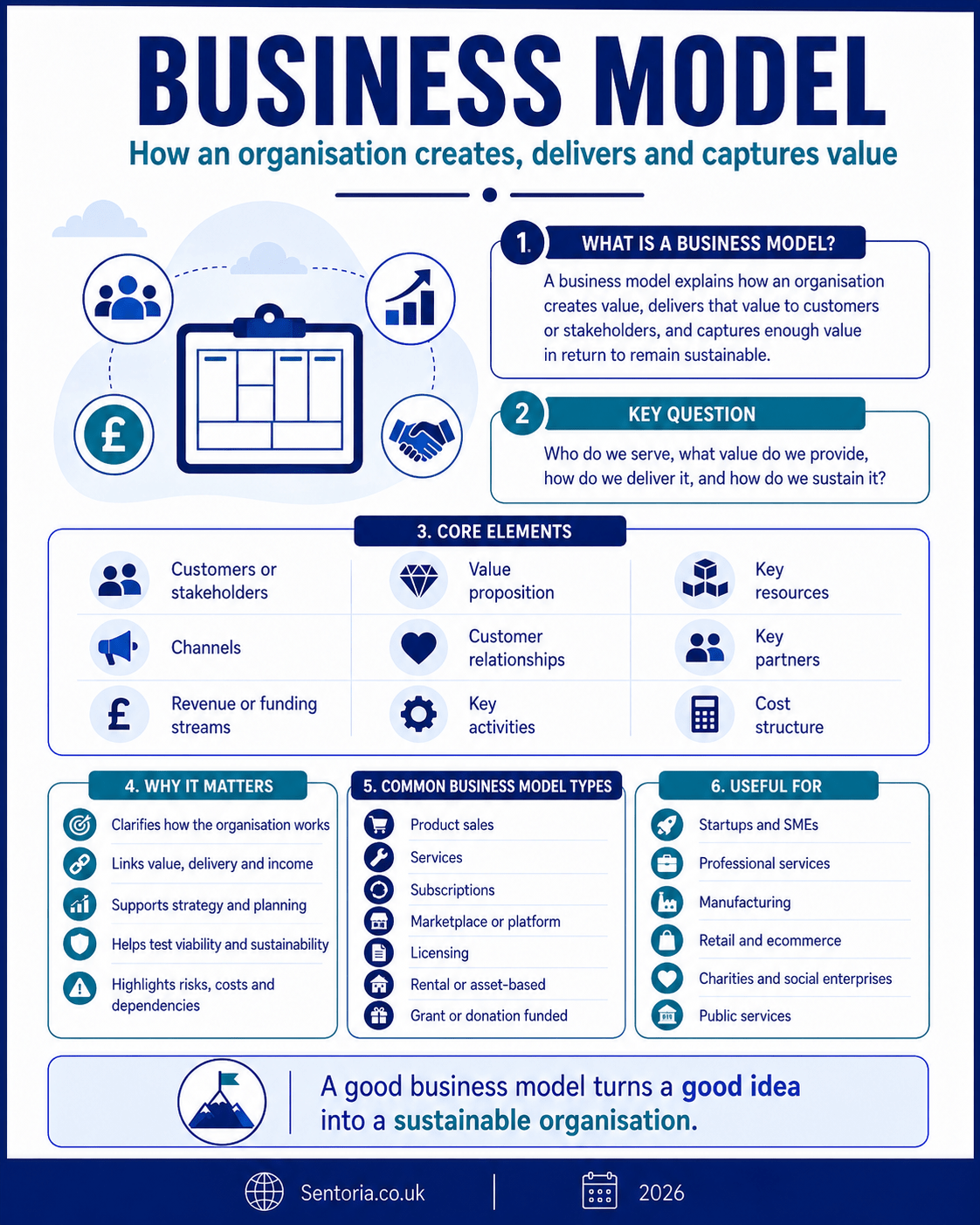
Business Model: A Practical Guide to Understanding How an Organisation Creates, Delivers and Captures Value
A business model is the way an organisation creates value, delivers that value to customers or stakeholders, and captures enough value in return to remain sustainable.
At its simplest, a business model asks:
Who do we serve, what value do we provide, how do we deliver it, and how does the organisation generate the resources it needs to continue?
That makes it useful for strategy, business planning, startups, pricing, product development, charity sustainability, public sector service design, professional services, manufacturing, retail, ecommerce, technology, property, education, healthcare and investment appraisal.
Used properly, the business model concept helps organisations understand how all the important parts of the organisation fit together.
It is not just about making money.
It is about understanding how value flows through the organisation.
What is a business model?
A business model explains how an organisation works.
It describes the logic of the organisation.
That includes:
- Who the organisation serves
- What problem it solves
- What value it provides
- How customers or stakeholders access that value
- How the organisation delivers the product or service
- What resources and capabilities are required
- What partners and suppliers are needed
- What costs are involved
- How income or funding is generated
- How the organisation remains viable over time
For a commercial business, the business model normally explains how the business makes profit.
For a charity, it explains how the charity creates impact and secures the funding needed to continue.
For a public body, it explains how services are delivered, funded and organised to create public value.
For a social enterprise, it explains how social impact and financial sustainability are balanced.
For a professional services firm, it explains how expertise, trust, client relationships, pricing, delivery capacity and recurring work fit together.
A business model is therefore broader than a product, a service or a revenue stream.
It is the system that allows the organisation to operate.
Business model, strategy and business plan
Business model, strategy and business plan are often confused.
They are connected, but they are not the same.
Business model
A business model explains how the organisation creates, delivers and captures value.
It asks:
How does this organisation work?
For example:
A software company may provide a cloud-based subscription product to SMEs, charge monthly fees, use digital marketing to acquire customers, support users through online help, and improve retention through product updates.
Strategy
Strategy explains where the organisation is going and how it intends to compete or succeed.
It asks:
What choices will we make to achieve our goals?
For example:
The software company may decide to focus on a specific industry niche, differentiate through ease of use, and build integrations that make it difficult for customers to switch.
Business plan
A business plan explains how the organisation will implement its model and strategy.
It asks:
What will we do, when, with what resources, and what results do we expect?
For example:
The business plan may include sales targets, marketing spend, product development milestones, staffing, cash flow forecasts and investment requirements.
In simple terms:
The business model explains how the organisation works.
The strategy explains how it will succeed.
The business plan explains how it will be delivered.
All three are important.
Business model and revenue model
The business model is also often confused with the revenue model.
The revenue model is only one part of the business model.
Revenue model
The revenue model explains how income is generated.
Examples include:
- One-off sales
- Subscriptions
- Membership fees
- Hourly rates
- Fixed fees
- Usage charges
- Commission
- Licensing
- Advertising
- Rent
- Grants
- Donations
- Public funding
- Sponsorship
- Service charges
Business model
The business model explains the whole system around that income.
It includes customers, value proposition, channels, relationships, delivery model, resources, activities, partners, cost structure and income model.
For example:
Two businesses may both charge a monthly subscription, but have completely different business models.
One may be a low-cost self-service software platform.
The other may be a premium advisory membership with personal support.
The revenue model is similar.
The business model is different.
History and development of the business model concept
The idea of a business model has existed in practice for as long as organisations have traded, delivered services or organised resources.
A market trader, manufacturer, landlord, professional adviser, school, charity or public service all need some form of model for creating and delivering value.
However, the term business model became much more common with the rise of modern management thinking, technology businesses, venture capital, digital platforms and innovation strategy.
Traditional business planning often focused on products, markets, costs and forecasts.
As markets became more complex, organisations needed a clearer way to explain how value was created across the whole system.
The rise of the internet made the concept even more important.
Digital businesses often did not fit traditional models. Some offered free services and generated advertising income. Some created marketplaces. Some used subscriptions. Some relied on network effects. Some built platforms where the value increased as more users joined.
This made it necessary to ask deeper questions:
- Who is the real customer?
- Who pays?
- Who uses the service?
- What value is being created?
- How does the organisation scale?
- What costs grow with usage?
- What activities must be controlled?
- What can be outsourced?
- What makes the model defensible?
- What happens when competitors copy it?
The business model concept became particularly popular through tools such as the Business Model Canvas, which gave organisations a simple way to map the main parts of a business model on one page.
Today, business model thinking is used far beyond startups.
It is relevant for established businesses, charities, public bodies, social enterprises, property owners, professional services firms, manufacturers, technology companies, education providers and healthcare organisations.
The reason is simple.
A good idea is not enough.
An organisation needs a model that allows the idea to be delivered sustainably.
Why the business model concept matters
The business model concept matters because organisations can fail even when they have a good product, loyal customers or strong intentions.
They may fail because:
- The cost of delivery is too high.
- The price is too low.
- Customers do not value the offer enough.
- The organisation targets the wrong customer segment.
- Delivery depends too heavily on one person.
- Income is too unpredictable.
- Funding is too concentrated.
- The model does not scale.
- Cash flow timing is poor.
- Suppliers or partners are unreliable.
- The organisation cannot reach customers effectively.
- The service is valued but not financially sustainable.
- The market changes.
- Competitors copy the offer.
- The model relies on assumptions that are not tested.
Business model thinking helps prevent these problems.
It supports:
- Better strategy
- Better business planning
- Better pricing
- Better customer focus
- Better funding decisions
- Better investment appraisal
- Better understanding of costs
- Better operational design
- Better risk management
- Better innovation
- Better product development
- Better service design
- Better board discussion
- Better charity sustainability
- Better public value decisions
- Better use of resources
- Better understanding of competitive advantage
- Better decision-making about growth
- Better assessment of viability
- Better long-term resilience
A business model helps leaders see the organisation as a connected system.
That is valuable because improving one part of the model may damage another part if the connections are not understood.
For example:
- Lowering price may increase sales but reduce margin.
- Adding more personal service may improve customer satisfaction but increase delivery cost.
- Growing too quickly may increase revenue but weaken cash flow.
- Winning a large customer may increase turnover but create dependency.
- Taking a grant may fund activity but restrict flexibility.
- Automating support may reduce cost but damage trust.
- Expanding product range may increase choice but complicate stock and operations.
The business model concept helps organisations think through these trade-offs.
When to use business model thinking
Business model thinking is useful whenever an organisation needs to understand, improve, redesign or test how it works.
Good uses include:
- Starting a new business
- Launching a new product
- Launching a new service
- Reviewing strategy
- Entering a new market
- Reviewing pricing
- Improving profitability
- Improving cash flow
- Redesigning services
- Developing a charity funding strategy
- Reviewing a public service
- Planning digital transformation
- Considering a subscription model
- Reviewing customer segments
- Testing an investment proposal
- Improving operational efficiency
- Preparing a business plan
- Supporting board discussion
- Reviewing risk
- Planning growth
- Responding to market change
- Considering diversification
- Reviewing a loss-making activity
- Testing a social enterprise idea
- Assessing long-term sustainability
It is especially useful where:
- The organisation is busy but not profitable.
- Income is growing but cash is tight.
- Customers value the service but prices are weak.
- The organisation depends on one customer, funder or channel.
- A new idea needs testing.
- The existing model no longer works.
- Costs have increased.
- Delivery is too complex.
- The organisation is unclear who it really serves.
- The board needs a clearer view of sustainability.
It is less useful when treated only as a workshop exercise.
A business model should be tested against evidence, numbers and real-world delivery.
Core parts of a business model
1. Customer segments
Customer segments are the groups of people or organisations the model is designed to serve.
These may include:
- Consumers
- Businesses
- Public bodies
- Funders
- Donors
- Service users
- Tenants
- Learners
- Patients
- Members
- Subscribers
- Advertisers
- Community groups
- Employers
- Investors
Different customer segments may have different needs, prices, channels, expectations and costs to serve.
A business model becomes weak when it tries to serve too many segments in the same way.
The key question is:
Who is the model really designed for?
2. Value proposition
The value proposition explains why customers or stakeholders should care.
It describes the benefit, outcome or problem solved.
Examples include:
- Saving time
- Saving money
- Reducing risk
- Improving quality
- Providing convenience
- Giving reassurance
- Improving access
- Providing expertise
- Creating enjoyment
- Supporting compliance
- Improving confidence
- Delivering social impact
- Creating community benefit
- Improving learning outcomes
- Providing safety or care
A value proposition should be specific.
Weak value proposition:
We provide excellent service.
Stronger value proposition:
We help SME owners understand their numbers, manage cash flow and make better decisions through plain English monthly finance support.
The stronger version is clearer because it explains who is served, what problem is solved, and what value is created.
3. Channels
Channels explain how the organisation reaches and serves customers or stakeholders.
Channels may include:
- Website
- Direct sales
- Social media
- Retail stores
- Marketplaces
- Referrals
- Partners
- Distributors
- Events
- Public sector referrals
- Community networks
- Professional advisers
- Online platforms
- Physical locations
Channels matter because even a strong offer fails if customers cannot find it, access it or understand it.
A channel should fit the customer.
A high-trust professional service may need personal referrals and direct conversations.
A low-cost consumer product may work through ecommerce.
A charity service may depend on referral partners.
A public service may need accessible physical and digital channels.
4. Customer relationships
Customer relationships describe the type of relationship the organisation has with customers or stakeholders.
Examples include:
- Personal relationship
- Self-service
- Automated service
- Dedicated account management
- Community-based relationship
- Membership relationship
- Advisory relationship
- Transactional relationship
- Long-term partnership
- Regulated service relationship
The relationship model affects cost, loyalty and customer experience.
A self-service model can be efficient, but may not suit customers needing reassurance.
A high-touch relationship can create trust, but may be expensive to deliver.
The key question is:
What relationship does the customer need, and can the organisation afford to provide it?
5. Revenue streams or funding streams
Revenue or funding streams explain how income is generated.
Examples include:
- Product sales
- Service fees
- Subscriptions
- Memberships
- Licensing
- Commission
- Advertising
- Rental income
- Usage charges
- Fixed fees
- Retainers
- Grants
- Donations
- Contracts
- Sponsorship
- Public funding
- Training fees
- Events
- Consultancy income
- Service charges
Revenue streams should be tested carefully.
Ask:
- Who pays?
- When do they pay?
- Why do they pay?
- How much will they pay?
- Is income recurring or one-off?
- Is income restricted or unrestricted?
- How predictable is it?
- What costs are required to generate it?
- How does it affect cash flow?
- Is it sustainable?
A model may appear attractive but fail because income is too slow, too uncertain or too costly to acquire.
6. Key activities
Key activities are the things the organisation must do well for the model to work.
Examples include:
- Production
- Service delivery
- Sales
- Marketing
- Customer support
- Product development
- Fundraising
- Project management
- Quality control
- Compliance
- Training
- Logistics
- Data analysis
- Relationship management
- Content creation
- Platform development
- Property management
- Care delivery
- Teaching
- Community engagement
Not all activities are equally important.
The key activities are those that create value, reduce cost, protect quality or support sustainability.
The organisation should understand which activities must be controlled closely and which can be outsourced or standardised.
7. Key resources
Key resources are the assets, capabilities and inputs needed to make the model work.
These may include:
- People
- Knowledge
- Brand
- Data
- Technology
- Premises
- Equipment
- Intellectual property
- Cash
- Licences
- Supplier relationships
- Customer relationships
- Community trust
- Governance
- Systems
- Processes
- Vehicles
- Stock
- Land
- Professional accreditations
A business model is stronger when it is supported by resources that are valuable, difficult to copy and well managed.
A model is weaker when it depends on resources that are fragile, scarce, underfunded or controlled by others.
8. Key partners
Key partners are the external organisations or people needed for the model to work.
These may include:
- Suppliers
- Contractors
- Funders
- Referral partners
- Technology providers
- Distributors
- Professional advisers
- Public bodies
- Community organisations
- Logistics providers
- Landlords
- Developers
- Universities
- Training partners
- Healthcare partners
- Charities
- Regulators
- Investors
- Marketing partners
- Outsourced service providers
Partnerships can strengthen a model by adding capability, reach or credibility.
They can also create dependency and risk.
The key question is:
Which partners are essential, and what happens if they fail?
9. Cost structure
The cost structure explains the main costs involved in delivering the model.
Costs may include:
- Staff
- Materials
- Rent
- Utilities
- Software
- Marketing
- Insurance
- Professional fees
- Equipment
- Delivery
- Stock
- Finance costs
- Training
- Compliance
- Maintenance
- Customer support
- Development
- Fundraising
- Administration
- Overheads
A good business model needs a cost structure that fits the value proposition and income model.
For example:
A low-price model needs low costs.
A premium model can support higher costs if customers value the experience.
A charity impact model needs funding that covers the true cost of delivery.
A public service model needs clarity about subsidy, statutory duties and value for money.
10. Margin, surplus or sustainability logic
The business model should explain how the organisation remains sustainable.
For a commercial business, this may mean profit and cash generation.
For a charity, it may mean full cost recovery, reserves, unrestricted income and impact.
For a public body, it may mean affordability, value for money and service outcomes.
For a social enterprise, it may mean balancing mission and financial resilience.
The key question is:
Does the value created justify the cost of creating it, and does the organisation capture enough value to continue?
Common types of business model
1. Product sales model
The organisation sells products to customers.
Examples include:
- Retail
- Ecommerce
- Manufacturing
- Wholesale
- Food and drink
- Consumer goods
- Equipment
- Books
- Clothing
- Hardware
The key issues are product margin, stock, demand, distribution, returns, pricing and customer acquisition.
2. Service model
The organisation sells services.
Examples include:
- Accountancy
- Legal services
- Consultancy
- Cleaning
- Maintenance
- Care
- Training
- Design
- Marketing
- Repairs
The key issues are capacity, staff time, pricing, quality, utilisation, consistency and customer relationships.
3. Subscription model
Customers pay regularly for access, service, software, content or support.
Examples include:
- Software as a service
- Membership sites
- Maintenance contracts
- Advisory retainers
- Subscription boxes
- Online learning
- Media platforms
- Fitness memberships
- Support packages
- Managed services
The key issues are retention, recurring value, churn, onboarding and customer lifetime value.
4. Marketplace model
The organisation connects buyers and sellers.
Examples include:
- Online marketplaces
- Booking platforms
- Freelance platforms
- Property portals
- Delivery platforms
- Auction sites
The key issues are trust, liquidity, network effects, fees, quality control and platform governance.
5. Platform model
The organisation creates a platform that allows users, developers, suppliers or customers to interact.
Examples include:
- Software ecosystems
- App platforms
- Social platforms
- Data platforms
- Payment platforms
- Learning platforms
The key issues are adoption, network effects, governance, data, security and scalability.
6. Advertising model
The organisation provides content, access or attention and generates income from advertisers.
Examples include:
- Media websites
- Search engines
- Social platforms
- Free apps
- Content platforms
- Local publications
The key issues are audience size, audience quality, engagement, data, advertiser demand and trust.
7. Licensing model
The organisation allows others to use intellectual property, brand, technology or content in return for fees.
Examples include:
- Software licences
- Franchises
- Brand licensing
- Patents
- Publishing rights
- Training materials
The key issues are intellectual property protection, quality control, contract terms and scalability.
8. Franchise model
The organisation allows franchisees to operate using its brand, systems and model.
Examples include:
- Food outlets
- Gyms
- Education services
- Care services
- Retail
- Professional services
The key issues are brand consistency, franchisee support, quality control, training, fees and governance.
9. Razor and blade model
The organisation sells an initial product and then generates ongoing income from consumables, refills, parts or related services.
Examples include:
- Printers and ink
- Razors and blades
- Coffee machines and pods
- Equipment and maintenance
- Software and add-ons
The key issues are customer lock-in, consumable margin, compatibility and customer trust.
10. Freemium model
The organisation provides a free basic version and charges for premium features, usage or support.
Examples include:
- Software
- Apps
- Online tools
- Games
- Digital services
The key issues are conversion, free user cost, feature packaging and perceived value.
11. Donation or grant-funded model
The organisation provides services funded by donors, grants, commissioners or public bodies.
Examples include:
- Charities
- Community organisations
- Cultural organisations
- Social projects
- Non-profit services
The key issues are impact, funder relationships, evidence, restricted funds, unrestricted income, reserves and sustainability.
12. Rental or asset model
The organisation owns or controls assets and generates income from their use.
Examples include:
- Property letting
- Equipment hire
- Vehicle rental
- Storage
- Venue hire
- Infrastructure
The key issues are utilisation, occupancy, maintenance, capital investment, yield, tenant quality and asset value.
Business models in different industries
SMEs and owner-managed businesses
For SMEs, business model thinking is useful because many small businesses grow informally.
They may start with a simple offer and then add products, customers, staff, systems and overheads over time.
Typical SME business model questions include:
- Who are our best customers?
- Which services are most profitable?
- Which customers take too much time?
- Are we charging properly?
- Are we too dependent on the owner?
- What work should we stop doing?
- What income is recurring?
- What costs are increasing?
- What makes us different?
- Can the model scale without breaking?
An SME may discover that the problem is not lack of sales.
The problem may be that the model depends on underpriced work, owner effort, weak systems and poor cash flow timing.
For SMEs, business model improvement often means simplifying the offer, improving pricing, focusing on better customers, building systems and reducing dependency on the owner.
Manufacturing
Manufacturing business models depend on production capability, materials, labour, quality, capacity, customers and supply chains.
Typical manufacturing models include:
- Make-to-stock
- Make-to-order
- Contract manufacturing
- Specialist engineering
- Component supply
- Private label production
- High-volume low-margin production
- Low-volume specialist production
- Product plus maintenance
- Direct-to-customer manufacturing
A manufacturer might ask:
- Are we competing on cost, quality, speed or technical capability?
- Which products generate the best contribution?
- Are small orders priced properly?
- Are customers paying for customisation?
- Is capacity being used on the right work?
- Are material cost changes being passed on?
- What production capability creates advantage?
- Which customers create dependency risk?
For manufacturing, the business model should connect sales, costing, production, procurement, quality and cash flow.
Retail and ecommerce
Retail and ecommerce business models depend on product range, margin, customer acquisition, stock, fulfilment, returns and repeat purchase.
Typical models include:
- Physical retail
- Ecommerce
- Marketplace selling
- Direct-to-consumer
- Subscription box
- Dropshipping
- Private label
- Omnichannel retail
- Curated specialist retail
- Discount retail
A retailer might ask:
- Are we competing on price, convenience, curation or brand?
- What is the gross margin after returns and fulfilment?
- How much does it cost to acquire a customer?
- Do customers buy again?
- Is stock turning quickly enough?
- Are discounts damaging margin?
- Which channels are profitable?
- Does the customer experience support loyalty?
For ecommerce, revenue can be misleading.
A strong model needs margin, repeat purchase, controlled returns, effective fulfilment and sustainable customer acquisition.
Professional services
Professional services business models depend on expertise, trust, staff capacity, pricing, utilisation, client relationships and recurring work.
Typical models include:
- Hourly billing
- Fixed fee work
- Retainers
- Subscription advisory services
- Project-based consultancy
- Success fees
- Outsourced support
- Specialist niche practice
- Compliance plus advisory
- Productised services
For accountants, solicitors, consultants, architects and advisers, the business model might ask:
- Are we selling time, outcomes or reassurance?
- Are fixed fees profitable?
- Are clients paying for advice or only compliance?
- Is work delivered consistently?
- Are staff utilised effectively?
- Are we too dependent on senior people?
- Are we building recurring income?
- Does pricing reflect value?
Professional services firms often weaken their model by underpricing expertise, tolerating scope creep and relying too heavily on a small number of key individuals.
Charities and voluntary organisations
Charity business models are often better described as sustainability models or impact models, but the business model concept still applies.
A charity creates value through impact and captures value through funding, donations, grants, contracts or trading activity.
Typical charity models include:
- Grant-funded service delivery
- Donation-funded support
- Commissioned services
- Membership model
- Social enterprise trading
- Volunteer-led delivery
- Partnership delivery
- Community fundraising
- Charity shop model
- Mixed funding model
A charity might ask:
- Who benefits from our work?
- Who pays for it?
- Does funding cover full cost?
- Is income restricted or unrestricted?
- Are we too dependent on one funder?
- Can we evidence impact?
- Are reserves adequate?
- Which services are mission-critical?
- Which activities are financially unsustainable?
- What model protects impact over time?
For charities, a business model should not be judged only by financial surplus.
It should be judged by mission, impact, sustainability, safeguarding, governance and resilience.
Public sector and local government
Public sector business models focus on public value, statutory duties, funding, access, service design and value for money.
Typical public service models include:
- Direct delivery
- Commissioned delivery
- Partnership delivery
- Digital self-service
- Preventative service model
- Targeted intervention
- Universal provision
- Traded services
- Shared services
- Community-led delivery
A public body might ask:
- Who needs the service?
- What statutory duties apply?
- What outcomes are required?
- What delivery model offers best value?
- Can demand be reduced through prevention?
- Can partners deliver better outcomes?
- What should be digital and what should remain personal?
- How will access and equality be protected?
- What is the cost per outcome?
- How will performance be measured?
For public services, the business model concept should be adapted carefully.
The goal is not profit.
The goal is sustainable public value.
Property and construction
Property and construction business models depend on assets, planning, funding, rental income, development value, maintenance and occupier demand.
Typical models include:
- Buy and hold
- Development and sale
- Development and rent
- Refurbishment and repositioning
- Mixed-use development
- Commercial letting
- Residential letting
- Flexible workspace
- Asset management
- Regeneration partnership
A property business might ask:
- What value does the asset create?
- Who are the target occupiers or buyers?
- Is the model based on rent, sale, capital growth or redevelopment?
- What investment is required?
- What planning risk exists?
- What are the maintenance costs?
- What occupancy is required?
- Are service charges recoverable?
- What is the cash flow timing?
- What happens if market values fall?
For property and construction, the business model should connect market demand, planning, funding, build cost, tenant need, asset quality and long-term return.
Technology and software
Technology business models often depend on scalability, recurring revenue, product adoption, data, support cost and customer retention.
Typical models include:
- Software as a service
- Freemium
- Usage-based pricing
- Marketplace
- Platform
- Licensing
- Enterprise software
- Open-source plus services
- Data subscription
- Transaction fees
A technology business might ask:
- What problem do users need solved?
- Who pays and who uses?
- Is revenue recurring?
- What is customer acquisition cost?
- What is churn?
- Can the product scale?
- What support cost grows with users?
- What features drive retention?
- What data creates advantage?
- What makes the model defensible?
For technology businesses, a model can look attractive because marginal delivery cost is low.
But customer acquisition, product development, support, security and churn can still make the model weak.
Healthcare and social care
Healthcare and social care models must be designed around safety, quality, dignity, funding and regulation.
Typical models include:
- Publicly funded care
- Private pay care
- Commissioned services
- Specialist care
- Community-based care
- Residential care
- Home care
- Preventative health model
- Digital health support
- Partnership delivery
A care provider might ask:
- Who needs care?
- Who pays for care?
- Do fees cover safe staffing?
- What quality standards apply?
- What regulatory requirements apply?
- What occupancy or utilisation is needed?
- What staff model is sustainable?
- What happens if wage costs rise?
- How is continuity of care protected?
- How is dignity maintained?
In healthcare and care, the business model must never rely on unsafe cost cutting.
Sustainability must support quality and safeguarding.
Education and training
Education and training models depend on learners, employers, funding, outcomes, staffing, curriculum and quality.
Typical models include:
- Publicly funded education
- Private course fees
- Employer-funded training
- Apprenticeships
- Online learning
- Subscription learning
- Membership-based learning
- Vocational training
- Specialist qualifications
- Partnership delivery
An education provider might ask:
- Who are the learners?
- Who pays?
- What outcomes are required?
- What funding rules apply?
- What class size is viable?
- What tutor capacity is needed?
- What support do learners need?
- What do employers value?
- Which courses are financially viable?
- What quality measures matter?
For education, the business model should connect learner outcomes, funding, employer need, safeguarding, quality and financial sustainability.
How to analyse a business model properly
1. Define the organisation or activity being analysed
Start by deciding what the business model analysis covers.
It may cover:
- The whole organisation
- A business unit
- A product
- A service
- A project
- A charity programme
- A public service
- A property asset
- A digital platform
- A proposed new venture
Be clear about the scope.
A business may have several business models operating at once.
For example, a professional services firm may have compliance work, advisory retainers, consultancy projects and training services. Each may need its own model analysis.
2. Identify the customer or stakeholder
Ask:
- Who receives the value?
- Who pays?
- Who influences the decision?
- Who benefits?
- Who uses the product or service?
- Who funds the activity?
- Who regulates it?
- Who can block or enable it?
- Who is underserved?
- Who is most profitable or impactful?
The user and payer may not be the same.
This is especially important in charities, public services, healthcare, education, software and B2B markets.
3. Define the value proposition
Be specific about the value created.
Ask:
- What problem is solved?
- What need is met?
- What outcome is improved?
- What pain is reduced?
- What gain is created?
- What risk is reduced?
- What convenience is provided?
- What confidence is created?
- What impact is delivered?
- Why does this matter?
A value proposition should be tested with customer research or stakeholder feedback where possible.
4. Map the delivery model
Understand how value is delivered.
Ask:
- What activities are required?
- What people are needed?
- What systems are needed?
- What processes are involved?
- What partners are required?
- What quality controls exist?
- What capacity is needed?
- What support is required?
- What can be standardised?
- What must remain bespoke?
Delivery is where many models fail.
The organisation may have a good offer, but if delivery is too expensive, inconsistent or dependent on scarce people, the model may not be sustainable.
5. Understand the income or funding model
Ask:
- Who pays?
- How much do they pay?
- When do they pay?
- Is income recurring?
- Is income predictable?
- Is income restricted?
- Is pricing aligned with value?
- Is payment timing aligned with costs?
- What happens if income is delayed?
- What customer or funder concentration exists?
The income model should be tested against cash flow, not only profit.
A model can be profitable on paper and still fail because cash arrives too late.
6. Understand the cost structure
Ask:
- What are the major costs?
- Which costs are fixed?
- Which costs vary with volume?
- Which costs are rising?
- What costs are hidden?
- What does it cost to serve different customer groups?
- What costs are needed to acquire customers?
- What costs are needed to retain customers?
- What costs are needed for quality and compliance?
- What investment is required?
Cost structure is critical.
A model that relies on personal service, high quality or bespoke delivery must charge enough or secure sufficient funding to cover that cost.
7. Test margin, surplus or sustainability
Ask:
- Does the model generate enough margin?
- Does it cover full cost?
- Does it generate cash?
- Does it build reserves?
- Does it fund investment?
- Does it survive cost increases?
- Does it depend on unrealistic volume?
- Does it depend on unpaid work?
- Does it depend on one customer or funder?
- Does it remain viable under stress?
Stress testing and sensitivity analysis are useful at this stage.
8. Identify assumptions
Every business model depends on assumptions.
Examples include:
- Customers will pay the price.
- Demand will exist.
- Costs will remain manageable.
- Staff can deliver consistently.
- Suppliers will remain reliable.
- Funders will continue supporting the work.
- Technology will scale.
- Customers will renew.
- Regulation will not change materially.
- Competitors will not copy quickly.
Important assumptions should be recorded in an assumptions log.
The most important and uncertain assumptions should be tested first.
9. Identify risks
Business model risks may include:
- Customer demand risk
- Pricing risk
- Cost inflation
- Supplier dependency
- Staff dependency
- Technology failure
- Funding concentration
- Customer concentration
- Regulatory change
- Market disruption
- Competitor copying
- Quality failure
- Cash flow pressure
- Reputation damage
- Capacity constraints
These should be added to the risk register where material.
10. Decide what needs to change
Business model analysis should lead to action.
Possible actions include:
- Change pricing
- Change customer segment
- Simplify the offer
- Stop unprofitable work
- Build recurring income
- Improve delivery efficiency
- Reduce dependency on one customer or funder
- Strengthen partnerships
- Invest in systems
- Improve customer acquisition
- Improve retention
- Change channels
- Redesign the service
- Improve cost recovery
- Build reserves
- Improve data
- Strengthen governance
- Pilot a new model
- Update the roadmap
- Revise the strategy
A business model review is only useful if it improves decisions.
Common business model techniques
Business Model Canvas
The Business Model Canvas is one of the most popular tools for mapping a business model.
It covers nine areas:
- Customer segments
- Value propositions
- Channels
- Customer relationships
- Revenue streams
- Key resources
- Key activities
- Key partnerships
- Cost structure
It is useful because it shows the whole model on one page.
Lean Canvas
Lean Canvas adapts business model thinking for startups and new ideas.
It focuses heavily on problem, solution, customer segments, unfair advantage and key metrics.
It is useful where assumptions need testing quickly.
Value Proposition Canvas
The Value Proposition Canvas focuses on the fit between customer needs and the organisation’s offer.
It is useful because many weak business models fail at the value proposition stage.
SWOT analysis
SWOT can help identify strengths, weaknesses, opportunities and threats affecting the business model.
For example, a strong brand may support the model, while funding concentration may threaten it.
PESTLE analysis
PESTLE helps examine external factors affecting the model, including political, economic, social, technological, legal and environmental factors.
This is useful where the model depends on external conditions.
Porter’s Five Forces
Porter’s Five Forces helps assess the attractiveness of the industry or market in which the model operates.
It considers rivalry, buyer power, supplier power, substitutes and new entrants.
Value chain analysis
Value chain analysis examines how activities create value and where cost or differentiation advantage may be found.
It helps identify where the business model creates value operationally.
Unit economics
Unit economics examines income, cost and profit at the level of one customer, one product, one transaction, one project or one unit.
It is especially useful for software, ecommerce, manufacturing, subscriptions, services and marketplaces.
Sensitivity analysis
Sensitivity analysis tests how changes in assumptions affect the model.
For example:
- What if price falls by 10%?
- What if volume is 20% lower?
- What if staff cost increases by 8%?
- What if customer acquisition cost doubles?
- What if grant funding is delayed?
Stress testing
Stress testing applies severe but plausible pressure to test whether the model survives.
This is useful for cash flow, funding, cost increases, customer loss and market disruption.
Common mistakes in business model thinking
Mistake 1: Confusing a product with a business model
A product is not a business model.
The model must explain who buys it, how it is delivered, what it costs, how income is generated and why it is sustainable.
Mistake 2: Focusing only on revenue
Revenue matters, but margin, cash flow, cost structure, retention and delivery capacity matter too.
High revenue with weak margin is not a strong model.
Mistake 3: Ignoring the customer
A model should start with customer or stakeholder value.
Internal enthusiasm is not enough.
Mistake 4: Underestimating cost
Many models fail because they ignore overheads, staff time, support, marketing, compliance, delivery, rework or management time.
Mistake 5: Ignoring cash flow timing
Profit and cash are not the same.
A model may look profitable but fail if costs are paid before income arrives.
Mistake 6: Assuming scale will fix everything
Growth can improve a model, but it can also expose weaknesses.
If unit economics are poor, scaling may increase losses.
Mistake 7: Depending on one customer, funder or channel
Concentration creates risk.
A model may work today but fail quickly if one dependency changes.
Mistake 8: Copying another model without context
A model that works for one organisation may not work for another.
Brand, cost structure, customer segment, capabilities and timing matter.
Mistake 9: Failing to update the model
Markets change.
Technology changes.
Costs change.
Customer expectations change.
Funding changes.
A model that worked five years ago may no longer be fit for purpose.
Mistake 10: Treating the model as fixed
A business model should be understood, tested and improved.
It should not be treated as permanent.
Limitations and weaknesses of business model analysis
Business model analysis is useful, but it has limits.
It can oversimplify reality
A one-page model can make the organisation look simpler than it is.
Important detail may sit underneath each part.
It depends on assumptions
Many business model diagrams are based on assumptions rather than evidence.
The assumptions must be tested.
It can ignore execution
A model may look strong on paper but fail in delivery.
People, systems, culture, leadership and process matter.
It can underplay cash flow
Some business model tools focus on logic but not timing.
Cash flow modelling is often needed as well.
It can underplay risk
A model may look viable under normal conditions but fail under stress.
Risk analysis and stress testing are important.
It can focus too much on innovation
New models can be exciting, but existing models often need improvement rather than reinvention.
It can ignore mission or public value
In charities and public services, value is not only financial.
Impact, access, fairness, safeguarding and public benefit matter.
It does not replace strategy
Business model analysis explains how the organisation works.
Strategy still needs to decide where the organisation is going and what choices it will make.
Business model compared with other strategic and management tools
Business model and Business Model Canvas
The business model is the concept.
The Business Model Canvas is a tool for mapping the concept.
Use the canvas to make the model visible and discussable.
Business model and Lean Canvas
Lean Canvas is useful for early-stage ideas and startups.
It is more focused on testing problem, solution, customer segment and unfair advantage.
Business model and strategy
The business model explains how value is created and captured.
Strategy explains how the organisation will succeed over time.
The model should support the strategy.
Business model and value proposition
The value proposition is one part of the business model.
It explains why customers or stakeholders value the offer.
A weak value proposition usually creates a weak business model.
Business model and revenue model
The revenue model explains how income is generated.
The business model explains the whole system that makes that income possible and sustainable.
Business model and operating model
The operating model explains how the organisation is structured and run to deliver the strategy.
It includes people, processes, systems, governance and ways of working.
The operating model should support the business model.
Business model and value chain analysis
Value chain analysis examines activities that create value.
Business model analysis examines the wider logic of value creation, delivery and capture.
Use value chain analysis to understand the operational engine of the model.
Business model and competitive advantage
A strong business model may create competitive advantage if it delivers customer value better, cheaper, faster or more sustainably than competitors.
Business model and pricing analysis
Pricing analysis tests whether the income side of the model reflects customer value, cost, demand and positioning.
Business model and forecasting
Forecasting tests the likely financial outcome of the model.
Business model analysis explains the logic. Forecasting tests the numbers.
Alternatives and complementary frameworks
Business Model Canvas
Use the Business Model Canvas to map the main parts of the model on one page.
Lean Canvas
Use Lean Canvas for startups, early-stage ideas and innovation projects.
Value Proposition Canvas
Use the Value Proposition Canvas to test customer fit.
SWOT analysis
Use SWOT to assess strengths, weaknesses, opportunities and threats affecting the model.
PESTLE analysis
Use PESTLE to examine external factors that could affect the model.
Porter’s Five Forces
Use Porter’s Five Forces to assess industry attractiveness and competitive pressure.
Value chain analysis
Use value chain analysis to understand where value is created and cost is incurred.
Unit economics
Use unit economics to test whether the model works at the level of one customer, transaction, product or service.
Forecasting
Use forecasting to test revenue, cost, profit and cash flow assumptions.
Stress testing
Use stress testing to understand whether the model survives adverse conditions.
Risk register
Use the risk register to record business model risks.
A practical business model template
A useful business model template should include:
- Business model title
- Purpose
- Organisation, product or service being analysed
- Customer or stakeholder segments
- Problem or need
- Value proposition
- Channels
- Customer relationships
- Revenue or funding streams
- Key activities
- Key resources
- Key partners
- Cost structure
- Margin, surplus or sustainability logic
- Key assumptions
- Key risks
- Evidence supporting the model
- Metrics
- Actions required
- Owner
- Review date
- Link to strategy, forecast and risk register
Example:
Business model title: Monthly advisory service for SME owners
Customer segment: Owner-managed businesses in West Yorkshire with turnover between £500,000 and £10 million.
Problem or need: Business owners need better financial visibility, cash flow understanding and plain English support for decisions.
Value proposition: Monthly management information, cash flow review and practical advisory meeting that helps owners understand performance and make better decisions.
Channels: Existing client base, referrals, website, LinkedIn content and local networking.
Customer relationship: High-trust advisory relationship with regular monthly contact.
Revenue stream: Monthly subscription or retainer.
Key activities: Management accounts, cash flow review, advisory meeting, client communication, reporting, follow-up actions.
Key resources: Finance expertise, reporting templates, cloud accounting software, client relationships and commercial experience.
Key partners: Bookkeeping providers, tax specialists, software providers and professional advisers.
Cost structure: Staff time, software, partner support, marketing, review time and administration.
Sustainability logic: Recurring monthly income must cover staff time, review, software and overhead, while producing sufficient margin and client value.
Key assumptions: Clients will pay for regular advice, reporting can be standardised, advisory time can be controlled, and the service reduces client churn.
Risks: Scope creep, underpricing, weak client uptake, poor internal capacity and unclear value communication.
Actions: Pilot with five clients, define pricing tiers, standardise reporting pack, gather feedback and review profitability after three months.
Owner: Managing Director.
Questions to ask when analysing a business model
Customer and stakeholder questions
- Who is the customer?
- Who is the user?
- Who pays?
- Who benefits?
- Who influences the decision?
- What problem are they trying to solve?
- What do they value?
- What alternatives do they have?
- What makes them choose?
- What makes them stay?
Value proposition questions
- What value do we create?
- What problem do we solve?
- What outcome do we improve?
- What pain do we reduce?
- What gain do we create?
- Is the value clear?
- Is the value important enough?
- Can we prove the value?
- Do customers recognise the value?
- Does the value justify the price or funding?
Delivery questions
- How do we deliver the value?
- What activities are essential?
- What resources are essential?
- What partners are essential?
- What can be standardised?
- What must be bespoke?
- What capacity is needed?
- What quality controls exist?
- What systems support delivery?
- What could fail operationally?
Revenue and funding questions
- How is income generated?
- Is income recurring or one-off?
- Is income predictable?
- Who pays and when?
- Is pricing aligned with value?
- Is funding restricted?
- What happens if income is delayed?
- What concentration risk exists?
- What income streams could be added?
- What income streams should be stopped?
Cost questions
- What are the main costs?
- Which costs are fixed?
- Which costs vary with volume?
- What costs are hidden?
- What does customer acquisition cost?
- What does customer support cost?
- What does quality cost?
- What does compliance cost?
- What cost increases are likely?
- Does the price or funding cover full cost?
Sustainability questions
- Does the model make a surplus or profit?
- Does it generate cash?
- Does it cover full cost?
- Does it build reserves or fund investment?
- Does it work at current volume?
- Does it work at lower volume?
- Does it scale?
- Does growth improve or weaken the model?
- What risks could break it?
- What must change to make it stronger?
Strategic questions
- Does the model fit the strategy?
- Does it create competitive advantage?
- Is it clear who we serve?
- Is the model too complex?
- Are we trying to serve too many segments?
- What should we stop doing?
- What should we invest in?
- What should we simplify?
- What should we test next?
- How often should the model be reviewed?
The best way to think about a business model
A business model is not just a diagram.
It is the logic of how the organisation works.
A good business model should be:
- Customer-focused
- Value-led
- Financially sustainable
- Operationally deliverable
- Clear
- Evidence-based
- Resilient
- Scalable where required
- Aligned with strategy
- Reviewed regularly
A weak business model says:
“We have a good product or service.”
A strong business model asks:
“Who values this, how do we deliver it, how do we get paid or funded, and does the whole system work sustainably?”
The key question is not simply:
What do we offer?
The better question is:
How does the organisation create, deliver and capture value in a way that can continue over time?
Conclusion: the business model concept turns activity into a clear value system
The business model concept remains useful because organisations are systems.
Customers, value propositions, pricing, funding, delivery, resources, partners, costs and risks all connect.
An organisation can have a good idea and still fail if the model does not work.
It can have strong demand and still fail if margins are too weak.
It can have loyal users and still fail if funding is not sustainable.
It can have a clear mission and still fail if costs are not covered.
Used badly, business model thinking becomes a box-filling exercise.
Used properly, it becomes a practical strategy tool. It helps organisations understand how they work, where value is created, where value is lost, what assumptions need testing, and what changes would make the organisation stronger.
The real value is not in describing the model.
The real value is in improving it.
A strong business model process helps an organisation move from saying, “This is what we do,” to asking, “Who do we serve, what value do we create, how do we deliver it, and how do we remain sustainable while doing it?”