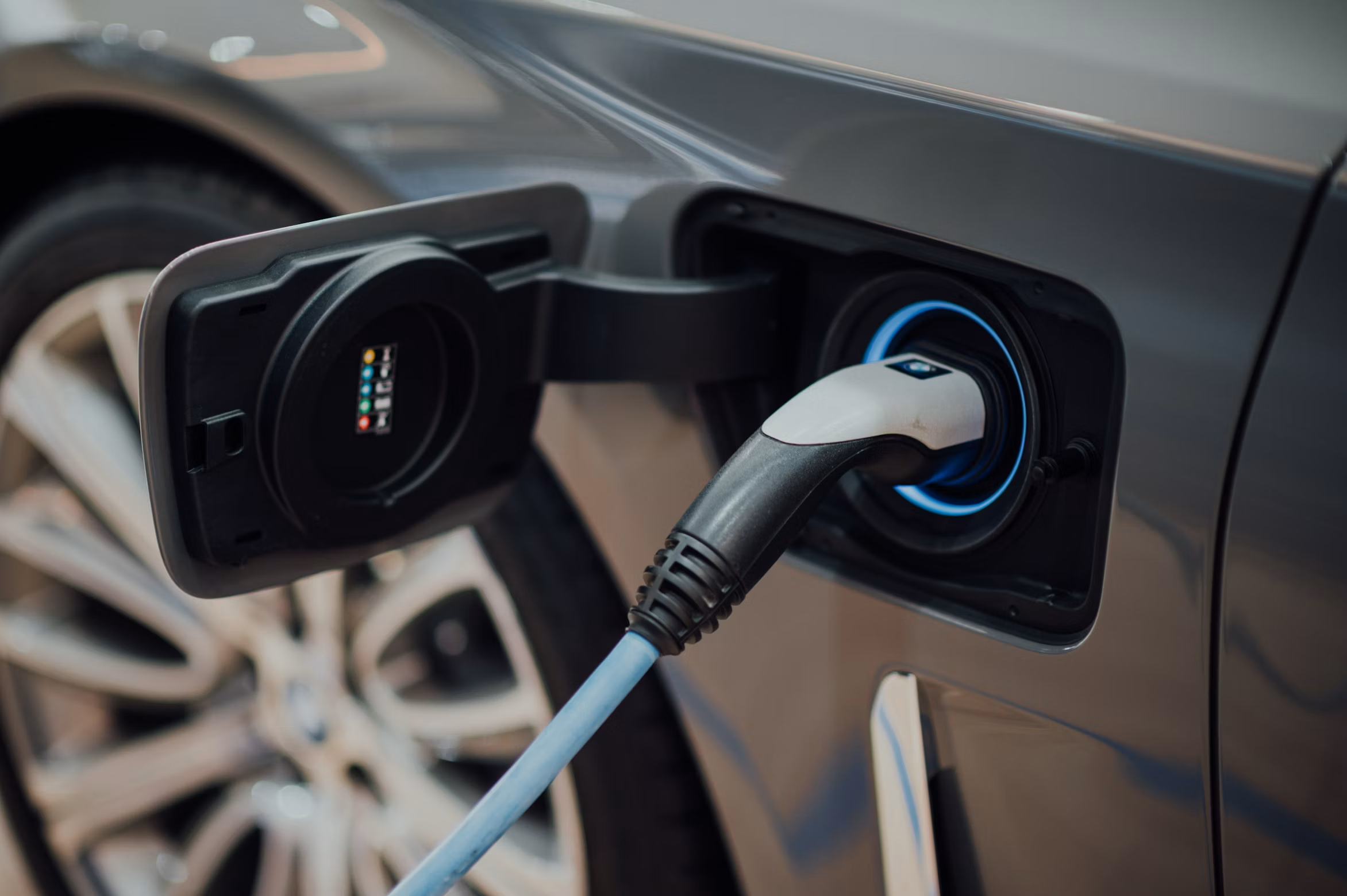
Reported plans to water down the UK’s electric vehicle sales targets have triggered fresh warnings over emissions, investor confidence and the future direction of Britain’s automotive sector.
According to analysis by thinktank Green Alliance, reported by Sky News, reducing the UK’s electric vehicle sales target from 80% of new car sales by 2030 to potentially as low as 50% could add up to 70 million tonnes of carbon dioxide emissions between 2038 and 2042. That would be equivalent to around 13% of the government’s proposed seventh carbon budget for the same period.
The issue comes at a politically sensitive time. MPs are expected to vote this week on the UK’s seventh carbon budget, which covers the period from 2038 to 2042 and is intended to keep the country on course towards net zero by 2050.
At the centre of the debate is the Zero Emission Vehicle mandate, usually referred to as the ZEV mandate. This requires vehicle manufacturers to sell a rising proportion of zero emission vehicles each year. Under the current framework, 80% of new cars and 70% of new vans sold in Great Britain are due to be zero emission by 2030, rising to 100% by 2035.
Supporters of the mandate argue that clear, long-term targets are essential to cut transport emissions, encourage investment in charging infrastructure and give manufacturers the certainty needed to plan new models, supply chains and factories. Critics, including some carmakers and unions, argue that the current pace risks placing too much pressure on parts of the UK car industry before consumer demand, charging provision and production economics have fully caught up.
A climate target under pressure
The seventh carbon budget is one of the UK’s legally binding stepping stones towards net zero. It covers emissions across the economy, including transport, industry, buildings, agriculture and aviation.
Transport remains a major part of the challenge because petrol and diesel vehicles stay on the road for many years after they are sold. That means policy choices made in the late 2020s and early 2030s will still affect emissions in the late 2030s and early 2040s.
This is why changes to new vehicle sales rules matter. A slower transition to electric cars does not simply affect one year’s sales figures. It changes the composition of the national vehicle fleet for years afterwards, leaving more combustion engine vehicles in use for longer.
Green Alliance’s warning is therefore not only about the immediate car market. It is about whether the UK can credibly meet its future carbon budgets if one of the main routes for cutting surface transport emissions is weakened.
The car industry’s difficult balancing act
The government is facing pressure from both sides of the debate.
On one side, environmental groups, charging companies and electric vehicle advocates argue that weakening the mandate would send the wrong signal to investors. Charging infrastructure companies, energy suppliers and manufacturers have already made investment decisions based on the expectation that electric vehicle uptake will continue to rise sharply.
Any perception that the UK is softening its approach could make future investment less certain, particularly when other countries are competing for battery factories, vehicle production, charging networks and clean technology jobs.
On the other side, parts of the automotive industry argue that the current rules are creating heavy compliance costs. Manufacturers that fall short of their targets can face penalties or may need to buy credits from competitors that exceed their targets. Some firms say they are having to discount electric vehicles heavily to stimulate demand, putting pressure on margins and raising concerns about jobs and plant viability.
The Society of Motor Manufacturers and Traders has pointed to the gap between battery electric vehicle sales and the mandated trajectory. UK battery electric vehicle registrations have been growing, but the market remains below the level required under the 2026 mandate.
That gives ministers a genuine policy dilemma. Moving too slowly risks undermining climate targets and investor certainty. Moving too quickly, without adequate consumer demand and industrial support, risks placing strain on manufacturers that are already competing with low-cost international rivals.
Sales are growing, but not evenly enough
The UK electric vehicle market is not standing still. SMMT data for May 2026 showed battery electric vehicle registrations up strongly year on year, with fully electric cars accounting for more than a quarter of the new car market that month.
Year to date, however, battery electric vehicles accounted for just under a quarter of new car registrations, still short of the 33% level required under the 2026 ZEV trajectory.
This creates a mixed picture. Consumer interest is clearly increasing, helped by a wider choice of models, government incentives, lower running costs for home charging and heightened sensitivity to petrol and diesel prices. However, the pace of adoption remains uneven, particularly for motorists without access to home charging or those concerned about upfront costs and charging availability.
For businesses, this creates a familiar transition problem. The long-term direction appears clear, but the pace, timing and distribution of costs are contested.
The industrial strategy question
The EV debate is also an industrial strategy debate.
The UK has long wanted to remain a serious automotive manufacturing base. But the global car industry is moving quickly towards electrification, software-driven vehicles, battery supply chains and lower-cost production models. Chinese manufacturers in particular have become major global competitors, with strong positions in electric vehicles and batteries.
If the UK slows its EV transition, it may provide short-term relief for some domestic manufacturers. But there is a risk that it also reduces pressure to adapt and leaves the market more exposed to overseas competitors that are already scaling electric vehicle production rapidly.
A weaker mandate could also create uncertainty for companies investing in charging infrastructure. These businesses need confidence that vehicle uptake will grow steadily. If future demand becomes less predictable, investment decisions may be delayed, scaled back or redirected elsewhere.
That is why the policy debate is not simply about whether electric vehicles are good or bad. It is about whether the UK can align climate policy, consumer affordability, infrastructure investment and industrial competitiveness into one coherent strategy.
Government response
The government has argued that the EV market remains strong and that it is taking a pragmatic approach to supporting both consumers and British industry. Ministers have pointed to public investment in the transition, including support for charging infrastructure and grants to reduce the upfront cost of some electric vehicles.
The Department for Transport has also said the ZEV mandate includes flexibilities and that the government will review the policy to ensure it supports British industry while continuing to drive investment.
The key question is whether a review strengthens the delivery of the transition or weakens confidence in it.
For manufacturers, clarity matters. For investors, certainty matters. For consumers, affordability and reliability matter. For climate targets, the pace of emissions reduction matters.
If the government can balance those factors, it may be able to maintain momentum while addressing legitimate industry concerns. If it cannot, the UK risks sending a mixed signal at precisely the moment when the global automotive sector is accelerating towards electric vehicles.
A test of policy consistency
The reported rethink of the ZEV mandate highlights a wider challenge for government. Net zero targets are relatively easy to announce, but much harder to deliver when they require changes in consumer behaviour, industrial investment and infrastructure at scale.
Electric vehicles sit at the intersection of all three.
For business leaders, the lesson is clear. Major transitions need more than ambition. They need credible policy design, stable rules, practical support and an honest understanding of who bears the costs.
The UK’s next decision on electric vehicle targets will therefore matter well beyond the car market. It will signal how seriously the country intends to treat long-term policy certainty, industrial competitiveness and the practical delivery of its climate commitments.