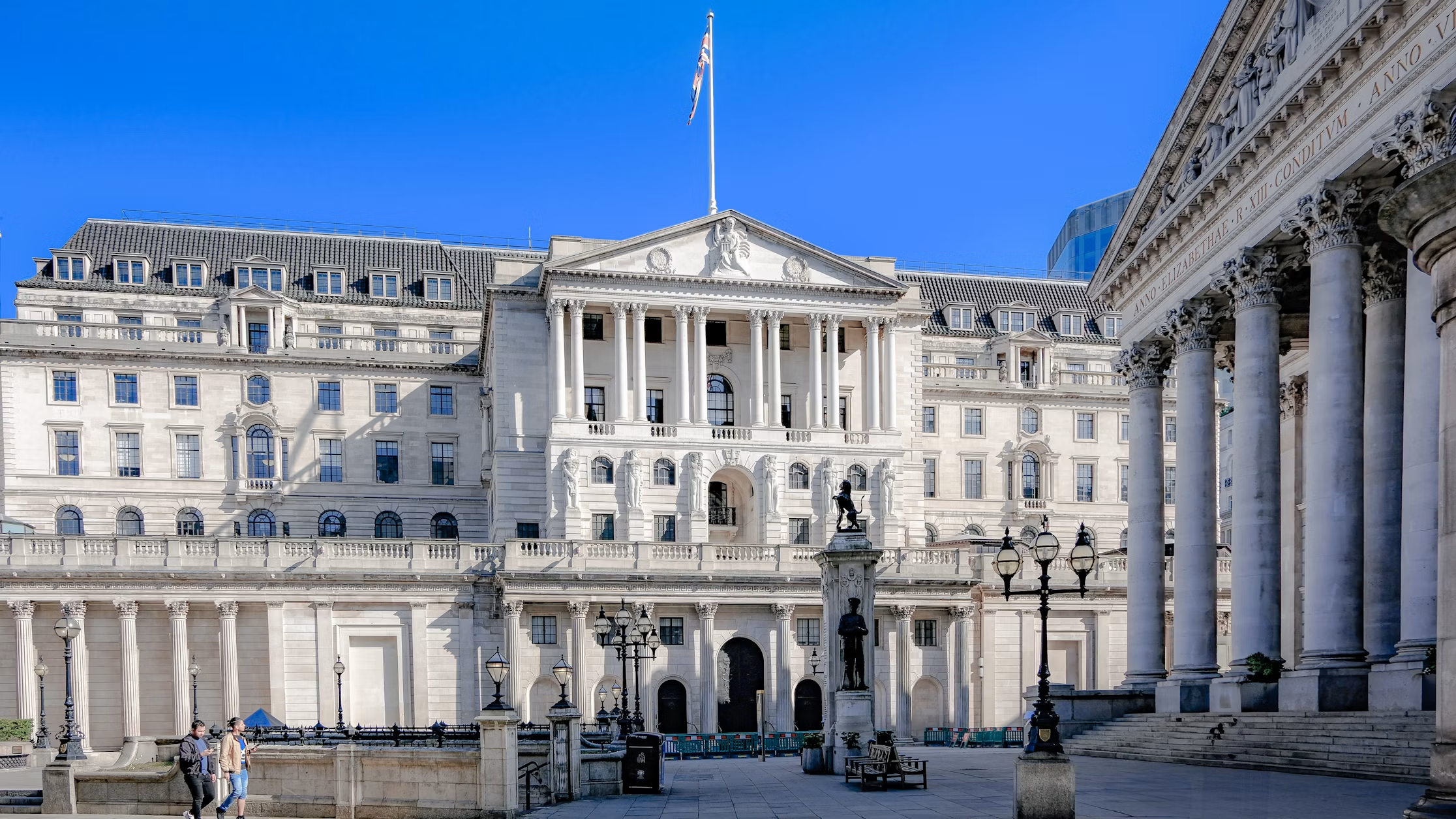
The Bank of England is expected to keep interest rates on hold this week, despite growing concern that higher energy prices and rising inflation expectations could keep pressure on businesses and households for longer.
The Monetary Policy Committee is due to announce its next decision on 18 June 2026, with Bank Rate currently standing at 3.75%. Financial markets and economists broadly expect no immediate change, but the tone of the Bank’s statement will be closely watched for signs of whether rates may need to rise later in the year.
The decision comes at a difficult moment for the UK economy. Inflation has eased from its recent highs but remains above the Bank’s 2% target. The Middle East conflict has pushed up oil and energy prices, public inflation expectations have risen, and businesses remain concerned about costs. At the same time, growth is weak, the labour market is cooling, and higher borrowing costs are already weighing on investment and consumer spending.
That leaves the Bank of England with a familiar but uncomfortable problem: inflation risk argues for caution, while a fragile economy argues against tightening policy too aggressively.
Rates expected to stay at 3.75%
The Bank of England is widely expected to keep Bank Rate unchanged at 3.75%. Reuters has reported that the central bank is likely to hold rates as Governor Andrew Bailey assesses whether higher energy prices caused by the Iran war will create lasting inflation pressure.
The Bank has already paused expected rate cuts this year. That pause is itself a form of tightening compared with what markets previously expected. If businesses and households had been planning for cheaper borrowing, the fact that rates are remaining higher for longer has already changed financial conditions.
This is one reason the Bank may decide not to raise rates immediately. Higher interest rates take time to work through the economy. Mortgage renewals, business loans, asset finance, overdrafts and investment decisions are all affected gradually. A rate rise now could add pressure at a time when the economy is already slowing.
However, keeping rates on hold does not mean the Bank is relaxed about inflation. The more important question is whether it signals that rates may need to rise if energy costs, wages or inflation expectations remain elevated.
Energy prices remain the key risk
The current inflation concern is heavily linked to energy.
The Bank of England’s April assessment highlighted the impact of the Middle East conflict on energy transportation and supply. Higher oil and gas prices push up motor fuel costs, utility bills and business overheads. Those costs can then spread through the economy as companies raise prices and workers seek higher wages to protect household incomes.
The Bank has warned that monetary policy cannot control global energy prices directly. Its role is to prevent temporary energy shocks becoming persistent inflation.
That distinction matters. If higher oil prices are short-lived, the Bank may tolerate a temporary rise in inflation without raising rates. If higher costs become embedded in wages, contracts, pricing behaviour and public expectations, the case for tighter policy becomes stronger.
The recent easing in oil prices following signs of a US-Iran agreement may reduce some immediate pressure. But central banks are unlikely to treat the risk as resolved until lower energy prices are sustained and clearly feed through to consumer and business costs.
Inflation expectations are a warning sign
One of the most important developments for the Bank is the rise in public inflation expectations.
The Bank monitors expectations because they can influence behaviour. If households expect inflation to remain high, workers may push harder for pay rises. If businesses expect costs to keep rising, they may increase prices sooner or by more than they otherwise would. That can make inflation harder to bring back to target.
Recent survey data showed that the public’s expectation for inflation over the year ahead rose to 4% in May, up from 3.2% in February. Expectations for inflation five years ahead also rose to 3.9%, the highest level since that series began in 2009.
Those figures do not automatically mean inflation will remain high. But they will concern policymakers because they suggest the public may be losing confidence that inflation will return quickly to the 2% target.
For the Bank, credibility matters. If it is seen as too relaxed about inflation, expectations could drift higher. If it tightens too much, it could weaken an already fragile economy.
Weak growth limits the case for a rate rise
The argument against an immediate rate rise is the state of the wider economy.
The UK economy contracted by 0.1% in April after earlier growth in the first quarter. That monthly fall suggests the economy may be losing momentum as higher costs and uncertainty affect spending and output.
The labour market has also cooled. The Office for National Statistics estimated unemployment at 5.0% for January to March 2026, up 0.5 percentage points on the year. Vacancies fell to 705,000 in February to April, the lowest level since early 2021. Regular earnings growth stood at 3.4% in January to March, with real regular pay growth close to flat.
This matters because the Bank will be weighing the risk of inflation against the risk of damaging demand. If unemployment is rising and vacancies are falling, workers may have less bargaining power than during previous inflation shocks. That could reduce the risk of a wage-price spiral.
Some economists argue that this gives the Bank room to wait. Higher inflation caused by energy may squeeze household spending rather than generate sustained wage growth. If households spend less because fuel, food and bills are more expensive, demand may weaken and reduce inflation pressure over time.
However, that is not a comfortable outcome for businesses. A weaker consumer and higher costs can squeeze both revenue and margins at the same time.
Businesses face a longer period of expensive money
For companies, the likely hold at 3.75% provides some stability but little relief.
Businesses that had hoped for rate cuts in 2026 may now need to plan for borrowing costs staying higher for longer. That affects working capital, stock financing, expansion plans, property investment, machinery purchases, acquisitions and refinancing.
Small and medium-sized businesses are particularly exposed because they often rely on floating-rate finance, overdrafts, asset finance and shorter-term borrowing. Higher rates can also affect customers, especially in sectors linked to discretionary spending, housing, construction, hospitality and retail.
The Bank’s decision will therefore matter beyond financial markets. It will influence cash flow planning, pricing decisions, investment timing and confidence across the economy.
For some businesses, the key issue is not whether rates rise this week. It is the uncertainty over the next six to twelve months. If inflation remains stubborn, rates may stay higher. If the economy weakens sharply, the Bank may eventually need to consider cuts. That uncertainty makes planning harder.
Savers and borrowers remain on opposite sides
The interest-rate environment continues to divide households.
Borrowers face higher repayments, particularly those refinancing mortgages or taking out new loans. Businesses with debt are in a similar position. Higher rates reduce disposable income and can delay investment.
Savers, by contrast, benefit from better returns than they received during the long period of ultra-low rates. But even for savers, the picture is mixed. If inflation remains above target, real returns may still be limited.
The Bank’s challenge is that interest rates are a blunt tool. Higher rates can reduce demand and bring inflation down, but they do not directly produce more oil, reduce shipping disruption or lower global energy costs. That makes energy-driven inflation particularly difficult to manage.
The international picture adds pressure
The Bank of England is not making its decision in isolation.
Other central banks are facing similar trade-offs. The European Central Bank has already moved more aggressively, raising rates amid concern that energy-driven inflation could spread. Reuters has reported that ECB officials remain alert to price pressures even after recent diplomatic progress in the Middle East.
The Federal Reserve is also being watched closely, as US policymakers weigh inflation risks against market expectations. Currency markets, oil prices and global bond yields all feed into UK conditions.
If the Bank of England is seen as too cautious while other central banks tighten, sterling could come under pressure. A weaker pound can make imports more expensive, adding to inflation. On the other hand, raising rates into a weak economy could worsen the slowdown.
That is why the Bank’s communication may be as important as the rate decision itself. Markets will be looking for whether policymakers present the hold as a pause, a wait-and-see approach, or a warning that rates could still rise.
What to watch in the decision
The headline rate is only part of the story. The vote split will also matter.
If most MPC members vote to hold, markets may read that as a sign that the Bank is comfortable waiting. If a larger minority votes for a rise, it could signal that pressure for tighter policy is building.
The language on inflation expectations, energy prices and wages will also be important. Any stronger warning about second-round effects could push markets to expect a future rate increase. More emphasis on weak growth and rising unemployment could support the view that rates will remain on hold for longer.
For businesses, the practical message is that interest-rate planning should remain cautious. Lower borrowing costs are not guaranteed, and the Bank is likely to remain data-dependent.
A difficult balance
The Bank of England’s June decision is expected to be a hold, but it is unlikely to be a comfortable one.
Inflation has not returned fully to target. Energy prices remain uncertain. Public expectations have moved higher. Businesses are still facing cost pressure.
At the same time, the economy is not strong enough for policymakers to ignore the risk of overtightening. Growth has slowed, vacancies have fallen, and unemployment is higher than a year ago.
That makes this a decision about balance rather than direction. The Bank is likely to avoid an immediate rate rise, while keeping the option open if inflation risks become more persistent.
For households and businesses, that means the hoped-for return to cheaper money may take longer than expected. The immediate relief is that rates are unlikely to rise this week. The bigger concern is that they may not fall any time soon.